Why Doing Everything “Right” as a Man Is No Longer Worth it - Harry Miller
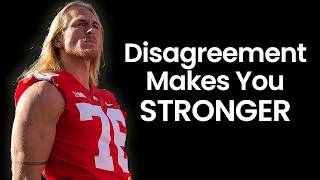
Harry Miller, a former Ohio State football player turned writer, describes his depression and suicide attempts after a career-ending knee injury. He argues that meritocracy no longer delivers real opportunity, and that modern culture's obsession with compliance has made men fragile and purposeless. Disagreement and hardship, he says, are what build actual strength.
Chapters
All right, Mr. Harry Miller, how are you doing, my friend?
I'm good. How are you?
I am good. Wearing my fashionable Princess Leia headphones. They look great, right? There you go. A little technical breakdown. Okay. For those people that do not know you or who you are, how did you go from Ohio State football player, mechanical engineer, to Instagram philosopher and poet?
Very slowly, painfully, and against my will for the most part. I would say for the most part, long story short, long backstory short, I grew up playing football and from like 7 years old was the— did very well at that. I ended up becoming the number 1 ranked center in the country, a 5-star recruit. Got recruited by Ohio State, went to Ohio State, lettered as a freshman, started as a sophomore, and was in position to start as a junior. And long story short, and this can be a whole thing we can undo, but I got to the point my junior year where I didn't really, it was hard for me to believe in what I was doing. I was very talented at the thing that I was doing. I was very talented at playing football, but I did not think that it was what I was supposed to be doing. It did not bring me— I just didn't think it was my purpose. And at that point, once realizing that, I think a lot of people are the same way. I couldn't bring myself to go through the motions and pretend to do that anymore. However, because I felt compelled to do it going into my junior year, Because I felt compelled to do it because my parents had invested in me, agents had started talking to me, my coaches had invested in me, everybody had invested in me. I didn't think that I was able to cash out so late in the game. So, I got to the point where I became thoroughly depressed to the point of suicide, attempted suicide a few times that fall semester of my junior year when I was supposed to be starting Played in a few games that season even, trying to come back, trying to convince myself that I could make this thing work. But I realized eventually that it was unsalvageable. Fortunately, ironically I say fortunately, I ended up tearing my PCL, which physically took me out of commission. It physically handicapped me so where I couldn't play football no matter what for a short period of time. And in that period of time when I was immobile, it forced me to confront a lot of the things that I had suppressed in terms of my beliefs about myself and what I was doing. And ultimately it came to the point where when it came time to do spring ball going into my senior year, my relationship with football and myself had so completely changed that I couldn't keep pretending to do that thing anymore. And so, you know, I took the chance, I made the decision. It doesn't even really feel like taking a chance. You know, if your back is to the wall, it feels sort of like a compulsion of survival. But I ended up retiring from football, stopped playing football. And finished out my degree. I studied mechanical engineering at Ohio State. And, but ultimately, yeah, I decided to stop playing football. And upon graduating from Ohio State, I decided to move to New York City because I studied mechanical engineering, I played football, but my endgame really all along was to write and to share my writings. And I started the advice of my psychiatrist, my sports psychiatrist, Candace. When I began seeing her, you know, she asked what I wanted to be. I said a writer. She said, do you write anything? I said, no, I'm a football, you know, I play football. And she sort of, you know, she sort of checked me on that and said, well, I want you to start writing as part of the healing process. So I started writing, wrote my first short stories as I was going through my depression and suicide attempts. And now that would have been, you know, maybe 3, 4 years ago. I decided to move to New York City 2 summers ago to try to get that writing published because, you know, I didn't want to stay in Columbus. I didn't want to go back home. And I figured, you know, where else to go as a young dude to make a name for yourself if not New York City? That's as good a place as any. And so moved to New York City and started doing that, which makes it sound a lot simpler than it is, but really it isn't. Because I ended up writing a memoir about this whole experience. And again, long, very long story short, met with some publishers and met with some publishers in some really high offices on some really nice avenues. And they were really blowing smoke up my ass, really blowing smoke up my ass like I was a hot air balloon. And but then they, one of them like asked me a question. And I realized that if they had read the book, they would have known the answer to that question. And it was really this elaborate, like, thanks, but get back to us later. And at the time, I was just— I didn't really— I hadn't self-made a name for myself or anything yet. I hadn't shared anything on the internet. And I ended up getting just a lot of, like, deferrals, a lot of, like, you know, whatevers, get back to us laters. And one person explicitly even said, like, I don't think he knows what his audience is, which I took very personally because I know what my audience is. Who I'm talking to right now, right? And I know that that audience is out there. And so when that individual said that, it sort of lit a fire under my ass where I realized, and you know, this is just briefly, we were talking about meritocracy and like, where do you guys fit in that anymore? You know, I was a young dude staring at this like megalithic bureaucracy of just people who had— people who were well off and who were like sitting at the table that I wanted to sit at, but they didn't have a table for me. So they sort of like gave me like a turkey leg and told me to go like chew it underneath the floorboards. And, you know, for me, I knew my audience, I knew the story I wanted to tell. So that's when I started sharing on social media. And, and yeah, and that's sort of how we ended up in this position was because I just— I couldn't I looked at social media. I also looked at the books that they were publishing, and I thought that they were low quality. I thought they were unimpressive. I thought that it was like fast food. I thought it was like calorically empty, spiritually empty, energetically empty, and just like vapid. And it disgusted me. And I didn't mean to go on a tirade there, but that's how I felt, especially being denied by those same people. And so that's when I started sharing things personally. And, um, and yeah, it's been, it's been awesome. It's been a great turnaround. And it's been just so fantastic to connect with people like you and just people on the internet and cross paths. And yeah, so that's sort of been the trek of that. A lot of changes in identity, a lot of just trying to break through, breakouts and break-ins and breakthroughs, just a lot of breaking shit, just breaking things one way or another. And so that's been sort of what I've been up to for the past 5 years or so.
Beauty. Yeah. I mean, the publishing industry is special at best. Yeah. I published a book like 4 years ago, 3 years ago now, I guess. 3 years ago.
I don't know.
And getting the book published was a whole bunch of conversations and interviews with people that basically did what you said, right? Like, we love you, we love your platform, we love it. You know, we love all of this, but like men don't buy the type of book that you want to write. And so, you know, come back to us when you're ready to write the type of book that we basically want to publish.
Right.
And I was like, this is fucking ridiculous. But then I thankfully I had a publishing house that, you know, took a chance on it, basically let me write what I wanted to write. So I can't wait to read your book, man.
Oh, awesome. Yeah, I'll get it to you one way or another, come hell or high water.
So cool, man. Well, let's, let's dive in. What Let's just start like big picture based on personal experience, based on what you see happening with men. Like, what are some of the social constraints and pain points that seem to be unique to our generation, this generation of men that are sort of growing up in our world?
Well, I think, I think constraint is just the big word in general. And this is something I've had to relearn very recently. I've always been really enamored by, like, the classics in terms of literature, in terms of, you know, whether it's like real classical, like Odyssey and Nead, or American, like Moby Dick, or Dumas, like Three— Count of Monte Cristo, Three Musketeers. Like, I love, I love that stuff. And I read that a lot throughout university. And then, you know, growing up in school, and I read that of my own volition, right? And growing up in school, um, school taught me a lot of things. Most of all, it taught me how to be agreeable, which is useful. But then as a dude growing up, and I get thrown into the real world, and now I'm, I'm a living organism who's left to its own devices, who has a will and has to exist within, within an ecosystem Um, being agreeable is also a very euphemistic way of saying like getting eaten, you know. And agreeableness— freedom cannot exist unless it is defended and guaranteed by oneself. Freedom that is permitted by others is not freedom by the nature of it being permission. That's not freedom, that's permission. You can do whatever you want as long as you agree with me. That's not freedom. And for me, I was obsessed. I'm obsessed with that as a young person. And I think for a lot of dudes, you know, there, there used to be this sort of like swaggering ability to disagree and to be rough around the edges. And I think a lot of, a lot of the consequences now of just of a success, the success of our, the success of our sciences, the success of our cartography, the success of all these things we've done, which we've mapped out everything. We've staked like a fence in every single land. And now it's like there's, there's no new plot of land to find. There's just private equity firms fighting over the same thing over and over again. And it feels really hard, at least as a young dude. I'm, I'm just 24. It feels like I'm like late to the game. Like I'm reading about— I remember reading Moby Dick and that's Ishmael going down to the port and there's like an open spot on the ship. He's like, yeah, I'll do it. I'll be— yeah, sure, let's do it. Meanwhile, I go to New York City and it's like I grew up reading, you know, I read Kerouac and it seems so easy like, "Oh, I'll just get it. I'll get a job. I'll be this thing for a summer." And I was going all over the place trying to find a job as a 4.0 summa cum laude mechanical engineer, football player, Rhodes finalist, and I just kept getting turned away from places because they wanted me to have some specialty in some innocuous obscure thing. It was just very hard. Like, I just, I just have, I kept having to agree with people telling me to kick rocks. And, and it got really bad. And, you know, and on the topic of like leaving football because of depression, mental health, and my anxiety and suicidal thoughts, like in New York City, I was also in a bad spot where I was like a year unemployed, essentially. And, you know, I was just getting sort of kicked around and shoved around and sort of like dismissed all over the place. And I had a very clear moment where like, I was like, I realized if I just like lay down in bed right now and don't get up, nobody's going to come check on me until my body starts to smell or I don't pay rent. And I was like, well, then I got to do something. And that's sort of when I, you know, when I realized like, if I'm going— if everything's going to explode, I'm going to give it my best shot. I'm going to go on my terms, right? I'm going to go down swinging. And, um, you know, that's when I sort of started to like affirm myself. And if that meant, um, asserting myself or like disagreeing with others, like, I'd have to do it. And I think that's the biggest thing. I remember the first time I shared something on social media that kind of got some heat and people were disagreeing with me, I felt a visceral feeling in my body like I'd done something wrong. And I think that just goes to show how much I had inherited the the, the learned programming of like, I've got to agree with others or else I'm a bad person. And now the more, the more I read, like, I view disagreement like when a wind moves, when wind moves over a field of grass, all the grass blades bend one way. But if you stick like a little toy windmill in the middle of that field, it faces the wind, and that's how its colors fly. And so like, for me, I view disagreement I love friction now. I love conflict. I just love where there's resistance because that's where I know I need to be. And so, now, I think the biggest spin for me and I think the biggest constraint a lot of guys encounter is just constraint in general where you just, you can't disagree. And for me, I try very hard to bolster myself up with, with intelligence, facts, or wisdom going into that fact so that if I disagree, I don't look like an ass. Um, but now I think the biggest thing is like I try to disagree and like that's how I affirm myself. That's how I craft my identity is in disagreement. And I think that's where like a lot of, a lot of guys feel, you know, the most unfulfilled and unnourished.
Yeah, it does seem like culture has more and more moved towards the compliance, just like the notion of compliance, that you're a good man, you're a good boy if you comply. And I think that a lot of men, to your point, are maybe waking up from the unnatural like, yeah, just the unnatural experience of being a hyper-compliant man. And not even just compliant. Like, there's going along with the sort of norms and whatnot, but then there's a refusal to disagree. And I think it's become— I talked about this the other day— that in modern culture and society, it's become a social norm to kill a relationship because of disagreement, to just completely cut that person off. I'm not going to be in a relationship with you. I disagree with you politically or whatever. And that type of social incohesion, I think, is very strange. It's very strange. But I also think that for us as men, we have been— I mean, I see so many men that have been raised under the guise of compliance leading to some type of fulfillment. Was that something that you experienced? Is that something that you see within friends? Like, tell me a little bit about that.
Yeah, I think that's the general way to go, is to comply until success. You know, it's interesting. The Bill of Rights, all 10 of those amendments are framed in the negative tense. Congress shall make no law. Thou shalt not. It is freedom only exists with the ability to say no. And we've demonized saying no. And of course, the consequences is when you remove the ability to disagree, it doesn't occur. And then when it does occur, it occurs unhealthily and it becomes an example of like, you see why you can't disagree. But because there's been no healthy way to disagree like a gentleman would, to say like, uh, respectfully, no, I'm not doing that, because we've either made it to where you have to agree with everything or you have to be an ass about it, we've now completely removed it from the vernacular of how we interact socially. And, um, and again, compliance, the freedom that is permitted by others if you comply. Like, I think about even the word pliant, compliant, pliant, bendable, just bending to the will of others. Like, I have my own will and I know what I want for myself. And who's to say that— why do I have to bend to you? And no, absolutely. And I think that's just been a huge lesson for me, is to learn to disagree and to stick with it. And like, I disagree with— and again, like, it's not even personal. Like, I love I disagree with myself half the time. Like, if you, if you're really, if you really are getting after it and trying to figure yourself out, there comes a lot of times where you, where you have to check yourself and call yourself out and disagree with even yourself and be full of contradiction. And, um, just agreeability, like, agreeability is, is a euthanasia. It's, it's a mouthful of anesthesia. It's just like, it's sleep. And, um, You know, I like the fight. I like disagreeing. I like the way it like sort of makes my blood run and it's like, it's action, right? And so I think it's healthy. And by demonizing it, you can never get rid of, you can never get rid of an emotion or a natural phenomenon. If you try to suppress it, it's only going to like show itself up in a much more violent, uncontrollable way. And I think that's what happens now where it's like, because And I already said it, you know, because we have completely removed it from our vocabulary. There's, there's just a lot of just like extremes and nobody really— and now we're not even having a conversation now. It's just like, it's just pissing matches and screaming or clapping ourselves on the back, you know, which, which I get pretty sick of.
Yeah. Yeah. It's like over the last couple of years, I have been astonished at how many people try and use threats and coercion to try and get me to comply with how they think I should be operating. And that's been a very interesting thing because my role is that of a helper. You know, I'm really, I'm really here to help men, but I'm here to support men in finding agency again. And I call it self-leadership, right? Like how you lead yourself as a man, because that's the thing that I struggled with. For so long. I wasn't able to lead myself. I felt ineffective. I had very little agency. I couldn't say no. I was constantly sabotaging and lying and out of control. And I didn't like the version of who I was. And so giving men back the agency is a huge piece. But it's always interesting because I like to follow people that I disagree with because I want to hold or at least understand, like, what is your argument? What is it that you're trying to say? What is your worldview?. But that has become so not commonplace that I will, on maybe like a weekly basis, every other week, it's lessened now. But 2020, 2021, I would get messages every day from people being like, I can't believe you follow this person. I'm unfollowing you. And I can't believe you had this person on your show. I'm questioning your credibility. It's like, holy shit. I don't have to agree with these people. To want to understand their worldview. And I think that— what do you think is the downstream impact of not being able to have any level of tolerance for disagreement with other people, whether it's conceptually or psychologically or belief system or politically? What's the downstream impact of that?
Well, I think for, for me, a lot of, a lot of my personal logic is, is greatly influenced by my mechanical engineering experience. And I think about it, I try to be very mathematical with my logic where it's very iterative. And, you know, it's interesting, I'm going to mess this up trying to recall it now, but like, if I, if I, um, ask— so I'm coming up with a mathematical rule where essentially let's say like, um, every number has to be ascending. Okay, so every number— so I'm gonna list 3 numbers and they have to be ascending. Okay, you— let's say you say, um, or let's— you can only find the laws and the rules by proving what it's not, by disagreement, right? So if you just, if you just list, like, if you say 2, 4, 6. It's like, yeah, that follows the rule. Um, and then, but let's say you think the rule is it has to like grow by 2. So now you say like 10, 12, 14. Long story short, if you, you're operating, you're, you're, your whole worldview, you're operating under the assumption that it has to be this way, these are the laws. Well, the only way you can do it is by saying 3, 2, 1. And so now you're intentionally taking what you know to be true, doing the opposite, and then seeing what happens. And like, that's the only way, that's the only way I can operate, is like, I have to disagree with something just to see what's, what stays in frame. Because if you're only— and then the consequence of not disagreeing is that now you're going to just get constant feedback that weakens the signal, because it's just now you don't even know what the rules are. Um, and take that for any, any cultural norm, any, uh morality, any law, any, any convention, you multiply that by 100, 200, 300 years, you multiply that by whatever season of fashion, um, you end up just being downstream of a lot of things that were never really like interrogated. And, um, no, so like disagreement is the only way, uh, that you can find the laws and the rules. And so no, I think I love, I love disagreement because again, if you're doing this from a place of curiosity and play and fun, every disagreement is, is free information. Um, agreeing is useless because I already know that. Why would I care if you're— if it's agreeing with me, you know? Um, so I love disagreement. Like, it's, it's mathematically how you get to an answer, you know?
Well, I, I love that. I love that that's the perspective that you went. So I'll bring in the psychological, uh, frame which is that when we're not able to tolerate any type of disagreement, our persona and our ego begins to atrophy and it actually becomes much more rigid and indoctrinated. And so you're, you're more pliable in the sense that you're more manipulable by very specific rhetoric and narratives and doctrines because the whole of your identity has become so entrenched with one idea or one ideology that you can't escape that. And so it becomes like a black hole. Hole, right? Like a psychological black hole where all of a sudden gravitationally you just get sucked deeper and deeper and deeper into this entrenched ideology, and it becomes so hard for you to see outside of that black hole. It's like light can't penetrate it any longer. And so disagreement is the way to begin to break it down. I think what's, you know, one of the reasons why I want to bring this up is I watched this series recently. Have you heard of the show Dad Saves America?
I have not.
It's, it's all good. There's, there's a podcast and like a YouTube show on this, this guy. I can't remember his name is. He's going to come on the show. So he's called Dad Saves America and he does all these interviews and series and he's very clearly conservative and I don't agree with everything that he says, but he did this series on how this, the system of debate in America is collapsing and becoming ideologically hijacked., and they did this whole investigatory series into the main debate system within high schools. And what they found was that it is systemically sort of ideolog— it's systemically ideologically captured by a predominantly hyper-progressive narrative, so much so that you cannot— you will get deducted points for making certain counterarguments. You're not allowed to make certain counterarguments. You're not allowed to defend certain topics. You'll be told that you're going to automatically lose for trying to debate a certain topic. So, I mean, that's, that's sketchy to me, you know, and that, that seems to have— I don't know how else to say this, but that seems to have a kind of downstream net negative impact on men from a psychological standpoint. Like, if we can't psychologically fisticuffs, you know, and battle a little bit in disagreement. Like, it seems to completely atrophy us in a psychological way. I don't know if you found that as well, but—
No, I agree. And like, I'm trying to think of— as I love to read, like, Camille Paglia is somebody I love to read. She's like an art critic who's— she's left-leaning, but sort of like Nietzschean. And she's, she's very, you know, Um, I would say she's very like will to power, and she's very— she just seems very pragmatic. And you know, she talks a lot about, um, and I've also talked about this in some videos, about males being— men being obsessed with like objectivity and truth. And even you see it like, um, there's sort of like the prevalence of like autism in males and truth-seeking in autism. And all of these things. And, you know, she says sort of facetiously and also not, and I say the same thing where, you know, she says compared to women, aside from artists and homosexuals, compared to women, all men are autistic. And I think especially as a dude, which I think is hilarious. I think that's great. I think especially as a guy, as a dude, I mean, I'm truth. I don't know what there is if not truth. And I'm rather truth obsessed. And so to— ideology is not truth. Ideology, any ideology is truth as a means, not an end. And truth as a means, not an end, is a weapon. It's a tool. And tools are profane, not sacred. I think truth is something that should be sacred, something that is not used by man but that man serves. And so if you're going to use ideology as a means to censor and, and cut and atrophy truth, um, I just can't do it. And again, that's why I have— I mean, I have a few axioms that I think are like non-negotiable. But so if like, if this is truth let's say that— I don't know what it is, but there's truth right here. We're all so downstream of it through so many branches that, you know, we're fighting a couple branches across. But the only way to reach agreement is to work our way back towards base truth, find where we disagree, and then argue from there. But when you're moving purely out of defending or criticizing, or if you're moving purely ideologically, you're assuming that truth, which is source code here, is actually over here. In which case, any departure you make from your ideology, you're making from truth. And again, nobody wants to move from truth, so then you can't do it. And so if anything, I think the inability to debate in good faith, um, and to operate under the assumption like, hey, Truth is, truth is beyond both of us. Let's see where we're— let's see where our differentiation is, um, requires an immense amount of pride, and it requires you to fully, wholeheartedly believe that your ideology is truth, is the truth de facto, du jour, all around. And, um, everybody thinks that, so like, now why are we even arguing, you know? Um, and again, I think this is supposed to be— a debate should be engaging and fun and challenging, and hopefully we both learn something from it. But if you're operating under the assumption of, you know, and I noticed this a lot, in order to defend an ideology, a lot of moral claims are made. I saw a great— I forget his name. He wrote a book on, I believe it was on media, and he wrote a book on media. You'll be able to find it if you look up this quote. But he says, you know, Um, morality is a tool used to imply the idiot with dignity. And rather than having to defend a claim, if you just claim it's immoral or you claim it's against your morality, it absolves you the responsibility of that. It removes the burden of proof because now you just said that, right? And, um, I'm all for claiming things are immoral, but that can't be— that's not a truth. That can't— that can't be a source of operation, you know? And again, I'm thinking about this all from sort of like an engineer's perspective. But no, I just— and again, the only way to get through it is through disagreement, which like I think is like, that's how you do it, you know? That's math.
So let's see, let the best argument, you know, not let the best man win, but let the best argument win. I do think that this is— I mean, I've been, I've been working on this a couple of different pieces. One is the— the one's going to be called the the death of the social father, and the other one is the death of objective reality. And I think that those two things kind of go hand in hand. I do think that, that in a generalization, I do think that generally men are more concerned with objective truth and objective reality, the things that are measurable and witnessable, and women are much more interested in subjective truth and reality. And I do think that I remember hearing this quote. I'm going to take a hard right into politics. Hold on here. I remember hearing this quote from the Communist Manifesto from Marx, where literally in the very beginning it couches everything that he's about to say with, that which advances the revolution is ethical, that which advances the revolution is true. And so therefore you don't actually have to know what objective truth is. You don't have to get to what is objectively ethical. It is simply that ethics and truth become a tool, a moving tool that can constantly move around based on whatever is going to move forward and advance the ideology. And I think that that is in some way a summary of what is happening in our culture and society, is that there is now a bit of a workaround. I remember Yuval Harari saying, you know, the next war is going to be fought in intersubjective reality and in the reality of story and narrative. And I think that's very true. And it's kind of like You know, what's, what's going to win out? You know, it's like, is it going to be— can we find coherence between objective reality and subjective experiencing, or does one have to dominate the other?
Yeah.
Yeah. Anyway, I just said a whole bunch.
I think that's a consequence of like a lot of the, a lot of the Frankfurt School had— a lot of the Frankfurt School, like Marcuse, Horkheimer, they— their task was to sort of like revamp Marxism from an economic lens to a cultural lens, which involved this huge grappling with truth. And, and it's that quote there: to treat, to treat the truth like it's an electric drill, or like it's a gun, or like it's a toothbrush, is to elevate yourself above truth, which I think requires a huge exaltation of the self, right? And, um, you know, it's interesting It's almost to a religious sense, right, of like, I know best. And it's interesting how, you know, Marx criticized religion as opium of the masses. Um, I can't remember who wrote it, but there was an essay from the 20th century calling Marxism the opiate of the intellectuals. And what's interesting is that ultimately, one way or another, you're— there's a religion that you're submitting to. There is, there is a truth that you're submitting to, and You can't escape it. Like, you always have to serve one god. And, you know, maybe it's— maybe he's in the sky, maybe he's in the trees, or maybe he's in your mind, and maybe you're coming up with the great utopia. But you've got to worship something. And for myself, I just don't— a lot of the traditionalists told that, like, you know, the truth used to be something that we had to raise ourselves up to. And, you know, now it's something that we have lowered to our level, and now we play with like it's a football. Um, and I don't know. And I think it's very messy to weaponize truth, because any, anything you turn into a weapon is a weapon that can be used against you. And there are some things that should just be completely out of the hands of humanity. Um, I mean, truth, truth is more powerful than any atom bomb, right? And yeah, I mean, this goes into a whole deeper theory I have about— it's not— I'm not gonna say it's my theory, but, you know, French Revolution onwards, you see a very— go back even further— whether you're looking at the, the caste system out of India or even the Estates General out of France, um, which the French Revolution revolted against, you have at the top of the social hierarchy a religious class, a Brahmin class And of course, what happens when— long story short, that's got to be the motto of my life, is long story short. Me too, buddy. Whenever you, whenever you decapitate the religious class from the social hierarchy, what replaces has to be an intellectual class. But what's also interesting is when you look at a lot of— whether you're looking at like, you know, the Titler Cycle or Glubb Theory, like a lot of these like societal revolution graphs, the, the final stage, the decadent stage of decay and loss, is when intellectuals are at their peak because action has decreased and now we just talk about things and we intellectualize. And so, you know, it's interesting that having killed God, right, and so French Revolution, um, you, you see an explicit attack on the clergy, um, there's an effort by, by Spinoza, ultimately Nietzsche, like Nietzsche makes that final claim like you know, God is dead and we've killed him. Um, which I don't— I like— I don't— like, I'm a Christian. Like, I don't— I read that, and again, you have to read things that you can disagree with. Um, I think he's just— I think he's speaking accurately about the time is culturally we had removed God from that, and what replaces is man and his intellect, his enlightenment. Um, and, um, what's very interesting then is that's why you see so many people call other people pseudo-intellectuals. Because in the past, you could just call somebody heretic. If somebody— if I spoke wrongly about God, you'd call me a heretic and I'd be excommunicated. Now, because there is no objective God, it's one man's word magic versus another man's word magic, which is the exact same thing as when Moses has to compete with the Egyptian mages in front of Pharaoh. It's just like my voodoo for your voodoo, but it's all happening in our head and we call it science. And what's crazy is, like, similarly, just as you would have a peasant, um, who a thousand years ago would say like, hey man, like, just trust, do not question the church, do not question God, do not question any whatever, you've got people saying trust the science now, never doubt science. I have tattooed on my body nullius in verba, take no man's word for it, the motto of the Royal Society. Take no man's word for it. The motto of science is to take no man's word for it. And now I'm supposed to just take man's word for science, and if I disagree, I'm a heretic and I'm called a pseudo-intellectual? I think that's a consequence of— that's just a consequence of us not being able to disagree. Disagreement is the basis of science and rationale and logic. And, um, no, like, I, I think it should be— I think it— and it should serve truth, um, but now truth serves man, and, and that doesn't get us very far, you know. Sorry if my cats are making a ruckus off camera.
It's okay. It's a little meow here and there. Isn't bad. Okay, well, I think that's probably sufficient on the topic of disagreement. So to those listening, go out and disagree some more. It's okay to be in disagreement. And I think what's fascinating is I've actually given this homework to men in relationships who are who have become so— I don't want to use language that's like shaming, but they have become so soft in their ability to experience the discomfort of having their wives or girlfriends disagree with them that it collapses the relationship. And so I've given homework to men where I say, okay, I want you to disappoint your wife this weekend. I want you to do something intentionally that you know is going to cause a disagreement, that you know is going to cause her to be disappointed in some way, shape, or form, and to do it intentionally so that you can begin to build up your tolerance. Now, we obviously don't want to do that indefinitely and every single day. That'll collapse the relationship in a different way. But it does feel like— it does feel like collectively we as men have become very psychologically fragile in the comforts of modernity. And very relationally fragile in our sort of unwillingness to be in disagreement. And I do think that some of that is social media has made it very easy to be character assassinated, to have your reputation attacked. And I think for men, that's very challenging. So maybe we'll come back at this in different ways.
I'd love to add something to that. You know, I love to think about this from like a sort of like a mythological or symbolic sense, but like, woman being associated with, you know, earth and water, man like fire and sky, like traditionally, symbolically in old myths. You know, I tell, and I've told girls this, and they have reluctantly agreed with me, but like, I think the hottest thing a guy can tell a girl is no. Because again, and I talk about, and even in terms of like, and I'm a pretty shy guy when I go out. Like I'm not going out like crazy, but the image, like a girl sitting at a bar is like a dragon on a pile of gold. Like symbolically, it's like, it's daunting, it's terrifying as a dude, right? There she is, shoulder exposed, alone, looking over her shoulder, looking kind of sad. Why is no guy approaching her? And a lot of guys don't approach because they're very scared. But, and it's in her best interest to almost look unapproachable, to look daunting. That way, any guy who's a punk won't even come up to her, and any guy who's worth his salt will approach her. And by the virtue of him approaching her, he's proving some worth. He's, you know, pulling the sword from the lake, and like, he's, you know, he's got some nuts to him. And, um, you know what's really interesting is further, again, saying no, disagreement, is like a cell having a cytoplasm. The only way you can affirm what you are is to assert what you're not. And it's like, this is my membrane, inside is my cytoplasm and my organelles. Like, I am what I am. And, um, and again, that's what's interesting about like even the language of God, like, I am that I am. It's like saying I am is the act of being, which is also saying I'm not that either. And so I love saying no, and it also makes you much more comfortable where it's like, uh, again, the girls have reluctantly agreed with me that like saying no, saying no is attractive because there are so many— people pleasing is just a fancy word for prostitution. That's the exact— one's verbally, one's physically. But pleasing people is not necessarily an admirable thing. And especially as, you know, I don't know, I just think saying no is fantastic. If with other dudes, it'll make them— I respect the guys who tell me no. And I think no is a beautiful thing. It's a sovereign thing. It's like looking at a horse that like just runs out in the open field. Like, it's like, yeah, dude, you do you. I wouldn't even want to ride you anyway because like, I'd only— I like you. You deserve more than that, you know? And, um, yeah, I love disappointing people. I'm probably the king of disappointment, to be honest. Um, so yeah, I agree, I agree. And learning just like sit comfortably in that no, um, and to take the heat and to take the disagreement, because again, it's only, it's only affirming you. And, um, no, I think it's a beautiful thing.
You wrote a great article called Jerking Awake from the Hypnosis of High Achievement. And I thought it was really well articulated. There were some really interesting pieces in there that I tried to sort of break down. I do want to talk about toxic masculinity and performative men in, in a minute, but tell me a little bit about what has happened to merit and meritocracy within our society and how does that affect men? Because I think Have you seen this guy, Professor Jang from Performative History? So he seems to have a very oppositional or sort of negative view on meritocracy and merit-based society. He seems to see that as, at least how I interpret it, how he talks about it sometimes, as something that is negative. Or is that maybe it's just overemphasized and sort of overindexed within American culture? But it seems like your experience has been one that is akin to many within our culture and society today, which is that merit no longer really translates into opportunity and that the sort of meritocratic bargain that has always existed has collapsed. But the lie is kind of still being sold to men, you know, like if you are just good enough, you can go out in society and you can make it.
Is that gone? Um, I don't want to say it's gone, but maybe it's gone into hiding. I think about, um, one, I really, I really like Professor Jang's stuff, so I'm interested. I'll have to look at that video to see what, uh, his take is on that. But I also think, I think there's two kinds of merit, and, um, there is the, the, the merit that's given by others And then there's the merit that a man takes for himself. And I think a lot about, you know, the notion— how recent is the notion of a job interview, of being vetted, like, in such a way where it's like, okay, yes, I now approve of you, your merits impress me, you can have what I'm going to give you. I would say 250 years. I don't know if that's like a consequence of industrialization. Whereas prior to that, you have surveyors going out into the American West, getting scalped, like the most dangerous job in America, getting scalped, having their testicles cut off and shoved in their mouth and like, you know, warring and like, really talk about disagreeable. That's what that is. A man, and again, I think about even in the classic sense of like, I think about in The Iliad, there's this super sick scene where there's a young warrior fighting and he's so impressive. I think it's like Diomedes, I might be making that up, but somebody stops him and says like, who are you? And he says, my name is Hippolytus. Glaukus begat me, and I claim to be his son, and he sent me to Troy with strict instructions ever to excel, to do better than others, and to bring honor to my forebears, who indeed were very great. And there's this notion of taking and making for yourself, and it's not even— there's no asking of permission. There's just like, I'm doing it, I'm doing it, and you're gonna watch. And, and that's merit. And I think even just the virtue of meritocracy The fact that it's like— the fact that you've got to ask for permission to be recognized. Previously, you could just do things and be recognized. That's— I think that's the weird part, is like now there have been curated social stages that you must first seek approval from to enter, and then you can get your merit. But by virtue of you castrating yourself to, to enter that stage, um, the, the merit is now like there, there's like this fourth wall to the merit that's like not real merit because it's still— you're still in the game, you're still on the stage, um, participating. And, um, and yeah, so I feel like I don't know about meritocracy. Like, I, I'm sure I could have— I'm sure I could have done, um, a lot of things at a very high level if I wasn't the way that I was, if I wasn't maybe so stubborn, or if like I could get along better with like doing things I didn't want to do. But that's not what I wanted, and I couldn't do it. And, um, I think, I think the current state of meritocracy is— and again, it's, it's ideological. Like, merit has become an ideology in itself, or merit serves— if merit is supposed to be a synonym for truth and truth itself is a tool of revolution and a tool of man, then what use does that merit? Anything that becomes profane in the hands of man, I don't want to participate in, you know? And I think that's—
What do you mean by that? Anything that becomes profane in the hands of men, I don't want to participate in that.
What does that mean to you? It's not transcendental. Like something transcendental, it should transcend. It should move across both of us. It should be beyond both of us. I don't want to be spoon-fed lovingly or force-fed violently, um, reality. I want to find it for myself and chew into it. And I think— and that's sort of like what Aldous Huxley, like Brave New World, that final monologue where he says like, I want, I want, I want freedom. Like, I want the ability to do all these things. I want that for myself, um, because if it's given to me, then it's not mine. Whatever's given to me is not mine. And I think any initiatory process, you know, a teacher can lead you there, but ultimately it has to be you who does it. And, um, again, and if, and maybe, maybe it's stubborn, but I think the truth has to be stubborn because it has to be sovereign. It can't be, it can't be promiscuous. It can't be, it can't serve others because then it's not truth anymore. The minute it starts serving others and it's not an end, I mean any longer, it becomes mean, it becomes average, it becomes a tool. And, you know, and maybe it is stubborn of this. I'm thinking of like leading a horse to water, but you can't make it drink. The horse has to drink itself. And you just can't force-feed water to a horse. And I'm just very dubious of— I want to chew my own food. I don't want somebody to chew up my food. And spit it in my mouth because I trust my teeth, I trust my jaw. I've built these muscles, I can handle it myself. And, um, I don't know, I think, I think that's what the truth should be. I think the truth should be above everybody, and just as justice should be above all of these like transcendental cool like things that we associate with like a free culture and like the Enlightenment and rationality. The minute it serves man Slaves serve other men. How can you make a slave out of truth? How can you make a serf out of truth? If anything, I think we should be servants of truth. And so I think that's, that's my main, that's my main deal.
I think one of the other things that stood out— I love that, by the way. And I think that one of the other things that stood out to me, maybe sort of tangentially to that, is in the article, it seemed like there was a very deep notion that modern life kind of produces a more simulated version of meaning, you know, like a pseudo meaning, or, uh, what's it called? I'm totally blanking on this right now, but like, what's it called when you are, are taking a drug and they give you placebo? It's like placebo meaning, you know, it's like, it's hollow, it's not real, instead of, instead of real power. And that seems to be Yes. That seems to just be like fed to us constantly. You know, I'm almost— go ahead.
Go ahead. No, and not, not to like, not to condone the violence, but I think I was really impressed by Ted Kaczynski's manifesto, the Unabomber Manifesto. Like, I read that and he talks a lot about like surrogate activities, which modern man, devoid of meaning, pursues surrogate activities to give him the false, to make him feel his will to power or to climb Maslow's hierarchy of needs. Because devoid of that, he doesn't use his body for any practical purpose, so he finds surrogate activities. And, um, everything just feels like a surrogate activity where— and I think that's why ultimately nature ends up being so beautiful, is because nature is the truth. Like, I remember, you know, whenever I'm hiking or I've done some long trail runs there's just something so beautiful about, like, if I can't— if I sprained my ankle in the middle of the wilderness, these rocks would just look at me with apathy and the trees would just keep swaying with indifference, and I would die here and I'd be eaten by a bunch of wild animals. That's truth. That's nature. There's no surrogate to that. You can't fake that. And, um, it doesn't lie. And then the consequences in this, in the simulacrum, in the simulation, in the placebo. It's all imagined and it's all fake and it's all make-believe. But I don't want to have to make-believe. I just want to believe. I just want to, I just want to be in it. And, um, no, I think, I think that's the disillusion a lot of modern anybody, man, woman, anybody feels, is that this is all just sort of kind of put on. Like, I feel— and it— what's crazy is like, it feels like it's about to fall apart at any moment. And so like, it feels like I'm just storing a bunch of like Monopoly money that I'm not going to be able to redeem later because I don't know what's coming next. But it's like, it just, it doesn't bode well. And, um, no, I think there's just— and then with every— and then this— and then the, the simulacrum becomes its own like egregore, like its own god that we serve. And that's what I think is so interesting. Like, I think about on the topic of like serving truth or serving gods. You know, a lot of people in the modern age are like, are patently atheistic, and you know, they say God's not real. But I saw somebody was talking about the Greek gods, and they made a great point where it says like, do you think the economy is real? There, there is this question you have to ask about like, what is realness? Because there is a realness that develops when people collectively believe in something, and we collectively believe in this simulation we've set up, which is society., and it becomes its own god, and we, we collectively start to serve it. And that's why I say, like, one way or another, we're serving a god. And, um, you know, the irony is, is that any god of this world has to, like, eat its children, and it requires— it requires this weird pretense and fakeness and artificiality, and it doesn't— it doesn't make you happier. And, um, and ironically, even the people— even the people at the highest rung of that are still serving it. They're just the king of the rats, you know. And, uh, it just— everybody ends up eating each other, and, uh, nobody ends up as, you know, nobody ends up— I mean, it sounds so corny to say because it's said so much, but like, that's what, that's what the Matrix is. It's this collective thing that we've agreed to believe in, um, which again is, is somehow beneath us, and yet we all serve it. We created it. But now we're all serving it. And it's like, you got to be crazy to serve a god that you made, you know? And, um, no, that's what it feels like. It requires this insane act of like condescension and humiliation just to serve this weird idol that I whittled out of wood and like put on some altar. And it just feels deeply inauthentic, you know?
I think everybody feels that, you know? Yeah, it seems like institutions ideologies, culture have become the gods that are being served. And that I think the interesting thing about that is that institutions, culture, ideologies, they prefer compliance and obedience over excellence, or individuality, or agency, or sovereignty. You know, like they, they really are built on the backs of compliance and obedience instead of any type of excellence. And so they end up atrophying eventually. And I think that, I think that's where we're at. We're just at this, we're at this stage of, um, of atrophy that is setting in within institutions and ideologies that are clearly not functioning for really anyone, you know, for the average individual, for families, you know. I mean, I was gonna go on like a little tangent, but like, I mean, I remember seeing, uh, this thing. It was, I think it was in New York actually, and it was a meeting of family abolitionists, people that want to abolish the family system and abolish the notion of the family and empower the state to have much more control, um, over, over children, you know, socially and legally. And I think that, that for me at least, that type of idea is just appalling. It's abhorrent. And I don't think that we should allow it at all. But, you know, it's just we've weaponized certain words, right? And so the family is racist, the family is patriarchal, the family is the breeding ground of patriarchy. And so that needs to be dismantled. And so we need to dismantle anything that patriarchy touches or influences in any way, shape, or form. And what ends up happening is that you collapse the systems that form the ground of our psychological well-being. And basically, the short version is like, you fuck people up hard when you end up collapsing that. And I think what we've— at least when I look at the data, the collapse of the family system disproportionately is fucking up men. Not having a father in the house has to just be one of the single most detrimental things for a young man when you look at the data, without question. Yeah.
So maybe that's a good—
no, I— yeah, maybe it's just a good caveat, like a good sort of sidebar if you want to comment on that. But then you did a very interesting piece around toxic masculinity, so maybe that'll bring us into that if you want to.
Let's do it. Yeah, well, I think a lot of— again, a lot of toxicity, a lot of maladaptive behaviors occur when somebody has to practice a behavior that they've never healthily seen before. And so when a person can't disagree healthily, it leads towards unhealthy disagreement. When a person doesn't see a healthy father figure, it leads towards, you know, wife beaters and, you know, deadbeatism, right? So it's like if you can't see a healthy enactment of something, you're only go— it's a very— you're very rarely going to practice a healthy thing on accident, a good thing on accident. What's probably going to occur is an unhealthy adaptation to something that you fill in the vacancy of not having seen the thing done correctly. And, um, yeah, no, I, and I, and I think even like, and I, and I make a point like in the toxic masculinity video where it's like, um, and I, and I compared to like eucalyptus where it's like eucalyptus is toxic to humans, like it compare, it contains chemical compounds that would harm humans but there's an entire species which, which depends on it for sustenance. And I think it would be redundant to call eucalyptus toxic, um, like it's just— or to call it toxic eucalyptus. It's just eucalyptus. Like, that's its nature. That's its nature. And, um, some, some creatures cannot consume that. That doesn't mean other creatures can't. And, um, No, so I think especially, and I think, I think ultimately it's a dangerous thing to just to call somebody disagreeing with you toxic. Um, and when I think that's the healthiest, and you need, men need to like disagree, people need to disagree, even like women. Like, um, I tell a lot of my, a lot of my, my friends who are girls, you know, um, like you need to like stick up for yourself more. Like you need to cultivate that aspect of yourself. I think that's like a Jungian phenomenon of like cultivating the, the animus among women and then the anima for men. But you need to learn to say no to people because like they're going to take advantage of you. And like for me, I need to learn how to, how to cultivate my sensitivity. Um, but for women especially, you know, and, and talk about— you want to talk about sort of modernity and like men having a hard place in the world. I think about like women where it's like women having to compete And Paglia makes a fair point about this, but like, the brand of feminism that compares women to men and expects women to just be prototypes of men is like deeply unfair to women. It completely nullifies any gift that a woman has. Um, deeply disrespectful to women. And, um, you know, I told one of my, one of my best friends, his girlfriend, you know, uh, she works in Manhattan, and I say, you know, And we talk, we talk a lot about that because, you know, she's very, she's very sharp and she works at a high level. And, you know, I say, and she talks about, you know, not really feeling like she belongs with the boys. And I'm telling her, I'm like, you know, the only thing that guys hate more than a girl acting like a girl in a guy's space is a girl acting like a guy in a guy's space. The same vice versa, vice versa, that would occur the other way sexually, right? Um, where— or maybe not, maybe, maybe, um, you know, maybe there is— I guess maybe not because, you know, it is reinforced that guys should act more effeminately. But, um, yeah, this, this whole, this whole idea of toxicity I think is a big consequence of— I also talk about in that video that the concept of like yin and yang and how to be complete, a being must contain the opposite within itself. It must contain the contradiction. That, that's what makes it maximum amplitude. Fully complete within itself. And yin and yang is not a gray circle, um, because a gray circle is like a dead battery. You need poles to move current through things. And if you just have a dead battery, that's a gray circle. That's a mixture of black and white. And, um, I think that's what's toxic. That's what's toxic is like, is not letting each of the sexes be entirely themselves. And I, and I think it's really It's a clever mind game. It's a very smart mind game. You know, when if I say like I like to lift weights or whatever, like if I say I like to do stereotypically masculine things, I get accused of not being comfortable in my masculinity. But I love it. That's why I do it, you know. And it's almost this weird like egg where it's like, if you were really a man— and I hate that, and that's why I try to avoid it myself— like a real man does this. By virtue of me doing what you say, I lose my disagreeability. Like, the whole point of me being a guy is like, I want to say like, disagree, no, I'm not going to do that. And, um, no, and I think the huge reason we have so much toxicity is because we have no space for healthy. And I think that's, that's a repercussion, um, perhaps unintended, but, but a consequence, you know.
Yeah, it does seem like Jung had this interesting concept called anima possession or animus possession, where the unintegrated feminine or masculine. So let's just go with men. The unintegrated feminine within a man actually possesses his identity. So through a series of circumstances in his upbringing with his mother, what ends up happening is that he becomes more forward-facingly feminine and is not able— there's a whole bunch of side effects that I won't necessarily go into because of that. But it does seem like our culture is playing this role that is almost incentivizing men to become anima-possessed and incentivizing women to become animus-possessed. And what I see is so interesting is so many women becoming the men that they ultimately would like to be with. And it doesn't actually leave room So, you know, I watch all these videos, you know, I get sent these all the time from, you know, followers and whatnot. They're like, what do you think about this? And, you know, some of them are videos of women sort of commenting on modern dating and whatnot. And I'm like, oh, there's no room for a man in that woman's life based on the way that she's talking because she is— which they admit, right? Which is like, I am him, you know, I am the man that I ultimately want to be with. And so, you know, you have to— basically, I've narrowed down The value that you bring to me is basically I want somebody emotionally intelligent to emotionally connect with. And so you can even hear in what she's wanting from that man is I want you to be a feminine partner. But inevitably, and I've worked with tons of couples in this space, that woman gets with the man that fills that role and she is vastly dissatisfied.
She's really not happy. Yes. And that's what I'm saying. There's there's nothing hotter than saying no. Like, being a dude— I love being a dude. Like, I don't know, I was born, I can't help it. Um, but it's ironic, like, I'm trying to do this piece by piece. One, uh, well, okay, let's start with this. Uh, you raised a point about, like, um, anima possession. I think either Jung or Newman, someone else made a great point where it's like, if you can't healthily integrate it you will either seek to serve or dominate that thing, right? And that's when I, I say whether it's the, whether it's the, the boy toy, um, exaggeratedly, uh, feminine man or the quote-unquote like incel woman hater, those are both consequences of being unable to be a healthy man. Because if you, if you can't become a man healthily, you're either going to— if you can't healthily integrate the feminine, you're either going to destroy it or worship it. And a woman doesn't want either of those, I argue in that video, right? So similarly, when you— and then inversely, because that middle thing doesn't exist anymore, the woman becomes that because she's attracted, because she wants it, let's say, and she's attracted to it. So she becomes that. And then either one, whether it's the, the incel or the boy toy, like, those are both I would argue not what a man should be, right? They're both like extreme maladaptations. And, um, no, so I think that's a great point. And even, you know, Pagli, again, I reference her a lot because I think she's very sharp, um, even though we disagree on a bunch, because again, I think that's, that's what you have to do. Uh, she makes a point where it's like through, through a lot of the modern, um, what's the word she uses, um A lot of the modern, uh, what are the synonyms I'm thinking of for like unisex? Um, androgyny. Through androgyny, you know, through modern androgyny, we're saying that the ideal, um, you know, that the ideal man is a drag queen and that the ideal woman is a coworker, which is, I think, very unfair to men who don't want to be drag queens and women who don't want to be coworkers. You know, and I almost, even as I say that, I feel like I'm going to get in trouble for saying that, which feels very strange to me that I, that if I say like, I just want to be a guy, that comes across as something evil or unfair. And it fills me with great sympathy for all parties involved, men and women, because consequently a lot of guys complain about girls But it's like, all this stuff you're complaining about is also your fault. Like, how are you going to be— you're going to be a dude who says like he's a dude, he's a top guy leader. Leaders don't complain. They solve things and they do things and they fix things. And so simultaneously complaining and blaming is the opposite of taking responsibility and solving and addressing. And, um, that fills me with a lot of patience, you know, because I think it places the onus on me to get myself together and to, um, to disagree with myself first before I, before I try to criticize or disagree with, um, somebody else. But I think it ends up being both of the sexes end up screaming at each other, end up exacerbated with each other, and, uh, neither one has the language to sort of communicate why. I think you make a great point where it's like they end up fulfilling, they end up satisfying the opposite roles of the other But of course, they end up doing a really poor job of it. And then they're mad at the other for like not being the thing that they can't be themselves. And I think that's an interesting thing in terms of relationships or, or just in general social interactions is this, this weird, like, for like, and I would say currently, we are extremely like fragmented and individual and reserved. And yet, and yet also not self-autonomous and self-regulating. And so we withdraw from people if they're toxic and yet expect them to regulate all of our feelings, as if we're not being toxic ourselves from, like, pulling away from people. And so there's this weird, um, double standard, I think, that every modern person practices, where in the absence of, like, community, um, it's like It's just very strange of like protecting my peace, but also you can't be toxic to me. And there's no— and it removes this element of like sacrifice. There's— it removes this element of like sometimes you've got to have egg on your face, and sometimes you've got to look like an ass, and sometimes it's got to hurt and sting and burn and make you sad or make you feel weird. Um, sometimes it sucks, you know. Sometimes being a friend sucks because you've got to like really go through some hard moments with somebody. And, uh, for the— it's just very odd that, like, really in modern times we have never been more, uh, atomized and isolated and yet enmeshed together at the same time, like this weird, like, chain-link fence of just humanity. Um, so I don't know if you feel the same way about that.
Yeah, absolutely. I mean, I think it's a very good description of what's happening and the I think unfortunately nobody's really winning, you know? Nobody. Nobody. Nobody's really happy with the state of relationships. You know, I think you can scroll through Instagram for 20 minutes and scroll through dating and relationship advice and you're like, everybody sounds pretty fucking miserable.
You know, it's just so— it's miserable and it's accusatory and it's like so finger-pointy. And that's not what love is. That's not what— and honestly, whether it's men or women, whenever I see those like videos complaining about the dating scene, And 10 seconds, I'm like, I know why you're single. Like, you know, is that, is that out of pocket to say?
Like, well, I think that's, you know, I do think that that is the, that is the perplexing thing about social media is that many of the people that seem to have the loudest voices on how to make relationships work can't make relationships work. And many of the people that are teaching certain philosophies or psychologies or therapies, those are the people that are struggling with those things the most. And I think that that's sort of the tragedy of social media, is that anybody can just pick it up and sort of hang the banner and kind of seed advice. And my wife and I have talked about that endlessly because she's a marriage therapist, she's a counselor, and she runs a practice for You guys have got to have crazy arguments. Sometimes. Yeah, for sure. Yeah, yeah. But it's a lot of like, we're not afraid to disagree about what's happening in politics or at home or how to raise the kids. And we have loving but heated conversation and debate. And I think it's one of the most important elements to our marriage, that we're not afraid to disagree with one another and we're not afraid to hold opposing perspectives. And, but yeah, it is a very interesting thing within modern society that is kind of telling people relationships should be easy, relationships should have zero conflict, relationships shouldn't have disagreement. And I think when you look at the data of what's happening within relationships, it's just the net outcome is not good. It's very negative. And I think people are very unhappy. Okay. Well, we have to sort of wrap up here. There's many questions that I could ask you to sort of close this out. You know, we talked about toxic masculinity. You've mentioned and sort of dropped in on healthy masculinity a number of times. Obviously, disagreement, it sounds like from your frame, is a very important piece of that. What are some of the other pieces that maybe you've pulled or extrapolated from some of the greats over the years from your personal life and lessons? But also the lessons from those that you've read in terms of what is necessary for a man to move into a healthy place, for a man to feel good about himself, for a man to be contributive to society and truth and something transcendent?
Yeah, I think, like, the first word I thought of was just, like, bravery, which sounds, like, so hokey to say, but I think if you look at a lot of any of like the old philosophers or church fathers, like courage is the mother of all virtues. Courage is, maybe like C.S. Lewis says that like courage is virtue at its testing point. Like Hemingway, courage is grace under pressure. There is nothing I love more than when things are going wrong and like I take a deep breath. I love feeling composed when all around me everybody looks terrified. And even like, that's If by Rudyard Kipling. Like, if you can keep your head while everybody around you is losing theirs, um, I think that poem itself encapsulates really a lot of my, my ethos, or really any masculine ethos. But just like courage and bravery, and, um, it's super scary, and it's, and it should be terrifying. Like, if it's not scaring you, then you're wasting your time. Um, but again, Bravery. Bravery is disagreement against the self because it's the body screaming like, please don't do that. It's the ego saying like, please don't do that. And it's you saying like, it's your will saying, I'm going to do it because this is what I am. And so bravery is how you disagree with yourself so you can disagree with the environment. Like, that's how it goes. It's like, and that's why, you know, that's why I like weightlifting. That's why I like the gym because The body is the first realm of nature that the self has to interact with. And then through my body, I interact with the environment. So similarly, bravery is how I engage with my body to engage with the environment. And so just being brave and being courageous. And if you want to ask, like, how to become brave, how to become courageous, it's just, I think, to literally just read about bravery and read about courage. And I think something that really equips me to feel more comfortable disagreeing with others is, as I read, as I read the myths and I read the literature and I think about like the things it took for me to get here as a living human being, and, um, you know, I read about all these like a last stand here, like a brave knight there, and all of these things. And for me, if I'm getting in a disagreement with somebody I, I feel much more ashamed because I— as you, as you read the myth more, as you read history more, it becomes more alive. I feel more ashamed of letting down— maybe it's imaginary— but of letting down this hall of ancestors that I have, and this idea of like thousands of years of humanity getting me to this point. I am more terrified of having to disappoint them than disagree with somebody else right now, you know. Um, I feel like, and, and I, I firmly believe in like, you know, fate and destiny. Like, I don't want to die and get to the pearly gates and have to atone to, to God and to my ancestors, and they say like, bro, why don't you stick up for us? Why don't you stick up for yourself? And I say, because I was, I was afraid of somebody else, um, or I was, I was afraid And, you know, I don't think it's a coincidence that how many times it says like, be not afraid, like, and even in the Bible, you know, like, fear is the mind killer, says Frank Herbert in Dune. Like, fear is what makes you small and shameful. Everything is like, everything that makes you smaller is fear. And it's an illusion and it's ephemeral and it's not real. Bravery is real. Bravery is truth. And I only what I think is truth is things that make me feel braver and stronger and more beautiful. And, uh, you know, on the topic of like people giving dating advice and not, um, and looking miserable, like, I don't want to hear a philosophy that may— I don't want to hear a philosophy from a miserable person because how is that working for you, bro? I'm not interested. I don't care. I've been miserable before. That's not hard to be miserable and come up with good reasons for it. Every coward has good excuses. I want to be— I want to be better than what I am, you know? And so I think just bravery. And I think having courage and having guts and, you know, having balls and just like really not being afraid to, to put it on the line for what— for what you give a damn about and just giving a damn and really swinging for it.
You know, I think— Couldn't agree more, man. I have a son that will be 5 next month. And it's something that we work on. You know, like the one— I have all these like little mottos because of course he's, you know, he's pretty young still. So I have all these little mottos for him, like hard work is good work. And then the other one is do it scared, right? We do it scared. And I started to introduce this concept of bravery and courage to him of like being brave is when you do something that you're scared of and you just do it anyways. Because I took him skiing and he was like, I'm scared to go down this hill. Like, I go fast. And I was like, great, let's do it scared. And then away we go. And so, I think what you're saying is very true. I think that we as men have become inculcated with fear and that it has become so— we're like swimming through it every day of like you open up social media and you're just completely drowned by a tidal wave of fear.
That's how you control people is with fear. That's how you get compliance, is through fear. Absolutely. But fear is a suggestion, just like pain is a suggestion. Um, and I think a lot of people make the mistake of thinking that like fear has like logos behind it, that it has logic behind it. But fear is literally the most sensual, illusory, non-real thing you can do. Um, I mean, you had it when you were a child, and then you learned and you became less fearful, you know. And, uh, I think that's great. And I think about— that must be exciting, you know, um, to be able to instill that, like, in a young boy. Um, because there is just also something I love because I come across it on social media randomly, just like a video of like a, a kid, you know, snowboarding down a thing or like jumping off a thing. Like, there's just something so— it requires childlike faith. Like, it requires something deeply childish. And there's just something so gross about, uh, an old pessimist who's like so wise and he's justified doing nothing with his life. And it's like, yeah, dude, like, you're really smart, but like, you're not brave. And I think that's really sad, you know?
So it's awesome to hear that. Well said, man. Uh, well, thank you so much for your time today.
Where can everybody follow along with your work and check out some of your stuff? Uh, H_Miller76 on all platforms, I believe.
Yes, we'll have, we'll have the links to that in the show notes so that people can just go and click on that. Um, but thanks very much for everybody that tuned in. As always, don't forget to man it forward, share the episode with somebody that you think would enjoy it, maybe to have some conversation and debate with them. I think that would be great. And as always, until next week, this is Connor Beaton signing off.
More from Connor







How to Raise Strong, Unshakable Boys in Today's Culture, with Dr. Shefali Tsabary



