Why You’re So Anxious All the Time (And How To Fix It)
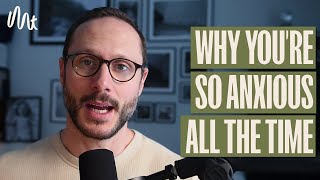
Connor Beaton breaks down anxiety as a future-based distortion caused by world instability, social media comparison, and nervous system sensitivity. Three fixes: regulate your body through breath and sleep, stop fighting the sensations, and gradually face what you've been avoiding.
Chapters
All right, team, welcome back to the Mantalk Show. I'm Connor Beaton and today we're going to be diving into why you. Why so many people are so anxious all the time. And it seems to be getting worse. And it's by design. I'm going to lay out for you why so many people's anxiety is skyrocketing and why it's being manufactured, in my opinion, more so than ever before. And then at the end of the video, I'm going to give you three, three specific things that you can do if you struggle with anxiety. Three specific tools that you can deploy to actually reduce your anxiousness. Okay, so let's dive in. First and foremost, we need to understand what anxiety is. Because for the majority of people, they look at anxiety and they say, well, it's a kind of disorder with feeling safe, right? It's a, you know, you don't feel safe or secure, even though you might actually be safe and secure. And that can be part of it. But how I want to frame anxiety is that anxiety is a future based distortion that rips you out of the present moment and takes you somewhere into the future. It causes you to fret about the future, right? So maybe your anxiety pops up and it's like, oh my gosh, am I gonna have to deal with this for the next hour? I have a meeting, you know, oh my gosh, am I gonna have to deal with this when I get home? You know, my kids and my wife are there and what if I'm anxious when I get home? And so it pulls you into a future based scenario. What's going to happen, what could happen? And your mind and your body start to try and predict, but you are not in the present. You are worrying about the future, something that could unfold, something that should unfold, something that you need to happen, something that you definitely do not want. But anxiety is always pulling you out of the present moment where 99% of the time you're genuinely safe, you're genuinely okay, and you start to worry or be concerned about something that has yet to happen, or something's happening inside of you and you are concerned that it's going to continue on indefinitely. So those are really the roots of what anxiety is. It's a future based distortion. Notice I didn't say dysfunction because there's nothing dysfunctional about it. Anxiety is not necessarily a problem. It can feel like that at times, but it's not necessarily a problem or a dysfunction. It can be dysfunctional, but it's not a problem. It's generally just a maladaptive strategy to try and prevent some type of harm, some type of issue from unfolding. Uh, now there are many things that contribute to anxiety, but as I talked about, I think that there we are living through a time where there is more anxiety and stress being manufactured than is actually true. Is there hardship in the world today? Certainly. Is the economy hard for the majority of people? Absolutely. Does that create stress? You bet. But there is more manufacturing of anxiety than ever before. I'm going to lay out the different forms of it that are happening, and I'm going to give you the ways in which anxiety is generally produced. So existential first, psychological second. So, number one, there's a changing world stability, and there is a perpetuation of catastrophe. So obviously you've probably seen it, you've probably felt it. It's in the news everywhere. It's very clear that the world is going through a transition. The global world order is shifting. And that type of geopolitical tectonic shift always creates a psychological rift. It always sort of has a wave that goes through the psyche of the majority of people in the human species. Right? And we've seen this time and time again in, in the past, whether it was before World War I or World War II or the Vietnam War or any type of change geopolitically. I used a bunch of war examples, but any type of change geopolitically, where powers shifted, that would ripple through the collective consciousness. And if you go back and look at historical archives, you will see that fear peaks, anxiety peaks when there is transition to the global quality of stability. So changing world order or stability is creating a good amount of anxiousness and unease. The second thing that has started to ramp up over the last two decades is what I call comparison addiction. Comparison addiction. Comparison addiction is you go on social media, you are fed a constant stream, constant diet of comparing your life to other people, the cars that they drive, the. The. The vacations and the trips that they're taking. And there's a kind of dis. Ease that the average person has adopted because they see all these other people living a version of a life that maybe they would like. And so you can find yourself at night or in the morning scrolling through social media, getting ready to go to bed, getting ready to go to work. And you're viewing the lives of people who, who are maybe doing things in that moment that you would love to be doing, right? Hiking a certain trail, visiting a certain country, you know, driving a certain car. And so you're inundated with the potentiality of life. You are inundated with the potentiality of life, and it is infinite. And that type of infinite altercation where you are in relationship with the infiniteness of possibilities of life is jarring for most people. And for some people, you know, you can get kind of depressed and sad and, you know, down. But for many people, what ends up happening is that this comparison addiction causes you to never feel okay or never feel enough with the life that you have. And in this kind of chronic state of, what do I need to do in the future to make my life enough to make my life better, to make my life like the people that I see online? So comparison addiction is the second one, number three. And this one's kind of a doozy. But it's the deconstruction of objective truth and reality, okay? The deconstruction of objective truth and reality. There is a push in the sort of postmodernist thinking to really deconstruct and any type of objective truth and reality. And this has permeated its way into certain political ideologies, into certain sort of college and higher education thinking spheres. And this is very jarring for the majority of people to interact with. The idea that there's no objective truth or reality there is actually jarring for the majority of people's psyches. Why? Because. Because how your psyche forms, how your psychology is actually designed to form, is to develop a sense of self in relationship with other, with objective reality, with something outside of yourself. And so when we begin to deconstruct definitions, biologies, science, you know, we begin to deconstruct these things and we make them meaningless, right? We dissolve the sort of notion that any definite, you know, definitions can just be changed at a whim. We can alter them to kind of be meaningless or circular for the average person. It begins to fracture and disrupt very subtly and at an unconscious level, their sense of individual stability. Because all of a sudden, if there's no there there, then how can they have something to sort of test themselves against? And this is a form of psychosis, right? What happens when somebody experiences psychosis, when somebody, you know, experiences something like depersonalization, where you begin to question whether reality is real or not? What's actually happening is that that individual's sense of objective reality becomes untethered to from everybody else's. And what has started to happen within our culture and our society, unfortunately, is that many people have started to untether and unplug and disconnect from any type of objective truth or reality. And so you see this kind of compartmentalization of people who are still living within. Here's what is objectively true. Here is what is, you know, we can objectively measure this, we can see it, we can quantify it. And other people are saying, no, there is no objective reality. Math is racist, science is, you know, bigoted, and we need to deconstruct the whole system. And for many people, that is causing them a tremendous amount of anxiousness because their psyche has nothing to root itself or mirror itself against. The last thing is disagreement as relational death. Disagreement as relational death. So many people are anxious today because they are worried that if I disagree with a friend or a family member or a colleague or a co worker, I'm going to be cut off. They are going to kill the relationship between us. Because it has become so commonplace to disagree, to have disagreement, lead to, to the ending of a relationship. And so family members, friends, aren't talking about their perceptions, how they feel about something, what they think about something, whether it's political or cultural or relational, because they are anxious that if they say one wrong thing that the other person disagrees with, the relationship will be over. So this type of disagreement as relational death is causing a tremendous amount of anxiety for a lot of people. I've seen it with parents, specifically, I've seen it with friends quite a bit. Certain social circles, you know, people are afraid to say what they actually think or how they actually feel because the threat of the end of the relationship is right there. So those are the existential things that are contributing to a rise in anxiety. My encouragement is that you do not participate in those things. You start to back out of them. You do not participate in the deconstruction of objective truth. You hold firm on those things. You start to let go of this comparison addiction of scrolling through social media and comparing your life to other people's. Let go of all of that. Obviously the world's gonna change. You probably don't have any control over what other countries do or maybe even what your country does to a certain degree. And I would not participate in disagreement, meaning that the relationship should end. My encouragement for you and for everybody that I know is learn to maintain relationship regardless of disagreement. Now, you obviously cannot control what somebody else is going to do. And I've had people in my life that are like, I, I don't want to be in relationship with you because I disagree with you. I can't control them. But what I make very clear is that how I want to do relationship and what is relational to me is that you and I can disagree and still be relational with one another. We can still be in relationship with one another. So those are the main pieces existentially contributing to it. From a psychological standpoint, there are some very simple things that cause anxiety. Okay? Number one is a higher level of nervous system sensitivity. Okay? This could be a biological or temperamental nature. Some people are just genuinely born with a higher baseline amygdala reactivity, meaning that their amygdala is more sensitive, more reactive, they have faster threat detection and they are slower to return to, to calm. Now, for some of you, that is going to be your experience. You have a heightened sense of threat detection. You watch people, you have a hyper vigilance. And maybe that is something that you were born with, maybe that's something that's a result of your environment, but it's there nonetheless. You have a higher level of nervous system safety. So this can show up in a multitude of ways. Number one, you can kind of be high right hypervigilant from childhood on, where you are constantly tuning in to what other people are saying, how they're saying it, you know, their facial features, their expressions, the little minutiae of changes in their temperament. And you can be very reactive to that. You can have strong reactions to any type of uncertainty. This is a big one that I have seen or difficulty settling once that anxiety has been activated. Right? For some people, this is, they get a little anxious, they can come back down. They get really anxious, but they can come back down. And for some of you, you will have a much harder time just soothing and settling the system. Now this is not a flaw. This is super, super important. It's not a flaw. It's simply a nervous system that has been tuned for responsiveness, but it requires skillful regulation. So you may have to work a little bit harder to, than the average person to regulate your system. But the beauty in it is that you also have a very finely tuned nervous system. I fall into this category. This is me to a T. I'm very hyper vigilant, very hypersensitive to people's changes in expression, their body language, their mood, their demeanor. And I have had to work tirelessly, religiously, ritualistically in order to hone that into a skill set, into a strength. And that's actually what makes me very gifted at the work that I do today. So it can benefit you. Number two is chronic stress and overload. Long term stress keeps your body in a sympathetic dominant state, in a flight or fight state. And some of the Key drivers for this are work pressures with no recovery. Financial insecurity can lead to that relationship instability and caregiving without support. When you have to take on more and more stress and responsibility in your life and there's no end to it, that is what can really create high levels of anxiety that you just can't seem to let go of. And this is many of the men that I work with, a lot of the guys that come to work with me are the high performing, you know, Wall street traders, hedge fund owners, they are professional athletes, they're CEOs and executives and they are just going at a high pace, nonstop with a high stress load and they're overloaded. And so that keeps over time stress going, which becomes anxiety even when nothing is wrong. So what will start to happen for people in the state is it is everything will be okay, but your system will be so fried and burnt out that you'll just be anxious nonstop. Now there's two more things that can contribute to anxiety. There's a few more that I'm not talking about, but these are the big ones. The next one is early attachment patterns. So if you have attachment wounds from early on in life, inconsistent caregiving can, you know, if you have an inconsistent parent, that can lead to hyper vigilance. If you had emotional neglect, that can lead to high levels of anxiety in your adult relationships, fear of abandonment. You can have unpredictable environments where you were growing up and that can lead to control seeking, right? So if you couldn't predict what was going to happen growing up, then very likely that you developed a personality that seeks control because you want to have a specific outcome, you want to know what the outcome is. So because of this, it creates anxiety in your relationships. You can have an anxiousness around the fear of rejection, the fear of failure. There's a kind of chronic self monitoring that can be going on because you always need to be in control. And there can really be a difficulty in trusting calm. Okay? Because if you grew up in an environment where as a kid you were constantly inundated with, you didn't know if mom or dad was going to be calm, cool and collected or like lose their shit, that's going to produce a nervous system that is always on edge, always on edge, always waiting for the other shoe to drop. And especially in relationships. So this might not happen in your work environment, but at home in your relationships. This need to control, this concern about the outcome will be very, very strong. The last thing that can create anxiety is PTSD and trauma, right? Big T or small T depending on whether or not you, you know, go along with that. But trauma doesn't always require catastrophic events. This is the misconception for a lot of the guys that I've worked with, they're like, well, nothing catastrophic happened to me. You know, I didn't have some massive acute thing. Well, that isn't always what trauma is, right? Sometimes trauma will include real deep emotional humiliation, chronic criticism. Bullying could be medical trauma. Witnessing chaos without support. All of these things can leave your nervous system stuck in the anticipation of threat, even when life is objectively safe. So if we had to take everything that we know about anxiety and strip it down into three effective methods. So that's all what causes anxiety existentially and from our background, and strip it down into three effective methods to work with your anxiety. Here's what I want you to know. Number one, regulate the body first, don't argue with your mind, okay? Regulate the body. Don't argue with your mind. Anxiety is primarily a physiological state, not a psychological problem, okay? For many people that start to feel anxious, they start to negotiate in their head. They try and talk themselves out of it, but which never works, right? When the nervous system is activated, logic doesn't land. You can't logic your way out of feeling safe or stop, you know, worrying about the future. Reassurance from outside often does not stick. And insight doesn't necessarily calm. So what should you do? Well, first and foremost, you need to slow your breathing. You need to get in touch with your breath. Your breath is the modulation dial between sympathetic, stressed, fight or flight nervous system and parasympathetic, slow, low, digesting, calm, peaceful nervous system. Okay? So using nice slow inhales through the nose for a count of four and long exhales out the mouth for a count of seven for three to four minutes can force your heart rate down, which will send the signal from the body to the brain to say, hey, everything's okay. Stop releasing all of those stress chemicals, the adrenaline and the cortisol. Let's stop releasing those because actually, I think everything's all right. So you want to utilize the body to send signals to the brain to calm down and rest. You are not going to talk your way out of it. So you can use steady movement. You. You want to make sure that you get regular sleep. For a lot of people that deal with anxiety, terrible sleep will create this kind of spiral where the anxiety gets worse and worse and worse. And obviously you want to reduce alcohol and caffeine as much as you humanly can. But the main Principle here is calm the body and your mind will follow. Okay? Calm the body and your mind will follow. Try to calm your mind and the body will resist. In psychology, there's a principle called the elephant and the rider, where the body is the elephant and the mind is the rider. And if the elephant is freaking out, it's going to go wherever the hell it wants, no matter what the rider tells it to do. And the misconception, the illusion, is that the rider is in control. And at some point, if the elephant's really scared, if it sees a tiger or a jaguar or something like that, no matter what the rider does, oftentimes the elephant is going to take over. So we want to go to calming the body first, and the mind will follow. This alone reduces anxiety intensity for most people by roughly 40 to 50%. So if you do start to do this basic breathing that I laid out for you, you get a little bit better sleep, you get some movement, you reduce caffeine and alcohol. That is going to reduce your anxiety significantly. Step number two, stop fighting the sensation. Stop fighting the sensation. Resistance fuels anxiety. It's its favorite thing to consume. So anxiety grows when we treat it as dangerous, unacceptable, something that shouldn't be happening, something that we need to eliminate immediately. And for all the men that I've worked with that have a lot of anxiety, their response to anxiety is, I need to kill this off. I need, like, I wish my anxiety would just die. I need to deal with it. And so we can take a very hostile approach to our anxiety, which actually fuels it. All right? This creates a second layer, which is a layer of fear, of fear. So you start to become afraid of feeling afraid. It's like, no, no, I don't want to feel that way. What we want to practice is normalizing or allowing ourselves to be in relationship with those sensations. Right. So how do you practice this? Number one, you name the sensation. I feel a tight chest. I can feel that my breathing is elevated. I feel buzzing, or I feel a heat. It feels like my body is sort of like a gong is going off. Usually for a lot of people, what big anxiety can feel like is almost as though everything outside of you is moving slowly, but inside, it's like the RPMs are revving super, super fast and you can't slow down. So name the sensation. I feel a tight chest. I feel like things are buzzing. I feel like I can't catch my breath and allow it without fixing that's what's happening, and that's okay. Stay present while it peaks and Falls. Because here's the thing about anxiety, it always peak and it'll always fall back off. And what we want to do is work to lower the sort of drawbridge or the foundation of our homeostasis. So if normally you're walking around the world at a 5 or a 6 already on the anxiousness scale, you're just naturally a little bit more of an anxious person, paranoid, worried. We want to use these practices to lower our homeostasis to a calmer state. That is the aim and, and how we do that in part is by acknowledging and letting go of fighting the sensation instead of saying, oh no, here's the anxiety again. I don't wanna feel this way, I don't have time for this, I can't feel this way, I gotta kill this off, you know, I need to deal with this. It's like, oh, okay, here it is again. Let me take a few breaths, let me take a few breaths for a few minutes. And this will retrain your brain to have a different response to, to that sensation. Okay, Anxiety is uncomfortable, not unsafe. You might want to say that as, as just a little motto to yourself, right? Okay, my anxiety is uncomfortable, but it's not unsafe. And over time your anxiety will lose its authority because your brain's response to it will say, oh, there's that experience again. It's okay. It's just like, oh, I feel sadness or I feel grief or I feel anger. There's that experience again. That's okay, no big deal. The last piece is move towards what you are avoiding. Start to move towards what you have been avoiding in small and deliberate doses. Don't try and you know, if you have like a little fear of heights, don't try and, you know, go cliff jumping. That's probably going to be a bit too much. But avoidance really is another major fuel source for anxiety. And a lot of the times we have this future based distortion come up, right? Remember, anxiety is a future based distortion because we have been avoiding things in the present moment. Oh, I don't wanna have this call, I don't wanna send the email. And so you put it off and you put it off and you put it off. And the more you put it off, the more you avoid it, the more the anxiousness builds and the more the pressure in your system starts to build. And so here's a simple motto. Relief today. Action today. Action today creates relief today which equals less anxiety tomorrow. Action today creates alleviated anxiety tomorrow. So what you want to do is just look at a couple different things, like one or two avoided situations, a conversation, an email that you need to send, a phone call that you need to make, an action that you need to take. And start to approach these things gradually, day by day. Start to knock off the things that you know you need to do that you've been avoiding, and repeat them until your nervous system feels safe. This is how confidence and internal security is rebuilt. Not through affirmation, but through experience. Okay. You will not alleviate your anxiety through affirmations. You will alleviate it through experience. All right, thank you so much for joining me. I hope that you enjoyed this. Leave your comments below. Don't forget to like and subscribe. And don't forget to man it forward. Share this episode with somebody that you know needs it. Maybe they deal with a little bit of anxiety and this could support them. And until next week, this is Connor Beaton signing off.
More from Connor







How to Raise Strong, Unshakable Boys in Today's Culture, with Dr. Shefali Tsabary



