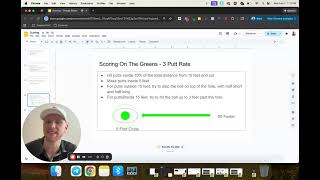
Connor Stirling Peterson teaches two rules to cut 3-putts: the 10% rule for lag putts beyond 15 feet, where the ball stops within 10% of the distance for a makeable tap-in, and the 3-foot hedge for closer putts, intentionally running past the hole to keep the next putt inside 3 feet.
Chapters
All right, let's talk about scoring on the greens. So the first side of this is 3-putt rate. In the next video, I will talk about birdie conversion rate. But we want to— we have 2 basic things we need to do. We need to be able to hit our lag putts inside 10% of the total distance. When I say lag putts, I mean putts outside of 15 feet. So if you've got an 18-footer, that's a lag putt. We want to hit that putt inside 10% of the total distance. I do not want you concerned about trying to make these putts. And the other side of this is putts inside 5 feet. We want to be able to do our best to make all of our putts inside 5 feet. That's a reasonable distance to make our putts from, and it works really well from the perspective of the majority of shots that you're going to have once you've hit the green. You're going to have putts from 20, 30, and 40 feet all day long, sometimes even from 50 feet. And if you can roll those inside 10% of that total distance you're gonna have putts from 3 feet, 4 feet, and 5 feet all day. You should be comfortable making those, and you should be comfortable lag putting from those distances. So the way to actually do this is for putts outside 15 feet, you want to try to stop the ball on top of the hole with half of them being short and half of them being long. So you can kind of imagine a little circle around the hole. Your shot pattern is going to look something like this, right? So you're gonna have this little oval where you got some short and some long. But we're not going to really miss left or right too substantially. Um, you know, just kind of the easiest way to think about this is you probably haven't missed a whole lot of 30-foot putts 10 feet left or 10 feet right, but you probably have missed 30-foot putts where you're 10 feet short or 10 feet long. That's kind of the basic idea, is that our shot pattern is longer around the greens here. Now for putts inside 15 feet, we want to try to hit the ball up to 3 feet past the hole. Now the reason for that is if we know we've got our 10% rule, so from 15 feet it would be, you know, plus or minus 1.5 foot and a half. If we just say every ball is past the hole, well then our furthest past, uh, putt would be 3 feet, and then our shortest one would be just past the hole barely. For— and that works really well because we can still make all of our 3-footers and 2-footers and 1-footers for the most part. But if I put you at 30 feet and we are 3 feet short, 3 feet long, and I push all of those putts past the hole, well, you're gonna have some 6-footers and 5-footers and 4-footers coming back, and you're just gonna miss some of those. And so we want to, to kind of hedge things, um, to our advantage here so that when we have a 30-footer, we're not thinking, how do I make this? We're not thinking, hey, make sure we get this ball to the hole. We're just saying, I wanna cozy this up in a 3-foot circle. Around the hole. So that's the basics of how we want to be scoring on the greens and specifically with 3-putting.