How To Make Long Term Progress 1

Connor Stirling Peterson shows golfers how to track progress using statistics like scoring average and greens-in-regulation every ten rounds. He explains how to spot gaps in your game and decide whether to play more tournaments or practice more, then make specific fixes tied to those numbers instead of random swing changes.
Chapters
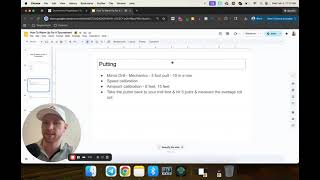
All right, so in this video, hopefully you've watched essentially all the other videos aside from maybe the mechanics and some of the tournament stuff. This is going to bring all of those things together. This is assuming that you've already gotten your 5 rounds logged, you've gotten your first practice plan, you've played another 10 rounds. Now what? That's really when to be watching this video. So So far you've gone through a lot of new information, right? There's been a lot of excitement with that. There's a lot of new things for you to think about. That's going to calm down over time. And that's one of the most challenging things with this, because if we're always trying to chase the new thing, then we're going to stall out. We're going to go off in kind of random directions because we're chasing novelty and new stuff and the excitement from that rather than consistency. And saying, hey, I'm going to be working on the same thing for a long period of time, and the thing that I want to see change is my scores, right? I want to be focused on the right thing and just keep my head down and do that. Okay, so you've played your 10 rounds again. It's time to update the practice. What we want to do is go over here, we've got our practice plan, and we want to go ahead and reevaluate where we're at. We're going to look at our statistics in our spreadsheet here. We're going to look at, you know, where we're at over our last 10 rounds. We're going to update that and say, okay, cool, now we're here. So I'll just do this as an example for Jason's stuff right now, just for the ease of— I got 72.78, 78, We've got 45, 83. We've got 5% here. We've got make rate, or we've got pretty conversion rate of 22.9, and we've got 2.7 off the tee. All right, great. So comparatively to the last time, we're down a little bit. Now, big caveat here, for these kinds of scores where we got a scoring average that's pretty close to par, this is going to fluctuate a little bit, and that's completely normal because we're at the upper limits of realistically what's possible here. So penalty rate, pretty similar. Greens and regulation, slight drop-off, but you know, still well above the 70% benchmark that I would set. Scrambling improved just a little bit, so even though we missed a couple more greens, we got up and down a couple more times, which makes sense. We improved our 3-putting a little bit, no real big changes there. And the biggest difference here is our birdie conversion rate dropped off a little bit. So that's really the thing that we're going to be focusing on next time we dig through this. We also have here as a secondary metric— or as the primary metric our scoring differential is continuing to trend in the correct direction here. So that's good feedback, but I can also see, you know, a scoring average of 72.6. In order to continue to see this kind of improvement, there's essentially two things that we're going to have available to us. We could improve our scores and continue to improve our bird conversion rate, but that's going to be very, very challenging, right? Is it something we're going to put effort into? Absolutely. But in Jason's case, we know that we're already in that 72 to 74 scoring area and kind of like general target. So one of the most important things for us to do over this next year is to lengthen out the golf courses. So some of you guys might be watching this video, we got a scoring average of 85, right? In your case, you probably don't need to worry about the golf courses at all. We need to be worrying about getting— improving those core statistics. Okay, so Long story short, we played our next 10 rounds and we want to go ahead and update our practice, and then we've got to go play another 10 rounds. Now, if you see a big gap between your practice and your tournaments, which you can just toggle here, practice and tournaments— if you see a big gap there, then you might be in a case where you need to play more tournaments, not for a rankings purpose, but just to get comfortable with playing in those tournaments and dealing with some of those problems. And when you run into those problems bring those to the weekly calls or DM me about it. Okay, now if they're pretty similar, we don't need to do as many tournaments because if we play better in practice, we should be able to see the same in, you know, in tournaments as well. This does not get changed out, or it's not different if you're in a simulator. So again, we can look at simulator rounds, outdoor versus simulator here, and we can see that Long story short, it becomes this process of making adjustments to what we're doing in your practice specifically. So what's going to get changed out in your practice? We're going to be looking at strategic stuff, we're going to be looking at mental stuff, and we're going to be looking at mechanical stuff if those things need to be changed. And then in all likelihood, we can change out our make drill for putting if that becomes relevant. We can change out our percentages and our difficulty on the approach play and off the tee. Those are the areas where we're really going to change. Everything else is going to be more strategic, mental, or mechanical. And we want to make sure that we're not just tinkering with our golf swing, we're making a specific change so that we can improve one of these statistics. So if we're looking at this and saying, hey, my greens regulation isn't high enough because I don't hit the ball on the green enough from this distance, and that's because I hit pulls, then I want to fix my golf swing to stop hitting pulls, not just I want my golf swing to look differently or something like that. Okay, so we're making those adjustments to the practice and then we're going to go play more golf. We want to see if the changes that we made are actually causing us to improve or if they're not. That becomes the next critical variable here, and we just want to repeat that process consistently. And so we're going to evaluate where we're at every 10 rounds. And so we want to see this process of scoring differential going from 3.59 to 2.7 to 0.94 to 0.19 to negative 0.43. So now if I look at it, it's negative 0.53. So we want to see that feedback that we're moving in the right direction, and as long as we're improving at the rate that we need to, we're good to go. We know that we're doing what we need to do, and the real challenge is going to be to keep the train on the tracks and to not go off and do something random. So hopefully this video makes sense. If you have questions, go ahead and comment below, but it's getting comfortable with this consistent Cadence. Everyone wants to be consistent, they want to see consistent results, but most of us don't really want to do the work of being consistent. And that's going to be the challenge for you now. And if you run into any problems along the way, that is when you bring it to the weekly calls. That is when you DM me. Do not sit on those problems. Let me know as soon as they come up. That way we can solve it and keep you moving in the right direction.