In this instructional video Connor Stirling Peterson explains a structured warm‑up routine for tournament golf, emphasizing that a warm‑up is not a practice session but a brief process to bring the player to the performance level they already possess. He outlines a progressive sequence—starting with putting, then short‑game, approach shots, and finally tee shots—detailing specific drills for each stage. For putting he recommends a mirror drill, AimPoint speed/aim calibration, and a lag‑putt rollout test to gauge green speed. The short‑game segment focuses on carrying the ball 5, 10, and 15 yards, checking rollout, and optionally testing bunker sand. The approach portion stresses spine warm‑up, evaluating contact, shot shape, start line, and adjusting trajectory for wind, using fewer balls than a full practice. Tee‑shot warm‑up mirrors the approach focus on contact, alignment, and shot shape, with wind‑related tee‑height adjustments. He advises a total warm‑up time of 15‑40 minutes, using the first few holes as an additional information‑gathering phase to confirm that on‑course conditions match the warm‑up observations. Throughout, he encourages confidence, data‑driven adjustments, and mental readiness, offering to answer questions via comments or direct messages.
Chapters
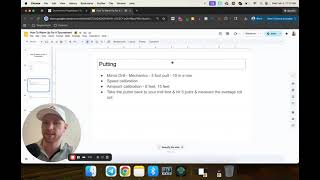
All right, let's talk about how to warm up for a tournament. So super crucial that we understand here, obviously we've already gone through the mapping the golf course, we've gone through your practice round, we've already done those things. Now we're talking about warming up for the actual event. Super crucial to understand that a warm-up is just that— it is a warm-up. It is not a practice session. Do not use this as a practice session. When you're going into a tournament, your goal is to play at the level that your game is currently at, not try to expand on that. Practice is for expanding on that level. Tournament play is just perform at the level that you're at to the best of your ability. Okay, so we're going to start with putting and we're going to work our way all the way into tee shots. We want to do it in that order because again, warm-up, it's easiest to warm up the shorter stuff first. Then finish off with drivers. So starting off the putting, first thing I want you to do is mirror drill. Same thing as you're doing in practice. The only difference is you're going to do 10 in a row instead of 20 in a row. The goal here is to build a little bit of confidence, get you comfortable with your stroke, but not have you do a full practice session here. We're not trying to really work on our stroke mechanics. It's just to get, get you comfortable seeing the ball go in the hole. Okay, now if you're doing Aimpoint we want to do a speed calibration and aim point calibration. We want to make sure that our arm bend is correct. I've got other videos that go through how to do that in the mechanics section under putting, but that's what you want to do. If you're not currently doing aim point, what you want to do is get the speed of the greens right, because the first thing we've done here is we have made sure our stroke mechanics are solid. That's going to help us with all of our shorter putts inside 5 feet. The other side of this coin is the lag putting, okay, provided our main thing isn't making more 10 to 15-footers, in which case we do need to take Aimpoint seriously and you need to go and watch those videos. But let's just look at the lag putting here. What we want to do is take the putter back to your trail foot. I I want you to hit 5 putts, drop 5 balls, and measure the average rollout. Okay? So when I say the back foot, I mean we're taking the putter back about that far. Okay. I just want to see when I take it back that far, how far does the putt actually run out? So you're going to see something like that, whatever that middle is for these putts. That's about how far that putt goes for you. Ideally, this is on something that's flat so you can understand, hey, if I'm putting uphill, well then I need to take it a little bit further back to get it that same distance. And vice versa, if I'm in downhill, it's a little bit less, right? So it just gives you a frame of reference on how fast the greens are running. That way, when you get out on the first hole and you— let's say this is 20 feet, right? You get out on the first hole, you've got a 20-footer, and you take it back to your right foot. And you hit it and it goes way past, well then you know, hey, the greens are running a little bit faster than they were on the practice green, and that's totally normal, right? On the flip side, you could have the same 20-footer and the greens are way slower, and then you know that, right? So we want to look at these first few holes as an opportunity to kind of collect information. And the same thing for our warm-up, really we want to be looking at it as collecting information of how is my game And then how's that going to interact with the golf course? Okay. That shouldn't take you that long. Moving on to short game here. You can do this in the short game area, or you can do this on the driving range. And so same basic thing. We want to carry the ball 5, 10, and 15 yards. We want to figure out the roll number. Realistically, we should know the rollout number from our practice round when we hit all those shots around the greens. That I talked about. Okay, if you haven't already watched that video, go back and watch the how to run a practice round video. And so we want to make sure again that we're carrying the ball those consistent distances. Exception here, you might want to go ahead and hit some bunker shots as well if the sand is kind of weird, or at least just to figure out what the sand is like. Odds are you're not going to be in 10 different bunkers, but just a couple of them, knowing what the sand is like is going to make it a little bit easier for you to get out of them. Bunkers are obviously very hit or miss, right? Sometimes you can have great bunkers in the practice area, get out on the golf course and there's nothing in the bunker, right? There's no sand. So we got to figure those things out a little bit on the golf course. Um, this foundational warming up, really your main thing is carrying the ball 5, 10, 15 yards. You should also know a little bit of that based off of your practice round. Know, hey, if the bunkers are unplayable versus, you know, hey, if the bunker sand is a little bit thicker or thinner than whatever you're used to. Okay, moving on to approach play. Main thing here, we want to warm up your spine. I want to get, you know, comfortable there. We really want to evaluate contact, shot shape, and start line feels, right? So hopefully you're able to roll out of bed, hit some type of ball flight that's similar to what you normally do. That's why it's important that we're hitting the same shot over and over and over again. So it's, again, it's just kind of the default, right? You're not going to go from hitting a 15-yard draw or a 10-yard draw as your default to hitting a 10-yard fade that starts left and cuts on you, right? You might wake up one day hitting blocks, but you're not going to have that dramatic of a change there. We mostly want to focus on par 4 approach shots or the areas that you're struggling with. You can go ahead and reference your practice plan again for those numbers. Okay, so it's pretty similar there. I would adjust down. So rather than hitting 10 balls, try to hit like 5. And again, the main point is, are you seeing the shot shape that you want to see and the contact? Not so much, hey, am I hitting every shot perfect? Again, we want to be thinking in patterns here. We also want to adjust your trajectory depending on the wind. So if you just recognize right away it's super windy, then hey, we want to be going more toward our knockdown shots and playing those distances rather than our full shots, okay? So we can keep the ball a little bit more out of the wind there. Moving on to tee shots. Again, same thing. We're looking at contact. How's that shot shape? Start line, right? If your main thing is, hey, I hit a draw, obviously just want to be able to say like, hey, I'm, you know, I've got my alignment, I've got my station here, I've got my alignment rod on the ground. I'm aligning myself from a right-handed player down the right-hand side here. I want to see this draw summing out. Is it doing that right? Is it starting right on me? Is it starting left on me? Um, just making sure that we're comfortable, we're seeing that same pattern that we want to see. Again, if it's in the wind, then we might want to tee the ball down just a little bit so that we get comfortable seeing that in that lower window. But that is the main thing. That's the main structure here. So in theory, you could run through this in as little as 15 or 20 minutes. Um, I wouldn't recommend going a whole lot over 40 minutes for a warmup session, just because we want to be able to have enough gas when we're out there on the golf course. We want to be mentally ready. And when we're going through those first few holes, those are kind of a warm-up in a way too. We want to be looking at each one of those holes as kind of, what do I have? How comfortable am I? Am I seeing the same shot shape that I saw on the driving range on the golf course? Those are really the things we want to evaluate. That way, once we get to hole 4, 5, 6, and so on, we're going to have a better sense of just where our game's at, and we can really be in it for, for the grind of the full 18 holes. So let me know if you have any questions below. Hopefully this is helpful. If you need clarification on any of this stuff, shoot me a DM, um, or bring it up on one of the weekly calls, or again, comment below.