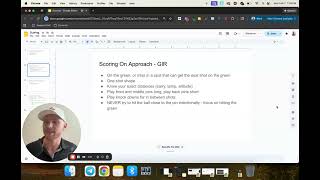
Connor Stirling Peterson breaks down approach shots into three pin positions: for front and middle pins, play deeper with a longer club and knockdown swing; for back pins, play shorter and let the ball spin back. Track your carry distances for each club and accept that you won't stick every shot next to the hole.
Chapters
All right, now let's talk about scoring on your approach shots. So the primary statistic that is going to represent this is greens regulation. And when we're trying to hit our approach shots, the first thing that we're trying to do is hit the ball on the green, or we want to miss in a spot that can get the next shot on the green. So we want to have awareness of if we do miss, where is going to leave us an easier up and down scenario. That's in part why how good your ball striking is actually impacts your overall scrambling number. Now, same thing as off the tee, we want to be able to hit one shot shape. So whether we're hitting a draw or a fade, we want to have consistency there. We do not want to just hit the ball straight. Straight is not an actual shot shape because you're not a sniper. When you hit a bunch of balls, you're going to hit some left, you're going to hit some right, and we want to understand how those balls get there and the shape that they're going to take and what that feels like in your golf swing. So you want to have as much of awareness of that as possible. Now, when you're hitting one shot shape into the green, if you're hitting a draw— in both these examples, I'm going to say that you're a right-handed player— you're starting the ball at the right side of the green and having it draw some amount, right? So if you just hit a block, then you're just going to be right side of the green or potentially right fringe. And if you really overdraw it, you're going to be on the left side of the green or the left fringe. The average green's about 20 yards wide. When's the last time you hooked your 7-iron 30 yards? It's possible, but odds are we're missing greens with the ball curving significantly less because we're not applying this principle here. So this is going to help you hit more greens in regulation. Now you also want to know your carry distances at the particular temperature and altitude that you carry that ball. So for example, let's say you hit your pitching wedge 120 yards. You want to know it's at 70 degrees and it's at sea level, or it's at 50 degrees and it's at 800 feet. You want to know that. And if you're not sure, just go ahead and look up where you're at altitude. So, you know, Los Angeles altitude, um, Raleigh altitude, just know whatever that is. And then just look at your phone for whatever the dis— or the temperature is, and then just note down in your phone your actual carry distances in just the Notes app. So I hit my pitching wedge 120 yards, I hit my 9-iron 130 yards. You want to know what these are exactly, so it's not going to be round numbers like that. You want to figure this out, or it's probably going to be like, I hit my 9-iron 132 yards, right? Because it's not just the best one, it is what is the average. And so we can get very specific about this in a simulator, but you should be able to have a pretty good sense of hitting to a particular pin and hitting a full 9-iron and saying, hey, the majority of them went past this pin. I know this pin was 127 yards and the average goes about 5 yards past, therefore I know I hit my 9-iron about 132 yards. You can have that down in your phone and you should have consistent gaps in between those numbers. Now, for the approach play, there are 3 different scenarios that we have on our approaches. We have our front pin, we have our middle pin, and we have our back pin. Now, for a front pin and a middle pin, we want to err on the side of hitting these balls deeper into the green. So let's take that same example. Let's say this pin is 123 yards. And we've already established that you hit your pitching wedge 120 yards. What does that mean? That means that you're going to hit a knockdown 9-iron and try to take the distance off that way rather than trying to hit a pitching wedge extra hard. Because if you run up and you end up being a little bit short, you can spin it off the green, or you can just miss it short by hitting it fat or something like that. Versus if you hit a 9-iron poorly, let's say you flush it into the middle of the green, who cares? You got a 40-footer coming back. You got to be able to 2-putt from 40 feet. If you hit it fat, you're right next to the pin. So you look like a hero. So in either case, that is the ideal scenario here. So front pin and middle pin, we want to play deep. For a back pin, we can play short. So if we've got 123 to a back pin, we know we hit our pitching wedge 120 yards. That means we can hit that pitching wedge. And if we flush it, great, we're right next to the hole. If we hit it way too far, odds are it's going to spin back a little bit on us. And if we hit it fat, no big deal, we're in the middle of the green, we two-putt, we go to the next hole. So that's super, super important that we're both being aware of where those pin positions are so that we have the correct error or kind of miss that we're going to want to have. And we're also using knockdowns to control our distance, right? So the back pin, we might be trying to go all out, but for the most part, with those middle pins and those front pins, we're taking the longer of the two clubs and hitting a knockdown. We do not ever want to intentionally try to hit the ball close to the hole. That's going to take care of itself just on our shot pattern. You want to focus on hitting the green. The reason for that again is the average green is roughly 20 yards wide. There's a good shot that whatever club you're hitting, your shot pattern is 20 yards wide already. So all we can really worry about is let's hit the correct carry number, which we've already gone over, which which is based on the position here, and just know, hey, this is going to come out kind of randomly. And there's going to be some days where— and some pin positions where I get lucky. There's going to be some days where I get lucky more often than not. There are some days where I get unlucky more often than not, right? So in this case, these balls right next to this pin are the lucky ones. If I put the pin over here, these balls are the lucky ones. You know, if I put the pin over here, then these ones are the lucky ones. Again, it doesn't matter. We just need to focus on hitting the green and trust that our shot pattern is going to materialize just fine over time.










