Behind The Stats Of A Division 1 Recruit
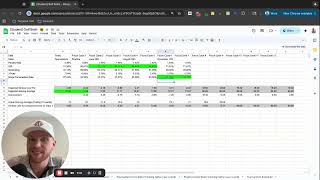
In this instructional video, the presenter walks through the statistical profile of a junior golfer who earned a Division I scholarship at Columbia, using the data to illustrate how elite college‑golf recruitment works and how a data‑driven coaching process can move a player toward that goal. He begins by explaining why recruitment is tied to a player’s starting point and improvement trajectory, then shares the athlete’s baseline metrics (penalty rate, greens‑in‑regulation, scrambling, 3‑putts, birdie conversion) and highlights the common gap between practice‑round performance and tournament results. The coach diagnoses the gaps, prioritizes greens‑in‑regulation as the primary lever, and describes specific interventions—aim adjustments on the driver, tee‑shot strategy, targeted drills to reduce 3‑putts, and a structured tournament‑preparation routine that teaches players where to miss and how to plan practice rounds. He tracks progress over a seven‑month period, noting modest improvements in scoring differential, percentile rank, and key stats, while acknowledging non‑linear development. The video then outlines the broader roadmap for Division I success: achieving a 70%+ GIR, maintaining a 72‑74 scoring average, selecting appropriate high‑distance tournaments, and hitting target ranking thresholds. Finally, the presenter markets his coaching services, offering a direct application for personalized coaching and a $147 tournament‑scheduling framework, and encourages viewers to explore additional case‑study videos.
Chapters
All right, what is going on? In today's video, I wanted to do something fun, which is to review the statistics of a player who is going to play Division I golf. They got recruited to Columbia, and I want to use this video, really go through their statistics to help you understand kind of where they started off, where they're at now, and really what Division I caliber golf looks like. Um, and so without further ado, let me go ahead and jump into the video. Um, starting first thing, one of the, one of the reasons why I don't talk a ton about particular placements— um, Columbia is obviously an awesome one, obviously super proud of this player for, for being able to pull that off. Um, but the reason I don't talk about that as kind of like a broad thing is because where a player is able to go to play Division I golf is in large part a product of where they started off, right? So if we're in a better position earlier, it becomes far easier to be be able to get recruited to play Division 1 golf. You have other cases where a player might not be in the best position, makes a ton of progress. Which one of those is technically a better outcome for— from a coaching perspective? For me, it's always going to be the player who improves more from a strokes perspective, um, comparatively to a player who, you know, potentially gets placed but maybe didn't improve quite as much. So, you know, I can absolutely talk about the players that I've helped play Division 1 golf, but at the same time, there's other players that come to me where they're like, hey, no, I know it's a long shot, but I want to have a real chance at this. And I know that you can help with this. And so I'm perfectly happy to help those players as well. Um, hey, I just want to kind of address that in this video, um, just so you guys understand a little bit better how this all stuff— this stuff all works together. It's very rare that it's a neat, um, you start working with a player who's not that great and then you make them amazing and then they get recruited to Stanford. Usually that's not how this goes. Usually if a player is a little bit better off, you know, sometimes you have a lot of improvement. That's, that's obviously fantastic and those are great examples. Um, but sometimes you have a player where you're able to help them move around a little bit better, right? You know, it's like they're already good, you made them a little bit better. You know, that sometimes has really big outcomes as well. So, um, anyway, without further ado, let's go ahead and hop into the statistics here. So first time we ended up looking at this, a penalty rate of 3.3%, greens regulation about 51%, scrambling about 37%, 3-putts about 7%, and bird conversion rate about 27%. So translation for that is we're hitting about half of our greens, Pretty hybrid conversion rate, okay 3-putt rate. It's a little bit higher than I'd like, but you know, it's not anything too crazy. Scrambling is about average, and penalty rate is kind of about average, to be honest. Um, and so looking at that, that's part of the reason they started working with me in the first place, where they're in a good spot overall, um, you know, but we need to be able to kind of accelerate this a little bit. So at the same time, compared to practice, you know, practice they're able to do substantially better, um, in large part, um, this is one of the things that a lot of players come to me or parents come to me where it's like, hey, we've got this discrepancy between, you know, we play really good in practice, we struggle in tournaments. One of the reasons I'm really big on looking at the statistics behind this is so that the player understands, okay, where are we losing shots on, where do we need to put our focus in tournaments, right? Because it's not that we suck at everything in tournaments, right? One of the things I typically see, and you guys can see it in this set of data, players tend to be— have a higher birdie conversion rate than in tournaments than they do in practice, right? So for whatever reason, they have more incentive, um, they feel like to make birdies, are a little bit more focused on the greens. Um, that said, scrambling almost always drops off in tournaments because when you're playing your home golf course, you know where to miss, versus you're playing a tournament, you don't know where to miss. And so a lot of the time, people make the mistake of saying, oh, this is a mindset issue, um, and it really isn't the case, right? So we always want to be looking at this from a data-driven perspective, not from an emotions. I always get the most concerned when I have a parent or junior golfer comes to me and they say, I already know what it is. They don't even look at the statistics. It's like, no, you don't. Um, and that, you know, those end up being some of the most difficult players to really help because if you're already sold that you already know what's working, um, and you don't have any data to back it up, you're not willing to be like, listen to the data, um, or you don't value the collection of the data, you know, it's just like you're gonna have a bad time. And I've got other videos where I talk about how important data collection is from, you know, average player progress. But anyway, I digress. Scrambling, uh, greens regulation, it's kind of a toss-up. Sometimes it's better in tournaments, sometimes it's better in practice. In general, you know, it should be easier in your practice setting just because you, again, you know how the greens are set up versus in tournaments it's a little bit, um, a little bit less complete information, right? And so it's really important that when we're kind of distinguishing between those two initially, it's like, all right, why do we have these problems? It's not just, hey, greens regulation is lower, scrambling's better, or whatnot. It's being able to zoom in and identify why, right? Are we executing on things the way we wanted to and we're just getting a outcome because maybe our preparation needs to be a little bit better. Um, or is it, hey, we're so nervous like we can't even execute on the shot, right? Those are completely different problems, but they can take the same symptom of higher scores in tournaments, right? So anyway, this is where this play started off. Um, to be clear, this was back in— I got a little trend report here. Yeah, so we started working together in April here. Um, has scoring differential negative 1.8, we're in the 4.12 percentile in his class. Um, Ranking ticked up a little bit relative to his class. That's because more players are in the class by about 800 players. Um, so he dropped off just a couple spots, got to a scoring differential of -3.03. Um, he's in the 3.27 percentile. Um, and so obviously not the most progress, you know. It's like, you know, we're looking at about 1.2 shots over the course of, you know, we got May, June, July, August, September, October, November, November. So I mean, that's over a 7-month period of time, we improved by about 1.2 shots. Definitely not my, my hardest flex as far as, you know, being able to help a player improve by a substantial number of shots. I've got other players on this channel where I've helped them improve by like 4 shots in, uh, you know, in a quarter, or, um, you know, 7 shots over the course of the year. So that's why I was kind of saying it was just like, this isn't as, um, it's not always perfectly linear. There's all sorts of different circumstances. But anyway, um, you kind of see The main thing that we focused in on here— penalty rate, um, you know, kind of, kind of benefited and moving in a good direction. The main thing was greens regulation. When I look at this set of statistics, I say the main thing we need to do is get greens regulation up. Now for him, he had a really solid, um, summer here, and so being able to get greens regulation up was a big part of that. The other thing we kind of emphasized was making sure we got better within a tournament preparation perspective of knowing where to miss. It's kind of the most overlooked thing that I see with junior golfers. Is understanding how to run a practice round and understanding how to actually adequately prepare for a tournament. A lot of time we just go out there and, you know, hit a bunch of shots, um, or we just go play for a score. We don't really have an agenda with it, or like we spend like 20 minutes on the green just hitting like random lag putts, never mind that we don't know where the pin's going to be and also we don't know how fast the greens are going to be, so that's kind of useless. You know, it's like we hit a good tee shot and then, you know, that's it. We're not considering like where are my bailouts off the tee, where are my bailouts on my approach shots, how easy is it to get up and down from these different scenarios, right? Those are the things that are you know, a little bit more important. So anyway, for this player, we were able to get his greens and regulation up. Um, we also got a scrambling up, which helped, you know, those are kind of a byproduct of the same set of skills. Um, 3-putts also came down. We were working on a couple of different drills, um, to really bring that down. That was kind of a nice passive thing that happened. And birdie conversion rate went way up. So that's a big part of why he was able to shoot really good scores during that time period. And you can see the projected score was down under par, which is obviously really, really great. Um, now at that point, we still wanted to continue to improve greens regulation. I mean, at 37%, you can't beat that. I mean, like, that's where Scotty Scheffler's at. That's where Rory McIlroy's at. You know, 2%, 3%, 3 putts— not going to beat that. That's really, really good. 54% scrambling— could you do better than that? Sure, but it doesn't really matter a whole bunch when you're hitting that many greens. Not really. Penalty rate, you know, 1% to 0% doesn't really move the needle at all. So greens regulation, again, is the main thing. Now, in August, greens regulation dropped off a little bit. You can also see scrambling dropped off a little bit. Reason for that is he was really struggling off the tee, so we were hitting it in the trees a lot. Um, he was playing in, you know, an environment where he had a lot of trees, so a lot of trees there. Um, and so that, you know, resulted in a little bit of a drop-off on greens regulation. And so the main thing that we ended up focusing on was getting a little bit more of an effective tee shot strategy, really biasing toward one shot shape. Ironically, one of the things we ended up working on was literally aiming. Of like how you needed to aim your driver. Um, because if I recall correctly, he was hitting, you know, what felt like a lot of pulls, but he was trying to hit a draw and he was pretty much aiming straight. And so he ended up in the spot where it's just like, hey, either I hit it straight and it's great, or I draw it a little bit and it's okay. But if I have any amount of curve on this golf ball, I'm in the trees, right? And then I get scared of that and then, you know, hit it right. Um, and so we got him aimed a little bit further out to the right to allow a little bit more curve off the tee. And that kind of brought him to where he's at right now, which is sitting about 71.6% of his greens, which is awesome. Um, my gold standard, 70%. Penalty rate hasn't really changed, right? But he's better off the tee because he's, you know, he's actually in play a little bit more. And, you know, scrambling's kind of in the similar range, right? So I mean, 50% when you're only— when you're still hitting 13% of greens, you're making 2.5 bogeys around, not bad at all. Um, same 3-putt rate, so we're able to hit more greens and 3-putt the same percentage. which is awesome, right? And 3-putt rate— or, um, I'm sorry, birdie conversion rate actually improved a little bit, right? So we are down from this overall high here with the scoring, you know, projected scoring average 71.85. We're a little bit up to 72.3, but this 72.3 is a lot more stable because we're hitting so many greens. Comparatively, for him back here, he had to make a ton of birdies to make up for where he was at, right? And so when that inevitably fell off, that had a pretty substantial negative effect on his scores. And just making birdies on a round-round basis is not something you want to bet on. Comparatively to hitting a bunch of greens, that makes life really, really easy. That's part of why Scottie Scheffler is the best player in the world. So, um, this is really what this process looks like. Um, you know, obviously, you know, with different players, the numbers are going to be different, right? This player is, you know, fairly elite. A lot of my better players, the main thing we're concerned about is getting better with their ball strike making, developing a more consistent pattern, being able to appropriately adjust and prepare for tournaments just with particular conditions. Usually ends up being that, making more birdies, which is kind of our priority basis right now. You can kind of see this in green. You want to get the birdie conversion rate up. For him, you know, we're not making enough middle distance putts, and so that's a big part of, you know, what we need to be able to improve on. Um, also go ahead and show you guys on Junior Golf Scoreboard over here, you know, these are the tournaments that he's played in this past year. Um, scoring average 73.4. So as you guys can see right now, we've got a set— a scoring average of— our projected scoring average is 71.3. We've got an actual scoring average of 73.1. And so for me, that tells me it's like, hey, if we play more events, you know, assuming we don't make any sloppy mistakes and compound errors, this scoring average is going to continue to trend down. This scoring differential is going to continue to trend down. Um, and these tournaments are all pretty solid. This is typically what I say I see with better players, you know. We're playing in our AJGAs, we're playing close to 7,000 yards, or 7,000 yards ideally, right? Um, and so that really is, um, you know, kind of the way forward. And you guys can kind of see here, you know, some of the most recent stuff. And we did this practice plan on— or on— I was analyzing his data on, on the 17th. So you'll see this last, you know, 3, you know, 4 rounds of golf, 5, 6 rounds of golf. It's like you got 66, 76, 73, 70, 71, 69. Like, that's, that's what that better golf looks like. You know, when we look at that August number, you know, what do we have, right? So we have, you know, 75, 74, 73, and that's kind of like better direction here. But we had 78, 72, 75, 73, 72, 70, 73, 75, 70. Kind of tough, right? Now we got the 65 in here, we got the 71, but some of these higher numbers here initially, um, you know, part of the reason I started working with this player because a little bit of a rough stretch, right? So, um, but this is what it looks like, you know, when a player ends up playing Division 1 golf. So I want to make this video to kind of help you guys understand, like, what this actually looks like. And as crazy as it sounds, like, how simple this is. Now, big picture, it's simple, right? We need to get ranked, we need to play in the right tournaments, get our scoring differential to the right range. For context, and this player had like 13 programs reaching out to him June 15th, sophomore year, like right away. Right? So, you know, that— and back then he had a score differential like -2.5 or something like that. I don't remember exactly what it was. Um, but knowing that makes this stuff really, really simple, right? We just say, hey, I need to get to that number. And it's like, well, what does that number look like? Well, we need to play generally a good distance golf course. Um, and it's going to be different for, for your child, right? It's like if they're 12, roadmap's a little bit different, right? Um, still important to be there and be thinking about this ahead of time and like actually applying a plan um, but your road map's gonna look different. We want to get down to that 72-74 scoring average. That's really what I like to see for, for the players that I'm going to work with who are going to play Division 1 golf. Um, that's about it. And it ends up looking like this. Like, this is, you know, just a real set of statistics that have dynamically changed over time, but this is about what it looks like. So I hope this video helps you understand a little bit better about what's required to play Division 1 golf. And if you want me to work with your child, you want me to help you and help them implement, uh, this process and get into all the little details about how to actually move each one of these numbers in an efficient way. Now, just go and hit balls forever on the driving range, which is not my methodology at all. That's something you want help with, there's a link below. Fill it out, this application to work with me, make sure that your child is in a position where I can actually help them, kind of walk you through what that looked like. You'll be able to schedule a call and be able to talk it over. On the flip side, if you're in a situation where you are looking for help specifically with tournaments, because, you know, going into 2026 right now. We need to be setting up our tournament schedule. If that's something you're a little bit in the dark with, I've got another link below where you can get my tournament scheduling framework. It's $147 right now. It might change in the future, but that's what it is right now. And honestly, like, if you go through that, if it saves you even one tournament, it pays for itself, right? So just a couple options for you guys. If you want more direct support, you want me to just do this whole process for you guys so your child just needs to go out there and work at it, um, application below if you want a little bit help with tournament schedule, just kind of like the high level getting this stuff started, getting your child ranked. Um, got the other link below there as well. Hope you guys enjoyed this one. Go ahead and check out some of the other videos on the channel, especially the case studies, just so you can see a few, uh, different examples of, of what these numbers can look like and what we're working on with, with individual players. So hope you guys enjoyed this one, and I'll see you guys in the next one.










