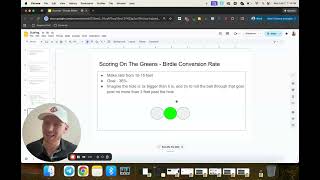
Connor Stirling Peterson teaches how to improve birdie conversion from 10 to 15 feet. Scottie Scheffler hits 36% of these putts for birdies. The drill: visualize the hole three times larger and aim to roll the ball through a gate extending three feet past it, treating near-misses as successes.
Chapters
All right, so let's talk about scoring on the greens, specifically with birdie conversion rate, getting your birdie conversion rate up. Now, odds are this is not going to be something that you need to worry about until we've pretty much shored up every other thing in your game, but I just want to make sure that this is documented here. So this is really going to be your make rate from 10 to 15 feet. A high-end goal is 36%. 36% is excellent. Um, for context, Scottie Scheffler is making about 36% of his putts from 10 to 15 feet, and his birdie conversion rate is about 36%. The way to do this and make it really easy for you is you have a 12-footer, let's say. Imagine you have your hole, and imagine that you've got— the hole is actually 3 times as big. Maybe you've seen those giant holes on the green sometimes. Essentially, that's what you're trying to do in your mind. And so what you want to do is imagine that hole that's 3 times bigger and just try to roll the ball through that goalpost and have it finish inside of 3 feet long of the hole, right? So if I roll this putt, I'm just trying to get it past the hole, up to 3 feet past the hole, between this little gate here. And if I just have it breeze over the edge, then you don't want to look at yourself and be like, ah, you know, I missed that putt. Just look at that as like, okay, cool, that was a good putt. And if I consistently do that, then I'm going to make my share of ones that just catch the edge a little bit or catch the bottom edge here. And sometimes what you'll be able to see is you'll have days where every single one of your putts actually went through this little gate and you just kind of have bad luck. And that's okay. That's something to be able to recognize rather than getting upset about, just to know, hey, we're going to have some bad days. And that's part of what makes golf so difficult, is there's, there's some stuff that's just up to random chance here. So we can't necessarily control making 36% every single time. Odds are you're gonna have days where you make a bunch of these, and you're gonna have days where you don't really make hardly any. And that's why all the other skills are so important, because when you have all the other skills and this goes well for you, you shoot into the mid and low 60s. And on the days where it doesn't go for you, worst case, you're a couple over par. So hopefully this makes sense. Let me know if you got any comments or questions down below. I will say that this is also heavily reliant on green reading, so we'll almost certainly be talking about Aimpoint if we haven't already, if we're trying