COMPLETE GUIDE: How Junior Golf Scoreboard Rankings Actually Work
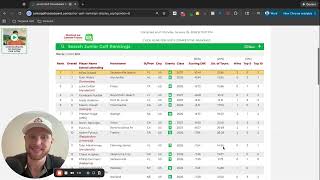
Connor Stirling Peterson explains how Junior Golf Scoreboard rankings work: scoring differential counts for 65%, tournament strength 25%, and finishing position the rest. Focus on class rank and percentiles, not overall rank. Players should wait until they average 77 before entering tougher tournaments.
Chapters
All right, what's going on? In today's video, I'm going to be covering how junior golf scoreboard rankings really work. Um, this is something I talk about all the time. It's absolutely crucial to understand. And one of the things that I find very frequently is that most families don't really understand how it actually works. And so I just want to walk you through it in this video. So I understand if your child is ranked or they want to be ranked, which you actually need to be paying attention to what things you can potentially ignore. Um, so let's go ahead and get right into it, starting with the basics here. So, uh, oh, I should say, you guys enjoy stuff like this, helping junior golfers develop to play Division 1 golf, go ahead, subscribe, leave a like if this is actually helpful for you. It does help push out to the YouTube algorithm and all that stuff. So anyway, I gotta do the mandatory stuff. So, um, there's 3 main things that go into what makes up a player's ranking. So you have the rank over here, um, This rank, largely irrelevant. Um, not really a thing you're going to be looking at, obviously, right? It's a byproduct of other things. I should also just disclose that we really want to be focused on the class ranking, not the overall ranking. If your child is 12, they don't need to be comparing themselves against seniors. That doesn't make any sense. You want to be looking at their class ranking. I'm going to go into more detail on that, but just a quick one right there. So anyway, There's 3 main things that go into making up a player's actual ranking. There's the scoring differential, which I'll talk about, the strength of the tournament, which I'll talk about, and the finishing position. Let's talk about finishing position first, because finishing position— everyone thinks it matters a lot, and nothing could really be further from the truth. Within junior golf, where your child finishes, whether they win, top 5, top 10, is almost irrelevant. Almost. Not 100%. Almost irrelevant. So if you were doing any level of calculus for your child about, oh, well, we need to win this tournament, or we need to finish here, or, you know, we don't want to play in that because that's more— stop. Doesn't matter. I want you to flush that out of your brain, okay? Um, winning LSF doesn't matter. Case in point, second-ranked player in the country has not won a tournament in the last 12 months. Granted, he's come in top 5 3 times. Number 3 player has not won a tournament in the last 12 months. Number 4 player has not won a tournament in the last 12 months. Granted, Miles has won 3 tournaments, so good for him, but it doesn't matter. Okay, moving on. Strength of tournaments. So strength of tournaments is essentially how good the other players are in the tournament that you're playing in, right? So as you can imagine, the US Junior would be very, very high strength of tournament, right? A lot of really great players. Um, now this is not something that you can game in any real way. So you might think yourself, all AJGA is better— probably true, but no guarantees, right? Not all AJGA events are created equal, right? So what this has done is they actually back-calculate how good the player was doing at the time that they played in that event, right? So you can't even look at it and be like, oh, so-and-so is really good, like, I think I'm gonna game the system by, you know, trying to play in this tournament because so-and-so's playing it. Doesn't work like that. You're not able to do that whatsoever. Don't try to. Yes, it's 25%, it's again almost irrelevant, and it's not something you can control, so don't focus on it, okay? So where does that leave us, right? I just told you everything I've talked about is irrelevant. Well, you've got 65% of this judged by scoring differential. Scoring differential is very important. There's other videos on the channel that walk you through how to do scoring differential, how to understand that, um, in more depth. But suffice to say right now, scoring differential is actually the thing that drives your ranking. The easiest way to understand it is scoring differential is that representation that shows us that if you shoot the same scores but you play on a harder golf course, So when I say harder, I mean longer. And when I say longer, typically what that's correlated with is better course rating. That's usually what we mean. Now when we think about that, we're thinking course rating 74, 75, 76. Those are good. Um, for girls, that's a lot easier to find than it is for boys. So boys have to do a little bit more 3D calculus with the tournament selection, but that's different than strength of field where we're trying to play against better players, right? We're just looking for long, hard golf courses, ideally assuming that's the biggest concern for your child, which is not necessarily the case. Just disclose that, right? We're looking at the scoring differential number. This is really what's driving this. Now let me see somebody who— okay, so in this case, this player has a better scoring differential than the player who's ranked ahead of him. He has won more tournaments than the player who is ranked ahead of him. But just in this particular case, This player is ranked ahead of him, slightly lower scoring differential, in part because the strength of tournaments is substantially better at that 21 versus the almost 27 there. Okay, now continuing to go down, it's not necessarily always the case here because we got this example where, you know, this player doesn't have necessarily a lot of wins. Um, point being, there's no real difference between the players ranked 11th and the players ranked 10th. Obviously they're both going to fantastic programs, they're fantastic players. If you're looking at the rankings that closely, you're looking at them too close. Loosely. You don't want to analyze this to death. Um, so that's how the ranking system actually works. Now there's a couple, couple layers deeper that we want to be aware of here. I'm just going to use Miles as an example because I know some of you guys are watching this video and you're like, there's no way Miles is a -10 scoring average, that's insane. And you'd be correct. Miles is about a negative, like, 3.5 scoring average depending on the average par on these holes. Let's go ahead and also look at some of these course ratings. So we're just going to pull out the handy-dandy calculator. So we've got 227.4 divided by 3 rounds of golf, scoring our, um, course rating of 76. Okay, let's look at the 303.2 divided by 4, course rating of 75.8. All right, 20. Next one, course rating of 74.7. 50.8 divided by 2, 75.4, right? Looks like he— yeah, okay, so that's US Junior. That makes sense. All right, next tournament, 76.8. And then last tournament here, 73.6. Ironically, these are some of the worst scores that he actually ended up shooting. Yeah, for whatever reason. So I'm always going to talk about playing longer, harder golf courses. Why do I talk about that? That— because that's what the best players in the country do. And so when I'm coaching a student, I'm just reverse engineering this process and identifying where your child is at in this process, um, and telling them, hey, here's what you need to do, um, based on your current skill level, right? If your child is scoring average of 85, you better believe I'm not telling you, well, you know, the key is playing the Rolex Tournament of Champions. Different approach, right? Now, if your child is already ranked 20th in their class and they're in 8th grade, Yeah, like we're going to talk a lot about, you know, how to position your child so that they're in a position where they can play in some of these invitations. We're going to be talking about what do we need to do the scoring average to be able to get that low enough, or we're going to be able to qualify into these easily, right? Those things start to matter a lot more. It just depends on where you're at. And so the beauty of kind of the way that I approach things, the stuff on this channel that do it, um, that talks about this, is it's dynamic based off of where your child is at, but it's all on this linear curve, right? That there's a curve here. And so there's the end goal, and wherever we're starting, right, we could be shooting 100 or 90, and— or we could be the best player in the country. Doesn't matter, same logic applies, right? So that's one of the really cool things about like doing what I do is I get to work with players at literally every one of those levels. The only things that I don't do is I don't work with just flat-out beginners, right? So if your child's never played tournaments, stuff like that, and they can't go out and shoot around a golf and you don't even know what they're going to shoot That's, that's not my thing. Um, but if this is something you want more help with for your child, there's a link below where you can fill out an application to work with me. Um, and just, it'll walk you through what that looks like, make sure you're in a position where I can help, and then you'll be able to schedule a call, be able to talk it over, make sure that it's a good fit for your child. Um, and just help you understand, like, you know, what's realistic, what's not realistic. I'm not that guy who's going to tell you, hey, you're going to improve by 10 shots in 3 months or something like that. It's not my thing at all. Um, Slow and steady progress, but knowing exactly what we need to do allows us to improve a lot faster than average. Anyway, back into the video. Appreciate you bearing with me on that. So what you're going to see here, you got class rank. Obviously Miles is the best, so he's going to be the best at everything. We also have this thing over here, and this is something that is not really accessible from a front-end perspective. So you guys are not gonna be able to see this stuff, but we're able to see this scoring differential. We're going to be able to see this class rank here. And we're able to see this percentile here. Percentile is the thing that most people don't know exists. Now, why is percentile important? Because if you have a 6th grader who is ranked top 100 in their class, it is not the same thing as being ranked top 100 in their class if they're a junior. So you can't look at that and say, oh well, you know, we're going to be here. At the same time, let's say your child is ranked, I don't know, 500 in their class or something like that. Maybe they're toward the bottom. You still can't look at that because just because you're ranked in a particular position doesn't mean you're going to be ranked in that position forever, right? So if they're really good, let's say they're ranked top 100 in their class, you know, we don't need help, we're already ranked top 100 in our class. You're like, okay, but you don't necessarily know where that percentile is, right? So it's like they could be ranked top 100 in the class but being like the 15th percentile, which is like, it's like, it's good and all, you're better than 85% of the other players, But that's not really Division 1 player. Typically Division 1 is about top 10%. Um, so not only do they need to continue to improve, they also need a little bit of reality check. If you're like, hey, like, I get it, like, you're in a good spot, like, you know, for all intents and purposes you are, but, you know, like, don't, don't be that guy who like dances at the 1-yard line. Like, that's a, that's a dumb position to be in. So we want to see where this is at. And as you can see, obviously, Miles, it's absurd, but let me just, let me go ahead and pull up the 2026 class just so you guys can see it's a little bit clearer. Uh, so let's just go ahead and go to like the third page here. Players ranked like 150, these are all Division 1 players. University of Oregon, right? Negative 3.3 scoring differential percentile, about 4%. It's pretty dang good. right? In theory, I think you can probably find some people are going to play Division 1 golf all the way to this page, right? As, as you guys see this, right? Are they Oregon State or some of these better programs? No, they're still pretty dang good. 8th percentile, right? So pretty solid. And so there's a spectrum on this, as you can see, right? Um, but long story short, when we're trying to understand how does Junior Golf Scoreboard and its rankings really work, we need to stay focused on scoring differential. If we can get the scoring differential where it needs to be in the right timeline, June 15th, sophomore year, we're gonna have a good time. We're gonna have coaches reaching out to us. We're gonna have options. As you can see, these players are getting recruited, you know, for the most part. I mean, even all the way down, these are ranked 300 in their class. These players are still getting recruited. That's a great thing to see. As we go further and further up, more and more players are being recruited. Um, now obviously Disclaimer: grades also matter, right? Not everybody has, you know, done their thing yet, but all things considered, that's really, you know, what the stuff looks like. So scoring differential, what we're going to see— I'll kind of show this and then we'll call it a video here. You can see in general the best players in the country, right, we've got lower scoring averages, under 72, a lot of the time under 71, but definitely under 72. Longer golf courses. They're essentially maxing out the hardest golf courses they can possibly play. Only other room to do is just lower the scoring average. So if you look at the guys on the PGA Tour, when they have a scoring average of 68 or 60, you know, 69.5, um, or 69, 68.5, um, they're all playing the same golf courses, right? You know, it's just a very extreme high level of golf, right? There's, to a certain degree, there's like a little bit of a running system, right? If you're playing the Barracuda, it's different than if you're playing in the Memorial. So there is a little bit of a regress in scoring even at the highest level. But again, for the most part, they're just competing on scores, right? You can't compete on tournaments. For junior golfers, you can absolutely just play some Mickey Mouse golf courses and have a scoring average of 69 and have a zero scoring differential. Not necessarily what I recommend, not really what the best players do. And let's go a couple, couple pages deep. You guys have already seen Miles at, you know, 69.5. Look, let's look at some of these other ones. So similar scoring average, golf courses aren't quite as hard. Let's go a couple pages back again. Another one, similar scoring average, golf courses are much easier. So you can also see, again, if you wanted to, higher scoring average, harder golf courses. So if you're looking at this and you're saying, okay, well, what's the best, best thing to do? Well, there's no one-size-fits-all. But all of these, as you can see, correlate back to scoring differential. So the key here is knowing, hey, we're playing in the right tournaments and we're bringing the scoring average down over time. We know where that's at, we know where we're at relative to that, and then we're consistently improving at a rate that'll have us being recruited at a scoring differential that makes sense. So hopefully this video is helpful. Hopefully this enlightened you on how Junior Golf Scoreboard actually works and where you need to put your focus. So forget about strength of tournament, we're trying to game any of that stuff. Forget about where their, your child's finishing. You just want to be focused on where we shoot in tournaments, are we playing in the best tournaments possible. As a rule of thumb, you do not need to think about playing in harder tournaments until your child has a scoring average of at least 77 in tournaments. And when I say average, I mean you actually track it and you can say average, it's 77 or it's 76.5, right? That's, that's really what you want to be looking at. Until then, all the meat is on the scoring side of things. It's going to be on Being able to figure out why do we shoot the scores we shoot. I've got other videos on the channel that go through that exact thing, um, but it's just been bringing the scores down. After that, you can start to do them, you know, at the same time. We made tournaments harder, keep the scores about the same range, maybe improve the scores a little bit. But that's really what the focus should be. Once they're in a 72 to 74 scoring average and they're playing about 7,000 yards on average, we're going to be in a really happy spot. So that's kind of like the long-term target. Obviously, if you want to be one of the best players in the country It's a little bit of a different game, right? We have to get even lower scores, we have to play even better tournaments. Same logic applies though. So hope this video is helpful for you guys. Um, more stuff like this on the channel if you want to go check that stuff out. If you guys did enjoy it, go ahead, leave it a like, and I'll see you guys in the next video.










