Connor Stirling Peterson breaks down golf scoring into five independent skills: tee shots, approach shots, putting, chip shots, and bunker play. Each maps to specific stats that determine your average score and consistency. Improving your worst rounds, not chasing one low score, gives you the most leverage to lower your average and play more consistently.
Chapters
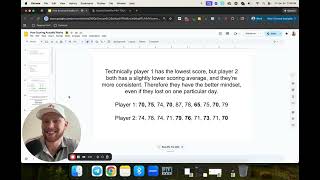
All right, in this video I'm going to be covering how scoring actually works. This is something that is absolutely crucial that you understand. This is something I'm going to reference a bunch in the future, so I highly recommend you get out a notebook, pen and paper, so you can take notes. I will have a quiz at the end of this module because I really want to make sure that you're grasping it, and if you're not grasping it I want to make sure that we see that and we're able to address it and make sure that you can understand what I'm saying here. So first and foremost, scoring is just a collection of skills. What do I mean by that? Your ability to take a good tee shot and your ability to make a 3-foot putt are both required for you being able to shoot good scores, but they're not related at all. You could have terrible tee shots and great, you know, make great from 3 feet. You're gonna have trouble scoring, and the flip side could be true as well. So it's really important we're talking about helping you improve and progress, that we're focusing on the development of those skills rather than the scores that you're shooting. You want to interpret the scores that you're shooting through the context of those skills. Now, those skills are going to produce an average score. Just your particular combination of skills can produce an average score, and you're not going to shoot the same score every single time. There's going to be inconsistency in those scores, and that's what I'm going to refer to as your consistency or your mindset, whereas your average score is more so who you are as a player and your overall skill. Now, the skills in golf essentially are the tee shot, your approach shots, your chip shots and kind of bunker shots, your lag putting, your short putts, your middle distance putts, and your recovery shots. That's about it. Now, these are the stats that apply to each one of those. So off the tee, it's a penalty rate issue. Approach play for the most part impacts greens regulation, although if you're playing very, very long golf courses, then approach and greens regulation can be impacted by how far you hit it off the tee as well, which is another statistic we'll be tracking. 3-putting is mostly impacted by lag putts, so putts outside of 15 feet, how close that second putt is, and your ability to make that second putt. The reason why that's so crucial is you're— if you hit a bunch of greens, you're going to hit, you know, balls to 40 feet, 30 feet, 50 feet all the time. If you're able to consistently lag those inside 10%, which is generally the goal, and you're able to make those putts inside 5 feet, then you're not going to 3-putt very often. Now, middle-distance putts, putts from about 5 feet to 15 feet, are makeable, but they're going to impact your birdie conversion rate more so than 3-putts. If you leave yourself a lag putt to 7 feet, if you miss that 7-footer, it's, it's not because you're bad at making 7-footers, it's because you had a bad lag putt. For those 7-footers though, if you start making more of them, typically what'll happen is your scrambling will improve, your birdie conversion rate will go up, and you know, that's something that we tend to deal with later in, in your game's overall development. You'll see all the way at the bottom here, compound errors are typically going to be related to recovery or chunking or blading your chip shots, leaving balls in the bunker, stuff like that. And all of those produce an average score, which you can see in the middle here highlighted. And you can see here between Tiger in 2000 and Scottie Scheffler, you can compare the two of them. So you could say Tiger objectively had better approach play. They have pretty similar scrambling, pretty similar, uh, 3-putt rate, although you could say Scottie might be a little bit better there. Almost identical birdie conversion rate as well. So very similar sets of statistics. Tiger was slightly better on his average score because he hit slightly more greens. Now you don't shoot the same scores every single time you go out there, and sometimes the gaps between scores are really, really big. And that's what is essentially your consistency. The technical term for this is standard deviation. So standard meaning average and deviation mean difference. So plain English would be average difference. Consistency or standard deviation is how we describe how different your scores are. So players with a better mindset shoot scores that are more similar to each other. So we've got Player 1 here who shoots 70, 75, 74, 70, 87, 78, 65, 75, 70, 79, and player number 2 shoots 74, 78, 74, 71, 79, 76, 71, 73, 71, 70. Now, which player has the better mindset? Technically, player 1 has the lowest score, and technically you could even look at this and say, well, they have one tie, and player 1 won 5 out of the 10 rounds that they actually played if they're going head-to-head in these numbers. But player 2 has a significantly lower average score— sorry, Player 2 has a slightly lower average score, and they're more consistent by a pretty substantial amount. Therefore, they have the better mindset even if they lost on a particular day. Now, Player 2 is also objectively better even though they would have lost in this randomly generated 10-round match. Their average score is better and their standard deviation is better. So why do they lose? Well, it's because if this is just like a random sample of 10 rounds of golf, and you can flip a coin that you know has a perfect 50/50 chance of coming up heads or tails and still get heads 5 times in a row, it doesn't mean you have a broken coin. It means you have more— you need to flip the coin more times. So in the same way, when you're looking at your rounds, you really want to be focused on those core things. What's my scoring average and how big is my variance? Don't worry about anything else. This is why you can't judge your game based on one round. This is why we plan out all the tournaments and we go play them. We don't judge them on an individual basis. We can learn lessons from them, we prepare for them, but we don't make big picture judgments based on the outcome of one particular tournament. This is why I say you can't win, or at least say I want to win this particular tournament, right? That'll just happen, but you can't do it intentionally. You can say, I want to lower my scoring average, develop my skills, or I want— can say I want to improve my consistency, which would be lowering your standard deviation. So this is a display of the scores that you're going to shoot. About 70% are going to happen, give or take your average, based on your standard deviation or your consistency. So within one standard deviation, you're gonna hit about 70% of your rounds. And then the other 30%, 15% will be better, 15% will be in the worst. So you can think of the average score as your skill and your consistency as your mindset. These are all your scores included. These are your worst scores. And when we're trying to bring your scoring average down, really one of the highest leverage things that we can do is just get rid of your worst scores. And because that resets your— all your total scores, right? So it shifts your average in a positive direction here and makes your game more consistent, and your scores will be lower on average. So that's why golf's a little bit counterintuitive here. If we only cut out your worst scores, the rounds where you essentially quit because you weren't going to shoot what you wanted, will both improve your consistency and your scoring average. So big takeaway here, your opportunity to be more consistent and lower your scoring average is in your worst rounds, not in your best rounds. You don't wanna be going out there chasing, say, hey, I wanna shoot my best round ever. Once you realize the train is off the tracks, to the degree that you're able to manage that at all, is where you're going to be able to demonstrate more consistency. And the way that you do that psychologically is focus on each individual skill and performing those to the best of your ability rather than focusing on whatever your overall score is. This is a fundamental thing. I'm sure I will go back to it in the future and talk more in depth about mindset, but this is fundamentally what you need to be doing. So the good news is better players almost always have lower standard deviations. They're more consistent. So not, not really that surprising. So here's an example. Miles Russell, best player in the country. His overall average is about 69.5, standard deviation's about 2 shots. Even the most recent rounds, a little bit worse, standard deviation's a little bit better. And so, you know, again, makes sense. Second best player in the country right now, scoring average about 70.9, standard deviation's a little bit bigger than Miles. As of recently though, his scoring average is a little bit better than Miles, and his standard deviation is also a little bit better than Miles. A student that I worked with a few years back got recruited to UCLA. His overall average, 71.97, standard deviation of plus or minus 4.5. And his last 10 rounds, 71.1, standard deviation of 3.48. Okay. Same thing. Now I want to also show you this principle in action. So this is one of the students that I've worked with this past year. And prior to working together, he had a scoring average of 74 roughly, and a standard deviation of 9.5. After working together, which we have this little line here, he's got a scoring average of 71.2 and a standard deviation of 3.38. So again, we see an improved scoring average. and we also see an improved variance in the round or more consistency that also brings those scores down. So fundamentally, your scores are your skills, and your school skills can be represented in statistics. And so when we make a change to your practice or your strategy or your mindset or your mechanics, that's going to fundamentally change that skill, which is then going to be shown in your statistics, and then that's going to change your scores. It's really important that you wrap your head around the way that this process works. In all the videos below, I'm going to cover what each skill needs to be able to do and what we need to try to do strategically to get the most out of it.










