How To Warm Up For A Tournament
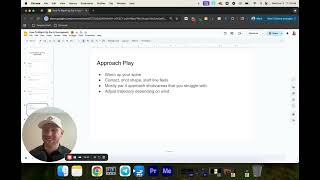
Connor Stirling Peterson breaks down a 15-20 minute pre-tournament warm-up for junior golfers in four phases: putting with mirror drills, short game with carry distances, approach shots with one consistent shot shape, and tee shots focused on contact and safe lines. A structured routine beats long unfocused practice when range access is limited.
Chapters
All right, what's going on guys? In today's video, it's another one per request. So once again, if you guys have any video requests, go ahead and put yours below in the comments here. I'm going to be covering how to warm up for a tournament. So maybe your child is out there and they're used to grinding on the driving range, and now they're in a tournament and it's like, well, do we need to get here 2 hours early, or is there something else that we could be doing that is maybe a little bit more effective and efficient? So that's what I'll be covering in this video. If you're new here, that's all we talk about is helping junior golfers, you know, excel at the highest level, specifically play Division 1 golf. And at the same time, um, if you're a returning subscriber, welcome back. It's gonna be a fun one. This is, like I said, requested. So if you got requests of things you want me to cover, go ahead, let me know below. This channel is really here to serve you guys. So, um, you know, I'm not chasing anything that's like viral here. I just want to give you guys really concrete, helpful advice for for junior golf. Obviously, um, there's a limit on how much I can do that, but I'm just speaking in generalities. If this is something that you want more direct support with from me, um, then there is a link below where you can apply to work with me directly and have me tell your child literally what to do on all this stuff. Or in some cases, maybe you just need a little bit of help with tournament schedule, stuff like that. There's also a link for that. So anyway, let's go ahead and jump into this video. So when we start off here there's 4 main parts of our game. Um, this might seem pretty simple, but if you really think about it, if something needs to be super complicated, uh, it's going to be very difficult to execute, especially when we're talking about trying to get kids to execute on this stuff. Um, so that's just kind of foundational. These things should be simple. And so, you know, let's kind of go through them. So I would go through things in this order, right? I would start with putting for a few reasons. Number 1, smallest movement, right? Um, it also tends to be the easiest to get out there and do. Right? So if you go play an AJGA event, you guys might know, typically there's a lot of people on the driving range, a lot of kids trying to figure out their golf swings. Not necessarily the thing that you want here. Um, that's the other big reason why this can be so valuable, is if you have a super long, uh, warm-up session, it's gonna be really, really difficult, um, to get consistency with that, especially in the bigger tournaments where it's like there's just not as much accessibility to, to the driving range, stuff like that. So anyway, start putting, then move on to short game, approach, play tee shots, in that order, right? T shots are last. Why? We're going to the first tee once we're done, right? So we want to kind of match this up in a way where we're going to be able to get through the stuff in a reasonable time period. Now, first drills I like to start off with: putting. My drills that I do in practice are a little bit different. I'm not going to be going into those. This is just specifically for the golf course, um, or for a tournament. So first one here, mirror drill. I'm a really big fan of using a putting mirror. Ideally, they can show your eye line and your shoulder line. That way we have consistency in our setup. And so, you know, we're just moving the putt, you know, the putter pretty consistently based on how we're setting up, right? We want to make sure our mechanics are solid. Um, this is something you're going to see pretty stock standard even across the PGA Tour, right? A lot of the guys are going to be warming up with, you know, training aids on the putting green, right? That makes a lot of sense. Just make sure that our basics, our most fundamental movement here is solid. That makes a lot of sense. I like to set up this putt from 5 feet. Ideally, this is a straight putt. You play this a little bit breaking, to be, to be fair, but I prefer straight just because if it's breaking, you might have some tendencies or some compensations that you make within your putting stroke. First, if you know this putt's flat, um, you can just aim your putting mirror straight into the back of the hole and you should be able to make all these pretty much no problem. I like to make 10 in a row. I don't like to put this— push this too high. The real point here is just have a little bit of confidence to be like, all right, cool, like, my putting stroke is solid today, let's move on to the next thing. Right? That's really the point of this. Shouldn't take you more than like 5 minutes, should be pretty quick. Next thing here, speed calibration. I see a lot of people do this thing where, you know, we get out on the putting green, we hit all these like random putts. In my opinion, that doesn't really help us much at all. I don't think your brain's retaining a lot of that information once you get to the golf course. Uh, you got anxiety, you've got adrenaline, right? You're amped up. I mean, it's not going to have that much carry over here. So what I recommend doing instead is kind of mapping out the length of your stroke and saying, okay, cool, well, if I take this putter to let's say my trail full foot and just finishing that stroke, right? So I take it back and, you know, carry it all the way through. How far does that putt roll out, right? That's going to help me calibrate a little bit better, presuming this green is, you know, pretty similar to the golf course. So let's just say for the sake of this example, take it back to your right foot, hit that putt, it's kind of like whatever your normal tempo is, and it rolls out on a flat surface, rolls out 20 feet, right? You get to the golf course, you do the same thing. Let's say you have relatively similar putt, right, where it's just like it's flat-ish. Do the same thing, goes a little bit shorter. Okay, cool. Now you've got essentially calibrated on that golf course. Granted, every green could technically be different, right? So this isn't, you know, constant. Let's just say, um, for the sake of this, do we have a general sense now of how fast the green is relative to how far we take our stroke back, right? So hopefully that makes sense of just how by using that information we can kind of say in the same way as like, hey, if I take a full swing, it goes this far. If I take a 3/4 swing, it goes this far. Same thing's true with the putter. It's like, hey, if I take this putt back to my right foot and hit it, it goes about this far. So if I have a putt that's, you know, let's say rolled up 20 feet, just to keep the example simple, if I've got a 30-foot putt, I know that I'm going to have to take the putter a little bit further back than my trail right foot in order to be able to get that putt to the hole, assuming it's a flat surface, right? If I'm putting downhill, obviously change things. But again, this is just to give the player's initial feel how fast the greens are. We don't want to just push in a bunch of information about just like a bunch of random putts and think that's going to translate really well to good lag putting. Makes a lot more sense to say it's like, hey, I've got my 20-footer, maybe I take it a little bit further back, figure out, okay, now I've got my 40-footer, right? This is something that can realistically be done in 5 minutes as well. It's not going to take a ton of time to figure this out, and I think it's a lot more effective, uh, use of your speed calibration. Same thing's true for— it's like if you've got a 10-footer, it's like it's probably going to be shorter than that trail right foot, right? You know, maybe it's half the distance, maybe it's somewhere in the middle there. Um, those are all things you want to be considering there. Um, the third piece here is I would do your Aimpoint calibration. If you do Aimpoint, this is a great thing to spend your time doing because you're going to need to change your armband. And if you're like most junior golfers that I've ever talked to, you're probably not routinely updating your Aimpoint calibration. So you should do that. Um, something that realistically takes maybe 10 minutes, but just making sure like how your armband's correct. In order to do that, you're going to have the right— have to have the right number of inches outside the hole per the stimp. Um, and whatever the slope is, you're gonna have to have your level ready. Um, if you don't do Aimpoint, then, you know, you just stop with the first two because, again, making sure our short putts are going to go in and our speed's decent, right? That's the majority of what we're going to be concerned about on the golf course unless you're shooting in like the low 70s on average, which is probably unlikely. So anyway, and if you are doing that and you want to make more putts, this is what you need to be doing. So figure it out one way or another, but you want to figure out the calibration from 6 feet and 15 feet because they're a little bit different, um, when you're standing at the ball, when you're standing a little bit behind the ball. So I'm not gonna aim point class here, but that's kind of what that looks like. All right, short game. Once you've got your putting sorted out, right, we don't have some crazy long putting routine here. We're not trying to get mentally gassed already. We're trying to make sure— I mean, like, yep, I can make my short ones. Yep, I have a decent understanding of what the speed is going to be. And now I know what my armband needs to be. You know, if I get there on the golf course, it's a little bit off, then you know how to adjust your armband, right? It's like, you know, if it was a little bit faster, then We're gonna scoot the arm end in just a little bit. If it's a little bit slower, we're going to let the arm out a little bit. Again, not aim point class here. Once we get to short game, we want to be able to carry the ball specific distances, right? So we want to be able to look at, okay, from just kind of a stock standard lie, can I carry the ball 5 yards, 10 yards, 15 yards? So something really big fan of in practice. But when we think about short game, right, there's a distance we need to carry it and there's distance that's going to roll out. We want to know those two numbers, right? And how we're going to do that, right? If you're just looking at it and you're like, I hope that I carry this as far, it's gonna be really difficult to do that when under some amount of pressure and you've got some adrenaline here. Versus if you're able to control this effectively with different things, you know, how you set up the ball, how far back you take the club, those sorts of things, a little bit easier to moderate this stuff. So 5, 10, 15 yards, really the numbers I like to see. And then figure out how much those rolls out. Um, typically you're gonna probably figure that out more in the practice round than you would in your warm-up, just because a lot of times the short game area kind of sucks, or you don't even have a short game area, you have to do this on the driving range, right? So anyway, but those are really things you want to know. So how far am I carrying the ball and how far is it rolling out? If you're missing the green and you've got like 20, 25, 30 yards to the flag, it's pretty bad miss, honestly. Like, the main thing you need to be worried about is just get the ball on the green. And if you're like, hey, how do I score better? Hit more greens, you know, like don't, don't miss the green by such a large amount. So it's like, if you're looking at overall practice, where do I need to put my attention? Odds are it's that rather than some of these shorter numbers. I think short game is probably the most overrated part in in every player's game. Um, everyone thinks, oh, I can get up and down all the time. It's like, you're not going to have a scoring average of 72 and 50% of your greens trying to get up and down all the time. Like, just, it's way too stressful, and the math just doesn't really work out. You need to hit a bunch of greens if you want to be able to shoot low scores. So that's why I just don't put a high value on this. Bunkers, you can hit a few if you need to. Realistically, you're not going to have more than maybe a couple bunker shots unless you're just hitting bunkers left and right. Um, and there's also not a whole lot of carryover between, like, you know, the practice area and on the golf course. That's just, you know, kind of been my experience. Can you hit a few? Sure. Does it probably— is it probable to have a big impact in a round? Not necessarily, unless you got some like wildly like strange sand or something like that. So you might hit a few just to figure out like, excuse me, what the sand's like. But yeah, that's about it. All right, cool. Moving on to approach play. Um, first thing here, it's a warm-up, right? So we want to warm up your spine. Um, first few balls you're gonna hit, you're probably gonna hear your spine crack, or maybe I just feel that because I'm getting old. Um, main things you want to be evaluating here: contact. Contact's most important. If you hit it fat or thin, none of the rest of the stuff matters. So contact. Shot shape's the next thing. I'm a really big advocate of one shot shape. Why? Because it makes it easy to aim, right? That, that's like fundamentally the easiest thing. Um, there's other input, um, other things that are impacted as well, but it's like if you're hitting a fade, you're aiming wildly different compared to if you're hitting a draw. right? Just in general, right? So if you struggle with aiming out on the golf course— parent who's watching this, if your child struggles out on the golf course trying to work the ball both ways, that's probably a big reason. So moving to one shot shape makes life a lot easier, right? If we know every single ball is going to fade or every single ball is going to draw, makes it very easy to aim left or aim right to account for that and say, hey, if I just make a good swing, this ball reasonably solid, starts in kind of a decent line, I'm going to have a decent outcome. right? So that gets a little bit in a shot patterns of understanding that, which again, it's not really what this video is for. Um, but just one shot shape, you know, so we knew he hit a draw, it's like we're hitting them, they're drawing, we're hitting them solid, kind of starting a reasonable line, great. If they're not, then we want to have the corresponding feel to fix that, right? If we're overdrawing it or the ball's starting too far to the left, we want to know what are the feels that I need to have to start the ball a little bit further out to the right. Now, to be fair, one of the things that I've kind of noticed, sometimes if your child is not able to find those feels to make those adjustments, there's a good chance they got some issues in their golf swing, right? They could be very timing dependent. Um, typically I see this with kids who have a lot of early extension. Maybe they just lift their arms up, you know, straight up behind them, and instead of getting any amount of depth, right, they just lift their arms up, they pull the shaft down, then they have to stand up and early extend. Um, in that case, it's going to be very difficult for that player to have any type of, you know, consistent repeatable shot pattern. And so sometimes that's a case where, you know, there has to be adjustments made within their golf swing. And so obviously when I'm working with a student, that's something I'm overseeing. It's not the main thing that I really focus on, mostly because I think a lot of players get carried away with golf swing mechanics, whereas they, you know, should be more focused on some of the other things that go into being able to play well. But nonetheless, that's one of those things that is definitely important here. So moving on here, par 4 approach shots. Um, these are the primary clubs that your child needs to be hitting on the driving range when they're warming up. Right? So, you know, unless they're consistently hitting terrible wedge shots— and by terrible I mean they're not hitting the ball solid, like they don't have good contact, or they're missing the green with like from 70 yards or something like that— odds are they should be spending their time on the shots that they're going to have the most. The reason I say the shorter numbers is because on par 5s, most of the time your layup is going to give you something like a lob wedge, right? So if you can't hit the lob wedge on the green, that's a problem. You need to make sure that that's club. But for the most part, like, we're probably pitching with a 9-iron, 8-iron, 7-iron into our par-4 green, something like that. We want to make sure that those clubs are just the clubs we're comfortable hitting, right? We have a decent idea of how much those are curving. We feel like we're hitting them solid. That way, when we go to the golf course, guess what? We're hitting the exact same shots. There's a lot of carryover. And if there's like weird scenarios, we still have some, some concept here. So for example, if I'm hitting a fade, I know I'm hitting a big fade out of the driving range, then I get on the golf course, my first shot, ball's above my feet, Well then I know I'm gonna kind of have a tendency to, you know, at least neutralize that a little bit. So the player can be like, well, I know the ball's gonna go left some amount, let me aim like right side of the green and figure out what happens here, right? Like maybe I miss it right and it still fades, maybe it draws a little bit, maybe it kind of hangs, hangs left and then just goes straight. Um, yeah, they can start to figure those things out because they have the stability on the driving range of whatever they're trying to do. Versus if you're trying to hit 16 different ball flights and you got on the hole and it's like well, you know, I got wind off the right and I got a ball up on my feet. It's like, you don't know where that's going to go. Like, you don't even know how to aim for that particular shot, right? So, um, par 4 approach shots, the main thing you guys want to be concerned about. Par 3s, kind of a crapshoot, to be honest. It's like, you got 4 of them. If you get 2 of them in regulation, like, it's pretty dang good. A lot of times you're going to have some, some of these that are going to overlap between the par 4 distances. You're not just going to have crazy long par 3s all the time. Um, and so in that case, like, if your shot can just hit 2 of them and then the other 2, they just, you know, miss the green, and worst case scenario, they make bogey, it's not gonna be a big deal. You know, that's not too much of a problem. Um, adjust trajectory based off of the wind. So if it's windy, which, you know, if you look out and you're like, huh, it's windy, it's windy, right? If you don't feel anything, that's— it's probably fine. But especially if it's, you know, windy, we want to be playing the ball down on our approach shots, right? So this is taking more club, shorter golf swing, potentially scooting the ball back in the stance— not necessarily, but sometimes. And trying to have shorter, kind of like shorter swings, more of an abbreviated kind of Tommy Fleetwood follow-through, or keeping the ball a little bit lower on our approach shots. It's really what we want to do there. All right, cool. Last one here, off the tee, contact shot, safe start line. You guys are probably seeing a theme here. This stuff's important, right? If we're not hitting the ball off the middle of the face, we're gonna have a bad time, right? Like, good luck having any consistency if you're hitting all your tee shots uphill. So that's thing number 1. Thing number 2, again, shot shape tells you where you're gonna aim, right? It's like you want to have one consistent shot shape. You do not want to be changing that. If you are a player who fades the ball and you're out on the driving range, you're drawing it, you need to figure that out. Like, that's a problem, right? Hopefully you're not changing your ball flight wildly on a regular basis, and so that shouldn't be too much of an issue for you. But if you're trying to hit a 10-yard, 15-yard fade off the tee, which is about what you should be trying to do, and you're hitting a 5-yard draw, that's a problem. You figure out why. And the easiest way to look at that is like, okay, where's it starting relative to my stance? You know, if it's starting left, okay, what can I do to get this clubface a little bit more open so that I can hit a little bit more of a fade? Hopefully that makes sense. Once again, if it is windy, you probably want to tee the ball down just a little bit, right? So if you don't hit the ball particularly high, this might not be as much of an issue for you. But for those of you who do hit the ball high, um, I'm going to call high anything over you know, 100, 110 feet in the air. Um, so that, that's probably, you know, high. 140 is very, very high. Um, under 100 I'd say is kind of normal, like 90 feet is probably closer to normal. Um, so if you're in the high category here, we definitely want to tee the ball down just a little bit. Yes, we're going to lose some distance, but if we're playing in the wind, our first concern is find the ball reliably off the tee, not hit it as far as possible, right? So one of the things I see junior golfers kind of mess up is they think, oh, I just want to hit the ball as far as humanly possible, so I can't tee it down because, you know, I'm gonna distance. That's fine, but hitting it 10 or 20 yards farther on average does not account for, hey, I've got an extra 1 or 2 penalty balls per round. That's going to be a problem. So again, we want to prioritize keeping the ball in play. If our greens regulation takes a little bit of a hit, which is the real impact of having a little bit less yardage off the tee, then okay, fine, it takes a little bit of a hit. But your greens regulation going down 5 or 10%, you know, maybe you lose a shot, or 2. But if you're playing in difficult wind conditions, it's not really that crazy. That's not so— that's surprising. Um, so these are the main things that I recommend doing. Um, so if your child is kind of like confused about what they need to do as far as, you know, a pre-shot warm-up or a pre-round warm-up when they're gonna go play around golf or they're gonna play in the tournament, this is what it really— what I recommend. So starting off with putting mechanics, speed calibration, then we get into short game. They always make sure we've got our par 4 approach shots solid. Um, we're adjusting trajectory based on the wind. We got our tee shots and go to the first tee. So all in all, In theory, you can run through this in about 15-20 minutes. You can take longer if you take more on the approach shots and maybe a little bit more time, um, on the putting. But I don't necessarily recommend here that we spend tons and tons of time in our warm-up and expect that that's going to translate, right? If you wanted to do that, I would challenge you to measure it, right? Hey, if we have a 2-hour warm-up session, does that get better results than if I just did this and it takes me 20 minutes? If it does, Fantastic. You know, do what works for you. Um, I'm just here to kind of say a lot of the time when players get into these 2-hour practice sessions, what ends up happening is they get in practice mode and then they don't always figure it out. Or a lot of times they don't figure it out. They get to the first tee and they're still in practice mode and they can't figure out, you know, what's going on. It's just a chaotic mess versus this allows you to go in there, have an agenda, say, hey, here's the shots I need to be able to have. All right, let's go play. In the same way, it's like you're gonna go build something. I have to build stuff around my house, right? It's like, well, if I don't have, you know, my drill and the right little bits and stuff like that, like, I'm gonna have a bad time, right? It's like I can't take a, you know, different kinds of like drill bits and like try and make them work. Like, I could, but, you know, again, if I don't have one of those tools, it's gonna be a real problem. At the same time, it's like you get those little, um, for lack of a better term, like, I'm not big on construction, obviously, um, as you guys can kind of see here. It's like you get those big tubs, just like all sorts of like different drill bits and, you know, this and that. It's like a bunch of that stuff's not even useful for you. It's not even necessary. It's not relevant to your thing. And this— it's helpful to look at golf in the same way, right? We need to pick tools we're going to have to use all the time. Everything else we can kind of just lay on the side, right? So as long as we've got our little toolkit that we need, we're going to be good enough to go to the first tee and figure it out from there. All right guys, hopefully this video makes sense. If you enjoyed it, go ahead and leave it a like, um, just help push it out to more people in the YouTube algorithm. If you're new here, go ahead and subscribe. Um, this is the stuff we cover every single week. So I hope you guys enjoyed it, and I'll see you guys in the next one.










