My Junior Golf Development Framework
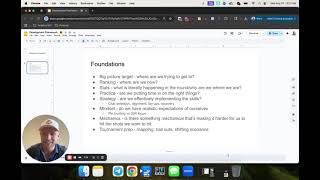
Connor Stirling Peterson outlines a junior golf framework covering goal-setting, stats tracking, practice design, course management, and mindset. He argues mechanics matter less than identifying weaknesses through scoring data and drilling to fix them, and recommends infrequent coaching sessions focused on strategy and mental game over swing fixes.
Chapters
All right, what is going on guys? In today's video, we're bringing back the presentations here, at least for, for this one. I'm going to be going through my junior golf development framework, and I wanted to make this video because I've kind of made myself in the space, um, very much the data and practice guy. And you know, to be fair, I think that that's, you know, well-earned. That makes a lot of sense. That's something I absolutely do focus on. That's something I think that most people really don't, you know, put together at all. Um, that said, there's a lot that goes into this that isn't just practice, right? And so it's also not mechanics either. Um, and so it's important that I clear up for you guys where your child actually needs to be focusing on, how all these things fit together from a development perspective, not just from a recruiting perspective, yes, but also just from a general development perspective. These are the things that they're going to need to have, um, in order to be successful. They're going to need to be able to put all these things together. So It's gonna be a good one, guys. Welcome in, excited to have you. Let's go ahead and dive right into it. So this is something that I presented on this past Monday on the normal weekly coaching call that I do with my students. Obviously I'm going in a lot more depth within that context, and I'm also going to be going into each one of these specifically over the next few weeks. So if that's the kind of support you want for your child, or if you want to go deeper into these things for your child and you also just want help with everything goes into this and just to be handheld through this process, I've got an application link below where you can learn more about what I do. And if you're qualified, then you'll be able to book a call into my calendar. So anyway, let's go ahead and jump into it. Thing number 1, what's the target? Where are we aimed? Because if our goal is just get better, right, like it's, it's that old like thing where you, you cover your eyes and like throw a a dart at the wall and then you just go over to like wherever the dart lands and you like circle it. And that's not a great strategy, especially when you have higher and higher level goals. You know, it's okay if you're like just starting off at golf and you've never worked hard at it at all and you just go out there and work hard. It's like you're gonna get better pretty much by default just because you're gonna, you know, there's just so many opportunities. But when your child gets into what I would say is kind of like the most common plateau, you know, the hard work plateau, somewhere around kind of like mid to high 70s, low 80s depending on kind of like their natural intrinsic skill and like how far they hit the ball, um, they're eventually going to hit that roadblock and they need to be a little bit more sophisticated with the way that they're approaching things. It's not about putting in more hard work, it's about putting in the right work. It's about focus, being focused on the right things. So big picture target, where are we trying to get to? Are we trying to play Division 1 golf? Are we trying to play at, you know, an LSU or an Auburn or Stanford? Are we trying to play Division 3 golf? Are we just trying to get, you know, better at golf in general, right? We want to be able to define that clearly so that we have a target we can measure our progress based off of. Because, you know, if I was working with a PGA Tour player, it's not realistic that they're going to get a shot better per year because they are already so good. It's like they got better by like a quarter of a shot, like that'd be fantastic. And that'd be worth literally like hundreds of thousands, if not millions of dollars for them. Um, but comparatively for most junior golfers, the average player I work with improves by about 4 shots per year. And that's compared to the average junior golfer on Junior All-Scoreboard that improves by about a shot. And most of that's because they hit it further, right? So all these things are relative to, to where your child is at and relative to whatever their goals are. It's a big part of how I'm able to model out, um, based on this kind of next piece, you know, what's realistic for a player, because I'm not ever going to sell anyone on aspiration, right? I firmly believe that we should set big targets because You know, in, in most cases, we kind of underestimate the amount of work and focus that's required to achieve any goal. And so it's better off that we set a really big goal. So if we fall a little bit short of that, we're still getting a pretty good outcome. Um, as an example, the players who typically play elite-level Division 1 golf, they want to be professional golfers and they want to be really good professional golfers. The players who end up playing, you know, let's just say mid-tier Division 1 golf, maybe they aspire to have like those really good programs. Maybe they aspire to play professional golf more broadly. Then you have players who aspire to play Division I golf, but they don't really care that much. Those end up being Division III players. It's like, there's kind of— and the players who are just like, well, let me just try and get Division III, they're probably not gonna end up playing college golf, right? So it's, it's just understanding, like, targets are a big part of how we set, you know, expectations for ourselves, and that's really, really important. Ranking's number 2. Ranking is important not just because It's a way for coaches to see, you know, your child, which is great. You know, that's definitely true, especially when you get to like June 15th, sophomore year and beyond. It's important, but it's more important. It's more value valuable because it allows you to see where they're at in an objective sense. So if you just go out there and like, God forbid, you're not even tracking your statistics or your child's not tracking their statistics, they just go out there and they play random golf. One day they shoot 67, one day they shoot 83, one day they shoot 77. It's just chaos. You know, one day they feel like they're hitting it good, or one stretch time they feel like they're hitting it good. Another time they feel like they're struggling. Maybe they feel like they're going, playing good, and then they get into a tournament, they struggle. It's like, it's just chaos. And so that's not very helpful because if any of you guys have experienced this, you probably know your kid goes out there and shoots 69 with their friends. All of a sudden they think that that's who they are as a golfer when the last tournament they played in, they shot 77, 78. And it's like, we want to make sure that whatever our expectations for ourselves are, are tethered to reality. So the example I like to give on this, let's say a PGA Tour player has a scoring average of 70, which, you know, it's probably a little bit above average. Let's say they go out of their home course and shoot 59, which is very plausible for a PGA Tour player to do. They go into a PGA Tour tournament and they shoot 69. They shot 10 shots worse. Or should they be pissed off? In my opinion, no, because their scoring average is 70. They shot 69. That's pretty dang good. At least it's on the positive side of their average. And so if they went out there and they're like, well, you know, I should have shot 59, and you know, I can't believe I shot so bad, like, you'd be like, they're an idiot. Like, it doesn't make any sense at all. But junior golfers do this all the time. They go out there and shoot 69 or something like that, and then they go shoot 79 in a tournament, they're pissed off. Or they shoot, you know, 71 with their friends, and they go shoot 81 in a tournament, they're pissed off. And I'm not saying that there's a 10-shot gap in between tournaments. It's just you can't compare what you do in practice in your best round compared to like your average in tournaments and say, oh well, it's not my best round ever, therefore it's bad golf. Like, it just doesn't make any sense at all. So you want to know— the long story short, you want to know what the average is in tournaments, and rankings will do that for you. Um, if you're looking at something like Junior Golf Scoreboard, you're going to be able to see a scoring average and scoring differential. Scoring differential is just to account for how hard the golf courses are, how long they are, based off of course rating, not the slope. For all you guys out there that look at slope, respect, um, but for better players, we're looking at the course rating. We don't care about slope because slope's just going to show us stuff like forced carries and stuff like that, which better players don't care about. Um, so anyway, gotta know where we're going, we gotta know where we're at. Hopefully that makes sense. Then we have statistics, right? So why are we shooting the scores we're shooting? Okay, you got a scoring average of 77. Why? Where do we need to be focusing on? Because some players can shoot 77 and hit, you know, 15 greens around and they suck at putting. Other players can shoot 77 and they hit, you know, 6 greens around, they have really good short game, and they need to develop themselves off the tee or on their approach shots. And other kids, they shoot 77 and they do a really good job, you know, putting green, they do a really good job on approach, but when they get out of position, they have these blow-up holes and they just, you know, go back-to-back triple, triple, triple, and that, you know, destroys a round, right? So there's all sorts of different problems. We need to know what those are objectively, and not just after one round of golf. We need to be thinking in terms of 5 to 10 rounds of golf, because that's actually going to show us what that player does on average, not just their best round and their worst round. And so it's really, really crucial that when we're looking at and we're thinking about this stuff, we are not thinking about best case and worst case. We're thinking about average and the deviance from average, right? So if I flip a coin everyone can kind of understand, you know, 50/50 shot. If I flip that coin, I get heads 3 times in a row, I start thinking, I'm like, I'm gonna get tails here at some point. And so in the same sense, if you have a particular average and you have a bunch of rounds that are way above that average, you can kind of expect that there might be a reversion to that mean. Now, at the same time, if we're improving over time, we're cutting out those worst rounds. And so we're gently kind of shifting the average up, which is realistically how we improve at golf is we don't intentionally shoot lower and lower rounds, we intentionally get rid of the worst things that, that cause those high, you know, scores. So for example, if we struggle with penalty shots off the tee, cutting down those penalty shots overall is going to result in fewer bad scores and more good scores because we improve that one specific skill. Now we don't get any of that insight though until we're actually tracking our statistics. You know, if your child's out there, just be like, oh, I know what I need to work on, and be like, okay, cool. Like, at the point where they run out of progress and they're frustrated about that, you You know, like this is what they need to do next. You know, if they're able to improve by 5 shots a year, just winging it, fantastic. But if you really want to improve at a high level, you need to track your statistics. And this is also becoming more clear to everyone anyway. Once we've got that, we need practice. So what are we doing? Are we putting our time in on the right things? So practice should shift, but I think a lot of people think it needs to shift more than it does. And so when we're looking at practice, we want to have drills that are a 1-to-1 correlation to whatever skill we're deficient on the golf course. What do I mean by that? If we can't make 4-footers on the golf course based off our statistics, does it make any sense for us to go work on a bunch of 8-footers? Hopefully you'd say no. It makes a lot of sense for us to work on 4-footers because that's what we're struggling with. If we can't hit a pitching wedge on the green, it doesn't make any sense for us to go and beat 7-irons and send video over to our coach and ask him to critique our 7-iron. It doesn't make any sense. We need to be hitting that club that's actually causing us problems on the golf course. And we also need to have the context of what are we actually trying to do? You know, hopefully you try and hit one ball flight, in which case your alignment on the driving range matters a lot. Where, where, like, how are you setting yourself up so you can hit that shot over and over and over again? Whereas if you just have solid contact, you're going to get a good outcome, right? If you, you know which direction it's going to curve, you understand shot patterns, which I'm getting ahead of myself a little bit in strategy, but you understand these things. You can say, okay, cool. We're putting time in on the right areas. And so to be fair, that's a big thing that, that I do with my students. I'm analyzing their statistics and telling them, hey, here are the drills that I want you to do. Here's how hard they need to be. Here's how many balls you need to hit, all that stuff. And that's huge. Like that's, that's very, very important. That alone between that and practice can, can have really big improvement. That said, it's not the end-all be-all. The next one here is strategy. How effectively can we implement the skills? So let's say we've got a good drill, on the driving range and we're doing a good job of, you know, hitting one shot shape off the tee. For example, let's say we hit drivers, and just for the sake of this, I hit a fade. So let's say we're trying to start that ball down the left side, um, fairway, left rough. We just want to see that ball bleed to the right. And occasionally we're going to hit a little bit of a pull, but as long as the ball's always shifting or moving somewhat to the right, we know we're going to be in a good spot. And, you know, the average fairway is roughly 30 yards wide, so in theory we're okay with a ball curving a good amount just knowing that we're going to have this shot pattern. So probably a good time to introduce what a shot pattern is here. I'm going to go ahead and, uh, bring up this analyzer here. I'll just pull up one of my own videos. So when we think about a shot pattern, if I'm hitting a fade, I'm going to have a little pattern that looks something like that. And so if I'm a better ball striker, I might have a smaller pattern or if I'm worse, I might have a larger pattern, but regardless, I'm going to have a pattern. And so the reason that we want to have one ball flight that we hit is because it makes it very clean of how we're supposed to align for that. So if we're in a fade, we're kind of aligning left side of the green and seeing that ball curve to the right, assuming, assuming you're a right-handed player. If we were hitting a draw, then we'd be aiming more like that, where the feet would be more aligned toward the middle of the green. Ball be starting right side of the green and we'd be curving the ball across the entire green to the left. Now, any of you who are going to tell me, hey, I think it makes more sense to be able to work the ball both ways, here's my challenge for you. And I would encourage you to do this with TrackMan, but you can even just like, you know, let us test this. Um, and maybe there's some other ideas you can come up with, but I just, I don't, I haven't heard any that makes a lot of sense. I'm open to hearing ideas. I'm not here to be right. I just want to help my students get better. And so when I look at this, have a student or have yourself hit 20 balls with one shot shape and measure how large the shot pattern is. Then hit another 20 balls where you alternate hitting a draw and a fade on every single ball and measure the size of the shot pattern. I bet you any amount of money that the shot pattern, the second shot pattern, we're trying to work the ball both ways, is larger than the one where you're just hitting the same ball flight over and over and over again. Because just like, if you're trying to go from hitting a draw to hitting a fade, like, you're wildly changing the direction you're swinging, you're wildly changing the face orientation. And it's like, can a PGA Tour player do that? Sure. But I'd even be curious, for a PGA Tour player, can that— is the shot patterning tighter? Because if we understand that when we're aiming a shot at anything, we're aiming a pattern, then we can't intentionally hit it in any one spot. You know, it's just like, which pattern is going to be smaller? And let's, let's go ahead and use that. Obviously the exception is you're playing in like the Northwest or the Northeast and you got those like trees where you have to like hook it around a tree and stuff like that. Fine. You in theory could have to play that shot, but more realistically it's like, okay, that just means that your tee shots are more important. Your tee shots are more challenging. It's kind of the way that I look at it. And to be fair, trees just make golf courses harder in general. Um, So it's like, everyone's gonna say like, yeah, well, you need to be able to shape it in these golf courses. I'm like, sure. But also how many times do you like shape it and it doesn't work and it doesn't curve when you're trying to hit the opposite ball flight? If you're normally hitting a fade, now you're trying to hook it around a tree. How many times do you just lace it and it just goes straight? You know, it's like gone. And so, you know, maybe in some of those cases it's better just to say like, okay, cool, I'm behind a tree. Like how far can I advance this ball within reason and get it up around the green and, you know, maybe get up and down, worst case make bogey just cause I hit a tee shot around behind a tree. Anyway, um, that also kind of falls into recovery here. But anyway, long story short, are we effectively implementing these skills? Are we like— we've put a time in, but are we actually implementing them, right? If we go ahead and work on one ball flight on approach and we're trying to work it both ways on the golf course, what are we doing? Like, it doesn't make any sense, right? Um, yeah, long story short, I think the other thing that kind of falls into this is like distance, um, distance on approach shots. So are we adjusting for front, middle, and back pins? Are we adjusting for the wind? Are we adjusting for our lie? So if the ball's above our feet, below our feet, downhill, uphill, um, out of the rough— all those different scenarios are strategic elements. They're not really things you can work on in your practice. Uh, you can't really practice hitting flyer lies versus dead lies out of the rough. Like, it's just like, that's something you have to go out on the golf course and figure out. Um, those kind of fall into strategy. If we don't have that, um, last one I'll give you guys is par 5s, understanding like what's your layup number, how often you hit it on the green from that layup number, and how often you hit the ball on the green overall. So if you have a very high par 5 greens regulation number and you go for it all the time, okay, fine, like, yeah, and you score well on those, fine. But if you're in a position where, you know, let's say from 75 to 100 yards, your on-green percentage is better than your overall par 5 greens regulation number, then it makes a lot of sense to just lay up to that number consistently if you want to be able to score better on those par 5s. Those are all strategic adjustments, aren't necessarily skill adjustments. Moving on here, now we got mindset. Do we have realistic expectations of ourselves? Um, and so one of the kind of like common ones that I'd go to is pin hunting versus focusing on greens regulation. You know, some junior golfers I talk to, a lot of them, they're like, hey, I'm just pretty much hitting at the pin, I'm trying to hit it close. And it's just the dumbest way that you could possibly go at a golf course, right? Like your shot pattern, going back to the strategic concept, is going to be pretty dang big. You know, from 150 yards, PGA Tour player is going to have a percentage error of about 10%, or just like cross all your clubs, you're going to have about a 10% error. That's going to be pretty good for 150 yards. Move the decimal 15 yards, 45 feet, divide that by 2, 12, uh, 22.5, right? That's their average proximity. So it doesn't really make sense to say like, okay, cool, the average green's roughly 20 yards wide, you know, for a tour player, it's essentially the size of the green almost. And so it's like, yeah, maybe they can gently shift it in one direction or the other, or they can say, hey, I've got water over there, so maybe I'm going to be a little bit more conservative. But it's like, there's just not a lot of you can do to try and like get it close. Like all you can do is just say like, all right, how can I hit it on the green as often as possible? And then the thing that most people don't think about. Everyone thinks about like directionally, but it's like hitting at the correct distance. If you guys watch Scottie Scheffler right now, because he's really great— if you guys want to go back and see my prediction on him from about 18 months ago, he's the next Tiger just because of, you know, statistics. Everyone thought I was crazy back then. Now it actually looks like it aged pretty well. But hitting the correct distance consistently is a big part of how you're going to be able to score well. And so everyone thinks about like shot shape is where— or a way to to be able to hit the ball close, but they don't actually think about things like hitting the ball down. So it's like you've got your stock ball and you've got like your knockdowns. That makes a lot more sense as far as like adjusting distance, actually give yourself more shots. Um, so anyway, having the correct distance matters a lot more than like directionally, because directionally it's just your shot pattern's too big versus distance-wise you're gonna be a little bit tighter in that. Anyway, there's also the element of just what do you expect of yourself? If you've got a scoring average of 79 and you go to a tournament, you're pissed off, you shoot 77. Doesn't make any sense. Like you have screwed up expectations. And so that's going to bleed into over into all your decisions. And so it's important that you understand it's like, okay, cool. Here's my game. Yeah. Let me go out and play that. And when something happens, that's well within reason, you don't freak out over it. And so many junior golfers, like they get bent out of shape because they like hit a bad tee shot that wasn't even like, like they mishit it on the face and it's like, they're still in play. They've still got a line to the green. It didn't really hurt them. And they're pissed off because they're like, oh, that was such a bad swing. It's like, yeah, dude, like you're gonna have a few of 'em per round. And it's like, you found that one. Congratulations. Like, like, that's great. And it's just understanding what to expect outta yourself on a, on a round-to-round basis. And, and also having the right attitude. I, I heard the other day, one guy talked about, I thought this was great, 'cause I've thought about this a bunch of times, is approaching your game with curiosity, right? You go into a tournament, you go into a situation, you're stressed out. Like, instead of being like, oh, I need to fight this. It's like, of course you're stressed out. Like everyone's stressed out. Tiger Woods is stressed out. How do you go into that and say, hmm, okay, I'm stressed, like what's going to happen? Like, I don't know, like let's, let's find out, let's, let's go out and like do the best that we can to try and execute on the shot. And you know, if we fail, like why did we fail? Like what happened? Like did I not hit the ball solid? Did I not curve the direction I wanted? Do I, did I hit the ball too far? Whatever. Now none of that lines up if we don't have the right practice strategy and so on and so forth before that, because we can't set up our expectations if we don't have the statistics. You know, we can't realistically have good expectations if we don't have good strategy, right? So those are foundational prior to the mental element, or I think people think that they can like mindset their way out of bad golf, which, you know, it's like, to the degree that it's true, I don't think it's true over a long swath of data. I think it's, you know, true in an individual round type of way. Um, but anyway, mindset's really important. It's something you need to be guided through, and it's not something that's just breathing techniques. Like, sure, breathing can help, but there's more to it than that. Now continuing on here, mechanics. This is something I almost never talk about, not because I'm not comfortable with it, but just because there's a lot of easier low-hanging fruit. My whole thing is helping you guys, or helping junior golfers improve as fast as possible. And usually mechanics is just not high on that list of something that gets them like instant results, right? Every now and then that's the case, but very rarely do we have stats, practice, strategy, mindset all dialed in where it's just mechanics is the only bottleneck. And when you see those guys go out there and they've got a weird swing and they get it like cleaned up and they start playing amazing golf. That's why, because they already had this stuff sorted out. And so the mechanics helps them, right? Versus you can have the best golf swing in the world, you can have super shot, like tight shot pattern, but if you don't know how to aim, then good luck. Like you're gonna get beaten by someone who has less skill, who's just, you know, has better strategy, right? So when we think about mechanics, it's I'm trying to do this thing and I can't do it, right? So I'm trying to hit a draw And it's not drawing. And I don't know why that's mechanics, right? Or it's just very difficult for me to be able to hit the shot that I want to hit. And so that's when we start looking at how can we make things easier for the players is really the way that I like to look at it. It's not so much like, hey, you know, here's this kind of end-all be-all, like, way that your golf swing should look. It's what kind of ball flight are we trying to create? What are the player's natural tendencies? And how can we give that player cues and feels to be able to hit the ball flight they want more reliably? For the least amount of kind of like invasive change, so to speak. So just to kind of give you guys a quick example here, if I wanted to hit a fade, so I'm trying to like— let's just say I'm trying to start this ball along this line here. Let's say I've got a green like this and I'm taking this club back here and I'm getting this club well across the line with a shut face. You know, the face is kind of like up at the sky. Well, it's just what is going to happen if I do that? Well, if my hands shift out, which they're going to, I'm going to open up. This club is going to get kind of kicked back around behind me, which is why that kind of like shutting across the line is like perfect for hitting, hitting draws, hitting hooks. I'm gonna have something that looks like that as far as the trajectory of my, my sweet spot here. And so instead of that club being through my hands, it might be more behind me here. And so if I want to hit a fade, I've got two options. Either I can just rotate hard and hang onto the face and, you know, hit some type of like block cut into this green, which, you know, to be fair, can work. Or I can make an adjustment to say like, or, or I can be in the case where most players are, they're just gonna try and hit a fade and they're gonna hit draws. They're gonna hit hooks. In the same sense, it's like if I wanted to hit a draw and at the top of my backswing, yeah, I'm looking like Ricky Fowler or something like that, I'm way laid off and my hands move in the same direction toward the golf ball, this sweet spot is going to want to kick out more in front of me, which is generally fine if you want to hit fades, but it's going to have a tendency to kind of like I go more in that position there, more out in front of my hands or in line with my hands. And so when we think about those mechanics, we're really just thinking for the players, just like, how can we generate a predictable shot shape with the most speed possible is really kind of the way to think about that. And so, yeah, I'm not going to— this isn't a comprehensive mechanics video. This is just to kind of help you guys understand how these things all fit together. And it's like, mechanics has a place. It just needs to be in the right place. And that's why I don't love the idea of like weekly in-person lessons with a coach because it's like, what do we have to talk about on a weekly basis? Like, your golf swing is not that complicated. And so if you need to see your coach on a weekly basis, odds are like you're not practicing in good format, you don't have clear drills on what you're supposed to be doing, you don't really understand your golf swing. And so as a result of that, you're gonna have to see your coach all the time. But it's like every good coach I know— and like, no disrespect to the people who do weekly lessons— but it's like every good coach that I know who's like coached at a very high level, you know, these are people who are charging $250 an hour to $500 an hour. Typically they're seeing their students for maybe a couple hours at a time, to be fair, but they're seeing their students over a longer period of time. So maybe it's like every month or, you know, maybe every 3 months or something like that, because the lesson itself is that much more impactful because just like the information is much more, you know, high caliber. And so it's like, if you guys are seeing a coach on a weekly basis and you're struggling, you know, it's like, if you're, if you're seeing a coach and you're getting great results and your child's consistently improving and we're tracking the statistics and we're going in the right direction, Don't change it. Like just keep on, keep it on, keep it on. But if you're working with a coach like super routinely and it feels like Groundhog Day where it's like doing the same lesson over and over and over again, and they're just like not charging that much. It's like, oh, we got a deal. It's like $50 or $100 an hour. It's like, that's not necessarily good. You know, it's like you go to the grocery store. It's like, do you really want to get the cheapest food there? Or like, do you want to get the good stuff? You know, it's like, you might, you know, probably not if you're watching this, but you might be one of those people who gets the, the, like the white eggs. They're like $3 for like 18, you know, or, um, 18 eggs. And obviously, like, things can be tight right now, but realistically, a lot of you guys watching this are probably business owners, or, you know, you guys are doing reasonably well because you play one of the most expensive sports out there. So it's like, you guys know how awesome the Vital Farms eggs are, and it's like, they cost a lot more because they're just better. And so when you look at coaching, it's like, the best coaches are going to charge more. It's like, yeah, there's some absurdities where it's like, you got the famous coach who just charges a lot of money because they're famous, right? That kind of thing. Or it's just like, to be fair to them, they just have a lot of demand on their time. So it's like they have to price it in a way where they're just like, what do I want to do to get out of bed? It's a little bit different than like just the value, but it's like $250 an hour, $300 an hour, $500 an hour. That's kind of the range of like a really good coach. You're just going to see them less often because they're going to help your child understand it in a more core and like fundamental way. Like the information is just going to be a lot higher level. Anyway, really important part of development. But it builds on all these other things. Last piece here that I'll kind of like touch on briefly is tournament prep. So if you have all these things sorted out, but you don't prep for a tournament, you're gonna struggle just like period, point blank, end of story. And you're gonna struggle, or your child's gonna struggle because they don't know where to bail out off the tee when they hit bad shots. And you're probably gonna have 3 to 4 bad tee shots per round. We are not gonna know where our bailouts are on approach shots. So it's gonna be really hard to get up and down when they miss the green. They're pretty much gonna make bogey like all the time. Because they don't know where they should be missing, right? And they also don't necessarily know how to handle changing scenarios, which is to say, like, let's say on a particular tee shot they decided they're going to hit iron off the tee, and then it's into the wind and they have to hit driver. How comfortable are they adjusting to those scenarios, recognizing like, okay, I'm trying to hit to a particular location because if I get to that spot, I'm gonna hit it on the green this often. If any of you guys watch basketball or know anything about basketball, that's kind of one of the concepts that you'll hear good players talk about, is they'll talk about getting to a particular spot. The golf course is the same way, right? There are certain spots that we want to get to in order to be successful. And so knowing how to get to those spots in a dynamic kind of changing environment is really important. Same thing with players' comfort level to know it's like, hey, I thought this would be the right shot, but I'm like very uncomfortable right now. I'm going to lay further back and then put the stress on the next shot as an example. Right. But tournament prep is huge because we need to be able to go into a tournament, play one practice round, figure out how the golf course works, and then go out there and be able to shoot reasonably well. And a big part of that just comes from knowing where all of our bailouts are. We need to know our bailouts off the tee. So that comes into like course mapping and then, you know, where are bailouts on approach as well. So hopefully this makes sense. This is a little bit longer video, but hopefully this makes sense to you guys to understand. It's like, if you have one of these, like oftentimes I talk to coaches, it's like, or, or parents, they have one of these things or two of these things. They have like mindset or they have a, a, a swing coach, but they're, or maybe they're like tracking stats, but they don't really know what to do with them. Right. So it's like, it has to all fit together. You know, maybe they're looking at rankings but they don't have any statistics, or they have ranking statistics but they don't know how to practice, right? It's like all of these things have to fit together in order to help your child improve. And so if this is something you guys want me to walk your child through so that you guys have a comprehensive approach to this, not just a narrow like, hey, here's this one little thing, but you— so you guys understand like a big picture how all this stuff fits together, uh, once again, application below in the description. Uh, if that's some— something you're interested in, go ahead, fill it out. If your child's not in a position where they can play Division 1 golf, then you won't be able to book a call. But if they are, well, at least you'll know. It's kind of like the thing that I look at that as. If they are, we'll be able to book a call into my calendar and we'll be able to talk over your child's specific situations. Hope this video is helpful for you guys and look forward to seeing you guys in the next one.










