Should Your Junior Golfer Track Statistics (And If So, Which Ones)
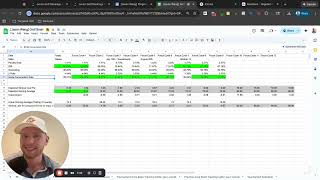
Connor Stirling Peterson explains which statistics junior golfers should track to reach Division I level, which requires a scoring average around 72-74. Focus on penalty rate, greens-in-regulation, scrambling, 3-putts, and birdie conversion. Ignore fairways hit and total putts, which don't predict scoring.
Chapters
All right, what's going on everyone? In today's video, I'm going to be covering should your junior golfer track statistics, and if so, which ones. Now, if you're watching this video, you almost certainly know your child should be tracking some statistics, so let's just go ahead and get that out of the way here. Um, assuming your child has been playing golf for any amount of time, right, we all know that, you know, to some degree at least, they're tracking their scores and they probably feel some type of way about whatever they end up shooting on a day-to-day basis, right? And so you also probably know that if you're just reliant on whatever they shot on a day-to-day basis, they're going to be on an emotional roller coaster. And if you've found a way to get caught up in that, then you're going to have quite the emotional roller coaster as well. So in this video, I'm going to be talking through really the stuff that you should be paying attention to, the major statistics that matter, and some of the stuff that really, uh, doesn't matter, um, hardly at all. And so I'm gonna go through all that in this video. If you guys enjoy it, go ahead and leave it a like, um, really helps push it out to more people in YouTube algorithm. It's a small channel, um, but really my goal is just to help you as the parent of a junior golfer, um, to help you understand this process a little bit better and what your child should be doing. And there's so many different things that go into helping a child play Division 1 golf. It's an extremely difficult goal. It's literally harder than getting into Harvard. And so, you know, there's a lot of people who talk about academic stuff and what you need to do to get into Harvard. There's a lot of people who talk about maybe sending out emails coaches. And maybe you've seen other videos from me about how I think that doesn't make a ton of sense. Um, but there's very few videos that go into the nuances of statistics for junior golfers. So, um, you guys are in for a treat. Hope you guys enjoy it. Let's go ahead and jump into it. So, um, first things first, I'm a really big advocate of knowing where we're going, right? The whole point of tracking anything is because we have a particular goal, and we need to be able to define that goal clearly. Otherwise, we're always just gonna be kind of unhappy. That's kind of how people are, if you haven't noticed. Uh, we have a goal. Um, typically, if we don't have that clarified, then we're just always going to be kind of displeased with, you know, whatever's going on, or we're going to be delusional and think we're amazing when we're really not. So, um, if you're watching this video, we're trying to play Division 1 golf. So step number 1 is really to say, like, you know, what does it take to play Division 1 golf? If you go to rankings and honors, college signings, you'll get this page here where you'll be able to see all the players got recruited back into 2018. For boys and girls. You're going to be able to see where they're ranked in the class, their scoring differential, and the program that recruited them, right? So that's just very valuable information. If you can understand what that is, um, it's going to help you a lot. I'm not going to say, hey, you need to get to XYZ scoring differential, um, because, you know, it depends on the type of program you're trying to go for. If you're trying to go to Stanford, it's a completely different set of math than if you're trying to go play at some D3 program. So I will say, in general, about -1 as a scoring differential is, um, is kind of the minimum to play Division 1 golf. Typically what I've seen— I have seen players get inside. I've had a player get recruited with a negative like 0.8, um, but again, you know, most of the time we're going to see closer to the -1 or better range. And so that's the first statistic we really want to be aware of, not because it's one that your child is tracking, but it's a target, right? So ideally they're getting that by the time they're recruited, which is going to be around junior year-ish. It kind of depends on when players actually declare, um, But that's kind of like the context there. Now, once I've got that, ideally, you know, if they're in a position where they're playing in tournaments, we want to get ranked on Junior Golf Scoreboard and have a ranking that we can point to, specifically a scoring differential that we can point to. Now, typically what we're going to find is for a player to have that -1 or better scoring differential, we're going to have a scoring average somewhere between 72 and 74, and we're going to be playing on reasonably long golf courses. For girls, it's going to be about 6,000 yards. For boys, going to be closer to 7,000 yards. Gets that math to work out really nicely for us. Now, once we got that, what are the statistics that I like to track? Um, because at the end of the day, we can say, hey, lengthen out the golf courses, um, and that's pretty straightforward. The other side of that coin is just lower the scores, right? So how do we actually do that? Specifically, what are the stats that I like to look at? I like to start at a high level, right? The main stats I like to look at are penalty rate off the tee, greens regulation, scrambling, 3-putts, and birdie conversion rate. That's going to give us a projected scoring average. Now, some of you guys might be like, oh, Connor, that's not very sophisticated, you know, you go ahead and do strokes gained, blah blah blah. Um, yeah, there's a reason that this stuff is as simple as it is. The reason I like to look at this is because this is predictive of what the player should shoot. You can run these numbers on literally any player, pretty much get what they should shoot. Now, the numbers that are not accounted for— this doesn't count for things like making eagles, this doesn't account for things like chunking chip shots, right? Um, this doesn't account for hitting into the trees, hitting the tree trunk and make triple, right? Um, and that's what comes out in what I call compound errors, right? So there's things outside of this category that really causes problems for us. But this framework is really, really helpful because it allows us to say, out of all the things we could improve, what's gonna have the biggest impact? And that allows us to say mathematically, here's what, you know, we actually need to focus on in order to improve, right? And so, you know, sometimes people are just like, they just want to go out and they're like, work with their swing coaches, do random stuff. And I just, I completely disagree with that approach to things. I think it can work in some cases. I think there's plenty of coaches that can flex more players going to play Division 1 golf than I can. Um, but I think in most cases, those coaches have worked with hundreds hundreds, if not thousands of players. And it's not that hard to go ahead and find a diamond in the rough. And I want to be clear for myself, you know, the players that I work with who go and play Division 1 golf, you know, it's like sometimes, you know, a good number of times where I've been able to have an impact in that player's game. Um, but a lot of the time that player is also just like very naturally talented, and it could have been some of the circumstances where they came to me where they're already pretty good and I was able to help them get a little bit better. Um, and there are other cases where, you know, they took what I had and they just ran with it, right? So there's a lot of intrinsic talent to the player. That's why I usually don't like to flex those kind of like high-end results, because it's not necessarily something that you're going to get, um, you know, if you chose to work with me, right? We're going to see something closer to average. Now I talk about the average player I work with improves by about 4 shots per year, which is about 3 times the, you know, the average CrossGolf scoreboard. Scoreboard's about 1.2 shots per year, and that really is a north star that we should be thinking about when we're thinking about these statistics, right? So we want to track these statistics with the point of being able to say, hey, I'm improving at a rate that makes sense, right? So I want to throw those numbers at you just so you have a little bit of context here. Now, if you're just like, you know, this all makes sense to some degree, right? I can see a bunch of numbers. I don't know how to do this. I just want help. Link below in the description. You can apply to work with me directly and I'll just do this for your kids so you don't have to think about this type of stuff. Um, but anyway, jumping back into the video here, this allows us to say out of all these things that are gonna have the biggest impact, what should we do? I'm gonna give you guys a quick rule of thumb here. Generally, if your child is hitting a lot of balls out of bounds, so over 5% is a lot, they're 3-putting a bunch, it's typically over like 8% I would say is a lot, or if they have compound errors, those 3 things are typically the first things that I knock out. So if I'm working with a player who's got a scoring average of 95, in almost every case those are the first areas we're trying to up. Now, have I worked with players who are shooting in the mid to low 70s who have a really high penalty rate? Yeah, absolutely I have. And so in that case, you know, that just becomes the easiest area for that player to be able to improve, to say, hey, we need to cut this down, right? There's no, there's no way that we're going to be able to manufacture a way out of this, right? We need to be able to improve that. Once we've done that, typically it goes on to pushing up greens and regulation. I like to see greens regulation get to about 70-ish percent. If we can get 70 or higher, we're gonna be shooting some low scores. Consistently, right? So it's not just saying, hey, I shot 69 this one time. It's like, I go out there and if I play bad, I shoot 1 over, right? In most cases, you know, if I have just kind of a ho-hum day, I shoot 67. That's what that looks like, right? Once we've got that, then I focus on birdie conversion rate, which just typically ends up being making more 10 to 15-foot putts. That's kind of like the order of operations there. And there's an endless amount of complexity that I can dive into that I'm not going to be able to do in this video. That's why I actually work with kids one-on-one. Um, but that aside, that's kind of the order of things. Now, one of the things you'll notice here, I track it, but I didn't say anything about scrambling. Um, scrambling, in my opinion, is one of the most overrated statistics for junior golfers. Most of whether or not you get up and down scrambling is whether or not you left the ball in a spot that's easy to get up and down, right? So if you're on the fringe, you got a 20-foot putt, you two-putt that, it feels like a two-putt, right? But technically it's an up and down. If you gotta hit a flop shot out of the rough over a bunker, you're not getting that up and down, right? You're lucky to keep that on the green. And so it's important to have that context, right? If you become a better ball striker, then you also get better at leaving the ball in the right spots. So in a certain sense, when coaches spend a lot of time on, on mechanics, it makes a ton of sense, right? Because it actually is one of the biggest impact things, right? Between penalties off the tee and greens regulation. The problem is most coaches don't track these statistics and then they don't update what they're doing in their practice with the junior golfer. Based off of those statistics. I think that's one of the areas where it really falls short. Um, and most junior golfers just don't have the discipline to actually do this. So if you're watching this, your child actually does it, all the better, right? Now those are the main high-level statistics. Now each one of these we need to be able to drill into, really be able to make a dent. And so my preferred tool, um, is a tool called Draw More Circles. These guys are awesome. Um, I love this tool. Um, part of the reason I love it is as a coach I've been able to suggest a few things, especially statistics that I wanted to see, and they actually added which is really, really awesome. It's also the easiest to use. I actually have a free trial. I give my students a $500 discount off the top tier, um, option that they have. Um, but yeah, there's a really good tool. I don't make any money off of this. I'm just literally what I use. I've tried everything out there. This one's the best. Everyone who tries to tell you something like, hey, you know, you can get, you know, like Arccos where it'll like tell it, tell you the answer or, um, or track your stuff for you. You still got to go back and check it. There's no way that they're going to get 100% accuracy. And so it's always important to just, you know, keep this simple. And it's like, at the end of the day, you pull your phone out, it takes you literally 5 seconds to go ahead and put in what you just did and then go to the next shot, right? It's the simplest thing in the world. So anyway, we're going to get a bunch of statistics. Most of these stats are completely irrelevant. I don't care about any of these, but there's a few that matter a lot. And so obviously we have the high-level ones that I just went over. We've got drill down here. So I'm not going to go through all these, but I'm going to give you guys a couple of nuggets. I'm going to give you one of the easiest ones. So if you're looking at your child's statistics here, one of the easiest places to look at is greens and regulation by the par, right? So par 3s, par 4s, par 5s. If your child hits fewer par 5 greens than their on-green percentage from 75 to 100 yards then that's an easy opportunity for them to hit, you know, to hit more greens. So in this case, for this player, he pretty much does, you know, 1-to-1 relationship, which is typically what I'm going to see. Um, but the reason being is, let's say your child hits 50% of their par 5 greens, right? So they're missing 2 par 5 greens per round, and they could lay up to 75 to 100 yards. For a lot of players, it's going to be like a lob wedge or a sand wedge, and hit that ball on the green, let's call it 80% of the time. What they're able to do is if they just lay up on every single par 5, they're going to increase their greens and regulation by 1 green per round, and they've increased their overall greens regulation by 5%, right? So that's really the power of this stuff. Same thing with 3-putting, right? I'm not just saying, hey, we need to get our 3-putts down. That's hard to do. I'm looking at it specifically and saying, okay, well, what's my make rate inside 5 feet, right? Can I make a dent here? What is my average distance on my second putt for my lag putts? Can I get that inside 10%? Those are usually the goals that I want want to see. Um, and so we can drill down endlessly into each one of these statistics, and that's not really the point of the video. The point of the video here is to help you guys understand the context you should be thinking about for tracking these different statistics, like what do you actually need. I want to also throw out a couple statistics that I just hear all the time that are completely useless. Fairways hit per round doesn't really do anything for you. Doesn't— it's not predictive, right? It's like you did super long, be in the rough all the time, get wedges on the greens, right? It's not a big deal. Puts per round, completely irrelevant. I don't care. You hit a bunch of greens, you're gonna have a lot of putts, right? So that's just, again, not helpful, right? It kind of disincentivizes the player to hit more greens, right? So it's not a good statistic. Um, yeah, like I said, scrambling, I don't like it at all. Um, those are kind of like the main ones that I see all the time that I just, I think are not particularly helpful. Greens regulations, obviously, you know, something that I would say is kind of like the Mac Daddy of all, all statistics. Um, But that said, if you don't have the on-green percentages or the, you know, par 3, par 4, par 5 percentages, they're going to have a very hard time improving that number because you don't actually know where the low-hanging fruit is. Um, and so once you have those statistics, the key is going to be to be— to design practice around those areas. So if your child doesn't hit the ball on the green, um, or there's a big drop-off between like 75 to 100 yards, maybe they're like 80%, and then they go to 100, 225 yards and only hit the green like 40% of the time. Well, that makes all the sense in the world to say, hey, you know, we're pretty good with our wedges or our short, shorter wedges, um, you know, we need to really work up and, and, uh, improve this area at 100, 125 yards to be able to get the overall greens regulation up. That's really the way you want to be thinking through practice. Same thing with your lag putting, short putts, etc., etc. You want to really build practice around these main statistics so you can either maintain them or improve them dramatically. Um, so hopefully this video is helpful on understanding just at a high level. Yep, you want to be looking at your golf scoreboard. Where's our target? We want to understand where we're at right now, and then we want to understand the main statistics we're looking at. We want to understand the best tools to be able to dig down into those statistics, and then we want to know what we need to do with that in practice. Now, those are all things that I do specifically for students. I work with them directly, build everything out for them. That's something you're interested in, go ahead, click the link below. And apply to work with me. I'm only going to work with players if they have a realistic shot at playing Division 1 golf. Um, and so that application will kind of help me validate that your child's actually in a good spot, and you'll be able to call, um, and we'll be able to talk it over, make sure it makes sense. I'm not gonna be one of those people who like chases you down and like calls you every single, every single day. Um, you want to make sure you're gonna have clarity on just where your child's at. And even if it's a little bit of a stretch, like, I'm gonna tell you, right? I'm not gonna tell you, hey, you can't work with me because your child's not good enough. Um, but at the same time, I want you to have clarity because you know, transparency. That makes my life a lot easier if everyone kind of knows where they're at and has clarity about that. Um, and, and we're just able to apply proven frameworks. That's at the end of the day what I'm doing here is taking the experience that I've gained from working with a little over 100 players at this point and passing it on to you to help you understand what works really well and what you need to be paying attention to when you're trying to help your child play Division 1 golf. So hopefully you guys enjoyed this video. If you did, go ahead and leave a like, and if you're new to the channel, go ahead and subscribe, um, and get updates from the videos like this every single week trying to do 2 a week, uh, this, uh, this year. And, uh, so stay tuned and go watch some of the other videos on the channel covering things like tournament selection, practice plans, AJGA, whatever you guys need to play Division 1 golf. That's what you're gonna find on this channel. All right, talk soon, guys.










