Alec Couros on Spearfishing, Citizenship, and Lateral Reading
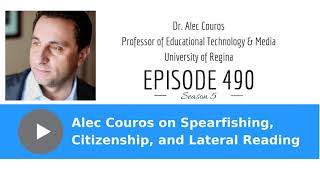
A short interview (10 Minute Teacher podcast, episode 491) in which Vicki Davis talks with Dr. Alec Couros about nurturing positive and active digital citizenship. Couros contrasts the early techno-utopian history of the web with today’s ubiquitous, corporatized internet, advocates moving learners from consumers to creators (multimodality, personal learning networks), and emphasizes information literacy practices—notably lateral reading, skepticism, and curiosity—to counter misinformation, deepfakes, and spear-phishing scams. The episode includes practical classroom suggestions and a closing sponsor message.
Chapters
Today's 10 Minute Teacher podcast is sponsored by Smart Brief. Stay tuned at the end of the show to learn how Smart Brief can make reading the news fast and easy, even during the school day. Today we talk to Dr. Alec Kouros on spear phishing, citizenship and lateral reading. This is episode 491, the 10 Minute Teacher podcast with Vicki Davis. Every weekday you'll learn powerful practical ways to be a more remarkable teacher. Today, how can we nurture effective digital citizenship? Today we're talking with Dr. Alec Carose about this topic. So, Alec, digital citizenship is a topic that sometimes it feels like we've been talking about forever. And I almost wonder if we've not gone backwards in our progress with digital citizenship. What do you think about that and where do schools need to be today with this?
Yeah, those are really good points. It does feel like we're going backwards once in a while. I tend to frame it as not even the digital anymore, not for some time now. But really thinking about positive and active citizenship is probably the term I use more often. But when we're thinking about, as you mentioned, you know, we think we're going backwards sometimes we have to be historic about these things. And the place I often start is thinking about a little bit of the history of our web, thinking about where we've individually been, but even the broader sense of history about the Internet as sort of a techno utopian beginning where it was this idea that we could just connect that back in the 60s to the 80s when we started getting into these connections, just this idea that someday we might be connecting to strangers across the Internet. And then we got into the 90s with muds and moos and some of the sort of geekier things as well. Then the 90s came around and we got a little scared because this Internet thing was going to stay around, I think for a bit. We were starting to get into web browsers and we started thinking about cyber dangers and so on. And so that was a big part of it. But I think understanding where we've come from and in our current stage now where we've really moved into this ubiquitous web, this idea that our kids bring phones into many of our classrooms, their parents support these devices, you can't go anywhere without being connected. We see heavier corporatization, advertising, bullying, some of the really negative aspects of it, but at the same time the more positive aspects and ones that we can really leverage are, you know, this idea that there's some amazing learning happening online in informal and non formal spaces, things that we can connect to on the Internet and things that can probably stimulate us and excite us in many ways in terms of how we can change our teaching practice. And I guess that's where I want to start, is start with the history and then move forward to what we can actually do about it.
You know, the learning is incredible. I have a student in my digital film class who literally started the class knowing more about Adobe Premiere than I do because he has subscribed to all of these channels, of all these editors and filmmakers who are sharing so freely. So you think we start with helping kids build a personal learning network or where does it start?
I think that's a big part of it. And I think even that idea of the personal learning network has changed. Used to be really sort of haphazard, connecting with every single person, you know, without discrimination, that you would learn from sort of generic educators. And back then when there was only a few of us online, and I remember first connecting with you on through blogs and Twitter, you know, it was just everyone who was out there who's excited to learn. And now I think you can be more picky in terms of who you choose. Like, I'm inspired by videos, channels, like Smarter every Day by Destin. I learned so much from not only what he teaches, but the way that he thinks about inquiry, the way that he gets readers excited. And so there's a lot that I can learn from in the delivery, the style, and if I'm excited by that, you know, my students in many ways are much more excited by that, but they're also expecting that from me in many ways. So it's important for us to bump up our game. And so this personal learning network means it's a personal thing. We have to get our kids, try to figure out what makes them excited, what sort of connections do you know as a teacher, and then sort of let them connect in different ways and hopefully they can bring that to the table and share back what they're learning and how they're learning.
So, Ali, does this mean to bump up our game that we, all of us teachers, and you included, we have to have YouTube channels?
Well, one of the things I do in my grad class is I actually help my students create videos that are sort of those really great style, interactive, engaging videos. Not necessarily channels, but, you know, thinking more about multimedia and multimodality, a great place to start is new literacy studies. The idea, especially from people like James Paul G. Looking at multimodality, multi literacies, and just getting this idea in your head that I Think students will learn in much more visual or auditory ways versus, you know, the text that we often bring them in. Of course we're not all doing that. I think many of us engage in all sorts of different, you know, hands on learning, visual learning. We can do things even better in some ways. And I think that's the big piece of that is really trying to understand at the very beginning how do we, you know, move students from consumers to creators. And I think a big part of that is allowing us to do the same.
So you've talked about the positive. Is that the first part of the positive, helping the kids move from consumers to creators. And you know, a lot of us in our classrooms have been having our kids create and share, but it still seems like that's not the norm, doesn't it?
It isn't the norm, you're right, because it is a learning curve for teachers. There's no doubt about it. Not all of us can pick it up as quickly. And I think we also have to think about some of the negatives out there, certainly. So concurrently, while kids are connecting and while teachers connect, we have to always be thoughtful about the sources that we choose, how relevant they are, how accurate they are. And so the second piece, which I think really is concurrent with the first, is nurturing a critical disposition or developing a skeptics mindset. So starting with some of the information literacy examples that there's lots of resources online, but even getting into everyday information literacy, the memes that you see on Facebook, debunking some of those things and you know, try to find the funny ones because it can apply to the more, you know, political, more ideological ones. But I think starting with just some very basic instances and habits of really debunking things, going through the processes of genuine information literacy, helping kids understand that everyone out there who puts something out there, these things can be false. And we have to understand that if we're going to spend any time on the web, we have to really develop a more critical mindset.
I like to do truth or fiction bell ringers with my students and give them less and less time every day to try to figure out if it's true or not. But you know, Alec, with AI, artificial intelligence, I mean they have a bot that can write a news story in just minutes that looks somewhat real. So I mean this information literacy is vital, isn't it?
Absolutely. And I know you are very aware of in fake videos, things like deep fakes, technologies out there that can create fake video very efficiently and very effectively. You have to understand that a lot of the interactions that we have online aren't real people. They are swaying belief one way or the other. Many of them are bots. Many of them come from the same accounts or origins. And it's very important to discern what's real and what's true. Part of this is getting at the idea of trust and understanding that there are trusted sources out there. And that's where we start. And it's sort of like, you know, Vicki, I trust you. I've known you for years. I know that if I'm on here, I can trust you. And when I read a newspaper or an article, there's a concept called lateral reading. It's this idea that ultimately don't just spend time with the information that you've been given in an article. Spend some time away from that article. Just sort of vetting, like, what's the source? What's the source all about? What do other people say about this source? And so this idea of lateral thinking is one of the key components of really strong literacy, digital or, or information literacy programs, making sure we better understand the source of the information that we're getting.
So that's a new one, lateral reading. You know, I think a lot of us do that, but there are those who don't. And I think also, you know, admitting that we shared something that was not accurate is important. Are there any other key components as we finish up that you think that we should be teaching students who are going to be successfully literate with determining truth or fiction?
One of the key pieces is this idea of being inquisitive, developing curiosity in kids. There's an APA 1990. The quote that I always use. The ideal critical thinker is habitually inquisitive, well informed, trustful of reason, open minded, flexible, fair minded in valuation, honest and facing personal biases, willing to reconsider, diligent in seeking relevant information? There's a lot more, but it's the idea of being focused in inquiry, this idea that you're always trying to learn more about what you're seeing. And that mindset is so important. Hemingway called it the craft detection, which is sort of a different way of looking at it. But really, to me, it's about being inquisitive and being genuinely curious. If we take on that mindset, that's such a big part of what will make us understand truth to a much greater degree. And I think that's a great place to start.
It is. And I do have to mention this. There's some scammers now they look up who the principal of a school is. I've had a real problem with it this year. And they will create a fake account and they will send a really brief email to all of the teachers that says, do you have a second? And it looks like it's from the principal. And if you look at it on your phone, you can't tell it's a fake email. And then if you go back and forth with the person, they'll ask you to go grab $500 worth of iTunes cards and scrape off the numbers and send it to them. And you know, it does cause confusion because of just how it comes through. And some teachers are just like, I just don't want to deal with this stuff. But it's coming to us now, isn't it?
You're absolutely right. That same thing happened with my dean, who I respect as an intellectual and he got caught up in one of these teams. So it doesn't matter how smart you are or how intellectual. It's about again, having some doubt, being a skeptic and asking some questions is such an important piece. Never being afraid to ask questions.
Last statistic I read was that one out of seven people will have their identity stolen. And if we can't get that detector in our mind to be skeptical and be wise, I mean, this is really something we're doing for kids in their future. Well, we could go on and on, but we won't. So Dr. Alec Kouros is an expert on digital literacy, digital citizenship, and as he said, it's just about positive and active citizenship. Thank you, Alec.
Thank you so much.
The evolving world of edtech can often seem overly complicated, but it doesn't have to be Smart. Brief on EdTech is a daily email news service made specifically for educators like us. It condenses the latest industry news into a quick two minute digest. The folks at SmartBrief read everything and we get what matters. So activate your free subscription today by heading to coolcattteacher.com smartbreed so that is coolcattteacher.com S M A R T B R I E F thanks for staying smart with SmartBrief. Thank you for listening to the 10 Minute Teacher podcast. You can download the show notes and see the archive@coolcattteacher.com podcast never stop learning.
More from Alec
Episode 14 - Dr. Alec Couros: The EdTech Explorer – Rethinking Education with AI
Online Learning in a Hurry Guest episode 6 - Alec Couros - Student's in spaces