ETMOOC 2.0 Session #4
Alec Couros hosts educators Paul Signorelli, Susan Spellman Cann, and Daniel Bassill discussing how AI can augment human capabilities in mentoring and learning. They explore AI's role in accessibility and its impact on youth and seniors, while stressing the need to keep humanity at the center of these interactions.
Chapters
Foreign.
Welcome to what feels like about the 18th episode. Vetmoo2 actually is only the fourth formal session with the two chats that we had in between on chat, GPT and artificial intelligence. We will get this going by saying straight up, we're circling back to the beginning of this. But now with three formal weeks of study to get three formal sessions together, plus the conversations, plus all that wonderful reading and writing all of you have been doing on this, it makes us ask ourselves, so what are we doing with artificial intelligence? And what can we be doing that makes our lives a little bit better? We're going to focus at least in the first part of this, when I'm doing the talking, getting you all engaged in this focus on a book that came out about five years ago, which is when I first got intrigued by artificial intelligence and the possibilities here. The book is called Human plus Reimagining Work in the Age of AI. And what it really gets down to is that sweet spot that we've talked about so much during at MOOC2, which what can machines do better than we do? And what can we do better than machines do? The book was written by a couple people here in the San Francisco Bay area, which made it very sweet when I was first reading and think, oh, they're like my neighbors. I could actually probably call them up or talk to them a little bit and see what's going on. I got intrigued though, as I was reading it more past the idea of trying to contact them, but do some follow up based on what I was seeing there, because they were talking about what some local people here were doing in the Bay Area as well as in other parts of the country using artificial intelligence, using robotics and other things. At that point, there was a fabulous story in there, about halfway in about a retailer that was playing with robots. They were designed to greet people at the front door of this wonderful, very popular retail business. The robots were programmed to be able to serve as the initial entryway for customers coming into the store. People could say to them, I'm looking for this. And the robot would lead them there. And when it got a little more complex than the artificial intelligence within the robot was programmed to deal with, it was actually programmed to say, let me take you to somebody that can help you. Instead of let me take you to my leader, it's let me take you to a human who might be able to help you there. I found that so intriguing that I thought, I'm going to go over to the place and check it out, go on over, started walking around, but there was no robot there. Looked around hoping to see the robot. Still no robot. The book had just literally come out. So the people have written it. Within the last year, after walking around and unsuccessfully looking in, trying to get my close encounter with alien intelligence in a retail store, I finally went up to a few of the clerks and said, so where's the robot? And he hadn't the foggiest idea what I was talking about. I said, well, I just read about this book. You guys are supposed to be big on this. And nobody knew. I said, well, is there a manager around I can talk to? So they referred me to a manager who referred me to another manager, and finally somebody said, oh, yeah, yeah, we played with that a little while, but we don't have it anymore. That short a period. You tried having that kind of thing here to take some of the burden off your human staff and we leave it with a robot. What happened? And they said, well, the people who designed that aren't with us anymore. I just started laughing. You look at this stuff and you get excited about something that looks so cutting edge, it's so inviting and so intriguing that you want to look at it, and in a blink, it's gone. And I don't want to make a prediction that ChatGPT is going to be the next version of that robot. But let us understand that we're all at the moment that we're having this course together, totally hyped up, because it really hit the public last November, December, here we are, end of May, early June, about six months later, and there is a second version out. Alec has talked about how that's an upgrade from what we've seen, and we played a little bit with that, but we really, at this moment, don't know where it's going. And so the fun and intriguing thing is to say, what is the potential? If it lasts and if it continues to evolve, what can it do that we can't? And what can we do to start incorporating that in rather than just looking at our morning papers or the morning blogs we read or whatever newscast we're listening to and hear the frightening fear story of the day of, oh, this went wrong with it, or this went right and it's taking over the world. Oh, no, it's not. Wait a minute. No, I think it's under the partially. I mean, this stuff just evolves so much that we're going to have to be evolving with it. And I think that's the excitement of doing anything through edmooc with technology. Looking at technology and asking ourselves, what can we do to incorporate this in an effective way? So let me with that just little bit of briefing and talking about highly recommending that book, by the way, even if some of the technology was gone before we got into it. Let us take the heart of that and ask ourselves, what could artificial intelligence, and specifically what could ChatGPT be doing to make our lives better and to better serve the learners that we serve? Anyone? Unmute yourself, put stuff in the chat, Send me a ChatGPT message, and I'll see if my phone picks it up. But anybody, what do you see coming down the road that would make it better? Okay, nobody had an idea. Second question, what do you see now? Anyone? What do you think could come out of this based on the conversation we've had here together? You know, I'm going to wait you out. You just know.
I'll start.
Thank you, Daniel.
First place, I thank you guys. Back in February, when we got together and we started talking about what is ChatGPT, I didn't know anything about it. And so you guys have taken the lead, you put this together, and I know a lot more, but I certainly don't consider myself an expert. But I'm an expert enough to know that there's a lot of different places I could go to keep learning. And I think that's probably the first big step. This is there many people exploring ways to use it, and we'll keep trying to use it. Just to put it in context, an hour ago, I started watching a TV special on ABC about the 1619 Project of slavery in America. And that's actually two hours long. So I left there after one hour and I'm over here. But for those who are curious about the history of slavery in America and the future of democracy, ChatGPT has already been shown by some of the different things some of you are sharing is it allows us to ask questions and set up a study process where we can all dig deeper and learn more. And maybe because of the ways of artificial intelligence, we could dig a bit deeper than we would have otherwise. And maybe we will find better ways to share what we're learning so that more people will learn. And maybe there's a different future than what we might see in front of us right now.
Daniel, you've been working in mentoring for quite a long period of time now. Are you beginning to see things where ChatGPT could augment the mentoring process? And if so, what's one possibility there?
What? No, I don't think any artificial intelligence will ever Replace the human contact. Now, with that said, the human contact of a mentor can help a young person or any person go deeper into the possibilities of what their life might be and explore opportunities they may not have had otherwise. But just like it's a tool for educators in the classroom, it's a tool for volunteers and tutors and parents working with young people in the night school hours.
Let's make it absolutely clear, my question was not meant to say how are we going to replace live mentors with artificial intelligence? I'm not suggesting that at all. In the spirit of the book Machine and Human, the whole thing here is find out what it would do to augment. I love the word augmentation when we talk about artificial intelligence and especially with ChatGPT. So you're sort of given a little bit of the answer I was fishing for. Let me tell us other people, based on what Daniel's saying, where he's hard right in the middle of the road saying this ain't going to replace humans doing mentoring, what possibilities are there where something like ChatGPT or an artificial intelligence might augment what we do and make the job we do easier and better for the learners? Any takers on that?
Can I take it somewhere else? Go ahead.
Sorry, Alex. I was just gonna say what Sal Khan has put into the Khan Academy with Khanmigo has basically given every student a tutor in a very friendly way. Not a mentor. Different for sure, but still. Generally the privileged students got tutors and now we've democratized that to put. To embed that in something like Khan Academy and give tutors to every student who has access to Kongigo.
Wonderful. Thanks, Lisa. Alec, what were you going to add in there?
That's a great point that by Lisa. I think the Conmigo tutoring, like the intelligent tutor piece is going to be very important going, going forward. Like, you know, and going back to Daniel's comment, you know, it's not going to replace the human touch or, or, you know, the care that comes from AI. And I would tend to agree with that. But, but I think, you know, larger picture I guess would be. For me, two points would be wayfinding and sense making and probably sense making before that. And I, I've, you know, some from, from very explicit examples. I heard a while back that there was a. And I saw the syllabus. There's a syllabus, you know, from Queen's University English 100. And it's like 44 pages long or 42 pages long. And I was trying to decipher it, you know, as a PhD and you know, I'm thinking undergraduates are deciphering this and it's very dense, it's not well, very well put together and just trying to figure out like how do I complete this course, how do I, you know, how do I get through it, how do I do assignment number one? It's really difficult to follow and, and I'm not going to take down the professor for this. I think we often do that and our syllabus gets, our syllabi get bloated and so on. But, but a student just said I'm going to put it into askyourpdf.com and I'm going to ask it questions like how do I complete the first assignment? And I played around with this and it was quite amazing. So like sense making in that sense like everyday task or making education or you know, what are the crypto markets going to do or should I invest in you know, this or you know, how do I, you know, how do I become a better human? Like those sort of like the, the any level education piece I think is really important. So making sense of the world or you know, what's happening in the Middle east right now or what's happening, you know, another part of the world. The wayfinding is I think that guidance that it can provide like with within that sense making there's also like let me, what happens if I explore this path and how far can I go down this path in terms of careers until, in terms of, you know, relationships or whatever else. And that, that way finding I think is really important to me. Those two umbrellas hit a lot of what AI will do and will help us. And I think those are just two natural, you know, human pursuits that have been around for such a long time. But you know, augmenting this I think with an intelligent tutor, you know, a non judging, non judgmental, hopefully well biased but biased in a different way than your, your average friend or loved one. I think those are really important attributes of what, what of, of AI and where it will take us I think in the future.
And you know, since it's our last session, let us pull as much of it together as we can. We talked in the first couple of weeks about that awful thing is coming up more and more these days where ChatGPT itself hallucinates. It actually makes up stuff that isn't there. So the bad side of it is we need to be aware that really we're looking at augmentation that needs some kind of a check. So if we're using it for mentoring, if we're using it for tutoring, we want to make sure the information that it's giving us and we want our learners to understand information they're getting from ChatGPT. They want to go and check that and continue to do their own research to grow off it. It's a great starting point. None of us that have used it at all over the last few months would use it as the starting and the end point of anything ranging from news reporting in a term paper because the stuff isn't at that level yet. But that said, it leads us down fantastic paths. I think Alex has done a great job of pointing those out. Let me hit a couple things that are in chat here from Tim. Transparency, holding on to some this is again on the question of what might it do, how might it augment us and how might we augment it? Transparency, holding on to some semblance of open sourcedness like Bruce Sterling's spines tracking where it all comes from in space and time, which got a thumbs up from somebody else. So obviously that one's striking home. Seen here from Matthew Augmented human curiosity. Not necessarily chat GPT, but artificial intelligence could nudge us to do the right things in the right order at the right time. Again, we remain in control of that, but it is our buddy in this to a certain extent without anthropomorphizing it too much that it is a useful thing. It leads us. Nadia says some mentoring can be transactional in nature and AI could help with that in accordance with the human contact and support. So if we're running with a theme here in that rogue kind of the wisdom of the crowd thing, we're recognizing this is fascinating, but it also is not something where we just hand everything over and say, ah, you're intelligent. I'm not. Give it up. You know, there's the responsibility and the thrill of exploration that goes with it. Lisa says, I just heard from a company tonight that has general AI career counseling, which is again another nice sign of how you can get that when you're ready for it. If you're the learner in your moment of need. Matthew comes back to for the first time in history, we get value out of garbage. Garbage in and value out, which is kind of an interesting thing. I haven't seen the garbage in yet. Matthew, actually, that's a fascinating question. Can you go a little further with that? Unmute yourself and yeah, I can do that. Thank you. I'm counting on you.
I actually went to the AI lab, Elliot Macy's AI lab last week or two weeks ago in New York. It was in Saratoga Spring. I'm not gonna say New York City, I'm sorry. But in any case, one of the things that came out is that it was really about corporate learning and that kind of stuff. But a lot of people were excited about the fact that AI could get inside an enterprise and have a closed in AI that would look at all the resources of a company and then would be able to make sense of it. Like would. Would be able to make sense of all the stuff that's all in all the databases, all the, all the stuff that's in Office365, whatever, and then try to make, to see the patterns and make connections, make human connections between people who are working on similar stuff in, in different silos or different, you know, branches or whatever and basically get value out of that. And I think that, you know, that's where, you know, that, that, that task of trying to detect these patterns, which is something that's way too daunting for any human, is something that the AI can do very easily. So, you know, trying to basically just do some kind of meta tags of everything and trying to figure out what's this about, is that a part of, you know, this project or that other project. So I think that there's probably something about this in terms of even in school, like efficiencies or whatever that can be achieved. But I think that anytime you can, you know, you can basically just say, well, this is just the stuff that human put together. And it's always like, there's never any metadata on this. It's never tagged properly. It's never, it's just text and even images and all of a sudden you can actually make sense of it. There's like patterns that emerge.
Actually. You make me think of being back in elementary school and listening to somebody lecturing or trying to teach me something that was far more complex than I could grab. I would look to somebody next to me go, do you have any idea what's going on over there? Can you explain it? And that was the other person doing what you're talking about. We can sort of see Chachi as the kid at the next desk that we turn to and say, can you help me with this? And sometimes I'll have the right answer, sometimes not. But at least it's that collaborative learning where you team up and you realize you're not alone. We're trying to do a lot tonight that gets the juices flowing a little bit. My challenge to you as we go through session four. Here is hold on to those thoughts and ask yourself over the next days, weeks and months, if ChatGPT continues to develop, what can we do that is really going to allow us to augment what we do? And what can we do to augment what it does to the benefit of our learners? Susan, run with it, please.
Okay, so hopefully you can see my screen and we're ready to roll. I do want to thank you for coming tonight. And it is important to create those Safe Spaces and ETMOOC2 has done that for us so that we can have a dialogue. And for sure, bringing humanity into the conversation is really important. And I think it needs to be coming through all of our conversations and how we're connecting and continuing to grow as we learn about AI. We have to bring humanity into the conversation. And so I like this quote. It's. And I hope you're seeing it. Are you good? Our ability to tap into the lost art of human interaction will be the difference between humanity preserved or our humanity lost. There's a lot that I know you probably have heard on the radio. It's the end of humanity. Our tv, it's the end of humanity. AI is going to destroy us. I really hope that it doesn't. I am an eternal optimist, for sure, and. But I like to believe that we have to keep humanity into the conversation. I think we need to find and strengthen those skills that matter face to face. I think we need to put our phones down when we are talking to anybody, anytime, anywhere. And I think there will be ways that we can bring that humanity into it. Right now, AI can't replicate empathy or compassion or the ability to think creatively or complex or critically, and who knows how that'll be. But I don't think that it will ever be a problem with AI. I think we're going to have to bring that humanity in many ways. And so I'm just going to start with a little humanity at the top. I'm originally. Well, I live. I've lived in Alberta for 42 years, going on 43 right now in the beautiful mountains in Calgary. And I originally came from the bottom picture in Nova Scotia. And I'll be going there in July. I go every year. And as you can see in the picture, that is what I look out when I look out my window in Nova Scotia. That's me in the kayak. And I think it's important for us to do a little bit about who we are. I have a little tiny URL. That I'm going to pass on to you. See if I can cut and paste that. And I'd like to let me see if I can do that. I might have a little bit of trouble doing that and if I do, that's okay. I will pass that along. It's. It's a way to the. It's tinyurl.com/about youc2 so it's tinyurl.comabout you@mooc2 and hopefully I can learn a little bit about you. Because really that's what @MOOC2 is all about. It's about making those connections. So we are, even though there's only a few of us here tonight, it's never too little. I know people are connecting all the time, but our friends in that mug are from all over the world. There are 380 people, at least 43 countries, 10 provinces, two territories and 24 plus states. And I'd have to really dissect to figure out exactly how many states, but it's around there. But we're happy that you continue to join us and we really hope that you continue to join us in the Discord community. After this is all said and done, I want to talk about one of the things that really excites me about AI and bringing humanity into the conversation. One of the things people who know me know a little bit or a lot about what's. What's happened to me in the past few years.
But.
I have a disorder called keratoconus and it's progressive eye disease. Specifically it's called pellucid marginal degeneration. But in since COVID has happened, my eyes have gone through quite the journey, let's just say and I've come along on that journey as well. I had a whole year where I did not see very well at all. I could not drive. I've just. When I think I have one thing and I'm getting moving forward. I had posterior vitreal detachment. I had many things, challenges with my eyes. So I lost my sight. I remember walking down the school hallway and I couldn't. I couldn't tell who was in front of me. It was quite something. Now these are reading glasses. Glasses don't work for me anymore. I have special contacts that are called scleros. So what's that got to do with anything? Well, it's a little bit about humanity and that I started because of Alec. He introduced me to be my eyes quite a few years ago and I started volunteering with them. Now at that time I could see better than I can see today. Well, actually today, right, today I see well. But for about three years there, I didn't see well at all. So I started volunteering with Be My Eyes. And then unfortunately for me, and it's a little bit of a joke, but it's true, it would have been like the blind leading the blind. So I couldn't volunteer anymore. I had to, you know, step aside from that.
So.
So what's got me so excited about AI is that it's about accessibility. The virtual volunteer tool, you know, that's currently in beta testing and uses vision to text, is so exciting. For me personally, if my site ever goes back as bad as it was, I would use that. And partly because I never saw myself as someone with a disability, I always felt I was very able, and I still am able and still very capable. And even during that time that I lost my sight, it didn't stop me from doing absolutely anything except for driving. And so the amazing thing to me about that is that it's hard to ask for help even for someone like me. I mean, I'm a psychologists, that's what I do, is help other people. But it's very difficult for me to ask for help. So having a virtual volunteer where I didn't feel like I was, you know, having to ask someone else, knowing that they could help me, they could get me a map and show me where to go, they could tell me what was in my fridge and then they could give me a recipe for it, they could help me to. And I have volunteered again with Be My Eyes and they'll ask you things like, can you tell me which spice in the cupboard is to the left? Well, with a virtual volunteer, you could just point it at it and it would tell you every detail, which is really quite incredible. I think it is transformative. It is providing more and more care for people who are blind, who are of low vision. And it excites me beyond excitement. And that's the thing about AI that really I'm most interested in is the things it can do for humanity. Like what can it do? How can it help people who are poor? How can it help people who make them more independent? How can it make things more accessible? And can it? Well, I think that it can. And there are many people that are making a difference. Sometimes all we hear is the negative stuff. And I like to focus on what is good. And there are some. There's an AI good lab that high school students use. There are people like Sherry Turkle and Kate Darling. Two women who are interested in tech and AI and want to do things that are better for people. I love that AI for good trains and mentors women. And I would recommend that you look at some of those resources that they have on their websites and I put them on our website in session four, so you can look at that later. But I have worked with youth for over 42 years and I believe strongly that they care and they care about AI. They're. They're involved. And I think one of the things we can do is get them involved. Ask them to join, ask them to be advocates, ask them to have a voice, find ways that you can do that so that they will continue to want to make a difference and make the world a little bit better place. Putting humanity at the center for sure. And yeah, a little humanity goes a long way. I want you to set your brain free and, and bring humanity into the conversation. Play a little more. I'm looking forward to. I was been more serious, you know, doing, trying to pay attention to AI for the last two months. I. I am playing and when I finish tonight, I am definitely playing a whole lot more. But the thing about AI is that you can create using it. So creating. I love creating. I hope you make a more. Little more human created art. Art is one of the most healing things that you can do for yourself. And when you see yourself as playing like a Little Kid and ETMUK1 gave me that ability. I was not an artist before etmuk 1. I am an artist in atmoog 2. All the art that you see in any of this is stuff I've created and I create art all the time. And one of the things that Alec used to always say is, you know, make your learning visible. So I've put my lousy art out there, I've put my process out there. It does not matter. And I think that's important. Listen to some old records on a real record player, you know, dance around your kitchen, whatever you need to do. Me being silly in the beginning, you guys couldn't hear darn thing. You know, you got to do more of that. Relationships do matter. And we know that, we keep saying it, but sometimes we don't act like it. I don't think. I think sometimes we don't remember to, to pay attention to the person in front of us. And so we need to foster and preserve those meaningful relationships even more. And I love that CL MOOC has that activity that they have a postcard activity and they've made it kind of a real Thing where you send a postcard. And I, I think those things are matter. When I got those postcards in the mail, I was excited that day. I was excited to see who was it from and where was it from in the world. And so making the time to do those things and, and it doesn't take long to, to send a postcard, find ways to do those kind of things that bring a little bit, a lot more humanity into the conversation. I think we all could step up a little bit better. And I. There's some things that you can think about and some questions to think about. What it is, what is it that you value? What is it you value and what matters when, when it comes to AI, are we really ready to become a machine's companion, even if they're willing to become ours? That's Sherry Turkle. I like that. It's really good. And are you ready to embrace AI fully with an open heart, keeping humanity in mind? And do you really think that trust, empathy, and understanding that comes from connecting to another person on a deep level, can that really be replicated by a machine? Will it ever be replicated by a machine? I don't know. They're all things to think about, that's for sure. And I hope that. I'm very happy that you guys all care enough. Even if people didn't come into these sessions, you care enough about AI that you joined them and you. I, I really want to put a shout out to all those CL MOOC people in Discord who have taken the lead and they have really engaged in the conversation and they have put out resources. And I, you know what? I think it's just amazing. And even I love that, you know, at the beginning of this session when we had a little conversation, an opportunity to have a conversation, it was Mary. I'm sorry, it was Mary. Marianne.
Marianne.
Marianne.
Yeah.
Nice meeting you. And I love that we had those moments to have those conversations, to find, okay, where are you? What are you doing? What's that kind of stuff? That those are the things that really matter and finding the time to do those things and eking out in your day, how can you set out in your day to make that matter for you? So I am going to pass it on to my fellow AT Mooker, Erin Luang, and she's going to talk about some other resources for using AI for good. Aaron, do you want me to stop sharing and you come on. Or do you want me to share your slides?
Oh, if you have my slides, I would love for you to share Them.
You know what? I have your slides. I'll mute myself and look at you.
See, this is humanity in its finest. She anticipates my needs more than a. More than a computer, actually. So. So besides being the person who sends you guys the weekly reminders to participate in epouc, my name is Erin Luang, and I was way back 10 years ago, one of the original, not co conspirators, but participants who knew absolutely nothing about technology and kind of getting involved. But one of my things is that I am a school counselor. Counselor, definitely from. From one of the original participants to co conspirator, we can move mountains. But I've been a school Counselor for over 20 years, and I have to tell you, as I've worked with my kids over the years, part of what has helped me stay connected with them is actually being able to incorporate technology and incorporate where they are at to keep myself relevant with what they need. So sometimes a kid shows up in my. In my office, and it isn't what happened today. It's like, what's on our playlist? What are the top five songs you just listened to in the last week? And it's just conversations about, oh, what app are you using? Oh, show me a picture of this or build me a pinterest of that. So it's about working with them, where they're at. And so I'm sharing with you a couple examples of where AI can help us do some of that stuff that Alec was talking about in the chat at the beginning, some of that sorting some of that grouping to help us be sort of more in tune with. And I have examples both from our youth generation as well. My second example will be more working with our elderly generation. I feel like AI can help us out across the board. One of the things that happens is especially over Covid kids were needing to reach out. Most kids who reach out don't want to talk on a phone. They want to use an app, they want to use resources. And the positive thing is that we're able to use AI to sort of sort those conversations and group them so that we can look for trends and we can look for things that are happening. So one of one of the agencies that is currently using AI right now is something called the Trevor Project. And the Trevor Project is specifically focused on LGBTQ youth and their needs and everything like that. It's named the Trevor Project in honor of a young man named Trevor who was not able to get the counseling, support, and resources he needed as a youth and ultimately took his Own life. And now this agency works to support kids in their times of need. Within this agency, which is run by people, not computers, but they use a variety of things. For example, they use algorithms so the kids text in for the helpline, and the algorithm helps them to analyze and categorize messages so that they can sort the messages out to the appropriate people to respond back to what the child is at, so that the child is matched with someone who meets their needs. They also use a natural language processing technology and they start looking for trends. They can then use that research, and it's real time research, not like 10 years ago, 20 years ago research, today, research to create PD and professional growth for school counselors on trends that are happening in the here and now. They also have a AI powered virtual assistant which they call Riley and he can be on the line 24 7. So they do have people on, but no matter, day or night, whatever is happening with a kid, they can get connected with their virtual assistant to do the texting back and forth overall, instead of having one person on the line who may or may not be trained to help with the specific needs. By incorporating these different technologies along with the human counselors, they're able to provide more personalized and effective crisis and intervention services to the young people that they're serving. So the Trevor Project is one example of where AI is not replacing them, it's supplementing them and complementing their resources of what they're already doing now on the opposite end of the scale. And this actually surprised me. And when we first in February, started talking about AI and wanting to do this, this at MOOC 2.0, I was like, oh, I better do some research. I went on LinkedIn and I actually signed myself up for a session on elder care, which almost sounds the opposite, like, how could AI be helping our seniors? But what actually ends up happening is there are a few different ways where we can actually inventory our seniors and their families and help them take this huge ocean of resources that are out there and help them personalize and find the things that they need for their own personal stories.
So.
Amelia is one of these digital agents. And what ends up happening is they work with the health care agencies as well as clients and they talk to both sides and then they find a meet in the middle. It's almost like having a virtual mediator. So the ME so that because it's virtual, it's sort of like based on your services, based on their needs. This is where we're seeing the lineup. So it's helping us do some of that sorting and everything so they have a, they can get through 93% faster. Helping seniors match up with appropriate resources. Another thing is lots of times, day or night, they're able to be at least the first line of defense. So like frequently asked questions kind of getting them through that first kind of getting them into the health care center and then if it needs to get more personalized, they re they go out from there. But it starts out sort of making sure everybody has a touch point in terms of, I mean marketability and stuff. It saves them 14,000 hours of manpower in do filing things, paperwork like some of those little manual things, so that the people that are being hired are being hired to work with the people, not to do all the background sorting and tasks. And their AI equipment participates in over 3,000 conversations per week. As I was listening to the seminar as well, they were talking about other benefits. So for example, some of our seniors maybe don't have family close by to come and visit them every single day or even every single week. So being able to do some of these partnerships where almost like chats back and forth, keeping some of the conversations going, doing virtual games and stuff like that, keeping sort of some of the stimulation going with seniors in the healthcare system or other ways. So I was actually surprised when I started doing the research just how we could be using it to supplement what we're already doing and complement what we're already doing to make sure that we are giving people personalized health care. Those are two examples both with our youth and with our seniors where I see us using AI to enhance their experiences with service and care.
Thanks Erin. Appreciate that. I'm going to skip to the last slide and then I'm going to come back to the what's next. But I, I think you know what's been amazing are these people on this screen plus all of you. This would have not come together had it not been for you joining us and for all the people doing some lots of little things behind the scenes. And so at MOOC 2 was great. I don't know if anything could top at MOOC1. It was such a, an awesome experience that is hard to describe. But I think at MOOC2 is, is although it's ending, it's not finished. So I'm going to go back to the what's next? And if you go to the website, I do have some what next slides that you can add to. We want you to think about what next so you can go to tinyurl.com 2what's next and you can see. So I'll repeat that tinyurl.com what next? But I'll let Paul kind of talk a little bit about what we're thinking, when we think what net what's next. And then we're going to bring you into the conversation. Thank you for listening. And then it's time to engage you a little bit more. Know that we do stay a little bit after Paul has to go, but we usually stay and for the last night we'll stay for those of you who want to have a conversation, but I'll pass it on to Paul about what's next.
Thanks. Brief answer is it's up to all of you. Daniel's already tossed out the first offering there and I'm just delighted to see that. What next? I'll connect with all of you on Twitter, Instagram, Mastodon and LinkedIn as long as you used OOC2 as a hashtag in your post. And that's pretty much how at MOOC 1 spread after the 10 week formal course ended. You as learners, you as co conspirators really have the responsibility and the burden on you. But it's a lovely burden because every moment you put into it, it's going to pay off in magnificent ways. So we've got discord now. Look, we're still going to have access to that, right?
Absolutely. For sure. Yeah.
Wonderful. So that's our formal meeting place until we find a better one. Or if we do need a better one. But secondary thing is these connectivist MOOCs like at MOOC1 at MOOC2 grow so much because people stay in touch with each other. They split off and have their own conversations. A couple of models that really worked well for us in the first year after at MOOC1 was some of the learners ourselves. Susan, Aaron and I were among the people that did this. We just put it out on Twitter that we were going to have a tweet chat or we were going to do something with the Google video system that we were all using at that time and whoever was there was there. And those continued like clockwork for almost a year with people coming in, continuing the conversation. So if that appeals to you, start that reach out to people, hit people by discord, hit us by email if you got the email addresses. But let us know what you want to do so that we can be there to support you and as we keep saying, see what happens over the next 10 years so that by the time we get around to Edmooc 3, this community is continuing to thrive and meet a need. Questions or comments from anybody else. I see somebody saying I miss Google.
Yeah, that's what it was called. It was called Google. We can. Yeah, I think that's what it was.
Yeah. There have been so many of them I've gotten myself. But while we're here as a group, at least in the live session, what else would you like to see us doing as a community? If this was a topic that you don't want to let go of yet?
I'm gonna, I'm gonna start, I'm just gonna ask. You can ask answer a number of questions. So the one would, how would you see yourself involved after at MOOC 2 is over? Everybody has busy lives and we know that the discord community kind of, we're trying to bring everybody in so that you can have those conversations because it's one place that everybody could go to. But the other question is what's, what's the most valuable thing that you've learned in this past couple of months? And Aaron, I am going to pick on you.
Okay, you pick on me.
Well, I'm picking on the other Aaron. Aaron, I'm picking on Aaron. Bloomberg. Yes.
Okay. Okay, I'll let the other Aaron get picked on today.
That's where I should have logged off immediately after.
CPG would have pulled you back in.
Here it is now, Paul, don't you have a drive to make?
Not yet. Aaron, I want to hear your answer.
So what was the question?
Well, there are two questions, sorry, how could you see yourself involved? And the other question is what's something that you learned during this past couple months that may stand out for, for you? Is there anything from what you've read, from what you did net mooc?
Good question.
Doesn't have to be earth shattering, you know.
Well, I, I think something that we can continue doing is us involved in the ATMOC is kind of be the, the voice of reason in a computer generated world. You know, we have, we've had these great dialogues on, you know, the pros and cons and how we can go forward and things. I think what happens when it comes to AI and it's artificial intelligence, but it's an artificial intelligence based on human intelligence. And so we like you brought in it has to stay human centered. So as long as we be that human centered, you know, role in our communities and our respective communities, whether it's a physical community or a virtual community, and be that voice of reason and voice of humanity, then we can ensure that the AI that is being used is being used in an ethical way and that we always keep it human centered and we don't let it, you know, become Terminator to reference the image that first came up. And that's something that I've learned and it's, it's so funny because a lot of things have occurred since we started as EPMUK in the library sphere that I'm very immersed in as well as I, I had texted Paul yesterday, I think it was, you know, both Google and Microsoft Bing as as of yesterday and today have really integrated in some of their experimental lab stuff. The AI Google just implemented in my, I signed up for the experimental stuff for Google so they added an AI chat feature into their, their, their Google search. So you put a subject in and all of a sudden it's anticipating further questions so it has it automatically available. And I just went, was going through the Microsoft Bing and they have Bing chat now which is full chatgpt in integrated form in the Bing search engine. So it's, it's, it's like they know that we're doing this and they're like oh, we're going to put the stuff out there because we have this community that's built itself so just, just seeing how integrated things continue to be and they're becoming more integrated literally day by day. And I don't think I was truly aware of that before I, I, we started the debt moat too.
Thank you.
I think it answered my questions.
Yeah, it did. That was great. I appreciate that. And would you like to join us in the conversation. And if not we'll pass it along to Is it Riet, Would you like to join in? Ah, yes. Thank you Susan.
I think for me the biggest learning was working, you know, the human and machine part, you know how to combine that.
And obviously we are on a learning path and we will learn a lot.
More but I think it is a very exciting journey.
I do agree. Thank you. Thank you so much Tim.
Oh my goodness. I wasn't expecting a call out in full transparency. I missed the last couple sessions. But I'm encouraged to see the discussion here because I do think we're sort of at this crossroads right now. And like I like at mooc one was, was so transformational to me. Like it is so many. That's what it sounds like and to kind of how do we kind of keep that going? Like for the last 10 years I kind of integrated it into everything I've done. I learned like the Canovan framework and all these cool things from that, that, that at MOOC one and again with that, too. With all this chat about chat, GPT and OpenAI and all this stuff. Like, how do we keep this conversation going without it kind of dying out? Like the. I'm looking around the zoom screen here and like, I don't like Twitter like many of you do. It's now with Elon Musk running the show. I'm really adverse to using it and I like LinkedIn. Some people don't like. So how do we kind of continue this conversation going? And maybe rather than like, the zoom thing is good, this remote thing is good, but maybe like an annual event might be a nice thing to consider. I don't know who organizes such a. Such a beast? Maybe Alec. But like, I'm just so what I learned there's still a lot of to unpack, but I am encouraged to see so many people talking about it, which. Which is nice.
Well, thanks, Tim. We do have an annual. We've met annually for the last 10 years. And the way to reach everybody has been through Twitter. A lot of us keep connected, so we know to contact each other. But that's why we're hoping people will stay connected on In Discord, because at least it's a common place. Because, you know, what's the common place? There is no common place anymore that people like to gather. But we're hoping that you will stay connected in Discord so that if we decide, hey, you know what, we'd like to have a Zoom, you know, two months from now, just to talk about what's changed since we first did this, or if you want to take the lead. That's the cool thing about At MOOC is that it's not one person taking the lead. It's someone saying, hey, I'll just do this. I'll organize this and I'll get this going. Just like they have in Discord. All those people from CL MOOC have kind of taken on asking people questions and trying to engage people, and that's what MOOCs can do. So we hope, Tim, if you would like to get something happening, you make it happen, and we're happy to join you.
That's what I was worried about. But no, I do appreciate that. And you're in the Discord. Discord is awesome for sure.
Yeah.
Yeah, we're happy to have you for sure. Lisa.
I just want to enter. Yeah, Rough minute to say that. I've had the most con comments that I've had is that Discord is not where it's going to be for most people.
Okay.
Yeah, so I think, I don't think we were able to draw the crowd into Discord. If you see it's the same few people that has participated in the conversation and I'm not sure what, but I don't think it's going to be Discord.
Yeah, I, I don't know, Valerie, that's a great question. I wish there was something that would bring us all together and I wish.
I had an idea, but I don't, I know.
I don't know if any, anybody else comfortable with it with Slack provides a really nice way for people to get back and forth, but it's the same kind of setup with Discord. So if Discord isn't reaching people, I'm afraid maybe Slack is going to have the same problem.
I think Slack is worse right now with some of the stuff that's come out this week about privacy and, and people being bullied and there's been a, a lot of work from the Mozilla foundation about Slack this week.
Well, I'm glad I've been busy and haven't seen it yet.
Yeah, anyway, I, I don't want to thank salary. I appreciate it, but I just don't think it's going to be Discord.
Yeah, there's a really great, there are several great comments. Before you do that, several great comments in the chat, I want to point out one from Andrea. For me, this is just the start of the conversation. I've been had a very busy time, haven't had a chance to connect via Discord and have Twitter for general information. I still have to try myself all the tools that have been suggested here. And I'd like to thank the organizer for pulling this together again. You know, we joke about this is the last week formally, but it's as somebody in the original one said, it ain't over till we say it's over. So keep talking to each other, keep exploring and draw us into it. If we're not drawing you fast enough into it, back to you, Susan. You were about to highlight somebody.
Yeah, that's okay, Lisa. Or if there's anybody else who wants to jump in before I turn the recording off. I'm going to do that in a few minutes. But feel free.
What is Mattermost, Alec?
Mattermost is it's an open source tool I can probably create. Open it up. They use it at University of Victoria with students. It's kind of slackish. I guess I'll see if I can actually create an instance of it and share just to see if you like this like it at all. But I have access to one at the University of Regina which I could open to people. Give me a couple minutes and I'll maybe just show you, just see what it looks like.
Okay. And I'll go to Lisa while we're waiting.
Yeah, thanks.
You're so good at having people share. So kudos to you for that. And I really share the frustration of some folks that the places that used to be so easy for us to connect on are not so easy anymore. It's so very frustrating to not have that because. So here's what I'd love to have. And I know that Discord could perhaps be the place or matter most might be the place. But just every time you do a cool thing using generative AI, it used to be easy to just go, oh my God, I'm doing this thing, check it out. And we don't like Twitter kind of got ruined and Facebook was doing a decent job at that for a bit and that's not really doing it anymore. So we need our next great thing for sharing, which we don't have yet, but maybe Alec will give us something. And then I just put in the chat that like in some of these conversations, these maybe simple sounding ideas that are big ideas I've liked. Like when you had Dr. Sarah Eaton and she shared six tenets of post plagiarism writing in the age of artificial intelligence and the idea that hybrid human AI writing will become normal and we need to stop trying to catch people doing it, but you know, encourage the use of that and normalize it and that humans can relinquish control but not responsibility. And our job as educators is for ourselves to verify insight information, but also to help our students learn how to do that effectively. So I like some of those nuggets that have come out and I do not use Discord very much, but I want to try to use it more just to like have this place to just be excited about all these little ways that we're using AI to do work more efficiently, effectively and benefit others. So hopefully we can figure it out.
Well, thank you and again thank you to all of you. As I close the recording off, a lot of you have engaged every week in some way or another. And with we so appreciate that. So we definitely hope to see you around and however we're going to see you, we'll keep the Discord open. I we do have a Twitter list of over 170 people I think and so there are many ways to try to connect and using that hashtag @mooc2, wherever you are, whatever you do. So at least we can see what you have to say. Say whether it be about ar, just connecting in general. So again, thank you for that, but I am going to stop the recording.
More from Alec
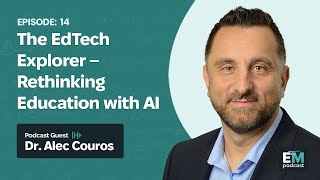
Episode 14 - Dr. Alec Couros: The EdTech Explorer – Rethinking Education with AI




Online Learning in a Hurry Guest episode 6 - Alec Couros - Student's in spaces