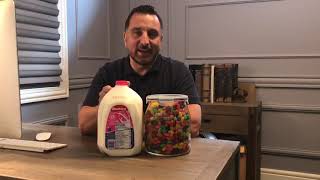
Short video by Alec Couros (professor, University of Regina) introducing a jelly bean estimation experiment to test the “wisdom of crowds.” He explains the Surowiecki jelly bean example, shows a roughly full 4‑liter jar of jelly beans, and invites viewers and students to submit guesses via a Google Form so the class can evaluate whether aggregated estimates outperform individuals.
Chapters
Hey everyone. My name is Alec Kouros and I'm a professor of educational technology and media at the University of Regina. I'm currently teaching a graduate course on social media and open education. And one of the things we're discussing this week is the idea of the wisdom of crowds. The term was popularized by James surowiecki in his 2004 book. And one of the experiments that he used was the jelly bean experiment. And the idea was basically he had a jar of jelly beans, something like this. People guessed the number of jellybeans that were in the jar and the estimates, sorry, the average of the jellybeans was closer than just about every individual guess. So I'm going to show you this jelly bean. I'm hoping to do the same thing here. I'll show you the jar of jellybeans. This is what it roughly looks like. You can kind of see the top a little bit. It's not quite full, but pretty much full. Got a Canadian jug of 4 liter, 4 liter jug of milk. It's not from Ontario like a bag, but it'll do. You kind of get a sense of size 4 liters of milk there. I will post some images as well, but the idea is I'm hoping for you or anyone out there to guess the number of jelly beans in the jar to make an estimate. I've got a Google form set up for that. If you've got students or kids, feel free for them to connect as well. They can also make a guess under your name. But really I just want to find out if this entire, this experiment is totally bunk, if it makes some sense or if there's some, there's something to this. So I'm hoping to learn more about this with my students and I'm hoping to learn from you. So this is where it's really vital for you to make a guess. Spread this, spread this around and hopefully we can get a lot of guesses to really figure out whether this works or not. Thanks.