Professor Alec Couros: "The Connected Teacher"

An interview with Alec Couros, professor of educational technology at the University of Regina, discussing the importance of social/networked learning, visualizing personal learning networks, and practical classroom strategies for making meaningful online connections. He describes course practices—building networks, a self-directed "learning project", and a "summary of learning"—that make student learning visible and emphasize relationships over platform tools.
Chapters
We're here with Alec Kouros today, who's in Regina, Canada. And why don't you introduce yourself, Alec, and we'll get on with it.
Sure. Hi, Howard. My name is Alec Kouros. I'm a professor of educational technology and media at the University of Regina. I've been here about 13 years and I guess my most recent work, probably in the last six or seven years, well, actually a bit more than that, is looking at social networks in teaching and learning. So that's, you know, connected learning, network learning, whatever you want to call it. The idea that networks matter in education, and they're probably one of the most important concepts, I think, in looking at teaching and learning in the 21st century.
What do you mean by visualizing open networked learning?
I wrote a post a while back, I think you've read it. The idea that, that we really need to get a sense of what our networks look like and how they work together to allow us connections. I mean, the connectivist problem that George Siemens raises in his theory of connectivism and what a lot of other people have created around personal learning networks or personal learning environments, whatever way you want to look at it. In visualizing networks and network learning, I think the idea that it's important for us to get a sense of, first of all, the tools around us. In my dissertation in 2006, I developed a little network teacher visualization, which I've adapted to and many other people have adapted around, rather than network teacher, network learner. I think those things go hand in hand. But first of all, really understanding all of the different types of tools that we can be connected to, whether they're microblogging tools, social networking services, whether it's even IRC communities, or if you look back at some of the more classic Internet communities, but all of these tools, I guess in some way mediate connections. The thing that I was probably a bit naive back in the day, and maybe I wasn't naive, I just wasn't ready to embrace at the time was just how important that again, it's not just about the tools, but moving in towards how these tools mediate connections and that really the people behind those tools are the most important. I had the wonderful chance of being at my dean's retirement last night, and one of the things that he talked about, he talked about walking through the field. He had a farm when he grew up and he had all of these different buildings around this farm. And he goes back now, today, and all those buildings, when he walks, he doesn't even own the farm anymore. But all of those buildings are down. And that playground of his youth is totally gone. The barn. And there was probably, he said, about half a dozen different buildings, and all those things are gone. But when he digs through the earth, he'll find things like perfume that he remembers women putting on and things that you'd put on your heel so that your heel wouldn't rub off, and different things that he kind of buried in the dirt. And he asked the question, sort of what endures? And I think that's one of the most important questions that we ask ourselves is what endures beyond. You know, when Facebook and MySpace and those things dissipate, when they're gone and they're replaced with something else down the road. The human connection, I think, is one of the most important pieces. So the tools will come and go, but really the idea that relationships matter more than anything, I think is really incredibly important. And the question we should be asking around all of the networks and all the implementations of software that we put in is we need to focus on what we think will endure in the future. And I think that's really a big part of visualizing networks and really focusing not on what connects us, but the connections themselves.
What kind of suggestions do you have for educators and students or just starting out about making those connections? I think your emphasis on making the connection is so central because I think without further instruction, a lot of people think, well, I'll get a lot of Facebook friends and I'll follow a lot of people on Facebook, on Twitter. And it's not really about the numbers, as I'm hearing you say it. It's about the connections. How do you do that?
Well, there's a number of different ways to read social network data. There's a lot of great tools out there that allow to. So if I decided to find a list out there that says the top 50 educators to follow on Twitter or whatever, you can easily subscribe to those people. Then you use a paperly tool to aggregate all that data. Then you've got a daily newspaper. You don't even have to go out and connect. Now, that's one way of certainly retrieving and getting some of the most important data of the day. But until you actually connect to one of these people, like doing what we're doing here, to have that memorable moment where you actually have a conversation and dialogue. If those tools no longer exist in a couple of years, I'll remember that I had a conversation with Howard, and I think that's what our students have to do is go beyond that actual connection. Go to a place that you've built a relationship that you are willing to find another tool to connect to that person. If that falls apart, you're going to say, I wonder where Howard is today. You know, Twitter is gone. I remember we used to contact on Twitter or Skype. But to build that connection that you would feel comfortable enough having a coffee with a person or talking deeply about their students or your students or so on. And I think that's incredibly important is that we can use tools for that data gathering, that social data synopsis and aggregation and those sort of things. But this one to one piece, the Google hangouts that I know a lot of my colleagues are using, where they'll just spend time together. DS106, I mean those radio connections. I know that DS106 is a thing, but it's much more than a thing as in radio. It's a community. It's a vibrant community of people who have connected online and who spend time face to face now because of those online connections. And I think that's so central to this. So with my students, I mean, and I could step back a little bit. One of the things that I've done in my class, and I was inspired by Dean Shresky in this is something called the learning project. So students will seek out a meaningful question, something that they want to learn online. So in a lot of cases they go to things like musical instruments. I had one student create mukluks because it was part of her cultural background and she never had a chance to do this. So often artistic or musical things. But really, to me, it's any question worth answering. And so what they'll do is they'll form network connections. Of course they'll read the Internet in a more consumption model, but they'll also form Internet connections and they will find ways to learn these things, whether it's on YouTube or whatever else. A multitude of resources and tools. But at some point they actually. What often happens in these projects is students will actually spend some time face to face. So the person who wanted to research mukluks, she actually found an aboriginal elder and she spent time with that person, learning the craft from that person. But the Internet mediated that connection. And that was interesting. Part of that project again is also retelling that story. How did I do this? Sharing what you've done. And I think the telling process is so much important in terms of the teaching process. So reversing those, what's more, central learning to become A teacher. Learning to be a teacher, I think is important. So reversing the priority of those two intertwined activities I think is really important. So primarily, I want learners, really strong learners in my class. And those people will be the great teachers. And I think making your learning visible is incredible. And that's one of the things that Dean Chereski and myself asking those questions. We asked two major questions in our class. How are you making learning visible? And how are you contributing to the learning of others? And I think those two questions are central to anyone learning in the digital age.
You had a great exercise about making learning visible that, you know, I think the best stuff is so simple when you see it that you think, well, why didn't I think of that? And why don't you just share that? Because I think it's so useful.
So which one are you referring to?
This is one where you're going to ask your students to learn a skill concept idea.
And that's the learning project I was just discussing right now. I mean, creating mukluks. Creating. Oh, I think you may be talking about something slightly different. There's also something called. It's a summary of learning, which I think may be a little bit different. So there is the learning project, which people just basically decide to learn anything and then share that learning online. But I also do something called a summary of learning. So at the end of the class, at the end of the course that they take with me, they do a summary of learning. I've had some really interesting ones. One I can share with you is a guy by the name of Matt Bresciani. And so what he did was he actually created a Mario Brothers styled sort of video game which was really, really cool. And he basically used Mario Brothers like the game as a way to actually share how he learned during the class. So that was his mode. I mean, he used video gaming and then he actually created screenshots. Every single screenshot. Like he created a video game animation using Mario Brothers. And then in it he basically showed all the connections that he made in class. Like he showed when he was bouncing up on the bricks, he'd actually show these little flashes of all the people he connected to, which is really neat. But what was more important about that, he created this 45 second animation, which was really a lot of work. And then he goes in right away and he decides to explain how he did it. First of all, this is what everything meant in this video. So he slowed it down, showed every symbol that he used in that video. So it was really good. And then he created another blog post that says, okay, you want to know how I did this? This is how I did it. So not only here's my learning, here's what my learning meant, and this is how I perform my learning. So it really is deep in terms of anyone else who wanted to create something like that. And so that was another project. So the three central projects in one of the courses I teach, the undergraduate course I teach is, number one, creating a network. That was sort of their big project. So with that, they blog, they try to get comments, and I think one of the most important things is that they. They comment on others, they connect on Twitter, they use hashtags, and so on. So that's a big thing. The learning project, as I mentioned before, is the idea that they will learn anything, but they have to share their learning online, but they also have to sort of document their learning as well. And then that final thing is at the end of the class, they do something called a summary of learning, which again, summarizes all the learning that they did in the class or selected learning that they want to talk about. But again, it all comes down to the idea that we want to make your learning visible. And of course, a lot of the learning that you do in the class is because of or due to the network connections that you create.
You know, I love the fact that we've been talking for, what, 10 minutes now, and we've used the word learning a hundred times, and I don't think the word education has come in once. And I think that's a good idea because it's, you know, in education, we expect people to spend all day learning, and it's surprising that so little time is spent reflecting on. Okay, so what does that mean to you? So thanks for making that visible, Alec.
Well, thanks, yeah, I really appreciate the time to talk about this, so thanks a lot. Thank you, Howard.
More from Alec
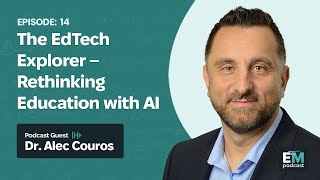
Episode 14 - Dr. Alec Couros: The EdTech Explorer – Rethinking Education with AI

Online Learning in a Hurry Guest episode 6 - Alec Couros - Student's in spaces