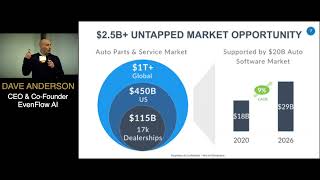
David Anderson - CEO & Co-Founder EvenFlow AI

David Anderson runs EvenFlow AI, which uses AI to schedule car service appointments at dealerships. The startup serves 120 of 17,000 U.S. dealerships and grows 170% year-over-year, charging $10-30k annually. Traditional calendar scheduling misses variability in repair time and technician skill, losing dealerships revenue.
Chapters
Welcome to another Founder Wisdom Pod. We have David Anderson with us today. He's the co-founder and CEO at Evenflo AI up in Chicago. Dave, welcome to the pod. Tell us a bit more about yourself and what you've been up to.
Yeah, thanks Charles for having me here. Um, yeah, so we're working on, uh, Evenflo AI, which is helping, uh, auto dealerships, uh, really improve the revenue and, and the operational efficiency of their service There you go.
Uh, what do you guys, uh, do specifically? You're specialized for dealerships, right? And if I use your software, what would I use it for? Let's start with that.
Yeah, so maybe, uh, first of all, we're B2B, so our customers are dealerships. But, um, from a consumer standpoint, maybe zooming out, like, what, what are we trying to do, or why does any of this thing matter?
Yeah.
So from a customer, I'll just take it at the most root level. Like, if you think about like car ownership, right, it's one of the most empowering things you can have, right? It gets you efficiently to, you know, A to B, to work or to, you know, groceries. So managing your social life, right? So car ownership is super important, you know, in your day-to-day life. Um, and then it's actually, uh, the single biggest or the second biggest, uh, purchase that most customers have. Like, if you own a home, that's the biggest asset. A car is number 2. If you're renting, a car ownership's the biggest asset. So it's really, really important from that perspective too. And then, um, what's been going on in the industry is the average car, uh, ownership is now— it's steadily been increasing over the last 25 years. An average, uh, age of the vehicle on the road is 13 years. Um, some of that's due to just manufacturing's been improving, but the second, uh, real driver of it is affordability. And most new cars, especially with the US, uh, manufacturers, like the, the cheapest price might be $50,000 or $60,000. That prices out a huge part of the segment of the population. And so that's driving this ownership And for, you know, extending it to longer and longer. And, and just like anything that's mechanical, in order for you to extend the life of it, you have to properly maintain it, right? It's like an air conditioner, oven, right? Like you gotta do the things to make sure that you extend the life to it. So from that perspective, that's what matters for the consumer. Now, from the dealership perspective, and this is just for any repair, but like we're focusing initially with auto dealerships from, that segment. Service revenue is about a little over 50% of their profit. And it's the way that they, it's their lifeblood of customer engagement through the lifecycle to help sell the next vehicle to you. So it's super critical, but the way that they've been managing the shop flow or the work—
Yeah.
The workflow is super inefficient and they're probably getting maybe about, you know, 65, 70% of their revenue potential by the way they're managing it there. And we're trying to change that dynamic of how they manage their shop flow, um, and then that gets better production but also has big impact on the customers themselves.
Right, so you make it more streamlined, more efficient. Is it like a CRM type of software? Is there like follow-ups to the client as well? Tell me a bit more.
Yeah, so there is some, you know, uh, engagement demand generation, but at the core it's like a— it's a shop loading optimization through executing of scheduling appointments. And so traditionally scheduling appointments have been simplistic of like just fill in a calendar, but what that approach does, there's too much variability and unpredictability in managing the flow of the shop. So what I mean by that is Variability is like, well, if you have a diesel engine, like you might need a different type of technician, you know, specialization than if I have an EV, right? Or if you just want an oil change versus I have a transmission repair, right? So there's, you know, variability in the skills required, but also the time to execute any of these services. You know, it could be a half hour, it could be 5 hours depending on the request. And then there's a lot of unpredictability. There, and, and maybe the best example of it is, uh, what people schedule for doesn't equate to what they leave on their repair order. So if you've got 10,000 miles on your vehicle, schedule an oil change, you're likely going to leave with just an oil change because that's what you need to do at that stage for proper maintenance. If I've got 80,000 miles on my car and I schedule an oil change, almost certainly there will be other things that I need to have performed with my car for that proper maintenance and extend the lifetime use of my vehicle. So we both might schedule an oil change, but like, what's the demand or the capacity that's being, you know, consumed for our appointments could be very different. So you can't just fill counter slots. It's really like a supply-demand optimization. And the way I think of it is it's almost like We want to load the shop as like a conveyor belt of work into the shop that flows in where there's capacity. And so what happens today with just sort of the calendar slots, you know, the simplistic approach is, uh, traditionally is like there's logjams in the morning. And so what happens in those logjams is, um, uh, the dealerships are worried about customer experience. They know you came in an oil change, it's 2 hours later, and they're worried that you're going to be very upset. So they just say Charles, we took care of the oil change. You know, your brake pads are, you know, they're pretty worn, but you're okay. We'll see you in 6 months, right? That's not doing you any favors. Um, or they don't even bring up, like, say, the transmission fluid service you should do to maintain the, you know, your vehicle, uh, safe operation, lifetime use of it, because they're just trying to move you through there, right? And so what, by doing more of this optimization of the shop flow, we're pacing the demand in Where the dealership can be more accurate of, um, in the promised times or the cycle times for the customer, but also give, you know, enough time and space to have the conversation of like, Charles, you know, you're due for this transmission fluid service. You told me you want to own this vehicle for another 10 years. Here's the value of doing this service right now. And, and then put the choice back onto you, right? Like, do you want to do it, uh, or not? But at least have that like— expert conversation about like the value of it instead of just rushing things through, right?
Um, what's the scale of the business right now? How much dealerships, how much shops do you have right now? And, uh, typically what do you charge them?
So we're, um, uh, we're over 100 dealerships. I think we're, we're getting close to about 120, uh, live. Uh, put That in context for people, there's 17,000 dealerships in the US. So we're still sort of at baby steps of trying to get market penetration there. And then, and then from the core service, you know, generally speaking, you know, we're priced competitively within the marketplace. These types of services, depending on size, can range from like, um, you know, $10,000 to maybe, you know, upwards of $30,000, you know, annual costs, uh, which is pretty standard within, within the industry there.
Does it depend on how many, uh, mechanics actually use the platform or how many customers use it?
So we try to, uh, have some basis of, of volume in there because obviously, like, if you've got, um, you know, you're only doing 10 repair orders a day versus you're doing 200, right, there's a different set of complexity, um, and also support we need to do if you're very large versus you're small. So we kind of have tiered pricing based on the volume associated with that and the complexity there.
You've run that business in 2019. How did COVID affect the business?
So, um, it actually— so there was no effect in the sense that like, uh, We formed it in 2019. This was, uh, kind of a part of our story where we were working in a similar company in healthcare, and in 2019 we were, um, right getting ready to think that we're ready to exit. We're thinking what's next. So we formed Even Flow just to study this space for a while. And so we kind of just, um, did, um, market research, you know, had lots of conversations, and then we, we eventually, um, Really built an MVP in late 2021. So in that COVID period, we were just in like the research mode, so it didn't have much impact on us.
Right. Um, how has the business grown since that time? Uh, has it been 1.125x per year? Has it been 200% growth each year? Like, tell me a bit more.
Yeah. Um, So this has been, uh, we've gone sort of like, uh, start and stop. So, uh, uh, right now we're growing, you know, around say 170%, you know, so we got a decent clip that's happening. Um, we've been steadily increasing our growth rate over time. Um, but, um, one of the challenges is that, um, we're like a new way of approaching the market. We're a new class of solutions. And so there's There's awareness and adoption curves that we're trying to get, you know, past people using like 20-year habits. We're trying to break that. So we're gaining momentum on that education and awareness. And I think we're only gonna just see growth kind of like double and triple here moving forward.
It's been your highest grossing top of funnel initiative. How do you get in touch with these dealerships and shops?
So, um, there's really been 2 main leverage points. Uh, first of all is, uh, historically just word of mouth from dealers. So it, it's an interesting ecosystem in that, um, you know, everyone's like 1 to 2 degrees separation, um, removed, and, um, there's a lot of cooperation and, uh, peer-to-peer, uh, networking within the, the industry. And so when we, you know, when you solve a problem for one, they often will recommend you to another, you know, in their inner circle. So that's been a really powerful lever for us. And then the second lever has been partnerships with the, uh, a lot of the AI scheduling agents out there. So these are the voice chat AI agents. And so what they are is a labor efficiency play, you know, to handle that customer interaction. And what we are is sort of the decision logic beneath it and revenue optimization. And so there's a synergy of us working together, and that partnership has been proved to be pretty effective for us with go-to-market.
So partnership with who? Can you specify? Like, I love partnerships right away, but tell me a bit more about that.
Yeah, so Out there in the market, there's like, uh, this is part of the noise or confusion out there that we're always trying to like clarify our positioning, but there's, um, AI voice and chat agents that are there to, you know, um, really their play is to replace out the call centers that the dealerships have for, you know, inbound, outbound calls or after-hours support with, uh, phone calls. And so they've been making a lot of, uh, inroads in the marketplace and adoption, uh, and part of their core function is, you know, they're replacing out these humans to schedule appointments, right? Um, so what we are behind the scenes is really that decision logic that's, um, powering— almost like think of it as like the intelligent call script for those AI agents, right? Instead of, um, them kind of— they're handling the voice interaction back and forth, but through our API integration, we're telling that AI agent, hey, offer Tuesday at 9:00 AM, or with this request, we can offer a rental car or a loaner car, or with this request, it's drop-off only, right? So we're giving all that intelligence behind the scenes for the AI agent to manage that interaction.
This year, your priority as a CEO, is it still sales? I heard that you were fundraising as well.
Yeah, so I think, uh, uh, like with many, you know, solo founders, like you always wear many hats, right? So, uh, um, sales is, is always, and I think will forever be, like a core, you know, uh, job description, you know, for me. I think it evolves over time of where my role is, but it's still super critical, uh, for me. Partnerships and building out that network has been another key objective. And then, um, uh, yeah, fundraising, you know, where we're, um, it— we're definitely actively trying to, uh, raise some more funds here, uh, to help fuel the next stage of growth.
Okay, and fundraising, have you fundraised before and why now, like 6 years in the game?
Yeah, so we've gone through a few different stages of fundraising, you know, initially sort of, you know, myself and the other inner circle that, you know, where we broke ground on, then friends and family, you know, type of. And then we got a— most of our fundraising to date has come from like the dealer owner-operator cohort, so our customers, which has been really impactful and powerful, you know, for us to, uh, develop the product and go to market there. And so we're just at another stage here where we've been growing, but we're still a very, like, skinny team. And, um, every day it feels like we're leaving opportunity on the table, and it's a race against time to try to really, um, build out scale, I think, and capture this, uh, white space opportunity that we're in right now.
Got it. Um, I'm asking because fundraising is hard. Do you have like existing, uh, a network, right? Like what will be your main system to fundraise and reach your multi-million dollar goal?
Um, so some of his existing network, you know, I, I think, um, what I've been doing, you know, whether we're actively fundraising or not, like There's networking with different, you know, institutions that we just have, you know, regular check-ins of just like, hey, this is where we're at. So kind of building a network of, um, you know, uh, potential investors who are, you know, just tracking us. So that's, that's one angle. The dealership, uh, owner-operators continues to be like, uh, you know, another angle of where I'm, I'm constantly going to. Um, but it's like anything, you know, um, uh, unfortunately, as a founder, you know, solo founder, you, you wear many, as I said, many hats, and you probably— each hat never feels as optimal as what you would want to if you could focus more time on it. I think there's, you know, a lot of opportunity of I could optimize that better, but I could optimize sales, I could optimize partnerships. All these things could be better if I could focus.
I love that. Um, what's been challenging about running that business? Uh, getting adoption in these shops and dealerships can be sometimes hard. Maybe requires you to step in and shake hands physically, right? Like, has that been challenging?
Yeah, for sure. Because it's, um, I'd say a couple things here with, uh, one is that change is hard in any walk of life, right? Like, change is hard. And then, uh, trust is, is critical. And the Unfortunately for the dealerships, I think that as an outsider coming in, you know, a lot of vendors have burned them in the past and with false promises. And so then they're just a little bit skeptical. So I always look at it as we're 50% software, 50% people. Like, we've got to earn their trust and that we're really a— our capabilities are real, but we're a— their tool, right? We're their enabler. We're not taking something away from them with our own agenda. And the only way you can do that is through, you know, uh, people interactions and, and, uh, really getting that trust established.
Trust, right? Like, I guess partnership is always great, but I think like running a podcast personally is, uh, is great for that because people can see you all the time. You interview your own ICP. You scale trust and have conversations that are often behind closed door, but you have them publicly, right? So that pretty much like your prospects can know that you're you're the same breed and you're trustable and you're authentic and you're there daily. I think that would probably be my my main one. Of course, people would say like case study and existing clients, but the podcast system you can use it to. get new clients. And the more clients you get, the more testimonials you get, the more market research you do, right? So what do you think about that one?
No, I, I'm definitely in, you know, intrigued with that because, uh, what's it— what's always interesting is, uh, our dealer customers, they always explain EvenFlow in their own words in a way that's like, um, even more effective than anything like I do, you know, because they just speak the language to their peers in a way that kind of hits home. And that actually establishes huge trust when someone can hear it in the language they use.
Do you have co-founders for that one? Like, why are you guys a good fit, a good chemistry?
So there was an initial core people that kind of like we broke ground not knowing like who was interested in Working on Evenflow or not, but really starting in 2022, it's it's kind of been me alone of like driving the ship here. So in that way, I pretty much operate as like a solo founder.
You're also like a university professor at the same time.
Yeah, that that's a although that's not much of a taxing thing. That actually was a big part of my COVID experience because I was. helping out with resource optimization with ventilators, beds, all the things associated with COVID And I got pulled into that from Northwestern University, City of Chicago, State of Illinois. So that, that was, as my wife kind of jokes, is like, you, the world shut down over COVID and you worked harder than I've ever seen you in like 4 months. So.
Yeah, I mean, how do you manage with all that stress? You know, like, do you have systems to let the steam off? Like me, it's physical activity, I would guess. Saunas.
Yeah.
About to have a big old good sauna today. Cold plunge.
Yeah.
I can fall in the immediate meditative state if I'm in a cold plunge, which is odd, right? Because at first you freak out, but with time your body like releases gigantic quantity of dopamine. So what's your steam-off system?
Well, I'm curious on the cold plunge. Did, did you have to build into that or did you literally just like, I'm all in?
And yes, no, no, it's not all in. And, uh, I guess my main tip for that, I've been taking like, uh, cold showers for years now.
Okay.
Um, yeah, so I always start my shower cold, but it's after workout, so my body temperature is higher and it actually feels good. And I'm in Mexico, right? I forgot where you were, but US.
Chicago.
Okay, yeah, no. Chicago is cold as hell. It's like it's like Montreal, right? I'm from Montreal. But no, I mean talking as well to other entrepreneurs help, right? Like I have Sunny as a co-founder, Emiliano, people that share my same DNA, right? Like. Commanders on a battlefield, sort of because you can't talk about business or foundership with most humans; they won't understand it. Yeah, I mean, my wife is an entrepreneur, but it's such a different business like photography, right? So even if I tell her stuff, she won't probably understand or like fully get into it, right? So I guess like, I have masterminds I run as well that I talk to like other founders and CEOs, but. No, you got to have a mechanism, else you just implode, right?
Oh yeah, yeah. I would say, um, I, I probably need to do better on this, but I think my anchor is, uh, you know, I definitely have network that I try to talk to on various topics, but like, um, my wife and family is the core. And then, um, if there's anything that we, we do, uh, my wife and I is actually, we're avid pool players of all things. But, uh, like, that's my, like, mindfulness is just zoning out playing pool for a couple hours with my wife. So.
I love it. Pool is, uh, it's great. I mean, it's not physically exhaustive, but there's a lot of strategies and there's a lot of focus required, right? So it's— and, uh, yeah, it's like you need to think of your next move, right? Just like business. Yeah, about just putting that ball in. It's like, what will happen after this ball goes in, right? Yeah.
Yeah, actually, you know, when I first started playing, this guy that was a real expert, he said the most basic advice, which is hard to do. He's like, I never take a hard shot. Why would you? And that was all because he put the cue ball exactly where it needed to be because he thought about one step ahead. So he'd say, hey, that's a great shot. That was really hard. Why'd you take it?
So I guess the greatest entrepreneurs think that way, right? Because entrepreneurship is so hard. A lot of us, we just focus on the very next move, but I call it like going meta, right? So you go, it's like Russian dolls, right? You go at the macro level and then you go macro. You think ahead, right? Of, oh, I'm starting fundraising as a service. Why? Because I'm starting a VC firm, right? And now I'll raise for others before I can raise for myself. And then VC firm is like, I get the full financial metrics of a bunch of companies. So that makes me smarter at business and I can start a behemoth after that. Plus I can grow my network, right? So it's like, it's always one thing that leads to another, like stepping stones and, or a staircase. You could view it that way.
Yeah, I always think of it as like, you know, climbing like mountains, but over hills is like if you move up one step, You don't know what other 4 steps could like open up, but you can't see it unless you take that step. So it's like moving pieces down the— or, you know, the analogy chessboard to see what opens up as you keep progressing, you know.
Oh, tell me about it. I'm an ultra runner, right? So like mountain is like, uh, is my spiritual animal.
Yeah.
Um, so yeah, sometimes it's so steep you can't see shit, right? And at one point you need to focus like one step in front of the other, right? And once you're at the top, you can admire the view, but like for how long, right?
Yeah.
Because you need to keep going and it's always the next thing, right?
Yeah.
And I think that's a disease, but it's also like a blessing as an entrepreneur, right? Like it's never done. It's not about like reaching the destination, it's about the journey, right? It's like we're— and I think that's fundamental if you want to be happy in life and if you want like true understanding of the game, Nothing is finite in life. You never reach a destination, right? And it's like people that say that AI is a finality. Well, humans are going to evolve with AI, right? We're going to intertread and co-evolve into this. And yeah, there's like nothing really finite. I don't think for that reason AIs can fully slash all jobs. I think it can replace a good part of jobs. And I do think that a bunch of humans would rather arrive at the destination and not do nothing, right? Yeah. But yeah, what do you think about all this?
I think, you know, with AI, well, first of all, what you said about, you know, the destination, or you're never complete, I like, yeah, that's life, you know, and it's continuous. And, you know, if you don't like what happened in, you know, the last day, the last year, or whatever, well, you always have the opportunity to do something different right now. Right. And so it's just that, that's, that's life. It's continuous motion. And, um, I always think like movement is life, you know, you just got to keep moving, um, and then you see what happens. Um, you know, with AI, it's, um, I think this is, uh, you know, I answered the questions you sent over. I, I think, um, it's an uncharted place because this is the first invention humans have that Like, we don't fully understand the use of it, right? Like a hammer or a wheel, right? You know, like, we understand that, you know, mechanics, but AI, like, it— we don't really understand it fully. And it's accelerating, you know, faster than we can keep up with it. So it'll be weird. It'll definitely be weird in a big dynamic environment in the next 5, 10 years where we end up.
I'll be pretty crazy, uh, but I'm in for the ride. So are you. I think it's our most, uh, crazy founders. Um, Dave, where can people find out more about you?
They can go to our website. It's, uh, evenflow.ai, or you can email me directly at davea@evenflow.ai. And, uh, yeah, I'd love to hear from you if anyone's interested in talking. Was Dave and Charles for another
More from David
UCDP #88 – Smarter Shop Loading: Fixed Ops Capacity, Recalls & Recon w/ Dave Anderson of EvenFlow AI
Tully Williams and Dave Anderson of Evenflow AI with Sarah Vantine at Ted Ings' Fixed Ops Roundtable
Evenflow AI with Dave Anderson, Sarah Vantine & Ted Ings on the Fixed Ops Roundtable Rock Revolution
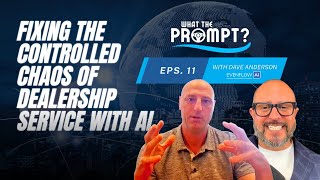
Fixing the “Controlled Chaos” of Dealership Service with AI | Dave Anderson, Evenflow AI