Why Saturdays Kill Service Revenue: With David Anderson
David Anderson, CEO of Evenflow AI, applies airline revenue management to car dealership service departments. His model predicts extra service time and schedules technicians like a Tetris game to fill gaps. Saturdays are the killer: customers and staff both avoid the shop, tanking revenue.
Chapters
Hello everybody, I'm Russell Hill. I'm your host at WTF, and that is What the Fix stops to all of you out there today. Glad you're here, and I'm joined today by Hello everyone.
I'm Charity, your co-host here, and we are joined today by David Anderson. David is the CEO and co-founder of Evenflow AI. David, welcome to the show.
Yeah, thanks Charity. Thanks Russell. Excited to be here. Yeah. Yeah.
Welcome. Uh, tell us a little bit about you and what you do. Okay.
Yeah, great. So, uh, As you mentioned, I'm CEO, founder of Evenflo. I always like to say, uh, preface it as like, I'm, I'm not of the auto industry. I'm still a baby by everyone's standards here. Academic by training, I have a PhD in applied math. I left academia and then, uh, ended up at United Airlines for a number of years and, uh, 14 years ago left, uh, United and started my own ventures with some partners, taking one of the few things airlines do really well, and that's sell every seat on a plane, and then apply it in other contexts. So we first looked at hotels, then golf courses, then most recently doctors' offices and surgery centers. And then a few years ago, I started Evenflo with the aim of trying to take some of those, like, learnings and best practices from those other contexts and apply it to the unique dynamic in automotive service.
When you say unique dynamic in automotive, boy, it is. You and I have had several conversations about that.
Sure.
That's wonderful.
Well, that's really interesting, David. How is automotive like filling the seat on an airplane or like a doctor's office or dental office?
So I actually think there's a lot more parallels with healthcare and, and, uh, but it, the analogies I like to use with healthcare, it's, uh, it's a little bit of a mix of, uh, an emergency room and a surgery center. And what I, uh, You know, talk about, uh, think about in the emergency room that, you know, the problem with the emergency room is like the average, like visit time is like 3 hours, which is almost like, you know, like oxymoron, right? Like it's an emergency. Why am I waiting 3 hours to get like, um, you know, treated? And the problem is, is there's 100% walk-ins and huge variability, you know, of what shows up in the shop. And, and that's those dynamics. like kind of trouble the service centers today, right? They get walk-ins, but then also huge unpredictability and variability of the work that shows up. And then on the other end of the extreme, like a surgery center, they're like a machine. They're like pit stop efficiency of getting these rooms ready for the next patient. But the advantage that they have is There's 100% appointments, right? Like you can't just walk up to a surgery center and say, hey, I'd like to get my ACL taken care of today. Right? Damn it. Why not? Yeah. And everything's known, right? There's no concept of an upsell, right? Like if I got my ACL surgery, like I'm not saying like, oh, doctor, like you're right. While I'm here, I might as well get my appendix out too. Right? Like you're, you're, you're there for one reason and it's known. And because of that, surgery centers can line up the resources ahead of time and plan for it, right? And that's what I would say with the automotive service centers, like what the need is, you'd like to run it like a surgery center, but you have this complication of like unpredictability and variability. So you need better tools to help manage that so it can be more like a surgery center.
I'm curious how you've tackled that. What, what kind of tools have you come up with to solve some of those problems that come into the dealership? You know, different cars come in, different scales of severity. How do you deal with that?
So I'll, I'll preface it. First thing is like, as a newbie coming in the industry, I just got a brand new notepad and asked questions and took notes of like how, how, how this works, right? And I'm still sort of a student learning of it. But, um, so there's a couple things that like fundamentally how we think about it though, is that first of all, like you've got this challenge of like what people schedule for isn't what they leave on the repair order. So I, I have like 80,000 miles on my Honda Odyssey and I schedule, uh, you know, an A1, B1 service, oil change rotate, right? I'm not leaving with that, right? Because they're gonna inspect it and they're gonna recommend, you know, additional services. So When we're scheduling an appointment, we, we use that as a baseline, but then we add on a prediction on top of that of additional time. Now, we don't know that we're gonna predict it's a coolant service, but we know that there should be more time, you know, depending on the context. And then we translate it back into clock time based on technician efficiency. So I call that like true demand. So at where we're treating every transaction or appointment request unique. And like predicting a true demand, and then we're loading it against the technician's schedule or the production capacity of how they like you know the staffing works. You know from when they roll on or off the clock during the day across the week, and so we're taking that and we're packing in like a perfect Tetris board. That's the goal there. And and then the other aspect of it is like there's got to be you got to have very specialized Tetris boards. So it's just not one right? Like Russell may be the diesel tech or you know Cherry. You're the EV tech, or I'm the only one survived on this hybrid cable recall. All those could be different Tetris boards that we're trying to you know optimize, and so that's the big you know maybe underlying framework that we're doing differently. And I always preface this just because there's all these questions about AI and prediction. But like we're 100% wrong on every prediction. Like I have never gotten anyone right. So it, like, I don't know if you're gonna decline all services, Jerry. I don't have that crystal ball. I don't know if Russell's engine has corrosion. I simply don't know that. But the way the framework works is that like if we're 15 minutes too high on car A and 15 minutes too low on car B, we still get the Tetris board right. And that's, you know, that still helps with the optimization there. So. That's like kind of the underlying framework there. Now, behind the scenes, I got all this other airline revenue management stuff that I'm ready to go with that, uh, I, when I first started talking to some service managers about, they're just like, what are you talking about, Dave? So I just kind of parked— Not from automotive, man. I'll tell you, it's different. I parked that for now. I'm ready to bring it back out, uh, when the time is right, uh, there.
So how did we find each other? I forgot.
Oh, well, I know how it was for me because I listened to your podcast and/or I've heard you on different podcasts. And so I just—
That's right.
Yeah. So for like a good portion of time, I'm like kind of an insular creature. So I just like listen, you know, from, you know, in my own like 4 walls. And then I think this year I just sort of motivated myself. I'm like, I got to start like reaching out and engaging the world. And so I just started reaching out to the podcasts that I like to listen to, and your podcast is definitely one of them. So.
Thank you very much. I'm gonna give Charity all the accolades for that one. So listen, welcome to automotive, cuz it is a different animal. And I, I, it's great that you see parallels, but how old is your company and, and what, what, what is it you're trying to accomplish? Yeah.
So I think, um, we've been around, well, I, I would say like, maybe there's 2 different ways to answer it is like, when we first thought about like entering automotive, that was like, uh, almost 6 years ago, but we didn't do much other than just study because I, I kind of assumed like, well, maybe it's all solved for, like, you know, they had all taken care of. And so we just kind of like studied it for a little while and then it got to a point where we kept passing tollgates of like, okay, I think there's a, You know, opportunity here. And then we really broke ground in earnest in about 4 or 5 years ago of trying to build it, you know, an MVP product for there. And I think at the heart of like what we're trying to do, Russell, I think we're, we're really trying to maximize technician productivity. And by doing that, we actually then can deliver a better customer experience. And then by doing that, we deliver a better employee experience. And all of this is like this virtual cycle, right? Like if you deliver one, it helps the other and they just keep, uh, the snowball's growing in a good direction, not in a bad direction with all of this. So.
Well, they're, they certainly need some help with scheduling. That's for sure. There's so many moving components. Charity, go ahead.
Yeah. So what made you come into automotive and say, You, you see a problem in a dealership and say, someone needs to fix this.
So I, I'd like to say like, this was some like grand strategic vision.
No, like, you know, come on, make it up. No, I'm just kidding.
Yeah. No, like we, we were, um, at a stage with the healthcare company where we were like, oh, we, we think we're gonna exit. And, and so this is an act. This is how good of a prediction I, I can be like. We were right that we exited, but we thought it was going to be 6 months and it was like 3 years. So I was a little bit off on that one. But we were like, a few of us were sitting around thinking like, well, what next? Because we've had, we knew there was different opportunities on this, like resource optimization, you know, throughout there. Like some people were asking us to do it for hair salons or financial advisors. And so I literally, I literally, it almost sounds cliché, but I had an oil change, you know, at my dealership and it took me like 3 hours. And, uh, I was like, maybe there's something here, right? Like, I don't know if it should take 3 hours. And, and so that kind of spurred the thought. And even the question, one of the first questions is like, well, if it is a problem and if we solve it, does it even matter? Right? Because there are some businesses where you could like 100% solve something for someone and, and they're just like, that is just like the rounding error on the rounding error. So I don't really care, you know? So that, that was like a first question. Is like, does anyone even care if we solve this?
Yes.
Yeah.
Yeah. I, I, I came to that conclusion of, you know, and I, I believe it. Yeah. It, it helps. Yeah.
Yeah. That's a, there's so many variables, but that, that's one of 'em. The customer experience in 3 hours. And let me guess, during that 3 hours, how many times did they communicate with you about the time? Probably not.
Not.
Yeah. Yeah. It's just, wow. Well, you, uh, you, you hit it and here you are now. And, uh, Charity, go ahead.
Yeah. Well, we've, we hear a lot about the troubles that customers feel when they go into their dealership to get serviced and it takes forever, or even just getting an appointment takes forever. So that's definitely an ongoing issue that has not been solved. And I know that you're all about AI, but before we get into AI, I wanted to ask you, what's one thing that dealerships consistently misunderstand about their own service operations?
Great question.
Oh, that's a good question.
Wow. Like, there's many more to come. Trust me.
She's—
I, I think, um, you know, the one thing that like is, is always like a, maybe not misunderstand, but like it, it seems like an unsolvable problem of the front of the house versus the back of the house. So they definitely, there's standard approach of counting cars, right? Like I'll take 4 at 9 or another 4 at 9:30. It's very much from the mindset of like, well, how much can my advisors check in and bring in the work? And I get it. Like you don't want 32 cars showing up if you got 4 advisors, you're just creating upset customers before they even get in the drive. But it's understanding that this, you know, the mismatch in the staffing and that if you solve the front of the house, you're actually like killing the performance of the back of the house and that's how you make money. And so I think it's understanding possibilities of how you can thread that needle. That's probably the biggest thing that I would say is consistent across each dealer.
So let me ask you this. You spent years studying predictive analytics and what's a decision dealerships are still making with, uh, gut instinct that should probably be data-driven? Gut versus real data.
I'll say this with service, uh, kind of continuing this, like the service managers who are using data, but they're not like as sophisticated or they don't have the tools that they need. And so They'll say, what I call is like the law of averages. They'll say, hey, you know, Dave, I got 100 hours of production capacity. Each RO is 2 hours, so I need 50 cars, right? And I'm good. I'm loading on my production capacity. The problem is, is there's huge variability. You know, one, a car is not a car. So if you, you know, zoom out over 3 months, that's perfect. If you zoom in any given day, You're like, it's feast or famine. You might've loaded 125 hours and then the next day, 75 hours, right? All on the same premise of the law of average will work. So it's kind of like you started the math problem and you stopped too soon, basically. Or they didn't, you know, have the tools to continue the math problem.
It's amazing that if my numbers are right here, that So all the cars that, particularly in major markets, all the cars that line up every day, 75% of them are there for oil changes. They're there during the warranty period, et cetera. And then you have all the other unknown variables that come into play, these swings that you're talking about, and they're really, really vast and they're being overwhelmed. And the next day they don't have anything except oil changes. And it's only during the first couple hours. After that, they're out of there. So what you do is you take all that data and you're able to come up with a prediction and training and help them be much more efficient at what they're— some places you need an appointment. What the hell do you need an appointment for? You're gonna end up waiting 3 hours. What do I need an appointment for? I need an appointment to wait 3 hours or, you know, and of course this creates, this creates the beginning of the end of the 7 out of 10 people that have defected by the time the warranty period's up because of those types of experiences. So. What, what your company does is help all that scheduling hopefully slide, but you gotta get a tremendous amount of buy-in too, don't you?
Yeah. I, and I always say it's, uh, we're 50% software and 50% people because, uh, what we need is a service manager. Uh, we have to earn his or her trust that we're actually their tool, right? Like we're trying to bring their vision at, you know, scale of math and, and automation and software and data. And, and, and that, that, that's a person-to-person interaction.
Yes, it is.
And it's a partnership or, uh, I, I can't, I, I gotta get a better example, but I always just say like, we're like a caddy. Like we're, we're there supporting them. We're not there You know, it's their game that we're here to make, optimize their game for 'em.
So.
Do you find that when you're sitting down with whoever he or she is, and are they seeing predictable patterns after spending time with you that they didn't really give it much attention or really didn't understand that maybe they start to see there, there is a light at the end of the tunnel?
Yeah, definitely. And it's also like, it gets 'em to think about things And it's always validated with them experientially. And I'll just like, as we start building trust, I'll give you like one specific example, you know, with this one service center on like Saturday. And this has played out with other service centers. So I'd say everyone's got a Saturday problem. Their problem is just different.
Yeah.
But there's this one service manager we work with and trying to build trust and like, you know, he kept having like some issues with Saturday. Then we looked at the data and like our predictions were spot on during the week, but we were always overpredicting on Saturday. And then we started talking to him about it and he is like, this makes perfect sense. He's like, customers don't want to be here Saturday. It's sunny outside. My employees don't want to be here. You know, so they're declining everything, right? Uh, generally, which again, I kind of, I put it in like consumer side is like, all right, I got my like to-do list on Saturday. Eventually then I'm going to do it and then I'm going to go relax, right?
Yeah.
Sitting here an extra 2 hours at the service center is not on the agenda for the Saturday, right? So then what, you know, what, what do we do about it? Well, let's just start biasing appointments to Saturday that we know can be very predictable. So it's a Toyota dealer. So that's like really heavy up on Toyota Cares, you know, because it's going to be oil change rotate and there isn't going to be much upsell. And then we can get them in and out. And everyone's happy, right? And then the 60,000-mile maintenance request, let's skew those to the week because there will be upsell and it might work better with their schedule and not sitting an extra 2 hours in the service center. So it's like these types of things that we bring forward with the data, but then we're always validating it real world of like, does this actually make sense or is our models wrong?
I've never heard that.
And then we try to execute it.
Yeah, I never heard it actually put that way. It's not like, yeah, Uh, 'cause I, I get my oil change for my wife's vehicle at the Ford, but it's on Saturday at their Quick Lane or Quick Lube. But I'm there at 7:10 to 7:15 and they open at 7:30 because it is sunny out and I damn sure am not looking forward to sitting there waiting on, uh, et cetera. But it's just the routine stuff. And yeah, you're, you're actually right. Who, who in the hell wants to sit in the service department on Saturday? They've been working their rear ends off all week. It's sunny outside. They gotta mow the yard and do all this other stuff. And it's like, no, I get it. Wow.
But you know, at the same time, those upsold services, right? Like they're not capricious. They're, they're things that are in the customer's best interest, right? For safety or like lifetime value or, you know, operation of the car. So they should do it. It's just that We should schedule the appointment where the time works out, right? Like, don't try to cram all, you know, 2 hours of service in 45 minutes on a Saturday, as you said, Russell, because I got to go mow the lawn or I got to go pick up my kid at practice, right? Like, let's just do it in the, in the proper timeframe.
Yeah. Yeah. So I'm sitting there and the staff don't want to be there either. No, no, they don't. I'm sitting there and you, you find all kinds of recommendations. Like, really? Really? Okay. Well, I gotta go mow my yard.
Okay.
I mean, I, I don't have time for this. So just schedule that during the week.
Yep. Yeah, yeah. And so, you know, that's that one context, but there's other contexts like this where it's like, there's all these hidden gems about how to run the operation better, you know, uh, that, and that's what we're trying to bring out and execute for, you know, the, The, our, our dealerships that we support. So.
Yeah. So you're taking software and looking at the analytics of the service department and using AI to kind of solve these traffic problems in the, in the shop and, and triaging cars as they come in based on the severity or upselling or the day of the week. That's kind of the problem that you're trying to solve. Is that, is that right?
Yeah.
Yeah.
And so, and it's about like, like, uh, loading the shop with all these things in mind. And so, um, you know, so I'll give you another healthcare example. Like, uh, when we did things with the, you know, orthopedic doctors, like every Monday morning, depending on the size of it, right? There'd be like 2, 2 people showing up as walk-ins with a broken arm. And the reason is they broke it over the weekend.
Right.
Yeah. And you know, and most people would be like, well, is it really that bad? Do I want to go back to the ER? Like, I don't want to spend 3 hours on Saturday in the ER, so maybe it'll be better Sunday. And it's not better. And then Monday, like, shoot, I better get this figured out. Right? But it was always arms. It was never legs. And if you go back to the people, why, why, why would it not be a leg? Well, if it's a, you, if you really break your leg bad, like you can't go to the bathroom by yourself. So, you know, at some point on Saturday, whoever's helping you or yourself, like someone's gonna call, cry uncle of like, we're not gonna do this again. We better, we better go to the hospital. Right?
Yeah.
So like, so we, we would predict it and like, you know, factor that in. And then, you know, I was using an example with the CDJR service manager and I'm like, you got tow-ins every Monday morning cuz some, a car broke down over the weekend. Right. And they're just waiting for Monday morning. So that's like, account for it now. You know, historically, and we can look at seasonality, like maybe it's 2, maybe it's 3. We're going to be wrong all the time, right? But at least we're going to, like, something is better than nothing, right? Like if we plan for zero and you're, and it's never zero, like we're already like got you behind the 8-ball there. So those are like the things that we're looking at the data to try to like set up the operation the best possible way each day.
I have never heard it put like that. Uh, you know, your analogy on the, on the Saturday thing or, uh, the money. Yeah, those. And it's not like, uh, the thing is, no, nobody really knows. I mean, I've been in this business 41 years. I never heard the Saturday thing put that. Yeah. Who in the hell wants to work on Saturday?
Okay.
Who wants to sit there for 4 or 5? They're only open half a day. You're going to keep me there. Until you close and end up, I'm gonna have to get a ride home probably, cuz you found this stuff out. It's like, yeah, you can, uh, that, that's really gonna affect repeat referral and retention, uh, that in itself. So this is the kind of stuff you notice. I'm sitting here thinking, okay, thank you for sharing what you did. You're an analytics guy, uh, PhD professor and all that stuff. Of course, we've had those, that conversation. I am not that whatsoever, but it's like, okay, you don't even, It's like, okay, the field that Cherry and I are in, we we better know what the hell we're talking about. Okay, because the people we're talking to, you're approaching it from a completely different aspect. That you're looking for patterns and trends and and analysis and analytics to help with the sourcing. You don't have to be a fixed ops guru at all. It doesn't sound like not not the stuff that you're talking about. You're taking some simple stuff that I haven't even heard in forty-one years about a Saturday. I'm thinking, well, who wouldn't want to be a you know? Well, now I now. Now I get it. Okay. I got so much to do on a Saturday. It's not even funny. And, and, and if I'm gonna do oil change like I do, they try to make recommendations for other things. I said, I'm here for oil change. That's all I want. And, and I'm in and out in 45 minutes.
Yeah.
Yeah.
Yeah.
Because I'm first. If I'm third or fourth, I'm not.
Yeah.
And, and I think you hit upon, uh, like how I think about it is, uh, you know, I, I look for the service managers You're the expert. You tell me how you want to run the shop, right? Like if you could control the strings of every single appointment, you know, and where you would sequence it, tell me that algorithm. And then I'm here to empower. I'll bring the math or the software to enable that vision, but I'm not here telling them like, hey, this is how you should do it because we did this in airlines and I know better. I don't know better. They know better. I need them to tell me, you know, conceptually, and then we'll enable.
Yeah, I bet, I bet that works really well, honestly, because you don't, you're not from, and they pro— but you don't need to be. The problems you solved on that side of it bring a lot of validation and reinforcement to what you're trying to do. You're just trying to help 'em solve a problem, a challenge, and not only a chall— it's every single dealership has.
Yeah.
Yeah.
It's been, I agree with that. But the, this is the important thing that I got like, uh, you know, schooled on this lesson probably in the first 10 dealers that I talked to is that there's some commonalities, but everyone's got their own unique situation and we need to account for that. Like we have to bend around the operation, not ask them to bend around our tool. Right. And I have to understand that like, Russell, you've got 10 technicians, you're a Honda dealership, and they all have like 10 years of experience. So you're gonna run it a certain way. Cherry, you're a Honda dealership, but 10 technicians, 5 of 'em are straight outta school. So you would wanna run it differently. And we have to understand that and then work with you to accommodate those nuances.
So your stuff is that flexible?
Yeah.
Yeah. But I, I, I'm, I'm, you know, I always joke, like, I, I'm like, oh, I think we got it all. And then I curse myself and literally the next meeting is like, I don't have it all. Someone threw another thing at me and then we're like, okay, we missed something that's building, you know, more flexibility for these use cases.
Well, that makes you better because I don't know what it's like honestly in the airlines and stuff like that. But one thing in automotive, it's a moving target. It's changing almost daily. People's needs and wants are changing daily, et cetera. Charity.
Let me ask you, David, what do you think is the biggest hidden source of lost revenue in service operations that leadership is not noticing?
It's really, I, it comes down to this bottlenecks. And so the way they load the cars with like from the front of the house or counting cars, you know, what, like I, when I ask a service manager I meet the first time, I just like, how's business? And more times than not, they just say like, oh, I'm just managing the daily chaos. And it's because of the bottlenecks in the morning. And the problem with that is when we look at the data and we see that is unit production goes down. What I mean by that is dollars per RO, revenue per RO goes down. And what happens in sort of the physical world is like there's a backlog and they just try to move more cars through in the same amount of time. And the only way you can do that is to do less. Right? And so it's hidden. Like you just say like, oh, Cherry, you know, you came in and here's your 60,000 miles and we did an oil change rotate. That's all great. You know, like it got good CSI score. But what didn't happen was the other services that you needed to have done, you know, for safety or, you know, extend the lifetime use of your vehicle. And if the team had time, They could have worked with you to explain the benefit of it. And then that oil change rotate then becomes oil change rotate plus more, right? And so it's this unseen, like, performance killer because they just say, oh yeah, a charity came in, you know, check the box, right? But like, it could have been a lot more if you just give the team time.
I saw a video yesterday on LinkedIn and this guy went and got his car checked and they went through the whole checklist and marked, you know, everything good, right? And there was clearly a windshield wiper that was busted and hanging off. You could see it. It was clearly right there. And they had marked his windshield wipers good, even though it was clearly not good. So it definitely makes you wonder, are they even checking? Are they kind of rushing through some of these things to get it done and move, move people along? Because capacity is a problem. And so should Service directors think differently today about capacity compared to what they did 5 years ago?
I think the problem and the dynamics are the fundamentals are the same. Layer on what like Russell said is like their business is dynamic. So whatever you think it is like today, just wait, 2 people quit or you get a new recall or something, right? Like, but like the The fundamentals are the exact same as they were 5 years ago as they are today. I guess 5 years ago, maybe in that weird COVID, like put that aside, but like 8 years ago versus today or even 2 years ago or 2 years from now, the fundamentals are there. So you just have to approach the problem differently. And what I'm hoping is that we're providing a new solution of how they can, you know, approach that problem in a, in a Uh, more effective way.
So, excellent. Everybody's talking about AI right now.
Okay.
Oh, hang on. Before you go to AI, Russell, can I ask one more question? Yeah. Yeah.
Well, of course you can.
I, I just wanna ask, what have you learned from other industries to solve this problem? So is it a matter of creating different funnels? So as cars come in, they get put in a certain funnel. This is a 30-minute issue. This is a 6-hour issue. This is an overnight, multiple-day issue. Is it a matter of doing something like that, or what have other industries taught you?
So I think, you know, maybe the first thing I would say is to, uh, be humble. So it's easy as an outsider to come in, in any place and just say, hey, I've had some success somewhere, so I'm gonna tell you how to do this, right? And, uh, all it takes is going to the second industry and getting, you know, smacked upside the head of like missing all the obvious things. Like to have that experience once to know that the third industry you go into, the fourth industry is to come in with like a humble perspective of like, there's a lot here that you have to learn before you have the right to have like a reasonable conversation with someone else. On it. So I think that to me is like really critical. Then, you know, more specifically, part of the, I, it comes down to like, I bucket it as like predictability, variability, and then resource pools. So, you know, is there predictability? Like, are you a surgery center where like, hey, you can't just walk in? Like, is there variability where like a job is a job or is it not? And so when in automotive, you don't have You have unpredictability and you have lots of variability, so you have to have tools to address it. But then resource pools are really critical too of like, okay, like surgery centers, you know, although they run like clockwork, the resources for it are tremendous. You have like pre-op rooms, operating room, post-op. You have, you know, anesthesiologists, you have like nurses for pre-op, you have nurses post-op, you have people in the operating room. Equipment, right? So it's a lot of resources coming to bear. Automotive, you still have some of those resources because if you start thinking about, is it a loaner car or, you know, is the waiting room constrained so it's only drop-off or is it a recall and we only have so many parts for it, right? So you, or, you know, advisors, technicians capacity. So there's a lot of resources that need to come to bear and thinking about how do you You know, the right pooling of that and then optimizing it. So it's kind of like I start with those 3 questions always. And then there, you know, I probably, you know, I'd say I start on second base in any industry. Like, you know, I, I kind of got some tools that I'm bringing or tricks, but I have to then learn to get all the way back to home plate, you know, from there. 'Cause everything's got unique situations.
Every single one of 'em are different, aren't they?
Yeah.
Yeah. But you know, I think it's, uh, that's kind of what makes it fun is like, you know, it's almost like meeting someone, you know, from a different part of the world. I always find it's fun is like, what do you find that's common? You know, that's cool. And then what do you find that's like different, you know, about your experiences? And that's cool too. So it's kind of like the same way is like the mix of that, you know, of what—
Well, Russell, head into your AI question, man.
Well, okay. 'Cause everybody is talking about AI. Right. What percentage of what you're hearing is actually hype versus reality? It's a great question, Jerry.
I'd probably say 99 point whatever you want is hype because I think AI is a, it's gotta be a hybrid of deterministic and probabilistic. And why most of it's hype is it, they're leaning into this probabilistic. It's a prediction and you think LLMs, right? Prediction is another. It's a fancy word to say guess, and when someone says hallucinate, an LLM hallucinates. That's like a fancy word of saying it guessed wrong. And so there's things especially. So in the sales side on variable, when you're selling in any context, there's a whole bunch of stuff that's a guess, right? Like you're just trying to find the. the right message, the right time to try to increase, you know, the win rate there. So everything's probabilistic in a lot of ways, right? Fixed operations, by its name, operation, there's deterministic workflows, right? Like we should not be guessing. Like I don't guess at a traffic light. If I see it's green, I go. If it's red, I stop. I'm not guessing. I love that. So what about yellow?
Yeah.
Yeah. Well, yeah, that, that's, that's where, yeah, you probably are predicting, do I make it or not make it? You know, and then you factor in all other stuff, but like, I think, you know, what the, what's missing is this idea of like, why, where's this mix of deterministic versus probabilistic? Deterministic again, you know, just for, that's a mathematic term, but that's like more of like a, rules-based or other technique sets. It's just like, if A, then B, right? And there's a lot of things in the service center, if you think about it, is like, if A, then B, and you shouldn't be guessing at it.
No, that's true. I listen, the first, um, I was a very early adopter of, and I, I consume and still don't know very much about it at all, but I know the dealerships are talking about it left and right. And what I also know Not this year, maybe not even last year, but the couple years before that when it first— ChatGPT first came out and all the hype, you know, and of course there's vast majority of it's wrong, hallucinations and stuff like that. But people actually take that stuff to the bank. But what I found was dealerships, and this is where vendors got hurt. Dealerships were signing up for stuff. Vendors made it sound like, yeah, this is what we have. It's the deal, et cetera. And as quickly as they were signing up for it is about as quickly as they were canceling it too. Because they thought their message was, yeah, it can do it. You don't even have to get involved. Well, now we realize that there's a human behind every, every type of AI. There's a human side of it. And dealers are much more cognizant of these. What they realized was the AI is not communicating with anything else. They got another ADD, another damn dashboard. They got 9 screens open, none of them communicate. And somebody led them to believe that AI was the magic bullet and it would solve all of that. Well, they've come out from under the ether. So I just wanted to see if you were right on that as far as hype. Yeah, because a lot of it's hype. I think, Charity, you think that too, don't you?
I do. I have a love-hate relationship with AI. Mostly I believe—
Is it more love or hate or is it, is it, yeah, hate? Yeah.
It's mostly the way it's being used, the way it's being implemented. You know, I'm still strongly believe there's a real need for the human element in it. You can't just take what you, what chat gives you and plug it in in replacement of emails, social media posts, like website content. Like people can, are really getting used to the keywords and the, and the way that it speaks. And it, it just sounds very distant and bland. And, but in this instance, I think. You know, maybe it could do quite a bit of good, you know, because, you know, if a car's coming in for an oil change, you know approximately how long that's going to take. And if X, Y, or Z goes wrong, you can estimate how long that would extend the time that that vehicle is going to be in the service department, and then it moves to a different funnel. And then those things can be built up into branches that can really be Understood over time to make the customer experience a lot more expected and, and a lot smoother. So, and I'll, I'll, I'll bring this into our next question, which is—
But I do want to, sorry, just to— I don't want anyone to get the wrong impression that I think there's a lot of power for AI and where the hype is, is just Misapplied.
Yes.
And, and it's, to me, it's like the, you know, the dot-com era all over again. You know, like, uh, eventually the dust will settle and then, you know, the world will figure out the right way. Now, my, my belief on like where AI will make the most sense, especially in fixed operations, is like, we need, it has to be a known process or workflow.
Yeah.
Like it's not gonna discover, like, it's not gonna tell you the best way to run your shop, right? Like, so it'll, there's gotta be a known process for it. And then where AI, especially agentic AI, is really good is like, okay, it's a known process. Well, let's hyperscale it. So like a human can only do it 10 times a day. Well, AI agent can do it almost infinite, or it's a near continuous process that like humans can't execute 'cause they sleep. They eat, they go to the bathroom.
Damn it. Why do we have to do that? I don't understand.
Exactly. And it's a, it's a nuisance, right? But like the AI agent will just keep running, right? And so in those cases, like, uh, I, I think the AI agents are like hugely beneficial for you. And then just share, just to bring it back of like where I mean from a probabilistic versus deterministic. So I schedule a diag appointment for like an engine concern, but I also am told that there's a recall, right? Well, we can, from a probabilistic prediction, it makes sense to say like, well, it's gonna be more than 1 hour 'cause it's an engine concern. And, you know, and based on your mileage, we think it's gonna be 3.5 hours. So let's load that. That's a prediction, right? That recall, the parts manager might tell us like, hey, I need 3-day lead time on it. I should not use AI to predict what the lead time is. Like, it's, it's a, it's the stoplight is red, you know, for 3 days. And then it turns green. I know that. So we're, there's no ambiguity. Let's execute that from like a deterministic standpoint. So I think it's just like the world's trying to learn how to use this in like the most effective way, but it's not the answer for all things because I'll leave you with like one story of this dealer owner told me about it. It's like, I, I don't do any like, you know, performance reviews or scales or anything. He's like, I, I got a 2 by 2 grid. You know, are you smart or dumb or energetic and lazy? And he's like, the, the dumb energetic ones drive me crazy cuz they're always running around doing stuff and then I'm trying to unwind it. And like an AI agent without any of that like power behind it, it's just a hyper, like a, it's like a squirrel drunk on Mountain Dew, right? It's like energetic and dumb and it's doing a bunch of things that you don't want.
You know, nor do you know where it's going.
Exactly.
And I'm curious, do you think we are overestimating what AI can do for us or underestimating what it could do for us?
Good question.
So in the current, like the, the, the solutions out there, I think it's an overstatement of what the true benefit is. But I think if we, when the, like, like in the dot-com era, and we get the dust to settle, like, and we start applying it in the most effective way, I think we may be underestimating where the true, you know, power is. It's just that the conversation isn't in the, you know, in the right zone about like, where do we deploy it and where do we get, you know, the benefits from it. So I think it's going to be a game changer, but it's Partly going back to kind of like how I think of Evenflow. Like I said, we're like the enabler of the service manager. So if you think of agentic AI, how could you harness that to enable like the fixed ops director, the service manager of like all facets of the, you know, in combinations with humans, because there's no replacement in some things with humans, but it's like, how do you scale? I think it could be immensely powerful, but that's not just where the conversation is today though.
Yeah. No, I agree. I mean, it's going to be real valuable warehousing, merchandising, parts distribution, connected services. I think AI could, there'll be a big play there, but you can't eliminate the human side. Still need technicians and people to talk to. You know, I mean, there's, yeah.
Well, like I said, in my own business, Evenflo, right? Like, I'm pretty sure I got like the best solution out there. It, it, I, I, what I saw you did.
Yeah.
But it doesn't matter if I don't build trust and establish a relationship with the service manager, right? Like it, it's, it, it's, it, uh, means nothing. So, uh, that's why it, it's at least 50% people, 50% technology.
Uh, everything we do, the first and foremost is relationships. Yeah.
Yeah.
If you can establish a relationship with him or her and build a foundation of trust and Transparency, then they're not gonna believe you, nor are they gonna buy for, buy in or buy from you. Yeah.
Yeah.
And, and I, I, you know, I think service managers have said this, but I've seen it and I think this is more a truism, is that, uh, it's an understanding that like not everything's gonna go well. And I usually tell a service manager when we go live is like, somewhere in the next couple weeks, I'm gonna really mess you up with something. Like, I don't know what it is, or obviously I would not do it, but like, We're gonna mess you up. But what's important is like when things get messed up is how do we recover from it? And, you know, and that's part of the, you know, the, the trust or, you know, the relationship because that's like in everything. Like, I, I probably could say the same thing to my wife is that at some point I'm gonna mess you up. Hopefully it's not too many times, but like, I, you know, like I mess her up, but it's like, how do I recover from that and make it, you know, better?
You know? I love your analogies. I'm gonna switch on you, Charity. I'm gonna switch. Okay.
Okay. Go for it. We're almost out of time.
You recently wrote a period about a period of self-doubt and reflection. And what did that experience teach you as a leader?
We have pivoted to about you starting your business.
Yes.
Did you, Russell, did you want to talk about like sort of the healthcare challenges that I had?
Whatever you feel comfortable sharing, the human side of Dave and how you And the things that are near and dear to your heart, because we all, we all have those things. If you're open to sharing, fine. If you're not, that's okay too.
No, I, I'm, I'm happy to, like, uh, you know what, uh, so I think one of the most transformative things that's happened in my life, and I would also say it's the best thing in, in sort of an odd way that's happened in my life, is I, I got diagnosed with cancer 3 and a half years ago. And I'll also preface it like, I'm happy to share about my experiences there, but I don't want any of your audience to feel like I'm ringing the bell. And I don't know if you know what that means, or maybe everyone in the audience, but in, in the infusion centers, you, you know, a lot of them, when you finish your last treatment, you have an opportunity to like ring a bell to celebrate. And it's a really powerful Mm-hmm. A bit. But, uh, like I chose not to, and some people don't, you know, do it. And I, I, I chose not to because, uh, I was conscious of, uh, I didn't wanna make anyone else feel bad. 'Cause I know that there was, there's always people struggling and then some people don't survive. Right. And so if that ringing the bell somehow, you know, impacts them personally, I, I didn't want to ever. You know, and so if me sharing my experiences, has anyone reached out to you, Terry, or Russell and said, hey, I didn't like how Dave was ringing the bell on all this stuff, and maybe my mom's going through this? No, it's like, I'd like, I would just ask, like, please, like, share their information with me, because I'd like to make amends if they—
Dave, it's the contrary. It's these parts that, because just you talking about it, and you already told me a little bit about it. That just you telling me about it created a level of emotion that this is the stuff that people remember about people that come on more than they do about what was talked about. They remember aspects of it, how it made them feel, because they can identify. And you and I spoke about, I shared some of mine, you shared some of yours. And I think, and that's, I think that's what we wanted to accomplish. I think you'll find the contrary. You might find people reaching out to you wanting to know more.
Yeah, I'm happy to do that too. So maybe, you know, what, what happened with my, you know, journey is that I was in tremendous amount of pain over, you know, the holidays for like 3 weeks and it to the point where I couldn't even stand up straight. But, you know, like most people, it's like, oh, it's a long year. It's the holidays. You're like, you don't want to disrupt any of the celebrations. So I just kind of like You know, gritted through it. And then I remember it was January 6th and I got off a conference call at 9:00 AM and I just, I cried uncle. I told my wife, I'm like, I'm going to go to the ER. And she's like, it's about time. Like you should have gone like 2 weeks ago.
Yeah.
And so I went and I just thought like, oh, you know, they'll just give me something. And then, you know, it turned out to be a lot more serious. And when they first diagnosed me with cancer, you know, I thought, The prognosis was like 6 months to live. And then I got through that, you know, sort of initial milestone, but then I got into immediate life-threatening situation where I was, uh, the odds were against me to last longer than 48 hours. And at the last, you know, period of it, it was like every 30 minutes they're gonna see if like, am I still alive or not? You know? And then thankfully I got through that, did surgery and started chemotherapy. And I was kind of sitting at a scenario where I had like a coin flip. You know, 50% chance I would be here today, you know, in 2026. And thankfully I made it through there. And it was a lot of, yeah, it was tough, you know, because you're faced with your own mortality. But like I said, it was the best thing for me because it really helped focus what is really important. Like when you're in the hospital, you know, thinking, you don't have much longer to live, like it crystallizes what you think is important. And it really is family, like my wife and kids. And one of the amazing things about it, or I find really powerful, is it's kind of like this paradox almost of how insignificant you are and yet hugely significant in the right way. So I think about it as like, In this universe of billions of years of all this stuff, like you're a speck. You're not even a speck, right? So you're insignificant. At the same time, you're so significant to your family. And that's what I focused on. And like that was really like powerful for me. And I try to remember that every day. And, you know, from a work standpoint, You know, I, I was trying, and what I was telling you, Russell, is like, uh, I was really grateful for Evenflo during that time. And, uh, I recall like halfway through chemo that like the, uh, my oncologist was like, well, Dave, this is the point in time where I write you, you know, a letter to your boss to you get medical leave the last 3 months cuz it's too hard. And I was like, there's, there's no one to write the letter to. And I, I remember that moment before I, I, I worked 90 straight days. Like, like, you know, 90 straight days, even in the lowest periods through it. And it took its toll, but at the same time, I was so lucky. And, you know, I would see people who like, you know, great corporate jobs or a great family, but like life moves on, right? For them. And then they would feel isolated and not needed, right? And they're struggling. And then the whole world kind of keeps going. But Evenflow needed me and I needed it. And it gave me like a, you know, a huge sense of purpose. And then on the other standpoint is, you know, like if I just had a shift at Target or driving the bus, right? Like I couldn't control my time. Like I was completely privileged as the founder of Evenflow. Like if I didn't feel like I could work at 10 AM on a Friday, I did not work. I would find another time to work. But like, if I was, you know, my shift was at Target, like I had no, I had no control, right? So I just was tremendously lucky, you know, to have Evenflo and working through it, even though it was unbelievably hard. I can't, you know, say how, tell you how hard, you know, say enough words of how hard it was, but I was just really grateful You know, it reshaped how I thought about my life, my family. And I was, I, yeah, Even Flow was just like a blessing for me. So.
Thank you for sharing that. That's, can't even imagine. And you can't unless you actually been through. But I, one thing I can resonate with, one of the worst times and moments in my life turned out to be the most clarifying and best moment I ever had. It set me on a completely different trajectory that I could identify with. And, and what, what happened inside and realizing about that speck. Yeah, I think of a huge white sandy beach and I'm just one speck, but I'm also part of the whole too. And, you know, I think that we as human beings sometimes try real hard and suffer from this thing I refer to as terminal uniqueness and we're not. really at all. As a matter of fact, we try so hard to maybe not be that, that we're what, because the flip side is we're closer than we could ever even fathom to each other. And I damn sure know that nobody's on there in the hospital wishing they would have put a few more hours in, you know, at the office instead of being there with their wife and kids. That's for damn sure. And that's a, that's a wake-up call. Thank you for sharing that with not only us, but All of us.
Yeah.
Yeah.
Yeah. No, I'm happy to, you know, yeah, that I did. Yeah. I'm happy if any of my stories, you know, help people or whatever, or they wanna learn more, like I'm always happy to share and help how I can. So.
Well, I've learned recently the story is really important, Dave.
Yeah.
Yeah. Yeah. I agree.
Yeah. And thank you for sharing that. And I wish we had another hour to go through your But we can ask for another opportunity. We sure can. We can ask you to come back in the future. I would love it. Love it. We have a whole other set of questions.
We got so many questions out here, it's not even funny.
Yeah. I always make more. No, I'd love it.
Anytime.
Thank you. Your analogies were, were great. Uh, for me, the best part of the whole show is what you just shared. The personal stuff. That's the stuff. Don't ever, don't ever forget that. Took me a long time to realize it. I'm still realizing it. Every day. Those, those struggles, those trials, those tribulations, those are the people, those are the, where people stop and reflect on what's going on in my life. Because what it looks like on the outside most of the time is not really what's going on the inside. And so that was a wake-up moment. And that's, I think I like looking for that in people. I like people sharing their Their crossroads, their defining moments where they wake up and realize we're up doing what we're doing every day. But boy, thank you. We're humbled, honored, and grateful that you accepted and came on and how you and I started building this. And certainly if you were mentioning that you, how we got together and now you reached out on LinkedIn, but you watched some of our podcasts, well, maybe you saw some of those personal things in there and maybe subconsciously or even consciously it resonated. Anyway, it's not easy to share that stuff sometimes. And we're better for it that you came on today and did. And for all of you out there watching this, when this comes out, watch the whole thing, the shorts, like them, love them, share with them, engage with Dave and ask him some questions personally or professionally, both. He's a wealth of information and great analogies too. I love the analogies, really great stuff. And I hope the takeaway for all of you is the same as it was for me. And I, I, I'm sure Charity is the, the things that, that make waking up every day all worthwhile. So this is a wrap for WTF, and that's What the Fix Talks. To everybody out there, thank you so much.
Yeah.
Thank you.
Thank you.
More from David
UCDP #88 – Smarter Shop Loading: Fixed Ops Capacity, Recalls & Recon w/ Dave Anderson of EvenFlow AI

Tully Williams and Dave Anderson of Evenflow AI with Sarah Vantine at Ted Ings' Fixed Ops Roundtable
Evenflow AI with Dave Anderson, Sarah Vantine & Ted Ings on the Fixed Ops Roundtable Rock Revolution
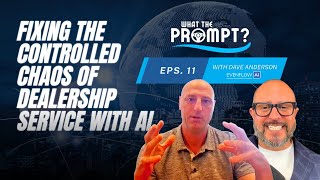
Fixing the “Controlled Chaos” of Dealership Service with AI | Dave Anderson, Evenflow AI