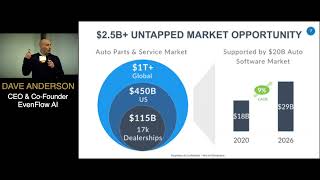
Evenflow AI with Dave Anderson, Sarah Vantine & Ted Ings on the Fixed Ops Roundtable Rock Revolution
Dave Anderson built Evenflow AI to schedule automotive service like airlines schedule flights. The platform predicts appointment demand, packs schedules tight, and integrates with all major dealership systems. Clients report 20-30% revenue uplift within months of launch.
Chapters
Welcome back to the FixedOps Roundtable. David Anderson is with us from a company called Evenflo. Evenflo intelligently schedules appointments to maximize technician production. A new face here on the roundtable with a great product and a great story, and we wanted everyone to hear about it right from Dave. Dave, welcome to the FixedOps Roundtable.
Thanks, Ted. Excited to be here.
Excited to have you, and, um, you got a great new product and, uh, you got a great story of how we got here. Um, I noticed that, uh, in our green room discussion, we talked about a lot of dealerships— most dealerships, uh, only capture 70% of their service revenue potential. And, uh, you and I probably both think that maybe even that is high for most dealerships. But you've got a great story. If you would tell us, what is Evenflo, Dave?
Yeah, so thanks, Ted. So as you said, what we are is a service scheduler. And what we're trying to do is bring a little bit different perspective to intelligently schedule appointments to maximize the technician production capacity. And I'm coming at it from a slightly different angle in that I'm like a baby to the industry. I'm a newbie. I'm academic in training. I have a PhD in applied math. I left academia and then found myself at United Airlines for a number of years. And then 13 years ago, I left United and started my own ventures with some partners trying to take one of the few things airlines do really well, and that's sell every seat on a plane, and apply those techniques to first hotels, golf courses, most recently with doctors' offices and surgery centers. And then a few years ago, I started Evenflo with the aim of trying to marry some of those best practices with the unique dynamics in automotive service.
Dave, that's an incredible story. And you're right, airlines as an example, they do a great job at selling all those seats. Is it Is it the way that we've been doing it in dealership that, you know, we haven't challenged the conventional thinking? And I imagine that's the problem you're trying to solve for dealerships.
Yeah, fundamentally is that the traditional tools haven't done a good job of matching like the demand that flows in with the shop's capacity and that mismatch of like demand to capacity it, it either creates bottlenecks where the, the shop is overrun at periods. And when you're overrun, we see it in the data and we hear it anecdotally from the service managers, is that they're just trying to move cars through. So then the unit production goes down, like the dollars per RO, the hours per RO, they have to decrease when they get the bottlenecks because they're worried about upset customers. And then inevitably there's other periods where, um, the techs are on the clock, but they're not flagging hours or they're just sitting on their toolbox. Right. And in the airline world, that's like leaving the gate with the seat empty. Right. You can't ever get that time back to sell it. And so this sort of mismatch of the demand with the capacity is causing the inefficiency in the shops.
I can't recall too many flights, especially recently, that had empty seats.
Yeah.
So give us the thinking, give us the, if you will, the new way and tell us how Evenflo is different than what currently is the way that we've been doing it forever, it seems. Yeah.
So, you know, the common practice or traditional approach, you know, my term is like you're counting cars. Now, you may count cars by express or main shop, but at the end of the day, you're saying, I'll take 5 at 9:00 AM, I'll take another 5 at 9:30. And you're treating a car as a car. And the difficulty of this environment is you got a lot of, you know, variability and unpredictability. So Monday's busier than Tuesday, but not every Monday, right? 9 a.m. busier than 11 a.m., but not every 9 a.m. It is unpredictable. Like customers walk in, they no-show, they're late, they're early. And then probably one of the most confounding issues is that like what people schedule for isn't what they leave on their RO. So if I have 100,000 miles on my Honda Odyssey and I schedule an oil change, it's extremely unlikely I'm leaving with just an oil change on my RO, right? And so that mismatch of like just counting cars with like the— what the production capacity is, that causes this inefficiency there.
And you're right, that's the way we've looked at it forever. And there are bottlenecks and this Dave, this seems to be the year that we're looking for efficiencies in fixed ops. All eyes are on fixed ops because it's, it's being recognized now really as the true profit center, uh, where others, you know, are variable, if you will. Um, tell us a little bit more. Tell us, how does it work?
Yeah, so, um, so instead of just like counting cars, right, like what we do is we predict true demand for every single— what I call true demand for every single appointment. So we look at like what's in the appointment. So it's a 100,000-mile Odyssey with just, you know, an oil change. That's the baseline of it. And then we predict what we think the additional flag time will be on top of that. And then we can translate that back into clock time based on the team's like efficiency or proficiency to do certain jobs. And then what we do is we look at like the production capacity of how the team rolls on the clock and off the clock by day, across the week. And we try to like tightly pack every single appointment into like a perfectly packed Tetris board. In that way, what we're doing is we're flowing the demand in where the capacity is. And people often ask me this of like, where do you get the predictions from? Like everything's tuned to their the dealer's data. But I will be the first one to admit, like, we're 100% wrong all the time. I've never got a prediction right on any car. Like, I have no idea that you're going to decline all services or you have corrosion in your engine. But it doesn't matter because, you know, we don't have bias. So if we're a half hour too high on car A and half hour too low on car B, we still pack in that Tetris board perfectly. To then get the right sort of flow of the demand to the capacity.
Okay, so take us through it. Um, you've mentioned other industries, you mentioned airlines, you mentioned hotels, you mentioned, uh, golf. Okay, um, what have you learned from working in these other industries? Because you're right, they're all matching demand, okay, with, uh, with consumers. And how do you apply this to a the retail automotive industry?
Yeah, so maybe the first thing I just would want to emphasize is like each time I go to a different industry, like first and foremost, it's important for me to be a student, right? It's not for me to come in and say like, this is a better way of doing it until I actually understand the context with it. And so I'm fortunate enough, the dealers I work with, they teach me every single day and I love it. And we can't be effective without that education there. And I also would say there's no perfect match, you know, but there is, you know, with healthcare, I think there's some interesting like analogies I would bring up. So maybe first is like, think about an emergency room. Like, why does it take so long to be in an emergency room? It's an emergency. You would think it would be fast. And the challenge is, is it's 100% walk-ins. And then it's coupled by the fact that it's hugely variable, right? Like a stroke patient is different than someone showing up with an ear infection. So the resources required to, you know, take care of one patient and the amount of resource has huge variability there. And so if you think about that from like the automotive perspective, it's really important to sort of try to control your schedule. Right. And if you just let it be free for all, then you're back to like an emergency room. And service director the other day said something. I'm quoting him all the time because I love it, is because he was having a hard time controlling his express shop. And he said, you know, we promise our customers, you know, we'll be done in express 1 to 7 hours. And he's like, we meet that promise time 100% of the time.
That's, that's, that's like the weather forecast, right?
Either going to rain or snow or be sunny, you know. Right. So, so, you know, from the emergency room, you think about like there's, there is, you have walk-ins, you do have variability, right? Like a transmission job is different than an oil change rotate, right? You have different resources there. But, you know, the key lesson is how do you control your schedule? And then you think about like on the other side of like a surgery center. And they generally work like clockwork, right? But in that case, like you don't have walk-ins, you generally don't have no-shows. Like if you have a heart surgery planned, right? You don't forget to put it on your calendar or, you know, have a conflict with a conference call, right? You're gonna show up for it. They know exactly what they're gonna do. Like you don't go to the hospital saying like, well, maybe I'll repair my ACL or have my appendix out. I don't know, right? You know what's gonna be done. And there isn't a concept of like upsell of like, you know, oh Ted, you're right. While I'm here, you might as well take my gallbladder out, right? Like, you know, it's a known procedure, known resources. And I think service centers, you know, a lot of service managers I talk to, you know, they strive to try to run it like a surgery center. The challenge is, is you have the variability and the unpredictability. And so that's where like the method of counting cars really kind of falls down with, you know, you're trying to run it like a surgery center, but then it's actually like a little bit like an ER with a surgery center and you need it just a little bit more sophistication to be able to manage that like variability and unpredictability.
That's fascinating and you're spot on. So Evenflo provides a platform to help dealers do this. Tell me about what some of the features are, some things that you'd like to highlight for our dealer audience, because you're coming at this from an angle that we have not done historically. And it's fascinating and refreshing to hear you say these things, Dave.
Yeah. So there's a lot that, you know, I could highlight from like our dynamic pricing to like the booking experience and simplification. Maybe for another time on some of those. But the one thing that I'm like really passionate about right now is recall management. And I think about it, I emphasize the word, you know, management because, you know, whatever the stats are, 80 million on, you know, repaired open recalls. It's huge, right? So there's volume, but it's about like management and like, is the customer ready? Is the op— operation ready and do you have business optimization? And so what I mean by that, I'm like, customer readiness is, do they know they have a recall when they show up? Right. So if they just think they're going to get an oil change and then you tell them in the drive they have a recall, well, maybe they didn't plan for an extra 2 hours, right, in their day. Did you convey to them the things that are important? Right. Like I know with the Honda fuel pump recalls, It was important to show up with a quarter tank of gas or less. Some models you had to get into the back seat, so you needed car seats out, right? Did you know that ahead of time or did you just show up? I filled up my tank on the way over to the service center, right? So is a customer ready? And then from, you know, the operation, I think about is like, well, do you have the parts available when they show up? Like the worst thing you want to have is a customer show up and they're ready for the recall, but you're like, I'm sorry, you're going to have to come back. Give me 2 days to get the part. Right.
Which, which happened to me recently. Yeah.
Yeah. Yeah. It's just it's not good for the dealership. It's not good for the customer. Right. Then, you know, does the technician have the capacity to do it? Right. So, you know, I know like the Toyota hybrid cable recall, you know, a service center might only have 2 techs that are certified to complete it. What if they're already full with jobs? Right. So thinking through the capacity, can you do it? And then, you know, from a business optimization standpoint, you know, people ask me in a macro way of like, well, what's the right mix warranty versus customer pay? I think it's kind of, you know, situational. Right. And so there's cases where it depends on the recall, it depends on the mix of demand that you have. And then how do you manage it? And so like, I know not to pick on them, but like Kia's got some warranties that I know service managers aren't crazy about what they pay, you know, and there's like this one-line RO that's kind of like a nuisance, like in the prime CP 60,000-mile, you know, 8 AM appointment and they're bumping each other out. Well, when is the right time to have that come in? Should you maybe, maybe, um, have them come in at 2 o'clock where you're a little bit quieter, right? And then what we've seen, if you try to like optimize a business, then those one-line ROs can turn into CP ROs too, because you're willing to spend more time instead of like, I, I got to get you out of the way because I've got this 60,000, you know, mile, uh, service with, you know, my prime CP work, you know. So it's about like thinking through holistically. It's not just volume, right? Like it's, are you ready? Is the customer ready? And then where do you want that volume within your business?
We're speaking to David Anderson. He's with a company called Evenflo, evenflo.ai. Not just any company. Dave has earned the seal of approval, the Good Housekeeping seal of approval from Steve Greenfield's Automotive Ventures, which very few companies do. And Steve is embarking and has embarked on a mission to help the automotive retail industry with a better process for managing our appointments and managing our day. Questions for you, Dave. A, is it available now? B, does it work better with some franchises or others? What about DMS integration? What about integrations and how does all that work? Yeah.
So we're, we're integrated with all the major DMSs and that's really like our source of truth back and forth.
Okay.
With that, we do have additional integrations like with X-Time or other, you know, key tech stacks there. And then it is available today. We're live with dealerships and Yeah, we're open for business. And, you know, we've been able to demonstrate some significant returns. You know, you highlighted sort of capturing 70% revenue potential.
Yes.
We've seen gains of like 20, 30%, you know, percent revenue improvement, you know, and a lot of our stores have broken their service growth records, you know, in the first or second month. And then we break it again and then we break it again. So, you know, We've definitely seen strong results, but it's like anything, like it's not a set it and forget it, right? Like we gotta partner with you, we gotta learn your business. And just if we think it's, you know, tuned perfectly, maybe you have 2 techs quit and now all bets are off, right? Or you get 3 new techs outta school.
Sure.
And that's a different dynamic, right? Or a new recall hits, right? Your business is dynamic, so we have to be with you right along the way to adapt.
So, audience watching who has questions, I'm assuming they can reach out to you. I see your email there. I see— I'm imagining that's your cell phone. It says call or text. What is the onboarding? What is the process like to get started? Okay. You mentioned a couple of big names. For scheduling platforms, um, and DMS integration, super important. What is it like to get going? How, how long does that take? It sounds like you spend some time, you know, doing your homework on the dealership as well.
Yeah, that part we, we've, uh, you know, after some hard knocks, we've kind of learned a few things. So we're, we're, you know, from when you say go and, you know, the DMS connection is available, so that's just say like Monday it's available, um, we can get you live in under 10 days. Yeah. But like I said, it's not a set and forget it. Like, you're— we're like your partner copilot along the way. And so we get— can get you up running fast, but we want to, you know, stay by your side throughout.
But it sounds like the return, the ROI, return on investment can be pretty substantial. Okay. With you just, you know, fine-tuning, uh, how the production occurs and looking at it from a whole different perspective.
Yeah, no, but, you know, another service director, he, he said it well. Maybe this is another perspective to have. Um, he just said, you know, when I started in the '90s, I did this all on paper and pencil, and I just knew, right? Like, Ted, you're calling off with this, and I want to have like Steve do it, but he's going to be tied up with the job till like 11. So why don't you come in at 11, right? So all that mental math, right, um, and expertise. But then, you know, with the benefits of, you know, online scheduling and automation and efficiencies with BDCs, right, what you lost is some of that intelligence. And what we're aiming to do is get the power of the automation, right, and self-service but bring back the intelligence to it. And every service manager wants to run their business differently, and that's their prerogative. And we're there to help enable it on steroids.
You mentioned the service BDC. A lot of our dealers have BDCs, centralized BDCs. Does it work best with a BDC? And there are some dealerships that still don't have a BDC.
We work in any channel. So we have our online self-service channel. BDCs, you know, we've again, like several— our first BDC managers, they schooled me on like what they needed. So I was the, you know, the student that was getting schooled in school. They say like, you got to make it this way. And we listened. So we have a really good solution for BDC. We integrate in with the AI agents. So, and so I just view that as just like another intelligent call script that we provide, whether it's a human BDC agent or the AI agent of just making sure, again, you're loading the shop in accordance to the vision of that service manager if, if he or she could schedule that appointment 100% of the time there.
So everybody, David Anderson with Evenflo. He helps you intelligently schedule appointments to maximize your technician production. Uh, very important in 2026. Um, I mentioned contacting you. Now, next week is NADA.
Yeah.
I know some of our audience is gonna be out there. I'm gonna be out there with Sarah. We're gonna be in the West Hall. By the way, if you're coming to NADA, you'll be able to meet Dave. He's gonna be with us for a good portion of that time. You're gonna meet him on our stage in the West Hall at NADA next week and get a chance to maybe ask some of your questions. Of course, you can do your homework today upfront and reach out to him ahead of time. You could visit the website. Your website's very impressive. It has a lot of great information on there.
All right, thanks. I appreciate that. Yeah, no, I, I'd love to, uh, meet up with anyone who's interested in learning more, like, uh, email, call, text, um, and we'll find some time there. Um, and actually, Steve, if you don't mind, I, I'd like to, like, leave one last thought. I'll bring it back to healthcare if, if you Bear with me. Yeah. So another context of it, just thinking about is primary care physicians. And in essence, like when you go to see your primary care physician, they're giving you an oil change. And maybe if you don't ask too many questions, they'll throw in a free tire rotation. But that's all what you're getting. So the way the economics are like work is they need to turn you in 8 to 12 minutes. Basically. So there's not much room for more. Now, they know— I know a lot of primary care physicians, they, they want to do more. They know that they want to give you a fluid service. They know you need to change your brake pads or give you an alignment, right? They want to do all that. They just can't. They got to turn you in 8 to 12 minutes there. Then the consequence of that is they're just triaging things, right? And it's not looking for long-term health outcomes, preventative medicine, but they're just kind of triaging near-term. If you think about like what happens in the dealership, you know, when the teams are at their best, they have time to talk to the customers about services and repairs that they need for either a, like, you know, safety, safe operation of their vehicle, long-term, you know, operation of their vehicle, the life of the vehicle, or minimizing their lifetime repair costs, right? All those things are in the customer's favor, right? They're not selling them anything that would be, you know, a counter to what they want, right? And so in that case, like, you know, you just think about like, where does this get in the way, right? Like time, you know, there's a lot of other factors, whether it's training, but time definitely gets in the way where they just don't have enough time to like pull through these services, explain it. But they are the expert of, you know, experts' advice, you know, with recommendations, um, with the demonstrable data, like a video, right, of like what the things you would do. And in that way, I've always thought of like coming in as outsider, the word upsell is an odd one, right? Like, um, I didn't look at it as my doctor upsold me a statin for my cholesterol. I looked at it as like he was looking out for my long-term health. That's right. Same way of like This coolant flush is in your long-term best interest, right? Like, I'm not selling you something. I'm trying to help you in your long-term interest. And so I bring that back to like time. Like, primary care doctors don't have the time. The, you know, the beauty of the service centers is like, if you manage the flow, you can create the time and you get better customer outcomes, better experience. And by the way, then you, you drive service growth. You flag more hours. The team makes more money, you know, ownership makes more money. Everyone's happy.
And you've got loyal customers coming back and you've got the retention of that customer, which is the big thing that many dealers look at as the holy grail.
Exactly. Exactly. And all of this, the system is like you're looking out for their interests, you know.
Dave, I'm going to invite you to come back this year. We have a couple more FixOps Roundtables coming up. I'd like to invite you to come on maybe even bring some of the dealers using this and some of the FixOps Roundtable dealers who will be using this. And let's, let's maybe have a conversation with them, talk about how it's going, things that they've seen, efficiencies that they've gained. Dave, this is fascinating. And this is really the first time in almost 7 years on the Roundtable that we're addressing some of these issues. And you're doing that today. And that's very impressive. Dave Anderson at Evenflo. So, and we'll see you next week at NADA. We're going to—
Yeah, looking forward to it. Yeah, thanks, Ted. Really appreciate it.
Everybody, if you want more information, you could reach out to Dave, Dave Anderson. First, visit his website, Evenflo AI. You see his email scrolling on the screen. He's active on social media as well as you see a phone number. You can call him or text him. If you're coming out to Las Vegas next week, stop in and, uh, stop in with the Fixed Ops Roundtable. We're in the West Hall. You're gonna likely have a chance to meet up with Dave there as well, maybe ask some questions in person. And, uh, Dave, thank you for making time to come in today and, uh, and spend some time with the Fixed Ops Roundtable community. I assure you, uh, this is time well spent for all of us. And like you said, the outcomes for the dealership as well, and the dealer group as well as for the customer Um, you know, that's, that's the most important thing ultimately, right?
So yeah, exactly. No, thank you, Tanner. Really appreciate it.
All right, everybody, David Anderson with Evenflow, Evenflow AI, here with us today at the Fixed Ops Roundtable.
All right, thanks.
More from David
UCDP #88 – Smarter Shop Loading: Fixed Ops Capacity, Recalls & Recon w/ Dave Anderson of EvenFlow AI

Tully Williams and Dave Anderson of Evenflow AI with Sarah Vantine at Ted Ings' Fixed Ops Roundtable
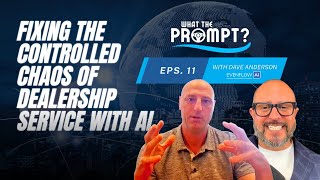
Fixing the “Controlled Chaos” of Dealership Service with AI | Dave Anderson, Evenflow AI