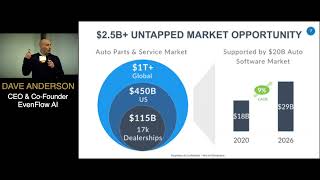
How EvenFlow AI Is Making Car Dealerships More Profitable | David Anderson
David Anderson built EvenFlow.ai to fix a core problem at car dealerships: the gap between what customers schedule and what repairs actually require. His AI predicts true demand to better allocate shop capacity, and he's targeting dealership groups with 10-30 locations using word-of-mouth and partnerships to scale.
Chapters
Hello to our audience and welcome to the Mapcast, where we shine a spotlight on leaders in the B2B space who have invaluable experience and insights to share. Today we're talking with David Anderson with Evenflo.ai. Hello, David, how are you? And welcome to the Mapcast.
Thanks. Thanks for having me.
I guess a great place to start is sort of, can you kind of give us a bit about your background and how you got to where you are today? What led to, uh, you starting Evenflo?
Yeah, sure. So, um, we're a B2B software that helps schedule optimization for automotive dealerships. Um, and so I'm not an automotive person by training. I, I'm, uh, more academic. I have a PhD in theoretical and applied mechanics. I left academia like a whole lifetime ago and then went into consulting, biotech, and then I found myself at United Airlines for a number of years here in Chicago. 13 years ago, I left to start my own ventures with partners. And it was— the common theme is like focusing on what airlines do really well, trying to sell every seat on the plane. And we've applied it in other contexts with like hotels, golf courses, healthcare, doctor's offices, surgery centers. And then a few years ago, um, uh, started Evenflo with the aim of trying to marry some of those best practices with the unique dynamics of automotive, uh, retail here. And, uh, that's kind of like the thumbnail sketch and it sounds all very linear and logical. Like in, in real life, it was not quite so linear and logical, but like you zoom out, like those are the, uh, connect the dots of my—
Okay. Yeah. Makes sense. So can you tell us a little bit about your specific role and how it fits into the bigger picture at Evenflo?
So I'm the CEO and founder of Evenflo. So I'm usually the problem and the solution right now to everything.
And I know you folks have employed AI with your software. Can you tell me a little bit about what some of the major shifts or trends you're seeing that impacted your decision to move in that direction and kind of where you're at in that journey?
Yeah, so, um, we started a company a few years ago, so this was well before, you know, the onset of really the inclusion of the LLMs and, you know, how that's been a game changer. We thought it from a predictive standpoint for solving part of our core optimization problem. And one of the challenges that, you know, with automotive services is what people schedule for isn't what they leave with the repair order. And so like just 2 simple examples there. I have 100,000 miles on my car and I schedule an oil change. It's highly unlikely I'm gonna leave with an oil change once they inspect the car and they see other services that are needed, you know, to, to maintain safe operation. Or the other example is I know there's something wrong with my vehicle, so I book like a vehicle engine concern or something, which is, you know, they might reserve 1 hour for a diagnosis. But the true repair time could be 3 hours. So this mismatch of what is scheduled with what happens on the repair order has been one of the challenges that plagues the industry. So that's where we were coming in with a prediction of like the true demand of each request, basically, to then load the shop based on the capacity of the true demand there. That's where we started out with. Over the last year, like a year ago, And like most founders, all I'm thinking about is scalability. Like, how do I scale? And I got into— there was like kind of 3 pain points that we kept coming back to. One is that we're a tool that's like any other tool. Like, I always say a hammer. Like, you could precisely nail a nail in the wall, or I could bang some holes in it if I misuse it, right? And so in the same way, like our Software is like an instrument or a tool that like it needs, you know, it can deliver huge value or it could cause harm there. So it's in business intelligence, how do you operate that? And too much of all roads were leading to me of like, how do you expertly operate, you know, this machine that we built? And then there's processes that were like semi-continuous or near continuous where it was just hard to get people to keep eyes on it, but they can't, you know, they go to the bathroom, they eat, they go to sleep, right? Like, I can't hire enough people to, you know, to manage these types of processes here. So it was these types of things that kind of got me to wonder, like, how do I scale? And so like 10 years ago, you just like raise more money and hire bodies, right? And then, right. Was really on the onset there that I was like, let me lean into AI. And so we're doing it really on two main themes here. One is, I like to say like our last two hires have been digital agent or AI agents that we've developed to operate our machine or the, and our next two hires are going to be two more, you know, uh, specialized agents that we're going to develop. So it's a way of scaling out like these near continuous processes. And then the last thing that I'm doing, which is kind of a journey that people— I originally brought up, they laugh at me and they say, because I'd say I'm going to build Jarvis for myself, you know, from Tony Stark. And like a year ago, they were like, you're crazy. But so I stopped saying it, but I still am going to do it. And I'm on that path. And one step that I've enabled is getting a digital mind of myself set up that provides like access to people to like ask my mind, you know, when I'm not available to like, how do I, what do I do? Like, what's the guidance? What, how do I operate this machine? And that's been, I'm like 2 months into it, but I'm like, I'm super excited about that.
That's interesting. Now, do you, do you pull from, do you pull from all of your interaction, all your written interactions to create this mind or how do you create that?
Yeah. So I had an idea of like, I should do this and I just didn't know how, but I, for like months I started like just, well, like any AI, you gotta train it, right? And you need data to train it. So how do I get that training data? Well, let me start recording all my, you know, conference calls or whatever. Let me just start getting transcripts of different things. And so I was amassing this data, not knowing where to use it. And then I came upon this platform, Delphi AI. I'm familiar with it. Yeah. And so then I just started playing around with that, but I, I've got like it trained on around like 600,000 words. If you put it in the context, that's maybe like 7 or 8 books worth of content that I've got in there. And, um, it's, uh, it's, it's working pretty good. It actually taught me something the other day and I was like, that's exactly what I would say, but I would not have thought of it, you know, on the spot. But, uh, I gotta keep working on it. you know, to, to get it to the next level too.
That's a, that's a fascinating concept. I was, uh, reading the other day that we're gonna see billion-dollar organizations being run with an AI as the CEO in a fairly short order in the next few years.
Yeah. I, I think, you know, to me that's like the, um, may, maybe like it's, it's the founder's fool's gold, right? Like a, someone coming to a founder and say like, hey, um, I got all this experience and I, you can just step aside and I'll run the company for you. And I'd like, um, in spirit, like I have no issues with that. Like if someone wants to do my job and I don't have to work and it's going to be better, like what's there to fight against? In practice, like that, uh, it's just never borne out in that way. And like the, um, the digital mind, like I don't know if it could, uh, I think it gives me bandwidth. It's like a force multiplier. Um, I don't know if it could ever replace me.
More like a gap filler than the main, the main dish, right?
Yeah, exactly. And you know, where you have access to it, like, you know, 24/7, you know, uh, depending and, um, and sort of concurrently, uh, with it. So I don't know. We'll see. We're on a journey. I haven't hooked up my voice yet because I, I'm not, I guess, emotionally or intellectually ready for that yet, but I got to do it because I, uh, I scheduled an interview of my digital mind with someone in the media, which will be live. So we'll see what happens. That's coming up in like a month or so.
I'd love to see that. So back to kind of the, your, your market, what are some of the major shifts and trends you've seen that have sort of affected how you approach? Is it, is it dealership service departments for the most part?
Yeah. Yeah.
What's kind of, what's kind of affected how you approach them and how you, how you convince them that, that your system is better than some of the legacy systems that are out there?
Yeah. So there's probably two things that really is top of mind, you know, right now for me. One is all the other AI noise is an impediment because, and what, and where the AI noise mainly is with the dealerships is like the scheduling agents, like a voice agent or a chat agent. And so there's so many of them out there that it's, and you know, the dealerships are trying to understand, you know, how AI should fit in their business. It's just confusing the situation. And so I just, from that standpoint, I'm trying to like fight through the noise or ride through it where I think it'll eventually sort itself out. But it, that's a bit of a more of an impediment than like a, you know, creating opportunities there. And then the other challenge that we have is, um, we're a new way of doing things. So, you know, so they're like the way most service managers would describe You know, when I state the problem, it's like, hey, this is a forever problem. This is a decades-old problem. We all know it. If you can solve it, that would be huge value. We show case studies, like how we solve it. We set up demo sites, we demonstrate it. But still, at the end of the day, we're trying to change habits or behaviors of people who maybe for 30 years in their career, they've done it one way. And change is hard. So we're in this adoption curve where part of going to market is trying to find the people who are, um, ready to jump in and adopt something new, a new way of looking at it and being judicious on where we see is sort of like the next wave or here's the laggard. So, and we don't have the bandwidth to hang out with the laggards at this stage, you know.
Gotcha. So what's working well for you and what's kind of been the opposite, what's been frustrating for you?
Well, I would say with anything with like go-to-market and scaling, like it, it, it's like you can't be hard-coded, right? You try everything, you know, and even something that worked 6 months ago might not work now, right? And so it's just constantly trying. And part of, um, one thing that's been critical for me over the years is just thinking through the product. We built a very configurable, flexible product that can handle like many use cases and these, dealerships, they all have like their own, like way they want to run the operation that we're trying to, you know, enable for them. So there's huge flexibility, but then it's like, you know, going to someone with like, um, I think of an airline cockpit, right? Like there's a thousand dials there and they're just like, what do I look at? What do I do with it? And so it's trying to like find the right pivot point for the product with the right segment to say, hey, these are the things to work on and What we've been really focusing and getting some benefit this year, maybe it's still the same product, but like a simple version of it, right? Like, you know, so that's, it feels less of a change. We get better adoption, we can implement faster. And then it's like a platform to grow from. That sort of mindset on the product and the evolution of it, like I think, and how it fits within the segment needs, like I think that That's been really key for me. And then the one really advantage and interesting thing about this automotive dealership world is, um, it's kind of, you know, there's 17,000 dealerships, so it's a little bit dispersed, but it's not true SMB. And they're all, but they're all connected. So word of mouth is actually pretty big. And then there's different educational, like venues or industry, you know, experts that we're tapping in from an education standpoint to help get the word out, but also to help people think about things differently. And that, that, um, we're kind of like 2 months into that. I'm, I'm pretty, I think it'll start really paying off from like the echo chamber in the second half of this year. I'm optimistic about that.
Have, uh, just out of curiosity, as your, is your primary customer the big franchise dealer with 40 locations, or is it more the, the mom and pop franchise that you're after, or is it all of them?
Yeah. Yeah. Um, we're, uh, we have like the, you know, the owners who have like 1 or 2 or 3. We have some of those, but so far our sweet spot has been groups that own like, say, 10 to 30 dealerships and anything beyond that. Then you start getting into like more of corporate play. You know, there's like a procurement process, a CTO, all that. And then that just, be, you know, as a startup, that's harder to navigate. But the 10 to 30, usually someone in the ownership is still heavily involved. They're looking for like, um, you know, uh, an initiative across their group to get, you know, rise the tide throughout that they would help like work with each individual location. And so in that way, there's some good scalability because I'm like selling ownership once and then it, opens up the door for expansion from there. But so that's kind of been our sweet spot so far.
Okay, okay. Now, so I guess a logical question is, 'cause it sounds like you've got a lot of ideas in motion right now, where do you see the business in 6 to 12 months?
So this is, I think this is the new paradigm of a startup though, right? You know, if 10 years ago with SaaS, like what, um, yeah, the tried and true playbook was like, okay, you got product market fit, double, triple down on commercialization. And you got like a 5-year window, you know, to like really drive growth rate. And then, you know, you got to think about version 2 of your product or, you know, a new product, you know, maybe 3 or 4 years into it, but like, you know, just hammer commercialization, right? Like, and if you're messing around with like features or then you get labeled as like, oh, you're just like in R&D mode, you don't know how to commercialize it. I think in today's world, you don't have that luxury. Like if, if you stand still, you're going to be, um, you're at risk of like people leapfrogging you that you didn't even know existed. Right. So it's not to say that the pressure of commercialization is off, right? Like it's, it's even doubly trouble, you know, like you got to evolve and, you know, do execute on commercialization all at the same time with, you know, maybe the same resources or less. And so that's partly why, yeah, I'm really leaning into these digital AI agents or digital employees to help scaling it in an efficient way. And then where I'm, where I ultimately want to take the, you know, the business, you know, so for the next 12 months, it's like commercialization, commercialization, evolve. you know, sort of, uh, the scaling using AI to help with, uh, you know, the operation of it. But in essence, what, like, what we are is sort of an intelligence layer solving a couple of use cases already for the dealership. And where I want to keep, um, expanding, maybe, you know, keeping on this analogy is like build the digital mind for each dealership. And that's part of like our scheduling is for the service manager. What I talked to him was like, hey, I want to automate your algorithm. If you could schedule every appointment, like, based on your expertise, that's what we want to power here. It's just that you can't because you take 100 appointments a day. So you, you know, and you got like 40 employees. How can you schedule it yourself? So we're trying to automate that. There's just more use cases where we're trying to— I want to build out this intelligence layer for the dealerships.
No, I think that's a brilliant tact because, uh, now you you can build a SaaS application in a few weeks. So competitors can pop up based on the baseline of your business all the time. So as you kind of separate yourself in these ways, I think it's unique. And I doubt that there's a lot of companies that service the auto industry generally that are that innovative. At least that's not been my— I have a brother that's a car dealer. He's been a car dealer for many years. Yeah, I wouldn't call that a innovative business model typically, and they're watching every penny that they're spending.
Yeah. Yeah. I would say, what I found is it's a lagging industry relative to other, you know, large industries and where they've traditionally invested has been on sales, you know, of selling vehicles. And then they have invested even less on like the service side of it. So it's lagging. And then this is the underinvested sector of their business, which presents a huge opportunity because over 60% of their profit comes from service.
Right.
And that's increasing. So it's just a, I look at it as just a great opportunity for us to help drive huge value for our customers.
Yeah, it sounds like you got a great field in front of you. So from a marketing perspective, how much How much investment are you making around marketing, sales, in those areas? You don't have to give me any specifics. I understand you're a private company, but are those concentration areas for you?
Ever, ever increasing. Like, um, you know, the way I look at it, um, and this is kind of the evolution of a, you know, a SaaS startup of like, uh, of how you think about it. So our first scalability, like, leg in the stool is I needed to make sure the product was stable at scale, right? Like, it's easy to build an MVP for, and like one dealership works, right? Now we got 10, right? That's a different thing. Now we got 50, that's a different thing. So we needed the scalability, the stability of the products. And so we cleared that hurdle. The next hurdle was we need to onboard people fast. So we were, you know, we were between like maybe 60 days of like start to finish. And now we got like 2 versions, like The simple version's like 48 hours. The, you know, complex version is like 10 to 14 days. So we, we solved for that. And then the third part of it is, um, account management value, you know, creation and emphasis and, you know, uh, supporting it. And we're, um, I'd say we're, there's still work to come, but like we've cleared some major milestones. And so now we're at a stage where like we can really go after marketing and know we can scale up. Like if I had before this stage, if I had just dumped a bunch of money in marketing, I would have just been at risk of huge retention risk because we would have fallen down somewhere in one of those legs, right? Now I have confidence that we can, we can work efficiently and we can support our customers and create value for them. And so that's last 4 months, we're really trying to push things up Now the education has been big, as I said, and then we've been establishing partnerships as another way to kind of get, you know, open our go-to-market aperture. And then we've been ramping up more of what I call like the digital marketing part. I think that's hard to say that like we're actually getting something specific, but we're trying to get like more digital noise out there, right? Like there's awareness, whether it's attribution that it worked or not. Like, you know, to me, I care less about that, more that like it's people are hearing about it maybe from more than one place and then they come to us and they say, hey, I'd love to hear a demo.
Okay.
Yeah.
Makes sense. So final question. If you could speak to your younger self before doing what you've done here, what advice would you have given you?
I would, well, there's advice I give myself. I'd say maybe if I can answer in two ways, there's advice I'm constantly giving myself that, you know, I'll articulate it. And then, you know, if anyone leaves comments or they could tell me like, hey, this is bad advice, you You should do something differently. So I'm interested in that, but like, you know, specifically to your question, I think, uh, on this, I think what you need to do is it's like the right balance of conviction and flexibility, right? Um, and I mean conviction in that it's earned and it's just not assumed, but like at, and I, I started Even Flow with the idea of like, well, I'm not sure, I don't know anything about auto, do I want to do this or not. So it was kind of like toll gates, like, well, if we fail this thing, I'm outta here. I'm gonna go do something else. Right. Like, and we kept passing it. And then, you know, at some point, like we pass enough toll gates that like, and then we started like setting service records for our customers are like, okay, I got conviction here. You know, like I've, I've proven this to myself. And what I would say is that's your North Star, you know, of, of working through. It's not just like assume because like I want it to be true. Like it's gotta be earned, but like once you have that conviction, that's your north star. Because like on any given day, like a startup is like a punch to the stomach. And the only reason why you would want to keep going at it is if you have like the conviction, you know, to keep pushing forward. But then with the flexibility is like you can have the anchor of the conviction of the You know, but like, don't get locked in on like, well, it's got to be this way, right? Like, or, you know, it's a constant like feedback system, you know, with it. The one thing I tell myself is, uh, and this is what I'm trying to navigate, is really is what is the right role of AI in all of this? Because, and I have some beliefs here, I don't know if they'll be true or not, but like on the AI coding, there's rules for like GitHub Copilot and stuff like that. I could see why if I were to start a new company, I might use like Lovable to get some proof of concept going. Like, to me, that's just the next generation of Figma. Like, I sold our first customer on a Figma prototype, but no one knew what Figma was, you know, so it looked real. Like, now I would probably do it in Lovable. But, um, that's like a, that's a big watch out for me of like, thinking that that's actually a solution because in any true, like, I think the core mechanics of SaaS, like, it's gotta be a machine or some functions or data, you know, something that's like solving something that's usually more deterministic. If you're leveraging like an LLM or AI to play the role of a deterministic, it's the wrong model for the, the, the right, you know, for the solution that you're looking for. And if you're building all that code out, then it becomes a black box. And then I think downstream, you're going to have huge problems maintaining it. And it, and it's, it's kind of like a, maybe a fool's gold in my mind. And like, it'll feel good from a CapEx perspective. And then 2 years later, just wait for your OpEx expenses. And you're going to wish you had done it differently. So, but I don't know if I have that right. You know, I got, I'm constantly asking people, I'm constantly, you know, you know, checking on it, but I haven't, the data that I keep getting back is like reaffirming that belief. But, you know, maybe I'm wrong. Like, 6 months from now, I'll ring you up and like, Paul, I had it all wrong, man. Like we should have done it differently. Yeah.
Well, one of the, one of the mainstays of a successful SaaS organization, and I've spent my entire career in SaaS, but one of the mainstays is that rigidity is death. So you absolutely have got to accept change, and sometimes it's wholesale change around the structure of the company, and things move fast, particularly in the early stages. Yeah.
Yeah. And I think in this world with AI, whether it's like you're using it in particular or just the noise around it, it's almost like 2 times as faster now, you know, it's just so—
Oh yeah. And 6 months from now we'll be having a different conversation. Well, amazing advice. It's been a brilliant discussion. I've really enjoyed it, David. And I want to thank you for joining the podcast today. We're really grateful that you could share your insights and your experiences about the company. And with that, I'm going to sign out for the Mapcast and thanks for joining us, folks.
More from David
UCDP #88 – Smarter Shop Loading: Fixed Ops Capacity, Recalls & Recon w/ Dave Anderson of EvenFlow AI


Tully Williams and Dave Anderson of Evenflow AI with Sarah Vantine at Ted Ings' Fixed Ops Roundtable
Evenflow AI with Dave Anderson, Sarah Vantine & Ted Ings on the Fixed Ops Roundtable Rock Revolution
Fixing the “Controlled Chaos” of Dealership Service with AI | Dave Anderson, Evenflow AI