Healing the System: Leadership Approaches That Elevate Growth and Empower Healthcare Teams
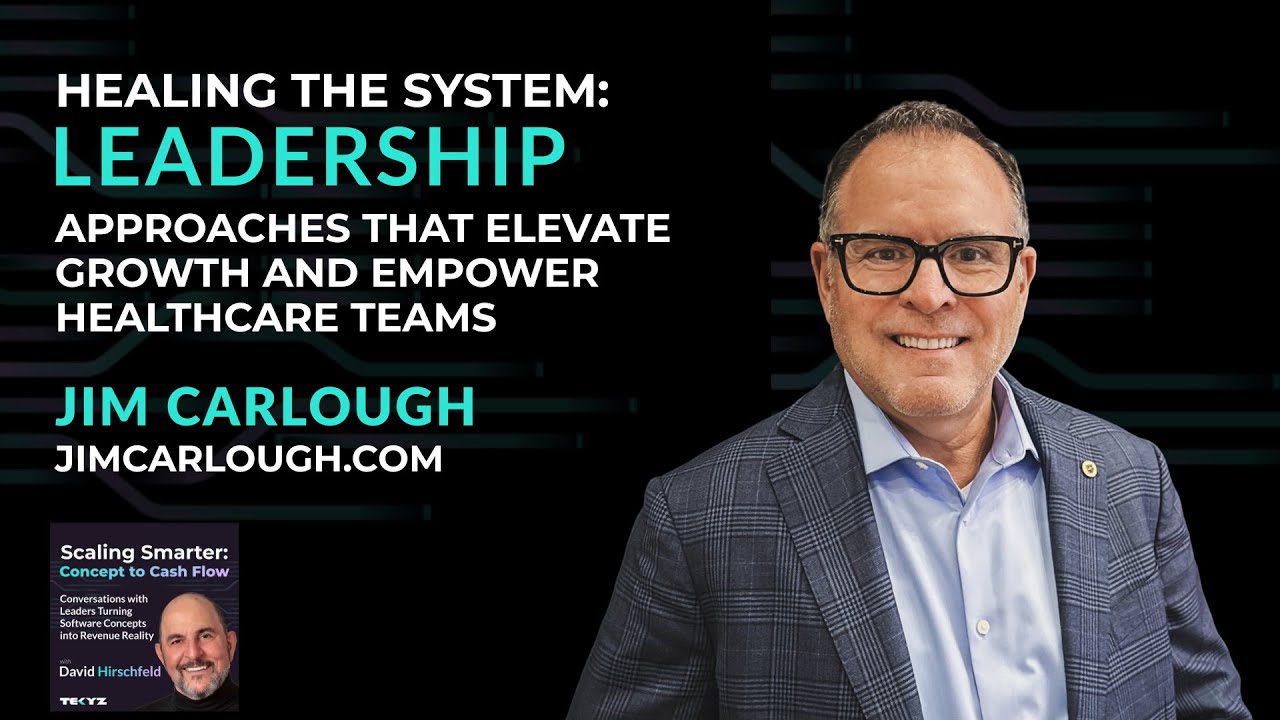
In this Scaling Smarter interview, host David Hirschfeld welcomes healthcare technology executive Jim Carlow, author of The 6 Pillars of Effective Leadership. Carlow recounts his 30‑year career that began in health insurance, shifted to health‑IT, and now centers on Impulse, a digital engagement firm serving one‑third of Americans. He highlights a systemic failure in succession planning—organizations often promote high‑performing individual contributors without a clear leadership roadmap. A formative story from his time at Perot Systems illustrates how compassionate employee care (providing food for a family of a hospitalized employee) built loyalty and set a cultural tone. Carlow traces his path through a Canadian hospital‑software firm, Perot Systems, and a Medicare/Medicaid fraud‑recovery company before joining Impulse, where the platform delivers text, email, IVR, print/mail, and portal outreach, plus analytics to identify rising‑risk populations before they become high‑cost users. He explains Impulse’s use of AI for sales prospecting, call transcription, and analytic modeling, while cautioning against clinical AI until proven. The conversation shifts to industry trends: rising GLP‑1 drug costs, post‑COVID health‑maintenance gaps, Medicare Advantage plan exits, expiring ACA subsidies, and the emergence of ICHRA and retro‑rated employer plans. Carlow describes his speaking focus on the 6‑pillar framework, especially its relevance during health‑plan financial distress, and mentions upcoming talks. He closes by sharing contact details and offering free copies of his book.
Chapters
Scaling Smarter wants to welcome Jim Carlow. He has been in the, he has been in the revenue growth and leadership world for the last 30-plus years. Jim has a bestselling book on leadership, and he has taken companies from $100 million to $1 billion. And he, we're gonna explore what he's done and how he's done that and how he's turned that into a bestselling book. Jim, welcome to Scaling Smarter.
David, thank you for having me. I'm excited to be here. I'm excited to talk to your audience and hopefully bring some value to them.
I'm hoping I can learn a little bit from you as well. So tell us a little bit about your background and what you're doing now.
So I have been in the healthcare industry my entire professional career, originally starting in 1983 to about 1996. I worked predominantly for health insurance companies, helping to grow them. And in the late '90s, I had the opportunity to transition to the technology side of healthcare, which was an interesting flip. But I also, at the same time, branched out and did work on both the provider side of healthcare and the payer side of healthcare, which sort of makes me understand both sides of the argument and what each other is trying to look for. But the last 25 years in leadership, 25, 30 years, or 25 years have been specifically on the technology side of healthcare, where I've done a lot of mentoring and developing of other leaders. And the one thing that I kept seeing was we had a habit, and this habit I have validated is not just in the United States, it's worldwide. that we do very poor succession planning. And over the years, as HR has cut training programs and different things has happened, when it comes time to finding a new manager, people start to scratch their head. And they typically will end up promoting someone who's a very good individual contributor from that either individual team or a nearby team. that they plop into that role and they wish them good luck. But they don't give them a roadmap of the things that would really make a difference between being really a taskmaster manager and one who's truly a leader building a long-term, committed, and high-producing team.
So tell me, tell me about some of the companies you've worked for that led you to figure this out.
The company that really brought it to light was when I worked for Perot Systems, which was started by Ross Perot himself. Mr. Perot was an amazing individual. He unfortunately is no longer with us, but his philosophy on management and on leading, and that he often said at company meetings, is, look, our job is— when people hire us, they expect us to be the Marines that are parachuting in, dropping down, getting the job done, and extracting out of there, perfectly resolving the problems that we were taking care of. And he used to have a philosophy on hiring and said, look, I only want you to hire winners. And if you can't hire winners, hire people who hate to lose.
And that sounds very much like him.
Yeah, it is definitely like him. It is definitely like him. But one thing that made him different was how he cared for his employees. And I'll give you an example. We had a policy that if somebody on our team, either themselves, the employee, their spouse or child, or one of their children, had a serious medical condition, we had to report it to his office and we had to ensure that we were helping that family get the best care possible regardless of where we had to send them or they had to go for that care. Nobody, not any other company that I have worked for, have gone to such extent to take care of their own families. And that to me, that compassion and empathy really taught me that was a huge differentiator and why Mr. Perot had such a strong following From his employees, yeah.
And I've never heard of another company that focuses on the individual employees like in that way.
Yeah, it and I'll tell you a quick story. I had a young man who was 28 who had to have open heart surgery and have a valve replaced, which was considered serious, and I had to report it. And Mr. Perot's office was wanting to bring the young man from California. to Texas because he felt he could get better care in Texas than where he was in California. Ultimately, the employee decided to stay in California because his family was close by. My responsibility was to make sure that family was taken care of. So I was arranging— I called the hospital before the kid got admitted and— or young man got admitted. And I said, I need to provide food to this family 3 times a day. I don't care how we do it. I'm going to pay for it. But I have to make sure that anybody that is there visiting this individual has food to eat. And they didn't know how to solve it. I talked to dietary. I talked to the COO. Eventually, the CEO calls me. And he said, what are you trying to do? I said, I have an obligation to take care of this kid's family. And, and I have a choice. I— you can either help me and let them get food out of the cafeteria or somewhere and bill me, or I'm sending caterers there 3 times a day, and they'll go to the waiting room on whatever floor the patient is on, and they will feed the family. He said, you're going to do that 3 times a day? I said, I have an obligation to do that. And so he said, let me call you back. So he calls me back a day later and he said, I found a way to do it. You don't need to send caterers into here, which would really disrupt the staff and get them upset. But we found a way and we worked and he and I worked out how we would do it. So a couple months later, the young man comes back to work. Everything's going fine. All of a sudden I realized I never got a bill from the CEO. So I picked— wow. So I picked—
this is the hospital CEO, right? Yeah.
Yeah. So I picked up the phone and I called him and he called me back and I said to him, I said, I've been waiting for a bill. I owe you money. You fed that family for a week and I, I promised to pay you. And he said to me, he said, Mr. Carlo, he said, I'm not sending you a bill. He said, you taught me a very valuable lesson about taking care of your employees. He said, and I would've never have thought about that, and I run a hospital. He said, but that little, that small deed of making sure that family had food went a huge way in keeping that family together so that they didn't have to be running back and forth out of the hospital to get food. He said, and I've made sure that my leadership team knows that we need to take care of our employees the same way. Ironic.
That must have felt great. Yeah.
It felt great that we were totally willing to pay for it. We were totally willing to fly the family to Texas and even put them up in housing. But the reality is showing that level of compassion for employees creates loyalty.
Oh, no question.
No question.
There's a difference with a hospital CEO that would have been willing to adopt that. I don't think you'd find too many hospital CEOs today that would consider that.
I agree. And this was actually a university hospital, so I don't want to give its name out, but it was a university hospital. But it was that impactful to the CEO that he adopted that practice and went forward with it with his team.
So what— and I know most of your work in the recent years has been healthcare-related or healthcare tech-related. What guided you in that direction besides this experience?
What guided me in that— it was funny because in the mid-'90s, health insurance was going through a huge transition. There was the adoption in the period where we had HMOs, then HMOs going out of business and going upside down. You had a lot of profitability issues and mergers and acquisitions, and it There was so much noise going on. I said, isn't there something more stable? And I just started to look on the technology side and happened to get involved with a start— wasn't a startup, but it was a Canadian software company that served the hospital market, but only in Canada. Our hospital systems are the same in Canada. It's just the reimbursement's different.
Yeah.
And it was an English product. It wasn't in French or anything. I brought them into the US and became their Executive Vice President of Sales and Marketing for all of North America and brought them in. And then from there, I went— I ended up at Perot Systems. Um, after a few years getting them up, set up here in the US and operational and refining their capabilities even in Canada, I found an opportunity came to me from Perot Systems and I jumped on it.
And that was—
and that started you in the whole healthcare On the tech side of IT. Yeah. And so the other companies that I've worked for are either IT-specific or services-specific in healthcare. For example, health management systems. I started in 2008 to 2015, and they were a technology-led vendor, but primarily recovering money for Medicare and Medicaid.
Yeah.
Fraud, waste, and abuse, overpayments, underpayments, and trying to ensure that Medicare and Medicaid were in fact the payers of last resort. A lot of people end up on Medicaid and they may not— and they may have the income to qualify for Medicaid, but somebody has them on their commercial plan, which means that commercial plan needs to pay for that. And so we had the ability to match And we're the only ones that had all of the data from all of the health plans to be able to match the eligibility to claims that were paid by Medicaid or Medicare and to go get that money and retract it. And ironically, we did it all on contingency fee.
And now you're— there's a lot of money there. So contingency makes a lot of sense, especially your confidence is high that you can resolve a lot of these healthcare payment issues, right?
That is correct. That is correct.
Yeah. So I get that. I get the revenue model there. And now you work for a company called Impulse? Yeah.
Impulse is a digital engagement company. We have several components to our offering. We offer everything from the ability for us to interact with members directly via text messaging, email, IVR, to help them engage more in their healthcare. Simple example is you're recently diagnosed with a new medical condition. We can push content out, either video, or just written content to help you understand what, what it is you're going through, what resources you can call upon, and provide those resources to you. We also have an analytics arm where we can do population health things and find populations of people who are underserved. One of the things that health plans struggle with the most is about 20% of their patients produce 80% of the cost. So we have a model that, that what we're looking at is not the people that are already in that bucket, but trying to identify the next wave of people who potentially will fall in that bucket because of things like the diabetic patient who misses 1 out of every 3 prescription refills.
Mm-hmm.
Or because what happens is then they end up having an episode and it's $20,000 in ER visit and admission to then get stabilized. We call that the rising risk population. And so we're starting to look at that so that health plans can then take that data and start to engage those members so they don't have that emergency room visit.
It's really similar to some of the things I'm working with now too.
Good, good. I mean, there's a lot of analytic plays in healthcare. And I think there's going to be some consolidation because everyone has their own models of the things that they look at, and not everybody looks at everything. So I think that's an opportunity in the future where there could be consolidation. The 2 other things—
Nobody looks at everything, right?
Correct. Nobody looks at everything.
You don't know where to put your focus because there's so much information and That information isn't necessarily aggregated in an insightful, organized in an insightful way. So which is what the problem you're trying to solve, right?
Totally agree. Totally agree. The last 2 components we do are print and mail ID cards, things of that nature, and also health portals. In terms of our size, we serve 1 out of every 3 Americans, which is a pretty big number.
It's huge. Yeah.
So we touch them in some way or another. So we have about 550 employees, all 100% remote, and we've been doing this— the portal side of our business started in 1999. The engagement side, it started in 2012. So relatively young organization.
Yeah, but not, but not a startup for sure.
Not a startup for sure.
Yeah. Yeah. And how is AI affecting your— and workflow automation now affecting what you do and what's going on in your company?
So we use AI in the sales environment a lot. We use AI in our prospecting activities. We use AI in recording and transcribing our minutes and also producing next steps, outcomes, And the AI is sophisticated enough to capture the words that are used by people on the phone and whether they're engaged, not engaged, supportive, or not supportive. And so we're starting to expand that even more in the future. Within the company itself, we're using AI in some of the analytic models that we build for additional assistance and looking for other things. We We're very cautious on AI on the clinical side of things only because it really hasn't— I'm going to say proven out, but that's my word. I think AI has proven itself, but I also think AI is not going to replace everything that we do.
No, certainly not right away anyway.
Correct. And I just wrote an article actually that I'm hoping to get published on AI and leadership because the 6 pillars that we were talking about, AI can't replicate. And so human, the human aspect of leadership is only gonna become even more important.
Yeah, I agree with that. And, and the need for people to feel like they can engage in a one-on-one personal instead of all just on Zoom, I see that starting to increase as well. It's starting to recover from, from the Zoom— what would you call it— like Zoomality, where, you know, and COVID, and nobody wanted to bother getting out of their house anymore to go meet with people. But I'm starting to notice people are hungry for that again.
We're starting to see that too. It's, it's a little bit slower. One of the things that we've noticed with a lot of the healthcare organizations Is many of them hired local people till COVID and then hired people remotely because that's who they could find. And when they did that, it means now, like, there's health plans that we're working with where when we say we want to have a meeting, they're like, we don't want to go to Oregon because we're in South Southern California. We don't want to go up north.
Right.
And 3 people there, but the rest of the company's in Oregon as an example. And so that remoteness still presents a little bit of a challenge, but I do think things are coming back to a more normal perspective in terms of wanting to be able to be face-to-face. I actually see it a lot now at conferences where the attendance is far up over where it was even pre-COVID. Yeah.
Oh, that's interesting. So I haven't been to a conference in The past couple of years. So it's, you're seeing a big increase now.
Big increase. Yes. Now it depends on the conference, but the conferences and some of the niche conferences, because of the niche that it may be in, like Medicare Advantage, that's growing strong and much higher than it was back pre-COVID. On the IT side as well, things like HIMSS and other things like that. And then the industry-specific ones. AHIP and others that serve the insurance companies and the health plans. Those are growing rapid— excuse me, growing rapidly.
One of my clients was just at the big healthcare conference in Vegas. I can't think of the name of it. And they said that it was just crazy, the kind of engagement and the number of people that were there.
Was it the health conference?
Yeah. Yeah.
I was there.
Oh, you were there?
I was absolutely there. And it was Absolutely massive.
Yeah.
And it's interesting because historically that conference was for investors to go meet companies. There were a lot of health plans there looking at the technology and that the things that the vendors were talking about for their own need versus investors that were there that are that go every year. The other big finance— not finance, but healthcare-related finance one is JPMorgan Chase puts a conference on every year in San Francisco. And that's another big one, but that one is truly all investor-driven.
So what trends do you see in your space that you're keeping a close watch on?
Health plans are struggling right now, and it's across the board. You read the press, Every one of the large carriers is claiming their costs, especially on the Medicare and Medicaid business, is rising much more rapidly than inflation is ramping up. And those costs—
What's the cause for that, do you think?
I think there's a couple of causes. They all claim it's the GLP-1 drugs. I'm not sure that's the only cause. I think there's other causes, like during COVID people didn't take care of their health because they didn't want to go out and get infected with COVID And I think we're seeing an uptick in people who didn't take care of themselves now needing that care, and that's causing some of the rise as well. But so there's— so they're struggling. I think we're going to see some more merger activity moving forward, which is just— It's not good. It's not bad. It's just I think we're going to have— we're going to have to see that. We've seen a number of Medicare Advantage plans close down for 2026. If you— a Medicare Advantage plan pulls out of a market, they can't go back in for 3 or 5 years. And so—
It's a big— it's a big decision for them to pull out.
Yeah, correct. And United has done it. Humana has done it. Cigna has— Cigna sold their Medicare Advantage business. And so it's pretty much across the board. They're doing that. And it's interesting with the stuff that's been going on in Washington with the budget and the ACA subsidies. When the ACA was put in place back in 2012 or 2014, those subsidies were set to expire this year.
Yeah.
They're only gonna be there for 10 years and they were set to expire. And everybody's screaming that the costs are gonna go through the roof. The costs were already through the roof.
Right.
On the ACA business. It's just impounded by the fact that if you take the subsidies away, you now have a bigger problem. And now how are you going to serve that population? So there's some interesting trends happening. There's things in the employer market called ICHRAs where employers in essence can pay the premium for an employee to join an ACA plan. Now, the benefit to the employer is they don't carry the risk then. But the negative side of that is you're subject to the cost of that population being served in that state and whether that population is as healthy as your employee population.
So if your employee population is less healthy, then you get dinged.
So in the employer market, Depending on the size of the company, if you're a 500-life employer, you may or may not be self-funding your business. If you're self-funding it, you're paying the claims yourself. Now, you'll pay them to a stop-loss level, and then you'll have a reinsurer take the higher claims. But you, in essence, are paying up to $100,000 worth of claims on an individual. But you can get different stop-loss levels. And so I From that perspective, it's cheaper for them if they see that their costs have been rising a lot more to go to an ICHRA-type situation where you can pay for the— you can pay the premium for the employee and they get on an ACA plan. But I don't see a 500-life employer company doing that. I see the small employers doing that. I think the larger employers may end up going back to what we used to call retro-rated. Where you paid something and we, the insurance company, would estimate what the claim costs would be for the year. If the claim costs came in under that, you got a rebate or a refund. If the claims came in higher than that, you got a higher increase for the next year. But I think that's the gamble that some of the players would, some of the true larger employers may opt to do if they're concerned about the rising of the risk.
Tell me about your speaking engagements and what gets you into that and what your focus in those speaking engagements are.
So I primarily focus on 2 or 3 different items. One of the number one item I get asked about is the 6 pillars. In fact, I'm speaking next week in St. Petersburg, Florida at a Medicare Advantage conference specifically on that and how the 6 pillars are more important during a time of financial distress that the health plans are having. And they're having— because of that, they're having layoffs, they're having to make cuts, they're having to get out of certain business lines or get out of certain markets. And the conference organizers have asked me to put the spin on it as to what they should be seeing from their leadership during these times of transition. So it's still, it's a segment of the framework, but it'll, it will be solely focused on the challenges that health plans are going through this year. I think I titled it Making It Through the Storm.
Hmm.
Because if there's, if you go back to last year this time, most every carrier was reporting losses. This past quarter, Q3, is the first time we've seen a lot of those turn profitable again. So the storm's not over yet, and there's still companies that are saying they're reorganizing and trying to find efficiencies. So the timing of the presentation is still warranted.
And you talked about— what was it? G1 drugs?
GLP-1 drugs.
It's GLP-1 drugs. Okay.
Empix of the world.
Okay. And why do you see those costs going so high?
Now you're going to get me on my political soapbox where I think, I think the American public pays an ultra-high portion of the R&D for most medicals, for most medications that are developed regardless where they're made. I think we pick up that tab and I don't think it's necessary. I mean, we first saw this hit us a couple of years ago with the EpiPen, where the EpiPen went from $100 to $1,200. And in essence, that became— I called it gouging. I may not be right, but that's what it felt like at the cash register. And they were the only thing you could get. But if the GLP-1 drugs are all brand new, they're all very expensive. They're all trying to recoup their R&D costs, and you can actually buy the same medications in other countries significantly lower than what we pay.
Yes. Yeah. And I've never understood why the American public has to burden that R&D cost. Because the drug companies can, because they're allowed to do that.
Because they're allowed to, they're allowed to do that. And their argument is We're a wealthier country and the underserved countries deserve a little bit of a break. However, and I don't know what a GLP-1 drug truly costs, let's say $1,200 a year. I know it's more than that. It's probably closer to $1,000 a month. But if you're talking a third world country that needs it to treat a diabetic, they should be able to get a significant— they should be able to get it cheaper. Not for free, but yeah, gotta be a different scale than the way it's tilted today.
Yeah, I completely agree. So I always ask at the end, what's, what's a favorite book you think that my audience would be interested in that you've read?
A favorite book?
Yeah.
Outside of my own.
Which, and the title of yours, give everybody the title of yours.
The title of my book is The 6 Pillars of Effective Leadership. A Roadmap to Success. Though I'm going blank on the name of it, but it was written by 2 Navy SEALs and it's on leadership. And crap, wish I could remember it. Jacko somebody wrote it.
That's okay. Anyway, you gave us enough information, we can look it up.
It's— it was a multimillion-dollar seller. It, it, as soon as we hang up, I'm gonna remember the name of it.
Of course.
And if I do, I'll email it to you. You can put it in the show notes.
Okay. I'll do that. Sure.
Yeah. So anyway.
Okay, Jim, I just wanted to thank you for coming on to Scaling Smarter, and this was a really interesting interview. Healthcare is near and dear to me because of the work that we do at Techies. Our biggest clients are in healthcare, one being an and AI as well. An AI nurse that helps that basically helps to be the interventionist to prevent people from ending up in the emergency room by doing predictive analysis and reaching out to patients just a real nurse would do and things like that. So I appreciate you coming onto the show. It was a really fun interview, and I will. Look forward to hearing from my audience how, what they think. And how do people reach you, Jim?
So I'm available on LinkedIn. I have a website, which is just my name, jimcarlow.com, all put together. And the last name is spelled C-A-R-L-O-U-G-H. But David, I'm gonna, you may wanna, you can edit this out, but I'll offer 5 free books to the first 5 people who comment on this show.
Oh, I love that. That's a great one. I may start to standardize that.
Correct. Now, what I want the people to know is just make a comment. Do not put your address on social media. We will reach back out to you to get your address. David will get it to me and I will mail you a signed copy of my book.
Awesome.
First 5 people.
Jim, thanks for coming on to Scaling Smarter.
Thank you, sir, for having me. I hope to talk to you soon.
More from David
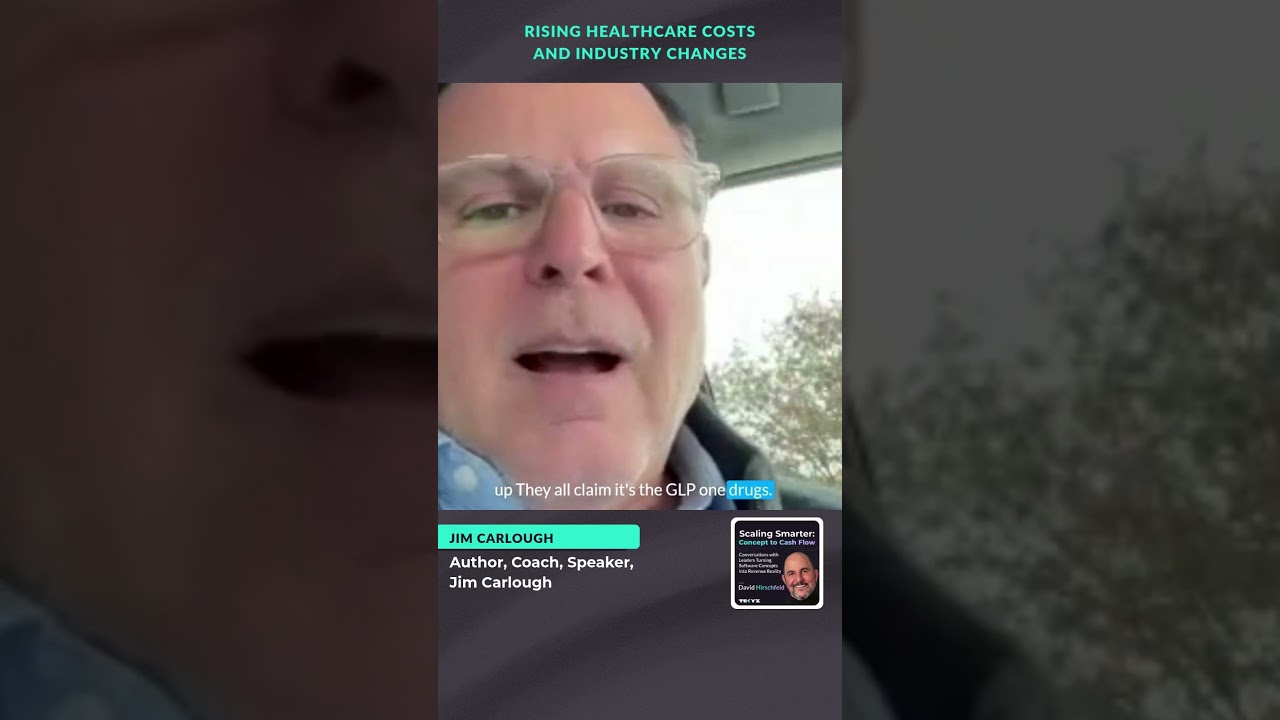
Healthcare costs are accelerating, and the ripple effects are just beginning.
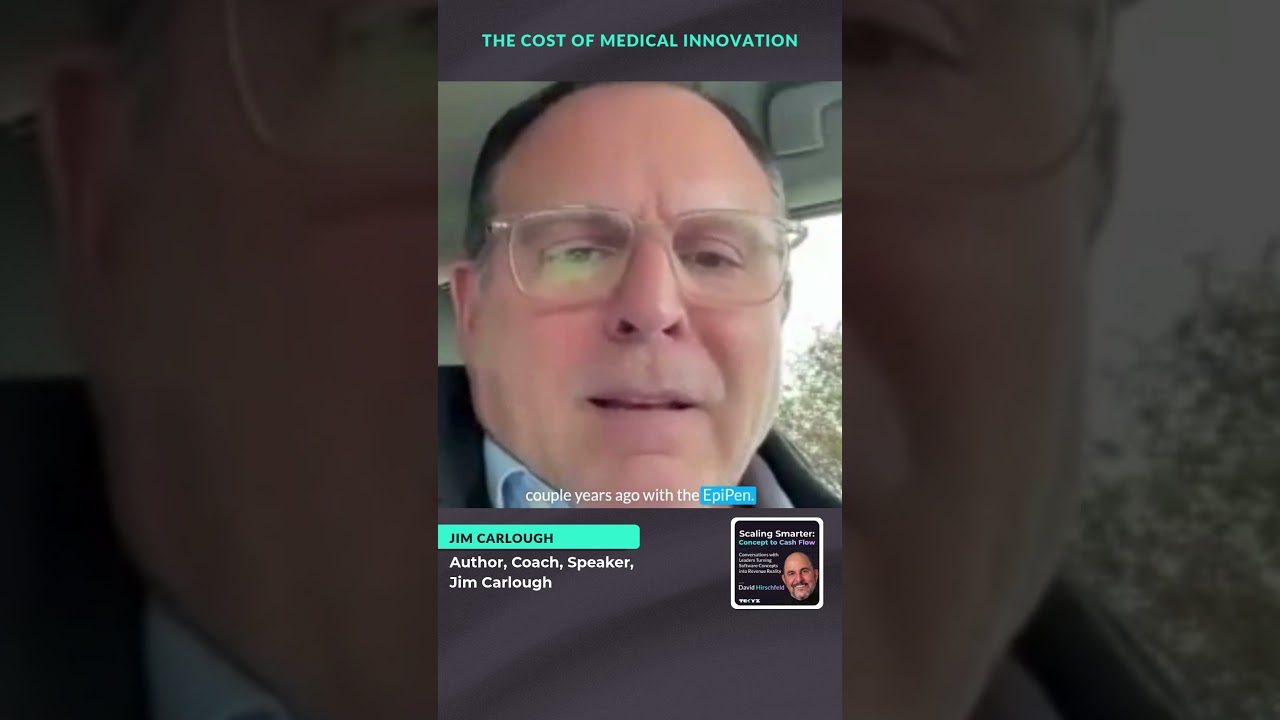
The challenge: medical breakthroughs are advancing fast—but costs are rising even faster.


