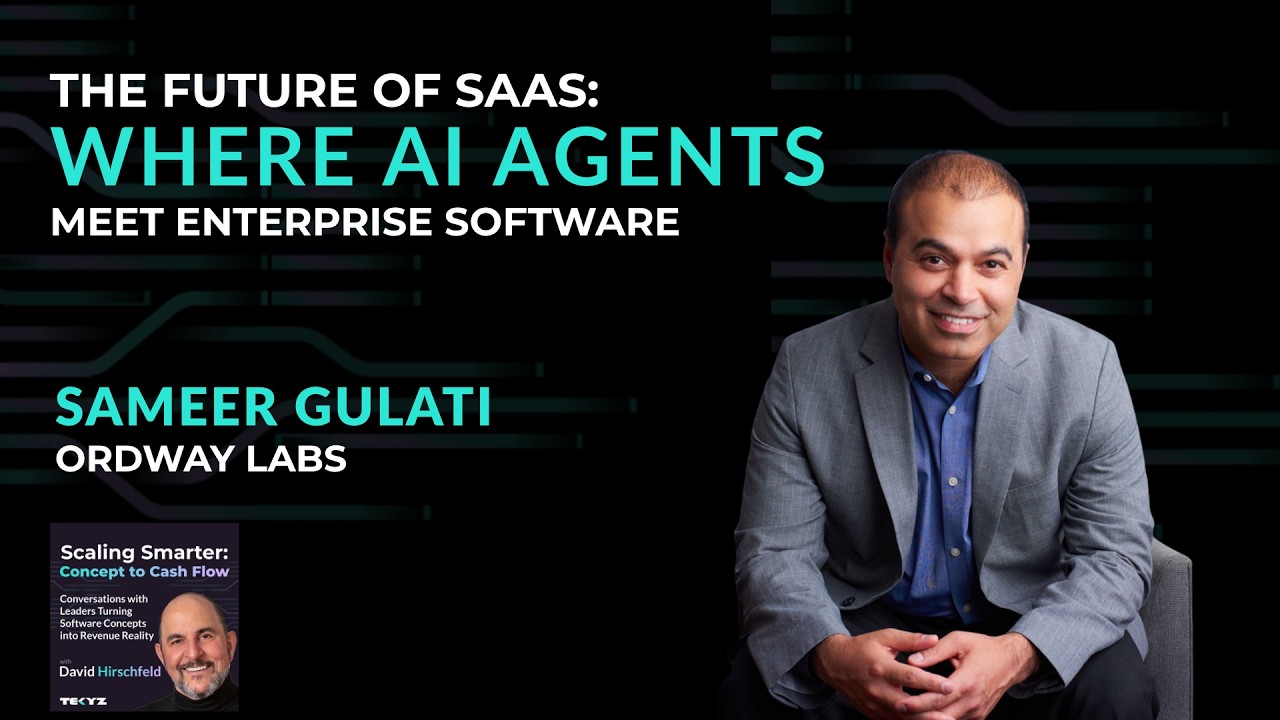
In this episode of Scaling Smarter, host David Hirschfeld interviews Sameer Gulati, CEO and founder of Ordway, a billing and revenue automation platform serving a few hundred customers with around 100 employees. Gulati outlines Ordway’s end‑to‑end post‑sale revenue management stack—contract management, invoicing, payment processing, revenue recognition, analytics, and GL integration—and explains how the company was born from a long career in office‑of‑the‑CFO roles at Intacct, Zora, and early Workday. The conversation shifts to how Ordway is using AI to “scale smarter.” Engineers rely on AI coding assistants such as Claude, and the firm has a corporate OpenAI license that lets product managers, solution engineers, and implementation staff build custom GPT agents. These agents automate repetitive tasks like converting sales notes into implementation to‑dos, generate streamlined hand‑off documentation, and power a payment‑reconciliation agent that pulls bank data, matches it to invoices, and creates payouts. Gulati notes the biggest productivity gains are in engineering output and implementation efficiency, while also experimenting with emerging tools (OpenClaw, PicoClaw, Ironclaw). The discussion explores the broader trend of applications becoming less static and more augmented by AI agents; Gulati argues that applications will not disappear but will evolve to embed agentic intelligence, especially in complex domains like billing, HR, and payments. He acknowledges compliance and data‑storage constraints that require structured, auditable processes beyond what current agents can guarantee. The interview closes with a forward‑looking warning that the next six months of AI progress will feel like decades, urging all companies—new and established—to adopt AI tools to stay competitive.
Chapters
Today, Scaling Smarter wants to welcome Sameer Gulati to the show. Welcome, Sameer.
Thank you, David. Thanks for having me.
Sameer is the CEO of Ordway. Uh, he founded it 8 years ago. They've grown to 100, uh, customers. They automate the post-sales revenue management process in some really unique ways, and I'm really looking forward to hearing his story. Sameer, why don't you give us a little background?
Yeah, thank you, David. Excited to be here. We are a few hundred customers, just to clarify. We are close to 100 employees at the moment. But just a little background about what we do and where I come from. Ordway is a billing and revenue automation company. We automate everything post-sale from contract management, invoice generation, payment processing, revenue recognition, analytics, all the way to GL. What drove us to start this company is your— the name of your podcast is quite adept for what we are doing, Scale Smarter here, right? We have moved away from a world where people are fretting about how do I generate an invoice easily? We have moved to a world about how do we really streamline the lifecycle of every dollar that's flowing through our framework, right? So sales GL automation definitely is a big pain point in many organizations. Sales and finance don't talk to each other. Sales closes deals and finance is being handed over those deals manually. So this is the premise of us taking the company to market. And a little bit more about my background before starting Ordway. I have spent 25+ years in the office of the CFO world. Some of the companies that I've taken to market are Intacct, which is now Sage Intacct, way back in the year 2000, Zora, another subscription management solution in early 2000s. I was an early employee at Workday when Workday was a tiny little startup in Walnut Creek, California. So, spent my entire career just thinking about solving problems for office of the CFO.
So, tell me how you're using AI and workflow automation to scale your own business at this point?
Yeah, AI certainly offers a lot of power. While we evangelize automation for our own customers in the world of order to cash, it's important that every company also figures out how to scale smarter. I love this tagline that you have, but yeah, we all have to figure out how do we scale smarter as an organization. Our own team has started leveraging a lot of AI benefits starting from AI coding tools. I think every engineer now uses Claude for coding. We haven't— we have been scaling by being able to produce a lot more code without hiring a lot more people. AI agents is used quite aggressively and our product managers, our solution engineers, our implementation folks have, many of them have created their own AI agents or like they like to call it, their own GPTs. We have a corporate license with OpenAI. They have created their own GPTs to simplify a lot of simple things that we used to do manually back in the day. One example is the notes that we put together from sales transition to implementation team. We have just been easily— we created an agent where we upload all the demos, all our notes, and we create very streamlined to-dos for our implementation team for handing from sales to implementation. That's just an example, but there's a lot of leverage about how we continue to learn and get better using AI capabilities out there.
Where in these development area, what are some of the biggest gains you've seen? In the, like, in the last 6 months? Because 6 months is actually like 6 years in AI time.
That's right. Engineering productivity is definitely the maximum gain that we have seen. But overall, there are definitely some market improvements in our implementation framework and definitely in our marketing outreach as well.
What do you think of some of these new tools that are coming out like OpenClaw and PicoClaw and Ironclaw and all the claws?
I think at the end of the day, they're all trying to solve some form of a problem, right? Like, we are leveraging these models out there and we are trying to really leverage many of these LLMs to see how these LLMs can work for us, right? At the end of the day, we have created a layer of intelligence above and beyond Human intelligence, right?
Right.
And the power of many of these tools really is on how can every human out there can take this extra layer of intelligence and let this intelligence do mundane tasks, chores. A lot of it can be automated. So it has become so easy to produce tools now. There's definitely going to be an arms race for these tools. We'll see which of these end up sticking in the long run.
Yeah, we're, we're struggling with the same thing with— I'm not struggling, that's the wrong word, because we're— the benefits have been amazing developing our own development framework that leverages these tools that can build enterprise applications as opposed to the Replit and the Luvables and things like that that can build simple, pretty applications, but nothing really sophisticated. So when you're in an enterprise environment, then it's all about being able to do impact analysis as you make changes and releases and being able to push out updates through some kind of CI/CD pipeline and automatically test and make sure that the quality is there and that you're not introducing problems in the new releases that you're pushing and Those are a whole different class of capabilities that, that the coding, that the coding tools like Claude Code, they don't handle well without a bunch of discipline built around it, which is what we've been working on.
Yeah, that's awesome. I think, I think there's a lot of potential to also keep training these tools to get better and smarter and so forth. And yeah, we, we learn new things every day and hopefully This only gets better over time.
So one of the things that like these other tools like OpenCLAW and PeopleCLAW and things like that are starting to make people realize is that applications, the concept of applications becomes less important than the idea of an application at the moment based on what the need is and what you need to present and deliver from information and store. becomes much more dynamic. How do you see that evolving and what impact would it have on you scaling?
Yeah, absolutely. I think if you see the journey of application development over the last 50 years, applications certainly were a system of record for the most part from from old school systems on mainframe to SaaS systems and things like that and so forth. But we have certainly seen software move in the direction of automation to start with, and the AI agents are a means to an end to further create and automate workflows and so forth. So we feel that some applications will probably become less relevant, But many other applications have to— applications will continue to have a role, but they will also have to evolve and make room for AI agents within their application too. What good is an application if it is just a system of record in today's world? The application has to work for you. The application has to be able to automate for you, make your job easier, and not have you to go through hundreds of clicks to get to what you are looking for and things like that. At the end of the day, I do believe there is a world where applications and agents will coexist. That's the promise. If you look at large companies like Salesforce and Workday, they're all launching new products with AI capabilities, AI agents embedded in that. It's not like their application is becoming irrelevant, but— It's that their application is becoming a lot smarter with the help of agentic AI.
No, but there, there are a lot of automate— marketing automation workflow products that are, have been, if not becoming irrelevant, have been struggling to keep their user base because people are finding it that it's easy to dynamically implement this type of functionality now. I don't know if where, you know, payment systems and things like that, if that's, it's going to evolve into those areas as Well, but it is, it is a shift in thinking. Maybe it's an opportunity to grow faster in different ways, but it's a big shift in thinking. It, you know, it's one of those things that I scratch my head about every day, trying to get my arms— you can't really get your arms around it. It's like getting your arms around a bucket of sand that lost its bucket. Right?
Yeah, I'll give you an example, right? Like in our world, You mentioned payments, right? Payment reconciliation is a pain point for— it requires a lot of human intervention, right? Like a system like Oddway will be able to automate, generate invoices, but we used to depend on third-party partners for payment processing, but the payment reconciliation was quite painful and quite manual, right? How do you leverage AI to solve that problem? You can build an agent to take the payout that some of these payment processors are sending to your bank, and then you can try and match it with the data that's coming from applications. But many of our customers complained it used to take like 3 days, 4 days, a month to reconcile payments. And not to mention some of the payments that are coming directly into your bank, they have to be matched to invoice and things like that. Now, you could spend a lot of time training an agent to start doing this, But at the end of the day, applications like us also have to take ownership that we need to build the agents directly into our application to automate this. And that's exactly what we did, right?
Yeah.
We ended up building functionality powered with AI agents that can automatically pull data from your bank, match to your invoices, create payouts, and auto-match the accounting reconciliation for payments to invoices and things like that. So that is the bridge between, Replacing applications with AI agents or applications becoming even smarter with agentic AI and making the life of their users a little bit easier. Like marketing tools, I get it. Some of those simpler tools probably were an overkill, but the more complex, the workflow-related frameworks like HR, billing, and payments, I think there's a lot of Potential there.
You have a lot of compliance requirements. You have data storage requirements. You can't just, you know, these aren't things that you, that you create and they disappear, right? You have to record all the exceptions, and you may have automated workflows to, for communication around those exceptions and reconciling the exceptions. But yes, you need structure. There are certain things you absolutely have to have a structure around where an agent is not going to be structured enough that it's going to— even if it evolves quite a bit, right?
True.
So yeah, I do see a world where you've got applications and agents all working together. I don't see a world where applications disappear completely, not at least in my lifetime, I don't think. But they become different. They become much more adaptable.
I think the biggest power of the applications really is the data that they contain also, right? Where a CRM database, your marketing database, and the tools are a means to an end, but the database is the key here. And what can agents do for you with that data available to them? Can they really save your employees, your humans some time on what we do, cleaning each record and making it work for us. I think that's where there's a lot of potential with data that resides into many of these applications.
Yeah, you know, agents don't have a good memory and they have a limited context window. Even if it's a million, right, tokens, it's still limited context window. A database, the data that you're storing doesn't have that context window or limitations. Yeah, I completely agree. So do you have any parting words for my audience regarding scaling and application development today?
I would say definitely the next 6 months would probably be more like 60 years of work back then. So if the last 6 months have been like last 6 years, the next 6 months are going to be like the last 60 years probably.
Yeah, it's crazy. It's crazy.
Yeah. So I, and if anyone is not embracing some of these new tools, they're definitely living in a different era. I think every company needs to just wake up, not just the new companies that are starting today, that every company has to go and look out and make some effort on how they can scale smarter, if you will. And And use the power that's available to us on our fingertips these days.
Well, I just want to thank you for coming on to Scaling Smarter, Sameer, and I'm looking forward to seeing how things evolve for you in your world.
Thank you, David. Appreciate inviting me and look forward to talking again soon.