IIN IG Live Perimenopause Melatonipause 6.13.2023
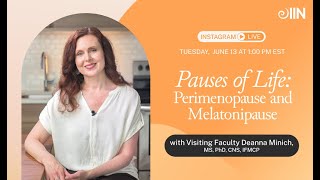
In this IIN Instagram Live session, nutrition curriculum manager Sherry Vital interviews Dr. Deanna Minich, a certified functional medicine practitioner and nutrition scientist, to explore two mid‑life hormonal transitions: perimenopause and the age‑related decline in melatonin, which they term “melatonin pause.” They discuss how perimenopause now often begins in the 30s, its physical, emotional, and mental symptoms (irregular cycles, sleep disturbances, hot flashes, joint pain, mood swings, libido changes), and the broader hormonal cascade that includes andropause in men. The conversation then shifts to melatonin’s roles beyond sleep—circadian regulation, glymphatic brain clearance, immune support, and anti‑inflammatory effects—and how modern light exposure reduces its production. Practical nutrition and lifestyle recommendations are offered: ensuring darkness at night, optimizing sleep hygiene, using blue‑light blocking glasses, consuming anti‑inflammatory, rainbow‑colored foods (especially orange carotenoid‑rich fruits), adequate protein and healthy fats, and considering plant‑derived melatonin (e.g., erbatonin) or supplements when needed. Adaptogenic herbs such as maca are highlighted for stress resilience, and the importance of strength training versus yoga for bone health during perimenopause is noted. Throughout, the role of health coaches is emphasized as guides who can help clients recognize hormonal pauses, adjust diet and activity, and provide emotional support. The session ends with encouragement that these transitions can be navigated proactively rather than viewed as doom‑and‑gloom.
Chapters
Hello, everyone. Hello. Hello, IIN community. How is everyone doing today? I hope you're doing really lovely. Sherry Vital here. I'm the nutrition curriculum manager here at iin, and I am so excited to share that today I will be speaking with one of our visiting faculty members, Dr. Deanna Minick. So she'll be joining in just a few moments. So today Dr. Minnick and I will be discussing two important pauses of life. We'll be chatting about perimenopause, melatonopause, so to say. Just a little bit more about that. Women are going through perimenopause earlier in life and longer. We're also living longer too. And so this IG live. This session today will really focus on food, as we know at iin, secondary food and lifestyle, or primary food, as we say here at iin. So food and lifestyle strategies that women can really use to support these midlife phases. As I mentioned, perimenopause and melatonin pause, which is the lowering of the hormone melatonin that we experience with age. And so I see. Hello. It looks like Dr. Minnick is ready to hop in. And so I'll go ahead and let her into the session today. All right, just a moment.
Hello.
Hello, everyone. See, just a moment here.
Woohoo. We made it. Hi, Sherry.
Hello, Dr. Minnick.
How are you today? Oh, please, call me Deanna. It's great to be here with you. We get to talk about one of our favorite topics, hormones.
So excited for this. I mean, professionally, like, it's great. But also personally, I gotta say, I've been getting more and more interested in this topic. So I'm really excited to see what we'll be diving into today. Before we get there, though, I would love to share a little bit about you in case our students.
Please don't. Oh, yeah, go for it. Yeah.
So again, Deanna Minick here. She is a certified functional medicine practitioner, a nutrition scientist, international lecturer and educator with over 20 years of experience in academia and in the food and dietary supplement industries. She's been active as a functional medicine clinician, in clinical trials, and in her own practice, food and spirit. She's the author of six consumer books on wellness topics, four book chapters, and, wow, over 15, 50, oh my gosh, 50 scientific publications.
I'm a nerd. What can I say? I'm a science nerd.
I'm here for all of it. Through her talks, workshops, groups, and in person retreats, she helps people, practically and artfully, which I love, transform their lives through nutrition and lifestyle and have to Say, I know you've been a tremendous inspiration for me and for many of our students. So can't thank you enough for joining us today.
It's a pleasure. And I'm seeing so many friends like Shahara and some others that we know from iin and, you know, we have a lot of cross talk amongst what we're doing, what we're all doing. Right. In a health coach space space and, you know, in the wellness space. So I'm delighted to be here with you to talk about all things hormones and to unpack this and to just get real about hormones. Because if we're not interested in them, we really do need to find ways to start to connect more into hormones in our body. Right. They're communicators.
Oh, my gosh. Absolutely. In fact, I was just reading, you know, thinking about this topic, you know, of the. For those just joining perimenopause and melatoninopause, I was just reading the other day about, like, just when we, if we wait till these times, right, like menopause or perimenopause to do something about them, you know, that can be a little more troubling. So, for example, they're saying it's like waiting for.
Waiting to dig a well, you know, when you're thirsty. Right. We need.
So get to prepare.
Yeah.
And little by little, right.
It's so true. And one of the things, one of the reasons why we need to start to prepare is that women are going through perimenopause even earlier these days. So instead of the typical five to seven years, like typically in the late 40s into the 50s, we're now seeing women starting to experience hormonal changes in their 30s. And men are not exempt from a pause as well, by the way. So where women go through perimenopause, men go through andropause or a lowering of testosterone. And then men and women both go through this melatonin pause where we have lower melatonin throughout our lifespan. So we kind of enter into this decline of all things hormone as we're making our way into our 30s, 40s, 50s and beyond.
Yes. That's so good to know. So important for many of us, no matter where we are on our journey today.
Right.
I think we can all take something from, from this conversation.
So with that said, I'm going to.
Dive right in in case anyone's like, well, what is perimenopause? What are you speaking about here? So can you share for those tuning in what this transition of life is?
Yeah. So Perimenopause is a time, it's a transition, where our ovaries are basically shutting down their reproductive function. So we're going from being reproductive to being less reproductive in the way of being fertile. And so hormones like estrogen and progestero start their decline. And as part of that roller coaster process where we go from being maybe up here and we start to go down with both of them kind of going down in that dance, we might have some symptoms along the way where sometimes estrogen is peaking up and progesterone is lower, or, you know, it's just kind of this dance of coming down into that pause transition. But basically, we're going from being fertile to. To not being reproductive in our bodies.
Okay, that's a great way to summarize this time. And hearing you mention, like, this ups and downs, I know that makes me think immediately of mood as one of those things. But that and other things. What can we know? Like, how do we know when we've entered this transition or this phase of life? What are some of the symptoms or things we may notice?
Well, definitely. Well, let's think physical, emotional, mental health. So starting with the physical, right? There can be changes in our menstrual cycle where our menstrual cycle becomes less regular, it might become more erratic. We might get two cycles in a month, or we might skip a cycle. So something starts to go off with the menstrual cycle and our normal pattern. So physically we have that just apparent change that something's off. Now, that doesn't always mean perimenopause. That could mean other things, like polycystic ovarian syndrome. There can be other things that could be connected to that. But in general, there's some kind of dysregulation in the menstrual cycle. The second thing physically would be sleep. Sleep can start to get thrown off. So we may not sleep very well even if we have slept really well our whole lives. You know, maybe we start to get a little bit more warm at night. These hot flashes that people talk about, or even night sweats. You know, joint pain. Pain is one thing that many women don't think about this. But as you start to get more of the aches and pains, like things that may not be connected to injury or some kind of aspect of our physical body, but we just start to have more joint pain, maybe our libido changes, so our interest in sex starts to wane or just kind of experience these fluctuations. And then in terms of emotionally and, you know, hormones to me, are so. They're emotional vectors. They're what get us to experience those emotions on so many levels. And so emotionally, when our hormones are like that, our emotions are like that. And so, you know, we might feel bouts of depression. We might feel anxiety. We might just feel, like, an overall state of lethargy, low energy. We don't have the same momentum to do things like we've had before. We might consider ourselves moody or, you know, kind of, like, irritable. And I kind of feel like, you know, sometimes women need to experience those things. Not to quell them, but to channel them out. Like, journal them out, artfully bring them out. And, you know, I'm 52. So during my perimenopausal transition, as I'm going through it now, you know, one of the things that's been so helpful for me in that emotional way is to paint. And I'm not showing my paintings here, but if you were to see my house, you would see them all over the house.
I've seen some of them. Very beautiful. What a great way to honor this time and to channel those emotions.
Sherry, I love how you said to honor this time. You know, some women are not looking forward to it. They're thinking, oh, my gosh, you know, I have to go through all of that, and I'm going through so many other things. I've got so much stress. But if we can, as women, really look at that time of our lives as being sacred, here's where we get into the spiritual aspects, right? And we even talk about that through iin. We get into the spiritual aspects of eating, of detoxification. What is spirituality? It's that sense of meaning, purpose, and aliveness. And what I have found is that when people go through this transition, when women are going through it, it's almost like they experience a renewed sense of purpose. They almost start to think about, like, okay, maybe I need to change jobs. Maybe I need to stop doing things a certain way. Maybe I need to end this relationship. It's almost like they experience this upheaval, and maybe that's for good reason, that our hormones are taking us on that journey. So rather than suppress it, maybe we need to ride the wave a little bit and not try to quell it, but to honor it, just like you said, and to see it as part of that process. I love that so much.
You know, I think about, like, our symptoms, okay, the hormones changing. We experience these symptoms. Symptoms are really like the body speaking to us. So it's like, what if we listen in what is the body telling us and how can we support that in.
All levels of our life? It's true. Now, sometimes it can get kind of, like, out of control. Like, maybe it's happening, like, way too early, and it's interfering with your work life, your friendships, your family life, your health, you know, And I do think that there's a happy balance of honoring the transition, but then also making sure that we're looking at food, lifestyle, do we need some additional help? And this is where I think health coaches can come in. They can start to work with their clients on, well, what is this pause? Why do we have this pause in life? Why are you going through this yin? Where do you need to soften? Where do you need to let go? Where do you need to flow? And do we need to make some transitions in your food? Do we need to be looking at your lifestyle? Do you need softer activity, not as aggressive and. Or maybe, you know, I know for me, I have been doing yoga all my life. Like, my thing has been yoga, yoga, yoga. And when I got to perimenopause, I was like, oh, my gosh, I need to pivot. I need to move into strength training because, yeah, you know, like, my bone now is going to be different going through the perimenopause and the rest of my life, I'm not going to have the same bones that I've had for these previous four decades. So you need to kind of see this as a reinvention time, a transition time. And I think health coaches are part of that process, because sometimes, no matter how much, you know, we need somebody to be there as a guide to listen to us, to support us in that process.
Absolutely. I'm so glad that you brought up the health coaching aspect, because that's where we excel. You know, I know clients really make these primary foods, secondary food changes, and really look at, you know, not just what's going on in the body, but what is, you know, what are we being asked to do during this time and how can we help this transition? Because I know to go back to what you mentioned earlier, it's like, oh, okay, those are all the symptoms. Wow, is this what I have to look forward to? But the good news is, and what we're about to get into a little bit too, is there's so much nutrition and lifestyle support that you can do to help yourself through this time. So 100%.
Yeah.
Well, I'd love to. And we're going to get into that in just a moment, but I'd love In case those. Would love to hear more about. We mentioned melatonin pause. So I.
Which.
This is so fascinating to me. I'd love to hear, what is this time? What's going on with this. This darkness hormone, Right? Yes.
Oh, my gosh. And that's a newer term, melatonin pause. I didn't coin the term Dr. Dick and Weatherby. You know, I was on a podcast with him talking about melatonin, and he said, wow, it's kind of like people go through melatoninopause. So I just wanted to acknowledge his brilliance and coming up with that. So what happens? You know, melatonin is a hormone, and it is released by the pineal gland, which is in the brain, and it helps to regulate circadian rhythm. So it's highest during the darkness. And unfortunately, many of us have darkness deficiency, where we have overexposure to artificial light at night. Right. We're on our phones, we're on our screens, and this is really toxic for our overall hormone health. If we're talking hormone health and what coaches can do, they can be talking with their clients about, like, how do you run your day? Do you run it by the sun and the moon in the darkness? Because the moon is instrumental for the menstrual cycle. And then we see the sun and the moon, the light and the dark, important for cortisol and vitamin D. And vitamin D is considered to be a hormone as well as a vitamin. And then melatonin at night, when we produce at that time of darkness. So we need melatonin for so many things, but, you know, circadian rhythm, sleep, immune health, brain health. You know, some of the things that really get me excited about melatonin is that we're learning how it helps the brain to detoxify at night. Some of the emerging research shows that melatonin is part of that whole process of the glymphatic fluid and moving things out of the brain. You know, we need to sleep because we're getting rid of things from the brain when we normally can't do it during the day. So melatonin is more than a hormone, but we need it during that time of darkness. Right. And as we get into our 50s, if you look at the curve, it goes. It plummets. It goes down, down, down, down. And, you know, our mitochondria is one of those storehouses of melatonin. And now we have lower amounts of melatonin in our mitochondria. So that's a problem. So we have to look at all of those Pauses. All of those dips in hormones, and melatonin is definitely one of them.
Oh, my goodness. Well, I think many of us knew the association with sleep, but this is news to me about the glymphatic system. That's so, so fascinating. So when this happens, when we have lower melatonin, are there any particular symptoms other than the sleep disturbances or anything?
We'll start there.
Anything else that we might notice related to that?
Well, let's go into sleep just a little bit more because sometimes when people have difficulty falling asleep, that could be a melatonin issue. So melatonin is important for reducing sleep latency or getting us to sleep faster. So if it's taking you a long time to get to sleep and you're kind of tossing and turning, you can't get to sleep. That might be a melatonin issue. If you're having issues with your core body temperature when you're sleeping, like you're too hot. Melatonin actually helps to lower core body temperature so we can sleep better. So if you ever notice, sometimes as it starts to get later into the evening, sometimes you get a little bit colder. That's kind of like the dim light melatonin onset. Your body's producing melatonin, preparing you for bedtime. You start to get a little bit more just chilled. And that's like your body's way of saying, hey, you need to go to sleep. So if there are temperature changes at night, that could be a melatonin issue. One of the things that we learned about the pandemic was that melatonin, vitamin C, vitamin D and zinc are all part of the immune health response. And so if you're somebody who is constantly getting colds, flus, you're more susceptible to viruses. That might also be something connected to melatonin in conjunction with many other things. We know that melatonin is anti inflammatory. I saw somebody was writing on here, right? Yeah, they're very astute. Yes, melatonin is a potent anti inflammatory. And in fact, there was one study showing that plant melatonin, specifically erbatonin, was more potent than synthetic melatonin. So there are different forms of melatonin on the market. And erbatonin, which is from plants, is actually more anti inflammatory and it has a lot of other phytonutrients. So kudos to whoever said anti inflammatory because that is spot on. And in fact, it's thought that that's why it's so important for sleep, because it quells inflammation at night. You know, if we think of brain on fire or you know, having all of this inflammation in the brain leading to things like depression, anxiety, neurotoxicity, sleep disturbance. It's thought that melatonin, because it crosses the blood brain barrier, could actually be helping in that response.
Wow, this is amazing. And also I'm like, note to self, I need to find my like blue light blocking glasses.
Yes.
They've been missing for a few weeks now. So all this is so, so, so important. So what can we, what can we do? So we have this lowering of melatonin with age. We can see these amazing, this amazing cascade of effects and benefits that melatonin offers.
Yes.
You mentioned plant melatonin. Is there anything else? Like, are there foods that contain melatonin? Are there herbs? What else could we maybe use to support ourselves?
Absolutely. So let's think of it as like a triangle. So at the base of the triangle we need to consider darkness. Are we on screens too late at night? Like, we need to mirror our flow of activity with the sun. And as the seasons change and we have more sun during the summer and less sun during the winter, we need to actually change our activities. Right. So just adequate darkness at night will help our melatonin. Secondly, let's look at sleep hygiene. Look at your bedroom. Is it at a comfortable temperature for sleeping? Is the mattress supporting the body? Right. Like the basic things. Right. So do you have an. I have an air filter in our bedroom because you know so many things. Pets are in the bedroom. So there can be many things that lead to poor sleep. Also not eating too close to bedt, making sure that we're having an anti inflammatory type of diet or just ways that we bring things in. One of the things that I talk about at IIN as part of one of my courses is eating the rainbow. Eating the rainbow of foods is important not just because of all of those colors and it's beautiful, but because you're getting phytonutrients that are anti inflammatory. So that's part of the picture of healthy sleep and healthy melatonin. But you know, some people ask me, because I am a nutrition scientist, can I have certain foods to help me with replenishing melatonin? And I've actually cranked some of these numbers to figure that out. First of all, plants are kind of unpredictable. What are you going to say, Sherry?
No, I was. It's just I get asked that a lot too. And I've been asked like, can I drink tart cherry juice before bed? And so I'm just like so, so curious to what you're going to say here.
Well, we've heard that about cherry. I think cherries are great actually. They're anti inflammatory from a number of different reasons. They have antioxid but they have minute amounts of melatonin. Very, I mean we're talking nanograms per gram. So you'd have to have a significant amount of cherries before bedtime to really replenish those even modest amounts of melatonin. And I think we should still be eating cherries, probably not so much at bedtime though. Right. Because having all that sugar and calories before bedtime, you know, there's kind of like best practices of not increasing things like insulin before bedtime. That may not be the best. But I think, you know, melatonin is in plants, it is in animals, it's in our own bodies. So it's good to be supporting our bodies with eating plants, eating high quality protein, having anti inflammatory fats in the diet. That's all important for hormones in general and for melatonin. You mentioned the blue light blocking glasses. I think, you know, I don't think it's practical for everybody to be off screens late at night. So I think we are going to have to need some workarounds, some hacks. So I myself have blue light blocking glasses. I have a number of different ones. Sometimes, you know, I'll just wear them even during the day if I feel like my eyes are getting strained. You know, we are starting to see more eye diseases and eye disorders cropping up now because so many people are on light and devices. So protect your eyes, your eyes equal melatonin. In other words, like your eyes are taking in the light that will signal the brain to make melatonin. So wear that eye mask at night if you feel like you have too much light in your bedroom, wear those blue light blocking glasses. And you know, for some people, they don't need to just wear them when they're on their devices, but let's just say that they're watching television or you know, it's starting to get later into the evening, like 6pm and it's already getting dimmer and dimmer. But we still have a lot of fluorescent lights around us. We could start to wear those blue light blocking glasses even in our environment. I wear them on the airplane if I take an evening flight. Right, right.
That's so smart. Yes. So not just if you're on the device, but even the light around us in our setting. It's important to consider too.
Correct.
This is like What a wonderful toolkit we've got here. Amazing things we can do. So it sounds like the anti inflammatory eating approach, really checking out the bedroom for sleep at the bottom of the pyramid there, you know, blocking the lights where we can. Can all really support us. All of us, you know, not just during this melatonin pause. Right.
It's true. You're right, Sherry. I mean, basically, when we're doing these practices to help fit with a better lifestyle, it's like we're helping all of our hormones. And then if people do need supplemental melatonin, you know, there is a time to do that as well. I know for me, being perimenopausal, I never thought I would have sleep issues because I sleep like a rock. I've always slept like a rock. But then it's not. So for the past, I would say six months, I had some sleeping issues. And so I did more regularly take melatonin and I was taking Erbatonin to help me because I was realizing, like, I am having gaps, I'm having. I kind of think of it like potholes. Like sometimes through life, you know, we have our foundation and, and sometimes we have more potholes where we need a little bit more, like, to fill in those gaps. So I had to just out of necessity, start to better regulate my endocrine system by taking in some Erbatonin, some plant melatonin. And that did help. That did help. So. But I wouldn't just say, like, that's the solution for everybody. Like children taking melatonin gummies, I think is just way too much. Right, right. It's not appropriate. It's like, let's just get the kids off devices.
Yeah. Oh, it's kind of like a band aid or we think that it's gonna help, but maybe there's. There's other things to look at and explore for sure. Yes. Well, this is so, so helpful. I want to actually bring it a little bit back to the perimenopause. And I know we've been speaking a lot about nutrition and lifestyle to support lowering of melatonin. What can we do to help support ourselves nutritionally through perimenopause before, during. What are some suggestions that you might have there?
So when it comes to hormones in general, especially perimenopause, we need to look at what's going in. So the nutritional aspect and what's going out, the metabolism and detox and elimination aspect. So what's going in. You know, we have to start looking at our nutrition in terms of do we have enough protein. Protein forms the basis for neurotransmitters. Do we have enough healthy fats? Right. Fats form the basis for hormones. So are we getting in healthy fats or inflammatory fats? So again, we may have to recalibrate in terms of our diet. Out of all of the colors of the rainbow, the one color that might be specifically important for women as they think about their ovaries and going through that decline would be orange. Orange colored foods. Things like mangoes, persimmons, tangerines, just oranges themselves. These foods contain certain carotenoids that seem to help with reducing ovarian decline or at least help a woman to better navigate that that time. There was also a study from a while ago that showed that women that were taking in more citrus fruits had an association with less endometriosis. There's something about orange and carotenoids. So orange colored foods.
That's so orange. Yes. But during this time, orange is the cordon. I love that. Is there anything. Got a few minutes here before we'll wrap up and yes, this will be shared later. I know some folks were having connectivity issues. If you could say anything for lifestyle, especially to support during this time the role of stress or joy or what can we really tap into?
That's huge. Yeah, absolutely. So if a woman has had a lot of stress and then she's going into perimenopause, her symptoms can be worse. So she needs to take care of that stress before perimenopause. So one of the things I think about would be adaptogens, if we think of plants. And one of the ones that I especially like and I take is maca. I take feminescence, which is specific MACA phenotypes that help with the adaptogenic response, but then also helps to support my body's own hormone production. So it goes even beyond the adrenals. So sometimes we might need some of the supportive plants to help us with adaptogenic effects and recalibrating. And then our lifestyle can catch up. Right. We can have more activity. We can start to quell the mind so that the body can take hold and start doing different things like sleeping better, living better, relating better. But it's all part of the big picture. I love your questions.
That big picture, bringing it back, like, we don't have to wait until we get to these transitions. There's so much that we can do to support ourselves. So I think this time can be. I don't know, I want to choose.
The right words here, but it can.
Be almost like doom and gloom. We hear the symptoms, we think about it but there's so much that we can do to help ourselves through these phases. So thank you so much for being here and sharing this with us.
It's been fun. So great to have the conversation with you Sherry and you know everybody put your questions on the thread and I'll come back to it later. And I know that this is really brief and just kind of a teaser but this is a really big area and I do a lot of lecturing on it and IIN has lectures on hormone health as well. So we want to support everybody and especially the health coaches to help their clients.
Absolutely. We could all use that support. Thank you so much. Thank you for being a part of the IIN community and I hope you have a wonderful day.
Wonderful.
Bye.
See you.
Take care Deanna.
You too. Bye. Bye. Bye.
More from Deanna




Gut Health, Stress & Sleep: The Truth About Supplements and Real Detox with Dr. Deanna Minich




"99% of Melatonin Is Made From Petrochemicals" Dr. Deanna Minich & Lara Pizzorno Interview (Part 2)



🎙️ FMP Essentials Show: Balancing Menopause Naturally with Phytochemicals | Dr. Deanna Minich