Melatonin as a Molecule of Consciousness: Tapping Into Spirituality Through Darkness
In this conference presentation, Deanna Minich explores melatonin as a multifaceted molecule that links biochemical processes, consciousness, and spirituality. She begins by framing melatonin beyond its conventional role in sleep, introducing its organic chemistry (an indole structure related to tryptamine and psychedelics) and its widespread presence in the body—especially in the pineal gland, gut, and mitochondria. She outlines melatonin’s diverse functions: circadian timing, mitochondrial regulation, antioxidant and anti‑inflammatory actions, immune modulation, neuroprotection, and facilitation of glymphatic fluid clearance during sleep. The talk highlights modern “darkness deficiency” caused by pervasive artificial light, positioning light pollution as an overlooked endocrine disruptor that impairs melatonin production. Minich connects melatonin peaks (2–4 am) to dream states, altered consciousness, gender‑specific responses, and the role of melatonin in memory, stress pathways, and brain detoxification. She then delves into quantum‑biological concepts—biophotons, microtubule geometry, and the Hameroff‑Penrose orchestrated objective reduction theory—suggesting that melatonin may influence photon‑based signaling within neurons. Spiritual and cultural perspectives on light and dark (yin‑yang, third eye, sacred pineal) are woven throughout, emphasizing darkness as a yin, feminine principle essential for consciousness. Clinical anecdotes include melatoninopause, high‑dose melatonin in oncology, and the modulation of melatonin’s effects by psychospiritual status. Practical recommendations cover circadian lifestyle prescriptions: managing light exposure (blue‑light avoidance, warm‑hue lighting, light‑meter apps), dietary sources of tryptophan and polyphenols, supplementation, meditation, music therapy, and emerging biophoton measurement technologies. The presentation concludes with an inspirational call to embrace both light and darkness to foster health, creativity, and higher states of awareness.
Chapters
Good afternoon. Who's paying attention? Great. 1:30. Here we go. Boy, talk about bringing lightness into dark. This is a great presentation. My colleague, friend, and a prominent face at this conference as well as at many others. Deanna Minick needs no introduction, but I'm just going to go for it anyway. What she's going to weave for you with colors and with an understanding of nutrients is really groundbreaking work for many of us who have followed, you know, thinking about melatonin in terms of sleep and having concerns about using melatonin and really understanding this compound in a big, massive, collaborative way. So, you know, let's just sum it up. 50 plus publications, a speaker and a teacher to all of us all over and people all over the world. I was just hearing about her most recent adventure in Columbia. And without further ado, thank you, Deanna, for joining us.
And.
And you guys are in for a real treat.
All right. Thank you, Ashley, for that warm introduction. Well, I'm just taking a good look at all of you because I feel like it is a privilege to share the same space with you to talk about something that is really near and dear to my heart that I'm really not sure how many people just worldwide have interest in, but it is around the biochemical basis of spirituality. And how do we start to connect the bridges between science and spirit? And what does spirituality actually even mean? Right, so I'm going to take you on an exploration. I am no expert on consciousness.
We're getting our slides there.
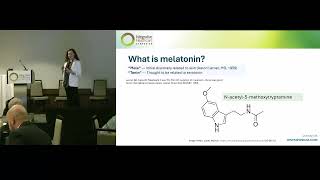
There we go. But I'm going to take you through an adventure of connecting dots. Connecting dots in the literature, in clinical work, in quantum physics, looking at cellular biology, neuroscience, science, botany. Let me just think, if I'm leaving anything out, there are going to be a lot of dots. And so I'm going to connect them in different ways that I actually haven't connected them before. So it's just really a nice. I was wondering if anybody's going to show up for this talk, but I'm glad you're here. All right. Melatonin is a molecule of consciousness. I'm going to chunk this out because there are so many different aspects to this, and I'm going to try as best I can to define them as we go. My disclaimer disclosures. All right, so these are the three learning objectives. I'm going to tour you through just a little bit about melatonin just so we're on the same page. So you know what I'm getting after with this molecule. Then I'm going to Talk a little bit. It's almost like we're going to revert back to being in a literature philosophy class and I'm going to start talking about this concept of darkness deficiency. I'm going to talk about the metaphorical, symbolic meaning of darkness and what that means in traditional medicine and in cultures. So talking about yin yang, masculine, feminine. And I'm also going to be talking about the connection of those things with things like biophotons and quantum biology. And personally where I think we're headed within medicine. Right. I was just talking with a colleague right before this. Talk a bit. Talking about sometimes you hear the same things at the same conferences and it's like, how do we start to bust the mold of how do we go beyond and actually in front of function, how do we get there? I'm going to explore that. Again, I'm not claiming to be the authority here. I'm just going to explore this from being more of an early adopter into this. So I just find that this is a really beautiful quote from one of the teachers that I have followed. So not just the Jeffrey Blands of the world and all of you in functional medicine, some of you are in this room, but also on more of the, I would say the spiritual, psychological, philosophical, people will do anything, no matter how absurd, in order to avoid facing their own souls. One does not become enlightened by imagining figures of light, but by making the darkness conscious. Carl Jung. So that will set the stage for where we're going. Ooh, sounds foreboding. All right, so first and foremost, let's just start with the 101 what is melatonin? And you know, here we have to look a little bit at the basics of kind of Organic Chemistry 101. I never really liked organic chemistry, but then later I realized, oh my goodness, this is actually nutrition. I have stirred and grown that love of organic chemistry. And if we look at the structure of melatonin and this is going to be important for this connection with consciousness. So that's why I'm going to call it out here. In fact, I even saw somebody with a tattoo of melatonin. I saw somebody with a tattoo of caffeine actually. So this benzene ring that we have, that six sided ring connected to a pyrrole ring, which is an indole, this combination of this indole structure, this is going to be really important for when we talk about biophotons. So melatonin, how did it get its name? Well, it was actually discovered in 1958 by a Yale trained dermatologist who was looking for a skin lightening agent. Back in 1917, there was a paper published showing that when the pineal gland of animals was put into a vat of frogs, that the frog's skin got lighter. So Dr. Lerner thought, well, maybe this molecule is actually connected to skin lightening. So he explored this and soon came to realize that it had nothing to do with skin lightening, and it had something to do with the brain and the pineal gland and sleep. So the name of it, however, is very dermatologically derived. So mello refers to the skin tone, refers to a very similar structure as serotonin. So hence we have melatonin, but actually Its chemical name is 5 Acetyl, 5 Methoxytryptamine. And I say tryptamine here. And the way I'm emphasizing this is because we are talking about consciousness. We are talking about vehicles, molecules of consciousness, and changing conscious states. And so the tryptamine family of molecules has been very active, as we see, with psychedelics like dmt. So melatonin is a cousin of dmt, but not actually connected by taking melatonin. You don't actually create DMT in the body, but there is a similarity in structure. All right, so where is melatonin found? It's actually found throughout the body. I would say one of the few places it's not found in the body is in the hair and in the nails, but pretty much it's found in every tissue in many cell types, which make it very intriguing, because when I think of consciousness, which I define as awareness, if we think of consciousness being everywhere, and melatonin is an ancient molecule, it's primordial. It actually evolved with people through the mitochondria, which I'm going to get into. So it's everywhere in the body. We have receptors for melatonin in order to take it up, we have not just cellular, nuclear, we also have cell membrane receptors. But I would say that the two main organs where you're going to find high concentrations of melatonin would be the pineal gland and the gut. So when we think of the gut, and I know that many of you have learned that we produce the most amount of neurotransmitters actually in the GI tract, I think it still remains an enigma as to why that is. We have some postulations as to motility or gut microbiome or autocrine paracrine effects, but I don't think we actually understand why the GI tract makes so much melatonin. But There is this postulation that perhaps it's doing something with the gut microbiome. We know that it has motility effects. So people that have GERD tend to fare quite well with melatonin supplementation, just as an example. And we know that most of the immune system is in the gut, and we know that melatonin plays a very intimate role with the immune system. Now, aside from the gut and the pineal gland, the rest of the body is making melatonin consistently. But there are different kinds of melatonin used for different functions. So when I'm talking about consciousness, I'm mainly going to be talking about the pineal gland. But I'd like you to be thinking across body systems as well. So you can see here that there are many extra pineal sources of melatonin. We're actually eating melatonin. We are getting melatonin through the skin, and ourselves are constantly cranking out a lot of melatonin through the mitochondria, which figures in largely to this consciousness element of connecting with the feminine or the yin, as I will talk about. So how many of you before you came here were just thinking that, oh, this probably has something to do with sleep and consciousness states, dream states. Melatonin actually goes way beyond sleep. And I feel like this is where it has developed a very negative reputation because people think, oh, let me just take more melatonin and then I can sleep better. But it doesn't actually work that way. Melatonin does a lot of different things. As you can see here, it is connected to the aging process. So as we get older, we actually produce less. I'm going to cover that. But what I would like you to think about is think like a scientist for a second and think of the functions of melatonin. I would say, even more than sleep, the way that we know about melatonin is because it is connected to the circadian signal in the body. So it actually keeps us in sync with nature. If we didn't have melatonin in the pinnacle of darkness at night, then the rest of our peripheral clocks intracellularly aren't primed with respect to metabolism or sleep wake cycle. So it's a really big deal to make sure that we have the right amount of melatonin, not just for sleep, but actually to prime our entire connection with nature in nature's rhythms through the cellular machinery. It is also a mitochondrial regulator, which I'm going to get into as it relates to biophotons, which I feel is one of the four running areas of health and healing. It's an immune stimulator, which is why we saw it during the pandemic being discussed as part of protocols. It's an anti inflammatory. And here's one of the unique things about melatonin that you don't find with other things, other antioxidants. It can flex to being fat soluble and water soluble, so it can get into watery tissues as well as lipid rich tissues like the brain. And that is what makes it very diverse and versatile and not necessarily connected in the traditional way to being a hormone. And then finally a neuroprotector and glymphatic fluid transporter, which I'm going to get into. That's one of the exciting actions. So one of the mechanisms of action is, especially as it relates to, let's just say consciousness, which is what this talk is about, is that the mitochondria can take up melatonin. It can also make its own melatonin. And it is thought that primordially that cells developed a mitochondria in this whole cycle of oxidative phosphorylation and respiration through melatonin, bringing in melatonin to help with keeping the balance of free radicals to quell those oxidative bursts. So when you think of melatonin, think of the M of the mitochondria, because there is a very strong connection between those two things. One of the newer things that I think is very exciting is this whole world of cellular biology that is merging with quantum science, which is now coming over into medicine. So this whole cellular process of what is called phase separation, in fact, there is some way of thinking in neuroscience is that one of the ways that Alzheimer's disease develops is because within the cell what happens is you start to get the proliferation of amyloid and you start to get a separate phase that develops in the cell and it starts to proliferate. And melatonin actually breaks that up. It breaks up the phases in the cell that aren't supposed to be there, whether they're a viral factory or amyloid protein or tau protein. So this is a really interesting concept. And if we think of again the mitochondria, the health of the mitochondria, maintaining vitality in a person and essentially consciousness, their energy, their qi, their ki, their prana, then we need to be fit in our mitochondrial health. The other thing is that melatonin hits.
On a number of different genes.
It's a very powerful agent in many different ways. If we look throughout the lifespan and to see when we were producing a lot of melatonin. We were young. Essentially, if we were breastfed, we probably got more from our mothers, especially if she was nursing us at night when her melatonin was higher, because it does come through breast milk. But essentially, as we make our way through life, what you can see is that we start to produce negligible amounts of melatonin. And it is thought that melatonipause, as has been defined and coined by Dr. Dickon Weatherby. By the way, I was on a podcast with him and he was asking me about melatonin and he said, deanna.
It sounds like you're describing melatoninopause.
I said, why yes, I think I am. Thank you. So menopause, andropause, adrenal pause, thyropause, I mean, so many of these different pauses. So melatonin in that way is trauma, truly no different in its way of acting as a hormone. And we do see that low melatonin status is connected with many different conditions, especially those related to neurodegeneration. So as we talk about consciousness states, thinking of the brain, however not limited to the brain, we need to be thinking about how does melatonin play a role in brain neuronal health, mitochondrial health. And I know all of you are systems thinkers, right? So connecting all of those dots to see how do we support the entire body system, right? And I'm not saying that melatonin is.
The be all end all, by the.
Way, but I do think it's a portal of entry because of its organic chemistry. And there are again, other molecules that share that chemistry. So on the very basic level, we know that melatonin is produced by the pineal gland. Back in the 16th century, the pineal gland was called the third eye, thought to be the seat of the soul by Rene Descartes, mathematician, philosopher. And we know that it is through the eyes that we receive the signals of light and darkness that ultimately signal that pineal gland that will then generate melatonin from serotonin, which then came from tryptophan, right? So tryptophan, serotonin, melatonin that then gets dispersed, dispersed peripherally in order to set the clocks. So that is just the pineal generated melatonin. And if we look at when that pineal gland generated melatonin is produced, it's in the pinnacle of darkness between 2 and 4am Now, I'm just going to.
Make a little bit of a verbal.
Leap here, but as people start to work on meditation, spiritual practice, one of the things that you start to see with some of these people is that they have these early morning wake ups. And oftentimes there are certain dream states, certain phases of REM and non rem. And so I do think that this peak of melatonin from the pineal gland between 2 and 4 might be significant in some way. I'm going to show you a slide on traditional Chinese medicine, chronotherapy, to look as well at organ system timing, because chronology and kind of looking at chronobiology is not something that is new. It's actually been studied in many ancient cultures. Right. So what is the significance of the 2 to 4am Wake up? Is there something in the realm of consciousness or in the dream state that could be circulating at that time.
Now.
Directly as we talk about consciousness? Because in my mind, consciousness is a spectrum. Like right here, all of us are awake, I'm assuming. Right. And if we're awake, we're conscious. You know, we have this awake state where we can make decisions. Sleeping is a different form of consciousness. Right. It is thought that we are, we can be in an altered state, state of awareness when we're sleeping or under anesthesia or taking certain things that are nootropics or psychedelics that start to alter our consciousness. In fact, one of the researchers in this whole area of consciousness is actually an anesthesiologist, Stuart Hameroff, who I'm going to show a couple of slides from. But essentially what we see in conditions, real medical conditions that are tangible, that we can understand consciousness in in is traumatic brain injury. What we see there is melatonin levels are decreased and these people that have been affected through a TBI can be helped with melatonin supplementation. The other thing with melatonin, trauma and consciousness, you can see that there is a connection between melatonin and memory and pathways related to memory. We see that there can be melatonin alterations with stress. I won't get into all the biochemistry of it, but essentially melatonin is coming from tryptophan. Tryptophan goes to make nad. Right? So when our body's really stressed and we need more energy, we need more nad, oftentimes we start to go down a different pathway, the kynurenin pathway, and we can start to make some neurotoxic agents that lead to changes in memory. So it's thought that melatonin's role in consciousness may be connected to perhaps some of its effects as it relates to stress and the pathways related to stress. All right, so I have five different mechanistic pathways as to why I think melatonin is connected to consciousness. And I'm going to just tour you quickly through each of them. One is just very simply, or maybe not simply, the glymphatic fluid flux. So when you are sleeping, when you're in this different state of awareness, your brain actually has the opportunity to detoxify and to release metabolites. And you have a separate type of lymphatic fluid in the brain called the glymphatic fluid, which is the lymphatic fluid that surrounds the glial cells. And when we are sleeping or under anesthesia, under these states of consciousness, we can actually remove more and there's more flux. This is in part why sleep is so important that your brain is doing its clearance. And in fact this has been referred to as brainwashing. But perhaps in a better, more positive light, we need a bit of brainwashing and cleansing, right? So this is how it happens during sleep. We can see the transference between the efflux out of the brain and this is impeded if there is inflammation in the brain matter. So those vessels aren't as accessible and.
You don't get as much removal when.
There is, quote, unquote, brain on fire or neuroinflammation. I just wanna show you here too in the graphic. When we think of the brain and we think of consciousness and we think of detoxification and clearance through melatonin, think of the eyes. The eyes are part of that system and the eyes are clearing along with the brain at night. And the eyes are the first signal to melatonin. So there's a body of evidence, and I listed some of the research studies here looking at melatonin and brain derived neurotropic factor. So bdnf, looking at it as a neuroprotector, or helping in cognition, helping with neuronal survival, differentiation. So it's clearly having some connection here with, with the neurons. And we're going to come back to.
The neurons in a second.
I was also talking with Dr. Pizzorno because he has interest in arsenic toxicity. It seems as though melatonin has some protective benefit against toxic exposures of different types, especially arsenic. And what I would say is that for this next mechanism, I'm going to describe that melatonin in a way is a conduit between waking consciousness and dream states. And in the shamanic or other traditions, they would say, well, what is the difference?
You know, sometimes the dreams are even.
More alive and we can gather so much Information from dreams. One of the things that you hear about people that take melatonin is that they have enhanced dream states, almost disturbing dream states, and they can't forget the dreams. They wake up and they're very bothered by this. And this could be because melatonin influences the REM state. And the REM state is our dream state. It's the part of our sleep cycle where we spend about 20 to 25% of our consciousness and having any kind of pre sleep exposure to artificial blue light or changing our environment, this can then change our sleep state. I thought it was really interesting, this smaller study in which they looked at men and women and they had them on 6 milligrams of melatonin. They asked them to log their dreams and women were more, I would say, hyper responsive to the effects of melatonin. They had more bizarre dreams, as the researcher pointed out. And while the REM state didn't change, the EEG pattern did change. So women had higher power potentials evoked during certain times of night. And there definitely seems to be a gender difference in response to bioavailability and even response to melatonin, which as we start to go a little bit more, you're going to possibly see a connection there. I'm not sure. So if we look at circadian regulation, we modulate consciousness states through melatonin, through our ability to be awake during the day and asleep at night. And so again, this is where many people think, oh, melatonin is just for sleep. However, if we kind of look at it in a bigger picture, which it really warrants, it's regulating the circadian rhythm. It also plays well with other neurotransmitters that can evoke consciousness states. So melatonin is a neurotransmitter, it's a neurohormone, it's a circadian regulator, antioxidant, anti inflammatory. But when it's wearing the hat as a neurotransmitter, as you can see here, it is very much connected to serotonin and tryptophan. It also inhibits dopamine release. So in this way, through our neurochemistry, we may be modulating these different consciousness states. And I don't have the research in here, but transcendence or states of transcendence have been connected to people's ability to have increased or changes in binding affinity of their serotonin to certain serotonin receptors. So the ability to be transcendent, right? To think out of oneself, to kind of be in that altered state. Of consciousness, where you see the great big hole. So serotonin is definitely. There's some really nice research on serotonin doing that. And now we're starting to see more on melatonin. So here's where I'm going to start to veer into uncharted territory with especially my expertise. Right. But there is a lot emerging here, looking at. And I can't negate this, especially because so much of my professional research work has been around phytochemicals. And what we see here is that so much of what we see in nature seems to be connected to more of the quantum physics aspects of our physiology. And in fact, if you start to dabble over into some of the quantum physics work, which can be quite complicated, But I think that there are some very simple ways to kind of put our arms around may be that some of these biophotons that we generate are connected in our states of consciousness. So the two people to look to for that research would be Stuart Hameroff, who is an American anesthesiologist, and he has partnered with Sir Roger Penrose, who is a Nobel laureate in physics. And so these two together have kind of been putting together this whole theory around consciousness being connected to not just the typical neuronal synapses and firing, but actually going beyond and to look at the quantum transfer of energy. And I just find this so exciting because all of us here in integrative medicine and health and wellness, functional medicine, we have always focused on more of does somebody have function? Does somebody have these certain biomarkers? And I have had conversations with people, even Dr. Jeffrey Bland, where I said, you know, can we back that up a bit? Maybe we need to be looking at the field. The field. The morphogenic resonance. Right, the charges. You know, we're very electrical beings. Maybe we need to be looking at.
The field which generates the form, which.
Then leads to the function. Right? Not to say I'm not negating that function is not important. However, I think in our 21st century metrics and where we're going, we're going to be looking at the field. And there are already people talking about the field, A lot of physicists and quantum scientists. We need to bring them over into conferences like these to help us to metricize, quantitate, understand, and just put our arms around this in a more medical way. And fortunately, as Laurie and other people know, there are devices now being created.
In order to help people to measure this.
So I want us to just really keep this in mind going forward with light As I talk about light and darkness in a more metaphorical way, biophotons, you know, that we are actually beings of light. And perhaps one day we are already seeing red light therapies at conferences like these. How do we actually assess our own.
Inner light, the biophotons that we're giving.
Off as a measure of not just our metabolic processes, but perhaps also our quantum conscious connections within the neurons? And I'll get into that a little bit more. And if you think about it, just to inject a little bit of thinking of spirituality and ancient traditions around spirituality, which I define as sense of purpose and mean meaning, and seeing your interconnection with things that are greater. And what I see here is that there is this. This talk of light and dark, good and bad polarization, right? So maybe there's something here to be said for light and darkness and looking at that within the body. All right, quantum entanglement. I know that this is after lunch, and this is probably like more than you were bargaining for with this kind of talk, right? But you know what? Quantum entanglement is just like another way of saying systems biology. To me, quantum entanglement just implies that when you have.
I'm going to pull this down a little bit. When you have an effect somewhere in the body, you are changing it somewhere else, right? That's really all quantum entanglement is.
And so this whole premise that speaks to consciousness is that when we produce.
Photons, that there can be this collapsed wave particle dynamic within the neurons that might be implicated in our states of awareness, in our state of being.
So I think that this could be really interesting. You know, is this what the ancient rishis and priests and monks and pastors.
And everybody, wise people that were. They were observing this, is this what they were looking at from that aspect of light and dark? All right, now here's where it gets very nerdy.
So hang on to this.
If you look at Hameroff's premise of nerve cells, what you see is that it's not just about the interconnections, which is a more classical explanation for how nerves send information. But within the neurons, what you see is that there is a configuration that is more geometric, and it is in a structure that would facilitate the movement of light and some kind of vibration, and that vibration going through these microtubules inside the neurons. You can see all these different geometric patterns of microtubules and how they could be connected to different neurons. This is where it gets a little bit more interesting. Because now if you think of.
If you zoom into a microtubule, what.
You will find is that you actually.
Have.
This benzene ring that is in all of nature, but especially these indole compounds like serotonin, like melatonin. What happens is they start to vibrate together because they're in this geometric configuration within nerves and within other body systems. Within that tube like structure, there's a transference of information as light. Again, I'm taking it back to that organic chemistry structure. If you start to look a little bit deeper, what you find is that melatonin plays a role in that neuronal cytoskeleton and also brings in the microtubules. There's a connection between melatonin and the microtubules. They increase the polymerization and they increase microtubules. The microtubules also modulate melatonin receptor function. It's kind of like the connection between melatonin and the mitochondria you then see with the microtubules. Now, what's also interesting is that the pineal gland, which is also incredibly intriguing from a variety of different standpoints. I'm sure if any of you know who Dr. Joe Dispenza is, he talks a lot about the pineal gland. It's comprised of microtubules and you can actually increase the microtubules just even temporally. And this is through the dark phase. So when we are in that 2 to 4am period, when it's very dark, when our melatonin should be high, now we're seeing the most amount of activity with the microtubules. Again, I'm just patching it together. I just see some connections and patterns here. Again, I'm no expert on the physics.
Side of things, but I, I'm seeing.
That this is a really important message in some way to bring into health, healing, connecting the biochemistry with actually consciousness states.
So again, quantum biology, there's a lot.
More here as it relates to. In this section, I'm just going to.
Talk about light and dark and I'm.
Going to wax in between the biochemical quantum and then I'm going to move into the ancient and spiritual. So photons, if we think of biochemistry, oftentimes we think of metabolites, we think of enzymes, we think of cofactors. This is more subtle than that. This is using light photons as a means of energy transfer. And I do again think that we're going to be in the future measuring with devices disease by the spray of light in certain parts of the body. I mean, this was already done by Dr. Fritz Popp many years ago. It just hasn't been carried through. And I would say in a way that's much more commercial. Serotonin, as I mentioned before, and tryptophan, which is an essential amino acid. So.
Right.
Tryptophan, again, is the precursor molecule. These have both been posited as compounds of consciousness already. So I'm actually not bringing up anything new. I'm expounding on what was already there and including melatonin, because of its organic chemistry, because they are very similar, and there's already indication for changing states of consciousness with melatonin. But I do think that for us to go deeper into photobiology, you know, I even my background's with food and nutrition, but I can imagine that we take our smartphones and we go into a store and we start scanning food for the amount of biophotonic spots that it's giving off as an indicator of oxidative stress and vitality of that particular food. Right. We won't be looking at numbers, we will be looking at light particles. And this has already been being done.
In a variety of different ways. Just even the pineal gland. There's so much talk right now about.
Wearing your blue light blocking glasses at night. We're starting to see the power of light and darkness.
And I think that if we don't.
Start there and we just jump to nutrition with no acknowledgement of nature or light or dark, it feels like we're jumping the gun. We need to start big and broad with nature and rhythms. The similarity here with the mitochondria is if you zoom in and look really close there, what do you see as offshoots of these different pathways? You see photons.
Right.
The mitochondria, if you were to look at it up close, when it's doing its thing metabolically, is giving off a spray of photons. With every metabolic pathway, too much light given off is actually more towards a disease like process. You don't want to lose your light. You don't want to put off too much light. You actually want to conserve and have that darkness within the mitochondria. So, yes, as I mentioned, the pineal gland has been referred to as the seat of the soul.
If you look at how the pineal.
Gland looks, it looks like a pine cone.
And that's why it was named as such.
It was regarded as very sacred in different types of spiritual literature. And it's also very unique in that it is crystalline in structure. And if you look at some of the information in neuroscience, it's that more of these neuronal cells are actually embodying this kind of crystalline microtubule structure that hasn't always been acknowledged. It's kind of, I would say, shaking the textbooks a little bit because it's a newer, more quantum model of neuroscience. The mitochondria, similarly, also a vital force through the lineage of one's maternal DNA. And as you can see, this quote here from our late colleague Dr. Michael Gonzalez, who I so miss energy transformation. And mitochondria produces a special state to condense energy and electrical vibrations. And so the mitochondria, to me represents the maternal represents the yin, represents the connection with ancestry in the way of giving us our vital energy and our revitalizing force. So I think that these two things work together, the pineal gland and the mitochondria. And the way that I see this is through, of course, light and dark. And I think that also bringing in this connector of melatonin, that we get melatonin from the pineal gland in response to darkness, and we get melatonin from the mitochondria in response to metabolic activity. Right. And keeping us vital at the cellular level. If you're not familiar with Dr. Fritz Popp, I would say look up his work. He's since passed on, but he had the Biophysics Institute in Germany.
And what they did is there are.
A number of publications on this already. But essentially measuring the spray of lights or biophotons from the body using different devices. And again, the goal is to not have the biophotonic spray because that would indicate that you're losing energy, you're losing that awareness. You're losing, I would say, the vital force. You're having more oxidative stress. But he did a number of different studies looking at biological rhythms, physiological functions, found a lack of symmetry on right and left sides as it related to biophoton exposure expression. So that is interesting. Now, if we talk about light and darkness, I also want to enter in color a little bit. You know, when I think of the mitochondria, I think of cytochromes, cytocell, chrome color, breaking apart bonds of energy. And in that process, having the spray of different photons at different wavelengths of light that actually do correspond to different spectra like blue, green, red, orange. And if you look really closely on this diagram.
Well, first of all, if you look.
At this, this is a great article. If you can get your hands on this, this is open access. The application and trend of Ultra Weak photon emission in biology and medicine and what they looked at here within the cell, you can see the different free radicals having certain absorbent capacities that would connect to colors. So imagine that you could even have a device that is measuring certain colors coming off of a person through the biophoton emission that would track with certain types of radicals, free radicals from the mitochondria. I know I'm taking you down the.
Rabbit hole here, but I'll zoom on up again. You know, essentially what I'm getting at.
Is that we want light and darkness. We want to do that metabolically, we want to do it circadianly, and we also want to do it spiritually and from a conscious perspective. They're all very connected. There are again, some great research on light emission. So UPE is ultra photon emission. So even with work on cancer, they have found greater emission of light, more metabolic spray with greater number of tumor cells. There are indications of actually tracking certain disease states using these biophotonic emission scanners. This is just one as an example of that. Now to dip into where is she going with this? Because this is all metabolic and sounding very biochemical. Well, if we connect to an altered state of consciousness like meditation, what we see is we actually conserve our light. We reduce ultra weak photon emission. And the way that this has been studied is through fingers, like many times in these studies. Kind of neat. There are devices where you put your hand on something and it will measure the amount of photonic spray. They've also done it on the forehead. And so you do see that there is that connection there between an altered state of consciousness and a change in one's photonic source or spray. And keep that in mind because I'm going to bring up melatonin in meditation. So light and dark. Do we have a deficiency of darkness? Why are people afraid of the dark? We wrote about this in our review paper, talking about melatonin as the next vitamin D. Where we talked about, it's almost like vitamin D and melatonin are like brother and sister, yin and Yang. Vitamin D is all about the sun, all about the Yang. You need sunlight, expose the skin to the light. Right. How important that is. And it is. And similarly, melatonin is like the feminine, the yin. It enables us to sleep, connect to nature, connect to nature's rhythm, connect to deeper states of consciousness through dream states. So if we have all light and not darkness, we're out of alignment. And I bet so many of the people that you're helping clinically, medically, really are just even off in their light and their darkness on many different levels. All right, so physiology of darkness why do I say we have darkness deficiency? I think because, well, look at how we live. We're in New York City, you go out at night, everything is bright. You know, it's unrelenting and it is constantly bombarding us. And we're changing ecosystems with this bright artificial blue light on the planet, right? It's making reproductive cycles dysfunctional, so it can disrupt the endocrine axis. In fact, I teach a lot on environmental issues. And one of the things I like to say because I really feel and know it to be true, is that artificial light is like the biggest, most societally accepted endocrine disruptor. It's like we all know plastics are bad, we all know that metals are bad, but we don't all see toxic light as being part of that same endocrine disrupting bucket, right? And kids scrolling late at night, changes in puberty, changes in reproductive health. So again, melatonin playing into that because it's the hormone of darkness. It only comes out from the pineal gland when it's dark. So again, artificial light at night, Alan, an overlooked endocrine disruptor. So I just want to show you this too. I mentioned that melatonin is produced in abundance from the pineal gland between 2 and 4am that's not the only thing that happens between 2 and 4. We also see higher levels of superoxide dismutase, catalase. In fact, it was funny we were talking about graying of hair this morning and talking about these enzymes.
Well, they peak at night.
So if you're not sleeping through the night, you know, chances are there are going to be a lot of these oxidative stress changes. Glutathione reductase is high.
Glutathione.
You know, I always love it when people have a favorite molecule.
Mine is not melatonin.
Melatonin is one of my favorites. But for the people who love glutathione, you know what actually helps to make glutathione? Melatonin and a lot of other things. Sulforaphane. You know, lots of different influences there, but all these things are peaking at night. That's my takeaway for you. When we are in this other state of conscious awareness, the body is in reparation mode. We are in repair. I'm married to an acupuncturist, so we have these east west talks all the time. And one of the things that Mark has talked about is the TCM chronotherapy.
And I said, mark, what's going on.
Between 2 and 4 in chronotherapy? In Chinese medicine, he's like, well, that's liver time. Liver time is between 1 and 3. And it absolutely makes sense if you start to think of the brain detoxifying, letting go of metabolites between that two and four by way of melatonin, which, by the way, I didn't mention this, but melatonin is also a carrier of the toxic metabolites into the glymphatic fluid. So it's actually helping with brain detoxification of amyloid and other compounds. So liver, brain, and thinking of dream state, you know, people have a lot of buildup in a variety of different ways. Things need to come to the surface. And sometimes I think it's a really good thing that people start dreaming very vividly when they take melatonin, because it brings things up and out. Just thought I'd toss this in here as well, since I'm going to talk just briefly. More maternal. Full moons can change melatonin levels. So believe it or not, just naturally, in a lunar kind of a way, you know, we are run by rhythms. We can't avoid it. Circadian rhythm, seasonal rhythm, even our month of birth rhythm. So depending on the month that you were born, you could have your own rhythm in that way. Full moons can change melatonin levels. This was done in a sleep lab where they showed that people during a full moon had less sleeping quality and lower amounts of melatonin four days before and four days after that full moon, which is so interesting from an ancestral perspective.
So what is darkness? You know, I grew up Catholic.
I was afraid of the dark. I equated the dark with something evil. And I feel that we need a reexamination collectively of looking at our global balance of light and dark.
Right?
Looking at the yin and the yang, looking at the energetic principles of masculine and feminine. And typically, the darkness is connected to the feminine principle of yin, at least in traditional Chinese medicine. So what I did was a little bit of a scratching of the surface to see what do all the different spiritual traditions say about light and dark. So I have some of these here. You'll have the presentation. So I'm not going to walk you through, but they all do say something about light and dark, which I thought was intriguing. And I just have wondered if there is a resistance to that darkness, Right. Where we might actually enable higher or heightened states of conscious awareness through something like melatonin. Right. So how do we connect a little bit more to the darkness, to the nighttime, to nature in that way? I had the Opportunity to interview a man by the name of Dr. Paolo Lissoni. He is an Italian oncologist. I think he's near 80 now, so he's retired.
And one of the things that he.
Did for his patients that were undergoing chemotherapy was put them on high dose melatonin. He thought it would be beneficial for them because he knew it was an antioxidant. And actually he was very philosophical. And I have found this with scientists and doctors and healers of different types that whenever they go really deep into something, all of a sudden they come out on the side of being very philosophical, being very spiritual. Maureen Murdoch.
Right.
You know, so these people, they start to realize that there's something bigger here. So one of the things that Dr. Paolo Lasoni divulged in research, and I also talked with him about this, was that the activity of melatonin seemed to be dependent, at least in part, on the patient's psychospiritual status. And it had maximal activity in the presence of real spiritual faith, which he actually does define in the paper. So I thought that that was kind of interesting. This article also talks about the psychoneuroendocrine immunology, looking at a role of melatonin in that.
And here's the connector. Now, with meditation lowering light spray or.
Photonic spray giving us more vitality, we see that meditation actually promotes healthy levels of melatonin and serotonin. So you don't even have to take a supplement if you are dedicated to that meditation practice. So in that first study that I'm quoting up there, that was in a longer term group of meditators, like people who had been meditating for about 10 years versus people who had not meditated. So long term, meditators also have greater pineal gland integrity and reduced brain age. So if that's not inspiring, I don't.
Know what would be.
So connecting into that neuroendocrine system with plants, I think is so important.
The one that I'm tugging on today.
Just happens to be melatonin. But there are polyphenols, some of you have heard me talk about polyphenols before, which also have that same benzene ring structure that can hold electrons and have that photonic resonance. And we know that polyphenolic foods, so foods that are high in polyphenols, tend to help us to acclimate to seasonal changes. Again, a nature rhythm finder.
And then maternal melatonin deficiency leads to.
Endocrine pathologies in children. Really important for mothers to have sufficient melatonin. Again Back to the maternal, back to the mitochondria, which is connected more to the mother. So this is kind of my takeaway slide. So kind of trying to connect all these dots which may seem all discombobulated.
To you, but melatonin, as I see it, it's a darkness molecule and it.
Is helping us to conserve our light. And we can look at light in a way of the mitochondria, I would say the metabolic cycles. We can also see it as a matter of opening up to greater consciousness states, whether through dreams or having a more fulfilling sleep which enables us to be more awake. I summarized all of that there. Then I'll just leave you with some of the clinical aspects like, okay, so how do you hit the ground running with all of this? That seems very theoretical. And she's just connecting dots and seeing patterns.
But give me the takeaway. Well, I say that embrace the darkness.
Embrace the yin, embrace that sleep time, dream time, and really work with, I would say, somebody even that is trained in dreams. You know, I feel like that is one of the portals to consciousness. Right. Do we need psychedelics or can we use our dream state? Can we start to leverage healthy light and darkness? So get your light right, get your darkness at night. Aim for tryptophan in the diet, which is an essential amino acid, right? So adequate protein. I find it always very interesting from an energetic and a societal perspective when I see trends come out and I feel like there's so much about protein right now. Protein is grounding. If we look at the energetics of protein, maybe we do need more of that tryptophan to take us more into these different indole molecules to help us to reach a different state of awareness. I think that good nutrition, nutrient dense food will help to elevate and change behavior ultimately. And then looking at food sources of melatonin, supplemental if required. And so looking at a circadian lifestyle prescription, I even call melatonin. I didn't put it in here, but I call it a circadian nutrient. I do think that vitamin D and melatonin, we could call them circadian nutrients. You know, we need a whole battery of things to keep us in alignment. So aiming for proper light and dark exposure. You know, I was on a plane yesterday coming here from the Seattle area and it would was late at night, it was 7:30 at night, and they had blue light in the whole cabin. And I was thinking I need to.
Write them and tell them that they're.
Going to help their customers to sleep.
Better at night if they have Like.
A warm hue of red, pinkish, orangish light, not this blue light. So I have in here for you some light exposure recommendations.
If you don't have it, the app.
That I use, it's a free one. It's called Light Meter Luxury. It's an excellent app. It's so easy to use. You just point your camera on your phone to wherever the light is and it will give you a reading. So we need to measure the light and conversely, we also need to look at the darkness, which we can infer from the light. I do think looking at spaces, you know, simple things that you can mention to your patients about facing a window if they're working versus not can make a huge difference.
Going outside for like bursts of 10.
Minutes can make a huge difference. Check out Dr. Sachin Panda's work. He wrote the circadian code. He's one of the forerunning, I would say, researchers in circadian science. He has such great practical tips in there around these kinds of things. And meditation just again, bringing that back to change our state of consciousness in order to give us more molecules of consciousness. It's like it keeps giving when we engage. If you haven't seen this book, I think it might be an interesting one. How many of you have seen the light eaters? Oh, okay. Of course.
So this is great because it talks.
About photons, it talks about plants.
Why have I been so fixated on plants all these years?
80% of this planet is plants. It has the biomass of plants, and plants are the ultimate photonic capturers. And this journalist talks so intriguingly around plants eating light and the transference of plants capturing light through photosynthesis and then us taking that in as part of the mitochondria and breaking apart those bonds and spraying again this colored light through the cytochromes. It's really a beautiful book.
I love it.
Music nurses with circadian rhythm disorders who are treated with melatonin and music therapy experience. Experience better sleep quality and reduce negative emotions. I also think music is a great conduit to changing states of consciousness.
Music therapy, and I've seen this in.
A number of studies. I'm just citing one here, but music therapy for neural protection and improved circadian rhythm for people with Alzheimer's and or Parkinson's. So again, helping the nerves to fire and wire and create more quantum tunneling through those microtubules. I just thought you might find this of interest. It's not like every music will have this effect, but this was a cell study. Cells subjected to 45 minutes of Chinese five element music, heavy metal, classic or no music. I'm just laughing because somebody said, but what if I like heavy metal? Won't it like beneficially change my cells? And I think you have to take that within context, right? So if you like the music, most likely it's going to have a benefit for you. But it was the Chinese five element music that had the most benefits. With increases in ATP, increases in glutathione, There was some with classical music, increased cell growth rates and reduced reactive oxygen species, Whereas the heavy metal music resulted in an increase in reactive oxygen species and a reduction in cell viability. Now that was just in this particular study, kind of a neat study, but essentially this is promoting better consciousness and states. I also think that creativity and dreams, you know, so many of us are. We're in the healing arts, yet we make no time for art ourselves. And art can come in so many different formats. Drawing, painting, thinking, journaling, whatever.
You know, I don't want to put.
Any limitations on it.
However, when that 2 to 4am Wake.
Up happens, I feel like it can be a calling. There can be something there that needs to percolate on up and call us to greater states of creativity. All right, so I'm going to stop here. Again, I had a number of different ways that I could foresee that melatonin could be, along with the pack of serotonin and tryptophan as molecules of consciousness in a variety of different ways. And I hope to leave you with this as an inspirational message. I will love the light, for it.
Shows me the way.
Yet I will endure the darkness, for it shows me the stars. Thank you all for coming. Really appreciate that.
More from Deanna




Gut Health, Stress & Sleep: The Truth About Supplements and Real Detox with Dr. Deanna Minich




"99% of Melatonin Is Made From Petrochemicals" Dr. Deanna Minich & Lara Pizzorno Interview (Part 2)



🎙️ FMP Essentials Show: Balancing Menopause Naturally with Phytochemicals | Dr. Deanna Minich