Science & Spirituality Talks with Alejandro Junger, MD
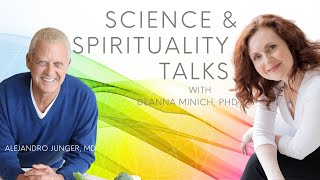
Cardiologist Alejandro Junger talks about healing the gut as the foundation for chronic disease, combining functional medicine with spiritual practice. He's spent time in Indian ashrams, worked with plant medicines, and now runs retreats that pair dietary interventions with trauma work like family constellations and coffee enemas.
Chapters
Hello, everyone. I have one of my great friends, mentors, colleagues, here with me to talk about science and spirituality. Dr. Alejandro Junger. Hello, Alejandro.
Hi, Deanna. It's funny that you call me a mentor, because I see you as my mentor and teacher.
Well, I feel like we're all each other's teachers in so many ways. And, you know, I was reflecting on our relationship and thinking back to when we first met, which was actually 2006. And at that time, you were mesmerizing to me because you had written the clean book and you had this vision. And so this is such an opportunity for me to showcase to everybody your thoughts on science and spirituality. So we're going to take them separately, and I first want to talk with you about your personal journey with science and medicine. So anywhere you want to go on this, this is not about giving tips. This is about you and your connection to science and, like, how do we figure things out, like those tight junctions in the gut.
So thank you for the introduction. My journey is still ongoing. Right. But one thing that I always had as a strong north was this desire or drive to help. Right. When I was little, I would help my friends with their toys, and then when I started growing up, I would help with other things. And it went focusing on helping people feel good, helping people be healthier, but not so much be healthier as really feel good. Right. And many times they go together, but not necessarily so. You know, I went to school, and then you have to decide what to do. I want to be a doctor. I want to help people. I want to help people. So I went to medical school and I dove into the science, and at the same time, I dove into the spiritual world, because my study mate, from day one, actually from the day we took the examination to enter medical school, was this guy, his name is Pablo, who now is the Archbishop of Uruguay. Wow. So maybe. Maybe in our lifetime, I'll see him in the Conclave because he's one step from becoming a cardinal and, you know, being able to access to be a pope, an Argentinian guy did it. Why not a Uruguayan? Anyways, he was just starting on that. On that, too. So when we got together to study, which was every subject, every day we would talk about medicine and we would memorize and we. But then we would talk about God and Christ, and I'm Jewish and he's Christian, and he didn't want to convert me, but he was convinced of something that he thought that if I didn't know it, I wouldn't achieve what I came here to achieve. So as a friend, he cared. So he put all these things in my head and we argued and we. At the same time, I became very, very good friends with the rabbi, with the orthodox rabbi in Uruguay who used me for my skills, which apart from studying medicine, I was a video videographer. I made videos, weddings and events and bar mitzvahs. And so he liked that and used to take me with him to film his events. But we used to have these really interesting talks as well. So I was interested in these words from the beginning. And then studies became tough and you know, medical school is, is not a walk in the park. So I had to really zone in. I had to stop all the video making. And I graduated from medical school and I ended up in New York doing my internship and residency in internal medicine at NYU Downtown Hospital and my cardiology fellowship at Lenox Hill Hospital. But when I arrived in New York, life was so different. I didn't have my, my future archbishop and the rabbi. I didn't have my family. I was working all day long. I wasn't eating the home cooked meals from my mom and instead buying food like products in supermarkets, which we didn't have in your way at that time. So everything changed and I started getting sick and I started, you know, I ended up with three diagnoses of irritable bowel syndrome, severe allergies and severe depression. And I was put on seven prescription medications. And it didn't really, it really makes sense to me. But the one thing that I noticed is that it's difficult to talk about these things. But I think that one of the gifts or one of the abilities that I developed in all these years of caring for people, or maybe I was born with it, I don't know, is the ability to feel what other people are feeling when they're telling me their thing, the story, right? And sometimes, you know, I get information and I'm not calling myself a medium. It's just an ability through my interest in helping, through my interest in medicine. When they're telling me their story, you know, I'm in with the. And I get all sorts of ideas. And that helps me a lot with helping people because you can go to a doctor and he can give you a plan, and it may be the same plan, but if the other doctor really listened and went in with you, it's different. And I know you know what I mean. So when I did try, at the time that I was diagnosed with depression, I did try antidepressants. And the doctor at the time Pointed to his head and he said, you don't have enough serotonin. So he gave me a serotonin reuptic inhibitor. I did lose the sense of dread, but I also lost my empathy because what I was telling you about the ability of really going into somebody, I lost that. So I didn't want it. So I stopped the antidepressants and I started exercising. And I got into the best shape of my life with a six pack. And I was training other people, but still, something wasn't okay. And the first thing I noticed was that my mind was always racing. So, you know, through studying what that meant, I came across Eastern philosophy and Eastern religions, and I came across the concept of meditation. And meditation described as the practice, practice through which you will be able eventually to slow down, detach from your thoughts, not identify with your thoughts. Right. And eventually even stop them and be fully, fully present. That really caught my attention. And one thing led to another. I ended up in a monastery in India, working as the doctor of the monastery. Huge monastery, it's called an ashram in India, where there was a living guru, meaning, you know, Christians follow Jesus Christ, but he's not alive in the flesh. Well, this guru is in that state, supposedly, and is alive, you know, so things happened with her when I. At one moment, she slapped me on my chest and I had an experience of what I understand now as cosmic consciousness. It was like a sneak preview, right? Maslow talks about it, Terence McKenna talk about it. I mean, all the people, and those are the older generations. Now there's this guy from the Omnivore diet, what's his name? Michael Pollan. Michael Pollan. So he writes about it when he talks about the mushroom experience. Psilocybin. And I've tried every plant that you can imagine, from ibogaine to ayahuasca, peyote, wachuma, all of them. And even though they were incredibly, some of them were incredibly deep experiences that I wouldn't be able even to talk about here because I don't have the language. That slap in the chest was all of them combined times 100. So I understood then and there that that is a possible state for human beings, right? And call it enlightenment, call it being fully present. But not only that's a possible state, my deep understanding after studying Gurdjieff and other and other teachers, is that that is actually what we came here for, to be in that state. And, you know, we like to think about human beings, like to understand everything, right? So we look about, oh, yeah, the plants they receive light and they turn CO2 into oxygen through chlorophyll and blah, blah, blah. So, you know, they're like the lungs of the. So. So, so the plants have a function. You know, we are functional medicine thinkers. So. So plants have a function. So what is the function of human beings on the planet? And Gurdjieff says that the function of human beings is really to be. To achieve being in that. In that state which we kind of are born with, but then we lose through programming. And that state is like oxygen to, you know, to the universe, but definitely to planet Earth. Right. And very few. And very few of us are in that state. I mean, I know I'm not, you know, and I strive to be. And that's my, my spiritual practice is that how do I achieve that state? Yeah, through meditation. Through meditation in action, whatever. Anyways, I ended up in the monastery, learned all these things and then came back. And I am still trying to find my way because we are so used to this organized rule oriented systems like the Western allopathic medicine system. It's in hospitals or in offices. You know, all my friends from medical school, my mentors, my teachers, they all have offices. You know, I go to the office and you wait in a waiting room and then they call you in and the charge is on the door and you go in and there's a blood pressure thing and an electrocardiogram and a pulse oximeter and the chair goes up and down. It's a very specific kind of thing, you know. Yeah, whereas. Whereas the relationship between healer and patient, or doctor and patient has nothing to do with that.
Right. Well, one of the things, you know, you're unique because I think for some people I've talked with, they started their journey in medicine and science and then later found spirituality. And I think for you it was intertwined. You were born with this hybridization of both of these things, both of these gifts. And in fact, one of your quotes that comes to me is not all doctors are healers and not all healers are doctors.
I want to be both.
Exactly. You did both paths. So I want to ask you kind of a thought provoking question. Do you think illness or being in this place of dis ease is really a spiritual condition? First and foremost.
I think that everything that exists, it's a manifestation of a spiritual aspect. So your question is kind of tricky because it wants me to think of it separately. Right. But it isn't. Everything that is occurring that we see, that we can touch is just an aspect of energies that we don't even understand. So, yes, life itself is a spiritual expression or an expression of something that it's, in part, spiritual.
And so in working with your patients over the years, how have you helped them to see their condition as something that is bigger than just a very simple diagnosis? I'm just kind of curious because you're such a deep thinker. I was at your house, and I remember you brought out all of these books, and, you know, Madame. How do you say her name?
Blavatsky.
Blavatsky. And, you know, you had all of these esoteric texts, and I knew that you had this depth. And then I would hear you on the other side talk about leaky gut. And I'm thinking, well, how does he see leaky gut in a spiritual way? How does he communicate that in such a way for people to see the bigger picture? Is it just a lack of boundaries, A lack of saying no, or is there something that's truly toxic? You know, how do we see the macro and the micro of what's happening to us?
You know, there was a very famous guru that I actually met in person and had a very particular experience with. But there's one thing that he said that was amazing. His name is Satya Sai Baba, and he used to say, I give people what they want in the hope that eventually they will want what I really have to give them, you know, Meaning I am not a guru, and I don't claim to be. I already flat out told you I'm not enlightened. You know, I have. I have moments of what I interpret as being fully present. They're very sporadic. So I'm not saying this like I'm, you know, plagiarizing his words. Right. But the thing is this. I'm a doctor, so I have a title that says MD Right? Physician and Surgeon. And the people that make an appointment with me because of that, I give them initially that. So people come with me with an ailment, with, you know, I'm getting bloated. I have a lupus. You know, I have Hashimoto, or low energy, low libido. I can't sleep, I can't lose weight, whatever it is. Right, Right. Initially it was only cardiology. Patients were referred to me after I became a cardiologist. But then I said, whoa, whoa, whoa. You know what I'm looking at? It helps every organ. And that's what I love about functional medicine. We don't divide things by organ. Right. We divide things by system. And systems are all interconnected. So you Know, I start helping people with what they come for me to help them with. And 99.9999-99-9999% of the people have leaky gut. And that's the problem that is at the root of what they're telling. When you repair that, wow, it's incredible. That doesn't mean that their journey is over. You know, you got them over that hump and they opened up to other things right at the same time. What I realized is that certain, and to talk about it in the way you asked me, spiritual things, which I don't really divide, but for the sake of discussion we talk about, spiritual things also need to be addressed. And I'll give you an example. Recently I was in Argentina and I was guiding a retreat and there were people from all over the world that came to the retreat, which is the promise is we will get you initiated in a gut repair program and we will connect you with healers that do other things that may aid in your whole process.
Right, Like a yoga teacher or massage therapy.
Oh, okay, you'll get into it. Yeah, no, no, I'll get into it. We have yoga teachers, we have massage tapping, biohacker, biohacking tools. We have something which I became blown away with, which is family constellations. Do you know what that is?
I love that. Yes, I do. I've experienced that a few times.
I have a couple of family constellators that are like, you know, it's unbelievable. It's what they, what they, what they help people break through. I never imagined possible, and I never imagined was so connected to the physical part, which is what I was telling you about in this retreat in Argentina comes this lady, very educated, well off. So she could have, you know, she could have and consulted a lot of people about her symptoms. And her symptoms were very much like, if I tell you, you say, oh, she has SIBO or histamine intolerance, right? Or both. But she had followed all dietary instructions from fodmaps to the clean diet. She had followed everything and nothing had worked. And the glutamine and, you know, anti, herbals, antimicrobial, microbial, herbal, antimicrobial deparcitation. I mean, she didn't have heavy metals. So there was no explanation why it wasn't working. You know, things weren't working. And she was about to take. And it wasn't severe because in severe cases, sometimes you say, you know, what, take the antibiotic, the triple antibiotic or whatever, rifaximin. But she was at the point she brought them to the retreat, and she said, doc, I'm about to start, because I don't know what to do. This is my last resort. So I said, okay. So, as we do in functional medicine, I started talking to her about her childhood, how she was born, C section or natural birth. Was she breastfed? Did she. Did she have to skip school because she was sick when she was a baby? Did she take antibiotics, blah, blah, blah. And then. And there comes a time when suddenly life got really dark, and it was a time that something happened with her father, right? So already it was so obvious, you know, looking at it from the outside of the story, right? But for her, it wasn't. She was just trying to talk about her belly. And, you know, anyways, I said to her, listen, I think you have two main problems right now. First, you're constipated. She hadn't taken a poop in, like, nine days. And second, there's something there with your father that is unresolved. It's an unresolved trauma. So I gave her a little bottle called Implantorama that I buy here in California, and I take over there for people. It's like a little colonic machine. It's a little bottle with a tube that you put in your butt, and then there has another tube that you pump air into it so that generates the pressure. And I do it with coffee and with water and chlorophyll and all kinds of things, depending on what I. So I gave her one of those. I said, have a coffee enema tonight. And suddenly they interrupted us because they were announcing that the Family Constellation session was about to begin. So I said, I think you should go. And then I didn't see until the next day. And the next day, it was like a different person. She had gotten a coffee enema. She pooped her brains out. And she had gotten a huge breakthrough about that thing with her father, and. And things completely resolved. It was unbelievable. And then she kept on doing the clean program for the week that we were there. But I kept in touch with her, and this is five months later, and she's like, never had a symptom again. So, you know, we go on Instagram and we see all these doctors, great doctors, functional medicine doctors, some of them dear friends of mine, you know, like will Cole and Dr. Josh Axe and even Jeffrey Bland and all this, you know, and they know a lot, but they. You know, everybody's spitting out concepts, you know, the lists. These are the medications that take away these vitamins and, you know, microplastics and this supplement is great. And this supplement. And I think that even though that's great. Completely missing the point, if what you're looking for is true healing.
Yes. So back to that woman that had this radical healing event. It sounded like it was connected to psychology or her upbringing. And then even something physiologic and physical, like having a huge bowel movement, can really make you feel differently, too.
Not an expert in. In psychology or. But, you know, I've had my experiences, and I can tell you this. It was such a heavy trauma. I saw it when I. When we were talking through her history, the moment that happened, her whole expression changed while telling me. Right. So. So, Yeah.
And along those lines, do you think that I just posted something on Instagram today because I had this inspiration about ancestral connections. How much of who we are today do you think is reflected in our ancestors? Like, are we actually. You know, when I think of spirituality, I think of the larger cosmos of everything that we're connected to. Right. So when you think of family constellations, we think of epigenetics, we think of famine, we think of war, we think of poverty. And often, like, we're not really dealing outright with those things in functional medicine. But like you said, there's so much trauma, whether it's in this life trauma, or maybe it's even epigenetically transferred through generations. Like, all of us as people have experienced these things. Right. Like through our generations, through our ancestors.
I'm convinced that we carry on not only in the genes. Right. But energetically, there's influences that we still don't understand. Right. Just like genes are inherited, these things are inherited, too.
Yeah. So into spirituality a bit. I think, again, it's beautiful that you encompass all of those different modalities within your retreats. You know, that's the richness of what you do. What if somebody were to ask you today, Alejandro, what are your spiritual beliefs? What would you say to them?
I would say that I believe that everything is energy, and everything is the same energy, just expressing differently, with different vibrations, and we are part of the same energy. And I'm not only saying it.
From.
The books that I read, when that happened with that guru, her name is Guru Mai, that enlightened being. I was put in that state. And in that state, you fully understand. I mean, there is no question about that. We are part of everything, that everything is energy. Bob Marley used to sing One Love. Right. It's one energy. And that energy is what I call God or, you know.
Yeah.
Nature.
So the oneness. And so do you think that part of the issue with people getting disease is that they don't have a sense of wholeness or oneness with themselves and everything else, and they become really fragmented and dissociated?
That's part of it, for sure. Yeah, for sure.
Yeah.
Well.
And in functional medicine, we talk about spirituality as meaning and purpose. So I'm curious if you have seen that with patients as well. Do they lose their sense of purpose? Do they lose their will to live? You know, you described when you were.
Depressed, I saw it in myself, you know.
Right, right. That's what made me think of that.
So that's why I recognize it in others. Right. And it's not like I saw it in myself. And then I went to the ashram, and then everything was completely fine. I'm still in the process. And there are times that I still feel disconnected. And I can correlate it to the state that I'm in. When I am in a state of presence, everything just flows through me. But, you know, at times I get identified and I get angry and jealous and depressed and, you know, whatever it is. And there are things that I don't even understand because sometimes I spend time with people that are suffering, right? And it is as if I absorb they're suffering. And when they leave, they feel a little better. And I took it on and I experienced that, too.
Do you think that that connects into this sense of. Let's just talk about the leaky gut for a second. Because you have this connection so strongly. So if you're taking on things from other people in an empathic way, do you feel like this has to do with kind of, like, the boundaries between you and others? Even. Or even, like. I'm just curious, because so many people feel overwhelmed and they take on things from other people. And they may not even realize it.
I think it happens to everybody. And it's unavoidable because since we are energy complexes, the moment energy gets close to energy, they affect each other. So it's unavoidable. It's not. You know, it's not even. I believe quantum physics has already demonstrated it beyond reasonable doubt. So, yes. Now, whether we. Whether you're conscious of it or not, and to what extent it happens or not, you know, you talk about boundaries and. Yeah, this is something that I've been dealing with all my life. It takes a skill to know how to. Because now I know that sometimes I take on other people's crap. And it's healing for them or helps their Healing. And I'm glad it is that way because I always prayed not to be just a doctor, but also a healer. But then I have to learn now because I don't have all the skills to really handle them. So at times I find myself suffering and depressed. And everybody says, but Ale, your life is great. You have three amazing kids and you're traveling around the world and you're helping so many people. And, you know, and I don't understand fully how and where it's coming from and how to deal with it.
Well, I know when I was working with some of the physicians at the Functional Medicine Research center, it was like they had a ritual or a process of kind of coming into the heart centeredness before going in to see a patient. And then also I know a clinician who has this process where he does a visualization after seeing a patient so that there is a clearing, right? Because like you were mentioning this aspect of taking things on, you know, what is the process for releasing that? It's almost like there's a movie on this, right? That. What was the, the Green Mile, you know, the man who takes on all of the. The cancer from, from people, but then he has to expel it somehow. So I'm just curious because I feel like ritual is part of spiritual spirituality and spiritual traditions and perhaps we miss the ritual in our everyday.
I think about it in a functional medicine way. You know, the functional thinking is great, right? So if the planet Earth is a living organism, it's a being, and the rivers are like the arteries and the forests are like the lungs and the, the oceans may be what's left of the amniotic fluid. And all the animals are different types of cells. There's platelets, there's white blood cells. There's, you know, and there's red blood cells. What is the function of red blood cells is to take oxygen from one place to another. So they capture it in the lungs and they throw it away where there's more acidity or more concentration of CO2, whatever. The rules of physics that play a role in how these things work, right? And with us, it's the same thing. We're like red blood cells in this organism, right? And we're bouncing around and we're taking certain things and we're giving out certain things. And what we are giving out is our state. When you are in a fully present state, you are in a state of vibration that benefits everything. Everybody. And people can notice it and say, oh, wow, what a presence he has or she has, or they See it as, you know, it just make you feel good. But when people are in that state, other people are attracted to them. That's what happens with enlightened beings. That's what happens with Jesus Christ, Muhammad and you name it, and the Buddha light. Yeah, yeah, nice. So, you know. But then again, there is this other side which is just like there are different type of white blood cells. Some attack bacteria, some attack viruses, some eat up the debris. There's different types of cells of human cells. Right. Some are more empathic, some are more creative, some, you know, so we all have our sub function within the bigger function. Right. Because what I notice is that even if I'm not having a good time, even if I'm depressed and I'm overwhelmed, I go, I sit with people in my retreats while they're doing the clean program and while we are effectively cleaning their gut. Because I don't take that lightly. I think that that is huge.
Huge.
So while all that is happening, even if I'm not in my best state, they benefit from the interaction, you know, so it's like, it's inevitable. In a way.
You're part of that whole healing experience.
Yeah.
You know, I'm kind of curious. I have two other follow up questions. One is some people would say that we're living in a time of. That's unlike any other time. Like there's this awakening that's happening whether we look at astrology or we look at kind of the polarity that's happening with people. Like some people are just at odds with each other in a big way. And some people would say that the planet is changing. The planet is kind of turning over as an organism. We're turning over as people. Do you feel like there's anything to that? Are we living in a time that is unique compared with other times, or do you just kind of feel like, you know, you don't get a real sense of that?
Yeah, I totally get a sense of that. You know, sometimes I watch TikTok. Right?
Yeah.
And the videos that I watch fascinated with. And I don't know if you've ever watched or anybody that's listening to the conversation. There's a series of videos that are. It's a Chinese guy in the middle of the mountains. It's all green and mountains. And he, you know, he grabs this piece of fur and he washes it and then he scrapes it with stone and then he puts this mud with, you know, with the urine of. I don't know, it's a whole process and everything is like, the music is very calm. It's like, it's like stopped in time. Right. Which is how I imagine more ancient times were in general. Right. And. This is the disease of, of the world today that we have. We're in such a fast pace, and we want the solution and we want the app to teach us how to meditate, and we want them. Gurdjieff, this teacher that I was telling you about, he says that, yes, we're all born with a soul, but in order to develop it, you have to work on it through meditation, it's through suffering or through prayer, because suffering is inevitable as well, which is what the Buddha says. So you develop this thing inside this, like the soul. And it takes time and it takes effort and it takes a methodology. And nobody's doing that. That everybody was. It's like, I think that nowadays there is this lack of developing our souls because of the fast pace.
Yeah. And what role do you see that AI will play in that? Can AI help and technology help us with spiritual development? Or do you see them as separate worlds? Like one side is very fast paced and quick and ultimate satisfaction. Right. It's. It's like no kind of nourishing the soul, or can we use that to help the soul along? Because I think that AI is inevitable. Like it's happening now, technology is accelerating. So I'm just wondering, I guess, in our final moments just to how do science and spirit go forward from this point on? Think of your children, because your children have been born into the age of technology, Right. So how is their process for spiritual development going to be different than maybe yours?
Well, if you want to talk about that, I'll tell you. The reason why my children are in the middle of nowhere in England, in the countryside, is exactly because of that. Because I'm sending them to a school where the teachers, it's a mother and a daughter and the husband or the daughter, they broke off a Waldorf school to create because the Waldorf school was already too fast paced to create a real Waldorf education where there is, you know, poetry and creativity and manual labor. And the town where they live is very. It's like that everybody's in slow motion, you know, so. So I do think about these things, and I am making huge sacrifices for them to live in such an atmosphere where they read and they, you know, and you see it all over the world. That's less and less the case. All the kids are like on a schedule. Boom, boom, boom, boom. You know, they have to do this and that. And that. Having said all that, I'm not against AI and technology. I think it's great. I enjoy it a lot. But it's a double edged sword.
It is. Why is it a double edged sword to you? Do you feel that it could go wrong?
It can go wrong. For me, for example, I've developed a certain addiction to. To. To like TikTok. Because when I'm. Because the thing is, it's incredibly interesting, you know, and entertaining. And so I'm in the airport, means I travel a lot and so I'm tiktoking, you know, and then. So. So. But that takes me away from being present a lot. And I realized that ever since I've gone on TikTok, I wasted way more time than, than. Than what is healthy spiritually, spiritually and materially.
Okay, but don't you think that we're getting further along, like with biohacking? You mentioned biohacking even at your retreats. Right. So like bringing in regiments.
I bring. I bring a biohacker to teach people some tools. But I don't think biohacking is gonna save humanity. If, if anything is going to save humanity, he's got repair. But the thing is that when you are really getting into gut repair, then you cannot separate it from the spiritual because some people's guts will not repair if there is unresolved trauma.
Yeah, yeah. Such an important feature of today's world to deal with, for sure.
Complete lack of. Or complete lack of presence, you know, and they go hand in hand. So we'll see.
Yeah, we'll see. All right, well, thank you so much. Any final comments or anything that we didn't capture as it relates to science and spirituality that you wanted to share?
We talked about a lot about spirituality. Right. And we left the science a little bit behind. And from the science point of view, what I am fascinated with and dedicated to is really to help people create the conditions for their guts to repair. Because, you know, a lot of my colleagues, which I respect and I love and I learn from, you know, I see people go there and they start trying to handle their hormones or trying to handle their nerves or trying to handle their heart or trying to, you know, but they don't create the conditions for the gut to repair fully. So all of that that they're doing is kind of patching it up. Yeah. And it's interesting and whatever, but until the gut is completely healed, all of the other things that you do for me are just patching things. The root is 99.999, if not 100% of chronic diseases of the modern world is in the gut. And when you. And of course, some people are easier to, you know, for repair to happen. Some people are really hard, and you have to investigate why. Is it heavy metals? Is it parasites? Is it unresolved trauma? You know, how. And then. And then who can help them? You know, so it's, you know, it takes a village also for healing.
Yeah. And also, like, how they sustain that healing. So they could go to your retreat. Maybe they have resolution. But how do you not go back into that imprint? Right. Because we create those energetic imprints.
And sometimes I want to know the answer for myself, because I know all the theory, and I've practiced some of it, some of the time, and then I also veer, you know.
Yeah. It's human nature.
Yes.
Human nature.
Yes.
Alejandro, it is so wonderful to have this conversation with you. Thank you for being open and expansive and sharing your wisdom and your heart. You're such, you know, you're a cardiologist with a big heart. What can I say?
Means a lot coming from you. Thank you so much.
Thank you.
More from Deanna




Gut Health, Stress & Sleep: The Truth About Supplements and Real Detox with Dr. Deanna Minich




"99% of Melatonin Is Made From Petrochemicals" Dr. Deanna Minich & Lara Pizzorno Interview (Part 2)



🎙️ FMP Essentials Show: Balancing Menopause Naturally with Phytochemicals | Dr. Deanna Minich