Science & Spirituality Talks with Catherine Clinton, ND
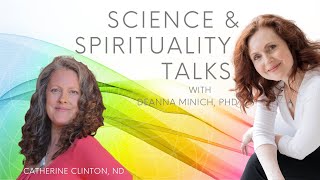
A conversational YouTube interview (2025) where Dr. Catherine Clinton—naturopathic physician and founder of the Quantum Biology Health Institute—describes her journey into quantum biology and how light, sound, fields and mitochondrial research inform practical lifestyle prescriptions (light exposure, grounding, silence). The discussion ties modern research to spiritual perspectives (interconnection, energy continuity), Catherine’s formative years and sense of purpose, and her views on balancing public work with inner life and on transition/afterlife; the episode ends with contact/book information.
Chapters
Hello, everyone. Welcome to another episode of Science and Spirituality Talks. Today I'm joined by Dr. Katherine Clinton. If you don't know who Katherine is, she's a licensed naturopathic physician. She has spent over 17 years helping people overcome their health issues. And one of the things that I know her most for is her interest and leadership in quantum biology. If you have followed her on Instagram, you know what I'm talking about, because she has the most enticing, intriguing posts, all on sound, light, biology. And she's also just recently founded the Quantum Biology Health Institute, which she has also brought me in as an advisor to. She's coming out with a book, and she does lots of different things. So welcome, Catherine. So glad to have you here.
Thank you so much, Deanna. I love everything you do. So I'm just excited to be here today and being a part of this.
Wonderful. I am, too, you know, because you and I are so much on the same wavelength as it relates to physical health and looking at energetics. But what I don't know so much about as it relates to your personal philosophy is your spiritual aspect. So what I like to do within these podcasts is to showcase a bit of a person's view on science as well as spirituality. Dive quickly into science, because I think that, you know, that's. That's the easy one. And I think that, you know, you can give a little bit of the. The high view of how did you get into quantum biology specifically? I'm kind of curious about that.
Yeah, that's a great question, because it's kind of a specific niche, Right. So I was in naturopathic medical school, and it was my second year of school school. It was that initiation year where they're trying to weed people out really long hours. And my nervous system just didn't have the foundation to endure that. And I was diagnosed with two autoimmune conditions and Lyme disease. I was doing clinical rotations underneath a physician who was actually my physician as well. And she really encouraged me to look at psychoneuroimmunology. And that's just a big words for how our thoughts impact our overall health. And at the time, I was looking at research with mitochondria. This is like over 20 years ago. And they were really new and emerging, and their association with health was starting to be acknowledged. And so I thought, okay, this is where I'm going to get better. I'm going to find something in the research. And I found research from Martin Picard looking at how our thoughts and emotions impact Mitochondrial function. And at the same time time, I found research from UC Berkeley, from Graham Fleming and Greg Engel, looking at photosynthetic bacteria. It's sort of the first real evidence we had of quantum mechanics in living systems. And I just was blown away at the research because really, what it is, quantum biology is really looking at this expanded view of the body. So there is this language of frequency in the body. Whether we're talking about electrons or photons of light or protons or vibrations from sound, what we see is this much faster, much more efficient way for the body to communicate and thus for the body to heal. And so it just blew my mind. And I just haven't left that arena or that rabbit hole. It's just so exciting, the research that continues to show, you know, in the dominant paradigm, we approach health and healing and the body from this chemical, mechanical viewpoint. And that's true, there is that aspect. But quantum biology opens up this new understanding that there doesn't have to be a physical meeting of a chemical in a receptor or a supplement or food and enzyme, right? It can be a language of frequency. Things can communicate with vibration, which is much faster, much more efficient. And so it really expands our understanding of what it means to be human and how we can heal.
Oh, I really like that. You said it expands our definition of what it means to be human in that way. You know, this conversation is all about you more personally. And so I'll tell you what I hear about people from just in the field around quantum biology. They say they love it, they get it, yet they find a hard time making it connect to their everyday. How do they know that these things are working? How do they metricize it? So in the field of functionality and using labs and using devices, and there are some devices that would fit into quantum biology. But for you personally, how do you have an experiential relationship with quantum biology? Like, how do you palpably connect to it through your experience?
Yeah, that's a great question. And I think that we can look at that from outcomes, right? That was part of my healing journey, was looking at the research with that and some of the early research with circadian biology and how light affects our biology. And these things kind of come, like, as a prescription, like we would get at the doctor's office, right? Like, okay, I've got to mind my thoughts. I have to look at those subconscious trains of thoughts. I need to align my rhythm with the rhythm of the sun. I need to immerse my body in healthy sounds and silence. So many different things. So quantum biology, we're looking at light, we're looking at sound, we're looking at fields of energy, whether that be electrical fields, magnetic fields, scalar waves or electromagnetic fields, or, you know, the field of our thoughts and intentions. And really what our metric is, is cultivate this relationship. Try this routine where you get out with am sun and get natural light throughout the day, lower the lights at night. And how does that impact your lab results, your symptom, how you are feeling? And there's a lot of evidence to this and showing that it does have a palpable, demonstrable, demonstrable effect on physical outcomes and disease outcomes and health outcomes. But for me, Deanna, the beautiful thing was that all of these things, all of this science, all of these lifestyle changes and someone would call them biohacking, right, Led to a relationship with the world around me, where I felt safety, I felt a sense of belonging. So now in the mornings when I go out and I put my bare feet on the ground and I see the sun coming up, I feel a sense of being held. And especially nowadays, there is so much chaos in world events, in our communities, so much division, and the natural world doesn't participate in that. The sun always rises in the morning. That ground always holds me up. And so even though we can look at different metrics and say, yes, light exposure influences our hormones and our immune system and our disease outcomes, and our thoughts do the same thing as well as sound and electromagnetic fields. I mean, our cells communicate with electromagnetic fields. All of that is interesting, and we can see the outcomes of that. I think really, the real powerful medicine comes from this relationship that is cultivated with the world around us, this sense of being held. And so for me, that was really the turning point where it was like, oh, my goodness, this isn't another supplement. This isn't another lifestyle routine, a lymphatic drainage or dry skin brushing. This is a relationship that goes beyond some of my human relationships, which are great. I love my husband, my family, my friends. They're wonderful. We have good relationships, but we're all human, right? There's always friction from day to day, moods and just being humans, right? Humans, we're messy, but the natural world is always there to greet us and hold us and give us that sense of belonging and let us know where our place is as humans, right? Going through school, it was like, we are here. We are humans. We go out into the world and we extract that isolated compound from a plant, and it does this. But this relationship that's cultivated by These habits really go beyond that and really foster this deep sense of safety and belonging.
As I listened to you describe how you experience the natural world through quantum biology, I almost feel like there's a Venn diagram. And the Venn diagram is quantum biology with spirituality. So what you're describing to me is this connection to the root chakra, right? Like really feeling connected in knowing that everything is O and feeling interconnection, which I might see as part of spiritual health. But I'm curious what you think about that and what do you see? Do you see that there's a line between spirituality and quantum biology? Or would you say that there are in some ways on the same path? Is, is that your spiritual path? So maybe you can wax a little bit more on how this practice that you just described, going outside in the morning, having your feet on the ground, always going back to nature, that your spirituality?
Yes, it definitely is. And I think that there is a definite line between science and spirituality. But it's been put there, right? It doesn't necessarily exist. And that's something that was put there, I think, you know, in the early 1600s when we started going through the scientific revolution and we started updating and getting incredibly high powered microscopes for the time and telescopes and really have this expanded view of like, oh, there's a microscopic world, oh my goodness, there's a galaxy out there, a solar system. And we cast aside some of the things that we can't see. And that's one of the beautiful things about quantum biology is it talks about this field of intelligence source God, this field from which everything comes out and will return back into some of the, the things that really excite me have that spiritual guidance or influence to them. This idea that energy isn't created or destroyed. Right. When we're talking about grieving the loss of a loved one when my father died, I can be very science minded. And to have science that validates, well, that energy isn't here. That physical body that you want to hang out with and hug isn't here. But that energy hasn't been destroyed. That energy still exists. And I think that that's one of the things that I love about quantum biology. This bridging of, of sort of hardcore quantum physics and the principles that guide that. And this idea that we are interconnected in a web of energy that's guiding life at all times, everywhere around us. And it really brings us full circle back to what ancient indigenous cultures always spoke of, right. Whether it was the Dao or the Tibetan storehouse of consciousness or the Akashic fields, or the idea of logos from the Greek traditions, or we see it in, in all of the religions, of course, but this idea that there is this intelligence or consciousness or vitality that goes through everything, and I think that was one of the most beautiful pieces that I have gotten from quantum biology, is that when I go and sit by a river, that river is talking to me. The rocks that I'm sitting on have a presence and an intelligence to offer. And it's not only me reaping the benefits of this relationship. It's a two way street. There's some responsibility there. And sometimes in this field there's pushback because it's such a new emerging field. It's a lot of work. There have been several times where I've said, you know, I just want to make a pot of soup and go to the park and sell it. That'll be my new job.
I like that.
Yeah, the soup lady. But then it's almost as if the world pushes me forward. It's almost as if the trees and, and the ocean and the rivers and the ground all say, no, you've got to keep going. You've got to keep talking about this. Because I believe that as much as we are in need of that relationship with nature, as much as we need to go out and see the sun and put our feet in the ground and be exposed to the negative ions at the beach or river, as much as we need that, I think the natural world really wants us to come back into relationship with it. You know, we have lived for so long on this earth in a reciprocal relationship, and we really walked away from that. And I think that there feels to me to be this calling for us to return.
So eloquent. Catherine, I really love this. I can feel your words, you know, and I can feel the sincerity and the integrity of how you live in the day to day and how everything energetically is threaded through this work, that you see it with high purpose. So this is who you are now. You know, this is Katherine Clinton. The year is 2025. Let's go back. Let's go back a little bit into the seed of your being and your formative years. And I'm kind of curious if you were one of those nature girls. Were you always playing out in the forest? Were you outside? Like, how has your path been formed by your childhood? I mean, did you kind of. You didn't wake up at the age of seven and say, mom and Dad, I want to be a quantum physicist. I want to study quantum biology. So help us to understand because I'm going to back you up even more after you answer this and get into why do we incarnate? You know, what is the reason for being so young? Catherine, who were you? Tell us a little bit about what that was like.
Yeah, I was born in the south and I was immersed into an environment that was very divided and there was a lot of racism and I didn't understand what was happening. And I was raised by a mother that would take us to different churches throughout our lives, different denominations, different religions. Right. She didn't pick one. And my father was an atheist. So it was this really sort of polar existence of yes, it's all connected or maybe it's nothing. And they, they were avid fans of taking us out in nature. But also, Deanna, being raised in the south in the early 80s, I didn't have a lot of friends because I didn't understand the social dynamic. I didn't understand what was happening with racism. My parents chose to not teach me about that, which I have chosen to do the opposite with my children because I think it is important that we know all those things. But because of that, I didn't have a lot of friends. I didn't understand what was going on. And so I made nature a friend. And you know, we just took my mother back to the place where I grew up in the south this summer and I was telling my children that I used to play with the little cicada skins that are discarded. Like those were my, my, my friends because I just didn't fit in socially. And so that child has, has found a social environment. Right. I have wonderful friends and a wonderful family. But there is this beautiful return to that childhood of, of belonging, finding that sense of belonging in nature.
Wow, that is so beautiful. So intricate how the threads of your early years have formed where you are now. And that strong connection that you have always falling back into the arms of nature. So, you know, we're going to get into more of the deeper aspects of the meaning of life kind of question. And I would say, you know, from your soul perspective, if you believe in a soul or a non physical aspect of your being, you know, what, what has really been your, even from that young age and that time frame, what do you think you were born to do? Like what was it to bring us back into nature? You know, what, what, or even yourself, you know, what was. When we think of purpose in life, which is even something that's studied in the scientific literature, what would you say from the time of inception was your purpose.
Wow. I think that's, in a way, still unfolding. But what I know to be true or sense to be true is that that feeling of being an outsider, that feeling of looking from the outside in, at social dynamics, even with my family, to some extent, that allowed me to more readily see these threads of sort of ancestral trauma running through society, running through my family. So one of the things that I've felt qu. Deeply is the need to help unravel that. And I talk a lot about trauma and the effects of trauma and what we can do using quantum biology to help unravel those. Those knots of trauma. I believe that it not only helps those future generations, our children, our grandchildren and so on, but I think it unravels some of that for our past generations and our ancestors standing behind us. So I've always felt that that was sort of the silver lining of feeling like I'm on the outside looking in all the time with social dynamics, with my family and with schooling. Right. Very much the oddball. And being coming from that position allowed me to kind of have this. This separation where I could see those dynamics more clearly. And it's helped me resolve some of my trauma. But in that, there's always that generational trauma as well. So I think that was one of the things that was my purpose, is my purpose. And then. Yes, I do. I think that I feel so passionately about this reconciliation between modern science and the incredible truths that we can uncover with that ancient wisdom that we have cast aside. Whether that's some of the ancient indigenous cultures and traditions that we all came from, and even religion. Right. Those things were cast aside as well. Like science. You're not supposed to have any faith. It's observational truth only. But that's such a huge misnomer. Everything we do is based on faith. So I am really excited about this reconciliation that brings both together. And when we bring both together, there is that unfolding of the relationship with the natural world around us. So I think both of those things have become very clearly something that I'm supposed to do.
That feels so right as I listen to you, based on your work and how you present that beautiful marriage of all different angles of nature, science, spirit. Katherine, I'm curious, because what you just mentioned about science and spirituality, the natural world. How do we know when we've gone too far? Because, you know, I kind of look at. If we look at ancient traditions and cultures, it's kind of like they're doing what they're doing. Then you have the scientists that are off doing their work in a lab or in a clinical trial. How do we know whether or not we have the best blend of ancient wisdom and modern science? How would we know that? Like, I'm curious how you manage that balance in the work that you do.
That's a great question. And I think really it comes from this humility, right? I really want to know the answers. I am looking at the research all the time. I'm so excited about new research. But then I have to like, zoom back and be like, I'm not sure we're ever going to get to that truth. I'm not sure that's even possible. I wonder sometimes if it isn't a practice in awe. And that is part of our purpose here as humans, to just reaffirm how incredible this portion of time we get to spend as humans in this lifetime on Earth is. And I think humility has such a grounding effect on, on our approach to science. You know, when I'm looking at the latest research with water or light or fields of energy, it can sound like we just discovered how important light is. Right? And it's like, okay, let's have a little bit of humility and understand that that has been something that we've been talking about as humans and holding as sacred for millennia. And so I think really, humility has played a huge piece in that and just understanding that, even though I think it's so exciting that we've possibly found. I just was talking today about research where the heartbeat seems to be affecting the proton spin in the waters of the brain. And there's this quantum entanglement through this bridge of organization, organized water. And that's so exciting. But then also, haven't we been talking about that forever? Haven't we been talking about how the heart is guiding our brain? I mean, the Egyptians talked about the heart as the center of the body from where everything radiates and, and the importance of water. So it's. I think humility has really played an important part and should play an important part in our science because I think we get so siloed in our research and we're searching and digging for that one truth that we can really hang our hat on when it's very nebulous. Right. It gets very vague when we kind of zoom out and what do we really know? We really know what we've been talking about for ages now. And so I think that can really help us in marrying the two.
Yes, you've said a couple of words that Keep coming back into my mind. You mentioned awe, you mentioned humility just now, which is such a beautiful word and always important to come back to. And in speaking about the ancient traditions and the modern science, like, how do we honor both and see that this is a natural transition to move the conversation back into you personally, because, you know, you kind of started from this place of I would love to just be in my kitchen making soup, and I just want to be away from everything, but yet I'm encouraged to move forward and nature is doing that. So I want to also reflect on that transition because this is another one of those situations of where we can look at inside, outside, yin yang, masculine, feminine, the classical polarity that we live within, or even the duality, like if we just make it simple and just say the. The two. So how do you manage? Because here you are at a position of lots of momentum right now for you, Katherine, you know, with your upcoming book, your courses, your remedies, your lecturing. So how will you maintain the silence, the soulfulness, the sacredness from within, while you continue to be outward and expanding and encouraging others to find all of these interconnections? How do you do this? And because perhaps in. In how you do it can also teach some of the people listening how they can better manage that inside, outside, field. I would say this dichotomy or how do we bring it together into unity.
Yeah, I think that. I think that there is such incredible life and vitality in both sections. Right. So we talked about this childhood of feeling like an outsider. After that, there were. There was about 15 years where I was doing martial arts and very outward and competing and going to national competitions and Olympic trials. And I think that that duality of. Of both feeds us. That's really the natural rhythm, right. Everything we're looking at, whether it's the rising of the sun, well, it also sets. And that darkness holds medicine. Sound can be so beneficial, but silence is so important, right? The light, the dark, the sound, the silence, they both hold their medicine. And for me, the way that I navigate these two extremes or that duality is to really make sure that I am being authentic. Right. Sometimes when we have that outward facing mission and we are all those things that you talked about lecturing and going and producing, there comes a point where you need a break and it doesn't feel authentic anymore. It feels like part of the job. And so I try to be mindful that when that happens, I can take a break. And that makes the work more impactful. And I think we live In a society where it's like, go, go, go, go, go, go. You don't have time to rest. You can sleep when you die, right? These real wild notions of we're supposed to always be on. But I think part of, part of the health that I find in doing both is, is that permission to rest and recharge and knowing that that is fueling everything that I want to do and this mission. And then on top of that, there's just this daily commitment to connecting with the intelligence of the world around us. Before recording, I was out walking and one of my favorite things to do is just walk. And the mind is racing and then layer by layer that starts to fall away. Sometimes I picture this toroidal feel where if there's this thought, this racing thought I can't let go of, I just let it go up and out and then pull silence and strength back in just really connecting with whatever we want to call it, that divine intelligence. God. A lot of people have been talking about Ethereum lately that's sort of coming back into our. Our common knowledge. So I think both of those things help me navigate and have the energy and passion to do what I do is to come back to some stillness, some silence, some rest, and to really cultivate a relationship with the natural world and with my family, if I'm going to be honest. They are really wonderful at keeping me humble, reinforcing who I am in my full sense. Right. I'm not just that forward facing. Dr. Katherine Clinton. This last summer I was speaking at a conference and I was speaking after Dave Asprey. And, you know, it was very masculine and lights and I was feeling nervous. And my youngest had this little can of slime and she was just pushing it in, she was making it fart. And she was like, mom, nobody cares. And I was like, you're right. Like, nobody really cares. Like, thank you. So they, they also really keep me whole and not living solely in that Dr. Katherine Clinton role. So that's a wonderful thing for me to connect to as well.
Children are such great teachers in so many ways. So I guess fast forward, how do you know that it's time to transition? Like, if you were in your best way to kind of like if you've already mapped out your life and you feel like, okay, now I'm done. I've done what I've needed to do. My kids are in a good place. I've got this book, you know, just how do you know? Like, I. I'm very intrigued with dying and death because I feel that there's so much about life that we can learn from those who are dying. It's almost like everything becomes really crystalline about what matters. So I'm curious for you personally, as we make our way out of this world, what would make you very satisfied? And you feel that you would feel like, I did what I came here to do, and I'm ready. It's a deep question, I know, in our final minutes here, but, you know, just thinking of the trajectory of your life, like, your reason for coming in, and then, yeah, what. What would make you happy and content?
You know, I can't. I have. I'm having a hard time answering that as far as, like, goals and missions and accomplishments. I'm thinking of it more as, what would that look like? I got my introduction into natural medicine by assisting with a midwife. And the power of that entry of birth was so important. And I've been at a few deaths, particularly my. My uncle, my aunt. We were out on the Olympic Peninsula. It was very isolated, and we were just caring for him as he passed away. And so for me, I think what's important about that transition is not whether I've accomplished what I needed to accomplish now as Katherine Clinton, and all these ideas I have about books and. And that it would be how I'm going out. Are there people around me that get a chance to say goodbye so that they're not left with this feeling of a lack of closure? Is there some sense of sort of a geometric kind of flow of the energy? Is nature around? Are people around? Are the elements around? When my daughter was born, we tried to make sure that there was fire, that there was water, that there was earth, that there was air. I think that would be important for me as I transition, that that flow of energy is there so my flow of energy can follow that elemental flow of energy, and that the people around me can say what they need to say, have that closure experience, that flow of energy so that they understand that the physical body is dying, but the energy still exists. So when you ask that question, I have no idea what I should be accomplishing to be ready to pass on. But I know how I want to pass on. I would love to be pat. I would love to have sort of a slow death where people could make their goodbyes and set it up in a way where the elements were present and we could witness that flow of energy so that we could more easily have that connection when the physical body passes away.
That is so poignant. I really love the idea of thinking of the Energetics of one's passing rather than what they need to have felt like they're, they're done. Like life was a to do list. And so thank you for reframing that. I feel like that's a very important piece of that transition. And then finally, when you're making that transition, where are you going? Where do you think we go when are no longer in physical form? Because one of the things you said early on was that energy is neither created nor destroyed. So does that tie into the afterlife for you and how do you see that?
It certainly does for me personally. And I don't have this idea of something so separate. I almost feel like it's this vision. Like when you look at how humans and their visual sense is so much different from an animal's sense of vision and what they can see with their eyes, I wonder if it's that way with energy. So that energy is always here, it's always moving, it's always transferring energy and information, but we can't always sense it. So I wonder, and I set my faith in the possibility that energy is still all around us here in this, this world, but in a way where we can't see it. And I certainly feel that with some of the members of my family that have passed on, ancestors figures, historical figures. Right. I feel, sometimes feel that energy and that passing of information or knowledge. And I. I think that maybe it isn't that we go somewhere else. You know, when we're talking about string theory and this idea that there are these multiple universes, I think we're up to maybe 12 or 14 now, right. These many different universes, maybe they're all existing here at the same time. And what we can see is what we can see right here and what we know to be true. Like I am me and here's my body and I'm sitting on this chair, but around me exists universes of energy at the same time. And if I'm not bound by this physical geometric mass, this sort of protuberance out of the field of energy that I'm taking right now, if I go back into this formless energy that can go through all of these layers, then. Then I'm here and there and everywhere.
Catherine, this has been such a delightful conversation. I so much resonating with what you're saying, feeling, sensing, intuiting it. Yeah, I feel like there's this emergence between physics, science, spirit, vibration fields, and it's all coming together within the confines of this conversation. So thank you for creating the space to have this, this exchange and I'm just wondering any final comments and also how can people find you and find out more about you?
Well, Deanna, thank you so much for, for doing this, for having me on, but for leading this conversation. I really think that the marriage of science and spirituality has been taboo for too long. So I'm so glad that you are doing this because they both hold such incredible impacts on our health and understanding of what it means to, to be here right now. So thank you for doing this. And everyone can find me at DRCatherine Clinton. That's the name of my website, DRCatherine Clinton. Dr. Catherine Clinton dot com. You can find me on social media, Instagram, Facebook, YouTube and you can check out my new book at DRCatherineClinton.com Optimize and it's all about what we're talking about here today.
It's an amazing book by the way. I've actually had the opportunity to review it in the pre stages. So I really love the book. The book is such that synthesis that we've been talking about. Thank you again, Katherine, for the conversation and thanks everybody for tuning in. Take care. Bye Bye.
Thank you.
More from Deanna




Gut Health, Stress & Sleep: The Truth About Supplements and Real Detox with Dr. Deanna Minich




"99% of Melatonin Is Made From Petrochemicals" Dr. Deanna Minich & Lara Pizzorno Interview (Part 2)



🎙️ FMP Essentials Show: Balancing Menopause Naturally with Phytochemicals | Dr. Deanna Minich