Science & Spirituality Talks with Joel Evans, MD
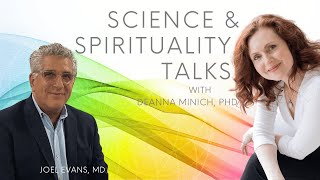
Dr. Joel Evans, an obstetrician trained in functional medicine, describes his path from delivering babies to integrating spiritual practices into patient care. He studied mind-body medicine under Jim Gordon and later learned esoteric modalities from mentor Tulia Kitty, now advocating for spiritual principles and interfaith unity in healthcare.
Chapters
Hello everyone and welcome to another science and spirituality talks. Today Our guest is Dr. Joel Evans. Dr. Joel Evans is a board certified OBGYN and international lecturer. He's also the director of the center of Functional Medicine in Ridgefield, Connecticut. He's the chief of Medical affairs for the Institute for Functional Medicine. And there he continues to serve as the external lead of IFM Advanced Practice Module in Hormone Health since its incentive conception in 2011. He's also the co creator of the IFM course on COVID 19 and he's co authored three published papers on the pandemic. So not only is Dr. Evans quite steeped and involved in functional medicine, but he's also practiced and taught mind body medicine since his training with Dr. Jim Gordon in the center for Mind body medicine in 1997. And he taught, done a lot there in terms of outreach. He has been in leadership roles in companies. He has written the Whole Pregnancy Handbook. And what I feel and know about Joel is that he has been a person in this, I would say in the healing arts who has been very successful at creating a crosstalk between functional medicine, spirituality and personal transformation. And I really appreciate that. So welcome Joel. Great to have you here for the discussion.
Great to be here, Deanna. Great to be here.
Super. Well, as I like to start out with all of the guests, we like to first dive into a person's journey through science and in your case, medicine. So I'm kind of curious if you could kind of take us back to your earlier days, what made you decide to go into medicine and specifically gynecology?
So what I would say is the decision for medicine came way, way, way, way before the decision for obstetrics and gynecology. The decision for medicine really was in childhood where for whatever reason I found myself enjoying sort of imaginary play as a doctor or as a surgeon. And you know, I was reading books as a young child, you know, high school level, you know books, bestsellers on, you know, books like Making of a Surgeon, et cetera. And I just sort of knew that that's what I wanted to do and ultimately found a way to, to bring those interests into a adolescent life and a high school life where I at a very young age became a first aid instructor, a CPR instructor, rode an ambulance, ultimately becoming an EMT right on my 18th birthday when I could, and ended up going to a six year medical program. I knew that's what I wanted to do. The decision for OBGYN really was interesting because I was actually upset that I went through most of my third year of medical school, not falling in love with a particular specialty. And I couldn't figure out what I wanted to do. And, you know, I went to Mount Sinai in New York City, a very sort of high powered school, where I knew that politically your chances for doing well, you know, had to do with how early you knew what your goal was, because you could then play the political games and get to know the people, gather the recommendations, etc. And here I was going through most of my third year and everyone that I would talk to knew what they wanted and I just didn't. And I was frustrated. And then I hit the labor floor and it just felt like home. And it was really. It was a strange feeling. It just felt right. And you know, what I can now say in retrospect was what I loved growing up with the ambulance was. And working in emergency rooms was sort of the excitement, but not from a voyeuristic perspective, but the excitement and then being able to be helpful in these times of extreme stress or circumstances. So the interest of being of service or helpful in exciting times. And one of my first deliveries was a very difficult delivery where the baby was not doing well and they had to have an emergency cesarean section. And then they brought out a very healthy baby. And I was like, wow. That sense of an extremely tense situation, but being able to be helpful and have a good outcome felt wonderful to me. And then the connection I had with patients, what it was like to bring in a new life into the world, that was all wonderful. Then in gynecology, I learned about surgical tests, technique, and I was very good at that and enjoyed it. I think my personality was. I always related well to women growing up and in college and medical school. Always had many female friends, sometimes more female friends than male friends. And so I was comfortable discussing intimate issues with patients. And it just felt right. And I just remember feeling, okay, this is it. And then intellectually, because I felt so good about it, I just was able to excel academically in that area as well. And so I ended up at Albert Einstein for my training. Very prestigious place. And the rest is history.
That's beautiful. I didn't know that about you and how you got into that particular discipline and that journey in. But I just want to back up too, because when you were a child, it sounds like just right from the get go, you had a strong sense of purpose and you kind of knew what you wanted to do. Did you have a mother or father that was a physician or surgeon?
That's so funny. I had nobody, Nobody.
Okay. No exposure to surgery.
No exposure. And I actually had anti exposure because my father was always telling me, go out and play basketball. Go. Stop reading about medicine.
Wow.
It was funny. Yeah.
You went against the grain, and you really. It was something you really wanted to do. You know, I'm kind of curious about that sometimes how children just come into their lives, especially somebody like you, where there was just such a strong imprint of something being that it wasn't environmental. Do you ever think about why? Why were you drawn to surgery? Why were you drawn to medicine? Why were you drawn to emergency situations like this? Did you ever think about that in more of a spiritual light of, like, how did you end up in that kind of realm?
My worldview is that there are things that I wouldn't say are predetermined, but I would say there are things where there might be a predisposition or a likelihood. And then we have an individual response to these circumstances that may be created for us by the universe, but we can still react and respond in ways that propel us in one direction or another. So, for example, my first exposure to wanting to be helpful was in camp when I saw somebody that was unfortunately drowning, and I wanted to help. I mean, I just felt inside that I wanted to help. And, you know, everybody was watching sort of with this fearful, appropriately fearful, because, you know, but I wanted to, you know, be able to help. And I knew that I needed to learn certain things in order to help. But I did have that realization in my early teens, you know, that I wanted to know how to help. And so I could have been exposed to that situation and said, oh, this is just. Ew. Somebody could be dying. Like, I want to run away from it as opposed to run into it. And so that's what I mean when I say we maybe are exposed to circumstances that. That may be destiny or predisposition or predetermined, but how we react to that exposure, there's always that opportunity or that choice or free will. And so.
That makes sense.
That's the way I would look at it. And so for me, every experience then became additive and would just reinforce that this is what I wanted to do. And so I could put in the time to study. I was going through an OBGYN residency in New York City. You don't sleep much. And that didn't bother me. And it didn't bother me because I had this incredible sense of purpose. And now I understand sort of about the power of music to heal. Right. But then I didn't. But at the same time, When I was chief resident and I had some clout, I would play music for these women that were in labor. Now when you think about, you know, healing music, you think about Joseph Campbell and the Mozart effect, et cetera. And I was playing probably salsa or whatever, but it was the music that the patient's reson with, right? And we just had this. It was just joy. It was just the power of joy surrounding a delivery with that external experience. So those were ideas, I think, that I never would have said I thought of academically. I didn't sit down at a desk and say what would enhance the experience of my patients. But I was there in the middle of the night and I'm like, you know what, let's put on some music and really get into it. And I would say to the moms, would you like to have some music on? What do you want your baby to be first listening to when they come into the world? And they loved it, and the nurses all loved it, and it was just great.
So do you think in that instance that you got turned on to Mind Body medicine and the effects of things in our environment and how they can change our state of well being or distress? Do you think that that happened just by way of those circumstances that you were presented with, where you're thinking, I would like to serve these women as they're having children and going through this tumultuous experience? So. So just in that moment, did it come to you or do you feel like you were already kind of there with Mind Body?
Well, I was there. And it's funny that you're asking me this because this is now the first time that I'm thinking of this through that lens. So it's making me smile because it's forcing me to sort of remember what I was thinking. And what I would say is, I didn't know the term mind body medicine. I did not know the term meditation. I would say the only molecule of joy that I was familiar with was endorphins from when you were doing exercise. But I knew that part of what I loved. And I'm getting a little tearful now because I remember this feeling that I loved making people feel good. I loved making people happy. And when I could walk into a room and say, let's put on some music, would you like that? And they would all, you know, and there could be three or four or five people in the room with them, you know, and everyone would say yes. And then it would just change the mood like that. That made me feel good. I couldn't connect it scientifically to anything. But I can tell you that it made me feel good, that I was making other people feel good. That was the driving power. Without understanding the why or why, you know, why is it important or how is it happening? I just knew that's what I wanted to do. And that's what I then ended up doing in my practice, which was trying to connect with my patients in a way that I could make them feel good. So, like, here's a story which I know Monique may have shared, and it's a great story because it's true, where I had somebody coming to me for two years. And back in the day, Metagenics had a program called First Line Therapy. And so we were trying to achieve ideal body weight, and this woman didn't lose a pound and still would come every month. And finally, Monique asked her why she is still coming when she's not losing any weight. And she said, just being with you makes me feel good. And I have heard from my patients consistently that that was something that I was able to. And this is where I'm blessed. And it's not me per se, but it just was able to happen that people would say that I could make them feel good, Whether it was a difficult medical situation, I could make them feel better about it, or, you know, the pain of labor, you know, whatever it was, I would help make people feel better. And I would tell you I was just trying to make them get well, and that making them feel better was just the byproduct of my personality. But now listening to this conversation and listening to me speak, now, I will tell you that that's something that I really tried to do. It was intentional. It was not just spontaneous.
Yeah. Yeah, definitely. And it sounds like it evolved over time into different aspects.
Yes. Yes.
You mentioned your father and your father having you, wanting you to go and play basketball or get out of the house and maybe be physically active and not be reading all of those books on medicine. What about your mother? I'm curious about that, because what you're describing in the way of helping specifically women, and you mentioned your female friends in college and then really being a beacon of service and support to all of these women. And so it just makes me curious about your relationship with your mother. Was it very close? Was it strong? Was it. Do you feel like she was a guiding light for you in the way of really thinking about women's health in any way?
Well, so what I would say is that my mother was the best example of glass half full the glass half full way of looking at life that I've ever met and was always pointing out signs that she observed, you know, so, you know, when I was thinking about, you know, do I want to go to the six year medical program? Yes, of course I wanted to be a doctor, but it's so much harder to do it in six years instead of eight. And I went on campus with my mother and it was a nice sunny day or whatever and like she caught the sun and she said, you know, this son is an omen, you know, this is a sign. So that was that. While she was struggling with incredible chronic pain, she had horrible scoliosis as a child and had surgeries in her, you know, I'd say somewhere between 11 and 13 where she had multiple back surgeries and was bedridden for a year and then had, you know, chronic pain. And so, I mean, I remember at her funeral in my eulogy, it was how she was able to always have this positive outlook while experiencing the chronic pain. And what I learned from that was it was the power of the mind that she could get beyond the pain. And that is the answer to your question of what did I learn from my mother? Was the power that the mind had to see beyond your own circumstances so she could see beyond her pain into her role as a mother, see signs from the universe, etc. And so that's what I learned. And when I would try to discuss those things, it was harder to discuss those things with men than with women. And so I would show up and it was just, oh, yeah, this is something you can do. Like the saying is that I sort of grew up with was coincidence is God's way of remaining anonymous. Right. But you could say that to people that don't believe that, and then you can be attacked and misunderstood and critiqued. But in my experience, the women I spoke to could accept that more than the men I spoke to about it. And so that's how it started. So that's really, in a nutshell, what I gained from my mother and how it led me to then becoming more comfortable with women. And then the gradual experience in OB GYN of feeling comfortable, that concept of being helpful in an emergency, and then, oh, wow, isn't this great? I'm comfortable with women. You know, like, it just all made sense. It just was wrapped up in a beautiful bow.
That's beautiful. Just in terms of your upbringing and how insightful your mother was in terms of looking at signs, and it almost feels like, you know, I don't know if she was the genesis of much of your spiritual thinking and thought and inclination. But I'm curious, what kind of spirituality did you grow up with as a child? Was it your mother who was more spiritual?
Really, it was. You know, I was very culturally Jewish, not very religious, and, you know, it was just my mother's. You know, I learned from observation rather than direct teachings about overcoming pain and so on. So really, I would say I didn't have a large spiritual or a big spiritual leaning or anything like that. Didn't read those kinds of books. And during my medical training, it was nothing conscious, but it was early on in my practice where I was introduced, like, if you know the name Bernie Siegel, who. Yeah. So I ended up meeting a woman by the name of Tulia Kitty, who was the one who ran all of Bernie Siegel's mind body groups. And she became my spiritual mentor and best friend for many, many years. And so she put me on a diet of spiritual concepts and introduced me to esoteric teachings and the world, as she would say, the world of the unseen. So what happened was I learned about mind body medicine, which is how can you get your mind to focus on a way that you're not thinking about your to do list and you're concentrating on a candle, a word, whatever, your breath, and that gets you out of the stress response and your blood pressure improves, your heart rate improves, your digestion improves, etc. So that was mind body medicine. But then the spirituality came in when you could be in one of those sort of, I'll use the word relaxed states, but it's not just relaxation. It's really a state where you're not focusing on this to do list. And the way I describe it is you lose track of time. So if you're doing something where you lose track of time, that's a meditative state. And so if I would lose track of time, I could then barely touch that there was something greater. And that's when I learned about the more esoteric teachings of energy medicine. You know, chakras, reiki, you know, I would talk to people that would self identify as psychics, and I would learn about astrology and just all these other ways of thinking about the world or explaining how things work, if you will. And I then, through my own lived experience, could understand that there was a lot of truth and validity to these perspectives. And I then was committed to marrying those concepts with what I learned in medical school in order to help people. And so then once the word got out, you know, that I was doing this all I'd be seeing world famous people in these esoteric arts as patients and so on. You know, it was always interesting to me because if I had to make a generalization, I would say that the people that I saw that were practitioners in these different arts would always be neglecting their physical body. And it was just the same way that some of our conventional doctors weren't really paying attention to what was going on emotionally, either in themselves or with their patients. It was, you know, both extremes were missing, you know, the middle. And luckily I had learned the language to talk to some of these people and get them to focus, you know, and, you know, I mean, like, I would have very basic conversations when I was just starting out. So I remember talking to, you know, world famous psychic and I just, you know, said, you know, excuse me if this question offends you, but do you think you're grounded?
How did they answer?
Right? It was like, wow, you know, their world, you know, was rocked by that question. And then we talked about how to bring their care or care of their physical body, how that was as important as nurturing the gifts that they had been given. I lose track of the question I'm answering right now, but all I can tell you is that it was through knowing people that mentored me. Like I was mentored by Jim Gordon, I was mentored by Jeff Bland, mentored by Tulia Kitty, who, you know, and so, you know, and then mentored by different people in these esoteric disciplines. So I feel like I have a good understanding of how everything can interrelate and that's how we achieve health. I mean, I remember talking to a gifted astrologer and it was, how do you answer the question about what is written in your particular birth chart, your houses, where you're going to be struggling physically? But how does that then overlie with what I have to do, which is take care of people and prevent illness? Am I wasting my time? And to be able to have those questions be answered by people in those disciplines was great because I remember we talk about Reiki, right? And you talk about a problem in the flow of energy, whatever microcosmic orbit, whatever word you want to use, about how the etheric bodies, causal bodies, whatever, these different channels through which chi or prana flows. And it would be like, okay, is the problem first in that energetic level which then creates the physical problem, or does the physical problem create the sort of imbalance in the energetic flow? And the answer would always be before a conversation is, well, physical starts in the energetic body. And I would Say, okay, but if I fall off my bicycle and I break my arm, did that start in my energetic body? Like, did that disruption over the broken arm start in the energetic or subtle body? And the answer was no. And I said, okay. So that's an extreme example of a physical thing leading to a change in the way energy flows. Why can't that happen? Starting at a more subtle level, so that if we're eating something we shouldn't and that causes. This is your area more than mine. But eating things that are foreign chemicals in our food and creates problems with the liver, which is the main detoxifying organ in the. So maybe the liver being overwhelmed by the toxins we eat then creates the issue with the energetic flow around through the liver. And so I said, my belief is that it can work both ways. So these were wonderful conversations. And at some point I would love to be able to sort of, you know, and we've talked about this, you know, because we're friends, about how we can bring these thoughts, you know, out into the world, which is the bridging between both disciplines.
This got so juicy. You just said so many things that I had to take notes. So I don't lose this. My neurons are firing. And I have so many things to ask you, but I want to ask a very grounded question. And that is when. How old were you when you met Tulia Kitty? When it sounds like she was kind of your entry point where you moved from mind body into more of this expansive esoteric thinking. So how old were you? Just so I can get a sense.
I would say 35ish.
Okay. And then you started to make this distinction. It sounds like from what I can infer between the mind body aspects, that is the music playing in the delivery room and changing people's states of consciousness, awareness and stress. And then you started to see that, wow, there are other things, other modalities. And that feels like a separate. I'm not sure if that's what you actually had conveyed, but I want some clarity on that. Would you see that it was kind of like stepping stones, maybe that even that insight from your mother when you were at the medical school, right. You know, she had a sign. So, you know, you're kind of registering this at some level. Then you move into the delivery room and you're playing music. You're observing how people feel. You then meet the mind body group. You. You get involved with them. You start to realize the mind body interface. But then it feels like there's something a bit separate. And I'm not sure if you see it as separate or that the mind body helps to explain some of these referred to as esoteric modalities. So can you describe that a little bit?
So what I would say is that my personal process started with mind body. And this is where I have to be grateful to Jim Gordon and the center for Mind Body Medicine, because not only did I learn how to understand the intellectual aspects of what meditation did for the body, but we had experiences, so it was very experiential. And so then I understood the power to change the way I felt. And I understood that I had sort of a little bit of mental or emotional baggage, you know, that I. That I carried. And that it would be important to find the roots of some of that emotional baggage, such as am I really good enough? The imposter syndrome. Because I had always been well thought of and done well. And, you know, so if I looked at the messages I got externally, they were always very, very positive. But then I didn't know was I good enough to live up to those expectations, if you will. So that's what I had to deal with. And then I had my little. My father's voice about, you know, do you want to do something else? And the story now I can tell about my father because we laugh about this, but I wrote my book, Whole Pregnancy Handbook in 2005. Great book, a little bit ahead of its time. And I showed it to my father, the first copy, and he looked at it and he was like, is it too late to change the title.
To what did he think would be better?
Don't know. Don't know. But you know, that's the classic, you know, that's the classic manifestation of the challenges of my relationship with him. Because externally everyone's telling how great I am. And then there's my father counterbalancing that. And so I really didn't know where I stood, if you will. And so that's why I had those aspects of sort of self doubt that then center for Mind Body Medicine helped me to understand that I could bypass that. Because that's when I understood through some of these exercises where we were talking about having imaginary conversations with what ails you. And I would have a conversation with this feeling of self doubt. And what I interpreted that to be is this is something that has to be overcome. Like it's not real, it's imaginary, and it's there for you to overcome. And that first week of center for Mind Body Medicine training, it changed me. And so I understood the power of these techniques and Then was able to meet Tulia about the spirituality piece, who could explain to me, oh, do you know what a soul is? Do you know what a spirit is? And I'd be like, honestly, no. And so we explored some of the teachings. What is soul? What is spirit? And are you more than your physical body? And so she came up with a simple thing. She goes, all right, so because you're a doctor, if you lose an arm, are you still who you are? Are you still Joel? Of course, if you lose two arms. Of course, if you lose two arms and two legs. And she goes, we'll just go on and on. And I'd say, wow, I guess I am not my physical body. And so then the next question was, who are you? I'm a doctor. And then she would just go, well, who are you? And who are you? And who are you? And this was also another teacher, Diana Williams, who I go to India with, who Tulia actually introduced to me. And she would always ask the same question. Who are you? Who are you? And ultimately, I found out that that question comes from a sage by the name of Ramana Maharshi. But if you keep doing this with people, it's their job. I'm a mother, I'm a wife, I'm a healer. And then ultimately, and it can take five minutes or it can. People can't get there in 20 minutes. And you do it again, and ultimately people will get to, well, I am a spark of the divine essence, or I'm a soul, or I'm spirit. And that's what I came to understand, or I should say came to believe, because there's no proof here. So that's what I came to believe about not only who I am, but who everyone is. And by treating everybody as though they are a spark of the divine just as much as I am, that we're equal. No one is better than the other. We're all in different circumstances for different reasons. And that's a whole other conversation. But what I understood was that we are more than our physical body. And that made me understand we're also more than our circumstances, which then made me understand that's really the most important thing that there is to know about who I am. So what can I do to improve the situation? And I didn't know how to define it, the situation of this spark of the divine within me, how do I improve the function or condition of my soul or spirit? And then that led me to understanding the importance of how we act, how we think, how we feel, how we act. Is what changes the condition of our solar spirit? That there's part of it that, yes, it is of defining origin, but it also functions differently. And you know how you feel when you're helping people. And at least I knew how I did that. That expanded me. You know, what makes you feel expanded? You know, what makes you feel contracted? Doing things that make you feel contracted are not good for soul growth. Things that make you feel expanded are good for soul growth. And anyway, that's the short answer to your very complicated question.
I have a question that just came to my mind after you said what you just did about not being in a contracted place. That that wouldn't be good for fostering soul growth. However, let me challenge you on that, or at least let me have you describe this a little bit more and unpack it. For people that are in what would seem like contractive situations, they might be stressful for any variety of reasons. Physically, emotionally, mentally, spiritually stressful. Like, do we sign up for certain things? Could we not leverage those in some way to be expansive? And in that difference of moving from X to Y, do we get a greater return versus being in expansion and bliss and Zen all the time? So how do you perceive the challenges of life as fodder for soul growth versus and perhaps, you know, I can kind of already discuss.
That's the great question. And so the answer is that, you know, what I said before is sort of the quick way to differentiate between what feeds your soul and what doesn't. Feeling expanded or contracted, but feeling contracted is what can propel you to soul growth. So what I would say is that when there are things, so you start learning how to assess where you are. It's what I would describe very simply as self awareness exercises. And you keep doing them until you have an understanding of is this something that is contracting for me or expanding? And if things are contracting, then the question is why? And what do I do about it? And I honestly believe that the circumstances that we have that lead to that feeling of contraction. If you go through a deliberative process of is there something that I can change and therefore I'll change it, and if there are things that I can't change, I'll change how I relate to it. So maybe I felt contracted by having to do the dishes every night, but I can't change that. I've tried and my family just won't change their habits. So then you say, well, maybe I'm really nurturing my family in this way. And if other people say I shouldn't be doing that. That's their thinking. But in reality, this is what my family needs. And I'm really committed to taking care of my family. So it gets reframed such that it's not so contracting anymore. So there are nuances to how we interpret that contracted feeling and what we do about it. But ultimately we want to not feel contracted. And then to your other point of is it unrealistic to expect that we're always in bliss? Absolutely. And bliss is not the goal. The goal is equanimity. The goal is equanimity and just feeling at peace with your circumstances, with whatever those circumstances are. Because if you're always looking for bliss, that's impossible to obtain. And so you have an expectation. And ultimately these are more advanced ways to think. But you really want to minimize expectation. Expectations as best you can. And sometimes people use the term radical acceptance. I don't like radical acceptance because that means you can't change what isn't working for you. But really what your goal is is equanimity and being at peace with whatever your situation is, having that self awareness to know what expands and contracts. When you know it contracts, you either try to change it or find a way to accept it, reframe it so that you can accept it. And when things happen that give you bliss, enjoy it, because it's your birthright to have these blissful experiences and try to see what they are and then do more. Like, if you, you know, love helping people, go into the helping professions. You know, if you love, you know, listening and talking to people, go into, you know, mental health or whatever, you know, like, there's nothing wrong with understanding what brings you joy. You just don't want to say, I have to be in joy all the time because if I'm not, I'm doing something wrong. That's the thought you don't want to have.
That's so well said. We have to manage those expectations. And if we just come at it from the standpoint of being at peace and just neutral. Just neutral. Like just go neutral on things.
Bingo.
And, you know, I really like what you said too, about the contraction of what we feel. And I feel like we all have moments of contraction in our lives. Whether they're in our astrological chart. They're a family member, like your father saying that to you about your book. I mean, those are like. You remember that. You remember those points of like crystalline contraction.
Yes.
And here we're talking about, like your growth. So I feel like, yeah, it's all really amazing to look at a person's lifespan and those moments that we seem to remember. And many of them are contractive moments and how important they are. I have a question for you that's a little bit. I have a lot of questions for you. And just in the interest of time here, we've got about five to seven minutes. I want to honor your time. But I have a more philosophical question for you that I've been thinking about with you, specifically, because you have been around a lot of births, you've been around a lot of new life, a lot of babies. And so, you know, that's a beautiful moment. That's a very sacred moment. What are your thoughts on the opposite of that? So looking at the portal of death, dying, that other state of what we might say is contractive versus the expansiveness of birth. So how do you, as a physician and also a spiritual thinker and seeker, how do you juxtapose those two things together, the birth and what is part of life, which is death? I'm just curious about your philosophical orientation to that.
I think there is something real about the term a good death. And, you know, we talk about conscious conception, we talk about conscious deliveries or conscious births. There is something that I would describe as a conscious death. And death can be expansive because ultimately, with my belief system, death is liberating because we are both the physical body, and as I said, we're not just our physical body. There's also this soul or spirit. And so the way I think of it is death is liberating the soul or freeing the soul from the physical body. And that is a good thing because it allows the separation. Because when we incarnate, we do separate from that divine source. And as we all know, life can be difficult, or I might even say life is difficult. Life is hard. And my belief is that it's much easier when you're not in your body, in whatever the spirit world is. And there's lots of different things to read about, how that's defined, but the universal common thread is that it's a good experience. And so I believe that for the person that's dying, death is a good thing, and for all the people left behind, it's a sad thing. And so, you know, I have worked with people that were dying, and there's a term being a midwife of that process, and I just think it's liberating. And so just because we were talking about my father, I was with my father for, you know, maybe three hours before he died, when I knew that he was Dying. And I was helpless to. You know, he was very uncomfortable, had a lung problem, and, you know, was grasping for air and was in pain. And, you know, the circumstances were such that I couldn't get him enough pain medication quickly, and I didn't know what to do. And so I actually got into the bed with him and, you know, closed my eyes, and we touched. I touched my forehead to the side of his head, so he was looking straight ahead. I was next to him. And I had an imaginary conversation. And he. So, again, emphasis imaginary. I have no idea if it's true, but I had this conversation in my head, and I kept saying, dad, it's okay. I'm releasing you. You know, everything that I thought one would do in this situation. And, you know, and then I heard again, imaginary. Who knows if it's true? But he's like, joel, this isn't just about you. Like, why don't you ask me if there's something that I need to say to you, and then maybe I'll be able to go. And I'm like, again, holding my head, and I'm like, okay, dad. And he's like, I got to apologize for never letting you know how proud I was of you. Now, that's why I say this could all be made up, because it would make such sense that this was all made up. But it felt so real in the moment, and for him to say that. And then I was able to say, well, I forgive you. And. And I think that I told him I thought it propelled me in ways that I needed to be propelled, etc. And then. What he said was, I want to talk about my funeral, or I want to talk about the eulogy. And he told me this story. Now, we didn't talk about this at all, but part of what happened in my evolution, as I did spirituality, is I discovered sort of Eastern or yogic tradition, ended up going to India. And he was very religious in the Jewish faith and did not like or approve of all of my sort of spiritual growth in India. Anyway. So then he says, and I really understand why you went to India. And what you need to know is that I was the same way. I just used different vocabulary. And I'm like, what? And so he's. So now the story, for him, his defining moment in his life was World War II. And so at 18, he was shipped off and was in D day plus five or something. And he goes, you know, I did what I was supposed to do. He goes, and I know that in your language, that's Dharma And I didn't know that then, but I did. And this was. He goes, I did my dharma. I served the. And then, you know, he got two Purple Hearts and a bronze. Anyway, that was the defining. Like, he was always telling war or not always telling war stories, but we knew they were always right below the surface. But anyway, I had that imaginary conversation. And that's why I say death can be liberating, because I believe that we cleared so much stuff and the respect I have. And so his eulogy was all about him doing his dharma. And I, you know, have stored letters from him from the war that I read. And, you know, and it was like, that's what I'm about, is doing the right thing. And then I was able to look at my life and put it through perspective of doing the right thing and helping patients with whatever modality was. Like, I could see the parallels, that my dharma is not just conventional medicine. It's also, you know, whatever. It's functional medicine, you know, whatever it is. So I think that that's the best example or the best way I can answer your question of why I think death is liberating.
Well, I don't feel like that was an imaginary conversation. It was a goosebump moment for me. I feel your father. Wow.
Yes.
You know, mostly when I'm talking with people and I'm doing these interviews, I'm literally asking them about spirituality. And I feel that in this conversation that we had, your life has unfolded in a way that we could perceive in a very spiritual way. I feel like you gave so many examples of things that have happened or how you perceived certain things that had happened, that we don't need to actually have spirituality as a separate category. It's like, over here, the way that you've unfolded this for us is that it is part of life.
Yes.
And I really want to acknowledge that because it's very distinct and very unique. All of these conversations are unique. And this is what I find as one of those unique points. It's like a kaleidoscope. So in our closing minute or so, I'm curious, as we think about bringing together science and spirituality, would just like your final thoughts on these two things together and the future of those two things together. So maybe even just looking outside of your experience and. Or using your experience to say, you know, this is what I'm hoping for, the future in terms of how science and spirituality will converge or not converge, and how do you see that? Some of the other people have talked about AI or, you know, you can Talk about it from however you'd like. But how do you see them in the future? Let's just say five to 20 years out.
Well, what I would say is, if I dared to dream about what this would look like, I would like to start with a basic understanding being transmitted and accepted to the majority of people on the planet. Meaning looking at this like a pyramid, and there's sophisticated spiritual energetic principles on the top, and then there's the basics. And I would like to see the basics being sort of understood and accepted and practiced by the vast majority of people on the planet. And it's similar to you with your PhD in nutrition and understanding the nuances of biochemistry of food and saying, well, you know what? I would just like people to eat better and take away the junk. And so for me, it's. I would like people to understand that being of service to others is good for both them and the person they're helping. And if they could understand that, if they could understand that they're more than just their physical bodies, and if they could understand that, you know, death is a liberation and to take away the fear that people would be so much happier, there'd be less conflict. So that's what I would love, you know, to see. And I think that we need, you know, sort of one of the things about crisis as we know, is it can lead to change. And the sort of conversations or the aphorisms about crisis and opportunity being the same character, Chinese character, et cetera. But I think that I would love to see the interfaith movement of different religions really get together and sort of acknowledge that the world is in crisis. And let's look at what is the same in different religions and start having each different religion in their vertical. Start talking about that and start talking about how we're all humankind, we're all God's children. Like just all the different religions would start that as a priority in terms of their teaching and less stress on the particular dogma of their own religion. And I think that if that could happen, that that would significantly propel humankind to a better place. Because we are dealing with conflict and political stressors everywhere in the world, environmental stressors. Challenging times are here, and I wish I was wrong, but I don't think they're going away anytime soon. And so how can we learn to be resilient in these stressful times of this planet? It's by having a thought process or a worldview that helps you deal with the hiccups of the world so that you're less reactive and thinking in those ways will make people less reactive. And I think that's what will make this world a better place.
So I would distill that into basics of spirituality, unification within religions, and resilience to help us with the everyday. The fruits of all of that beautiful, fertile, fertile verbiage. Joel how can people find you? How would you like people to connect with you from here on out?
You know, I would say you can always email me. I'm open to receiving emails. It's an easy email to remember. Joel evansmdmail I'm really not a social media person, so I have those accounts but never really look at them. I'm on LinkedIn, so you can get me through LinkedIn, you can email me directly and I'm happy to hear whatever you want to tell me about this particular podcast and these topics.
Wonderful. Well, thank you so much for being open to having the conversation and I've learned so much about you and I'm grateful to know you better. Thanks so much for doing this.
Thank you for having me.
More from Deanna




Gut Health, Stress & Sleep: The Truth About Supplements and Real Detox with Dr. Deanna Minich




"99% of Melatonin Is Made From Petrochemicals" Dr. Deanna Minich & Lara Pizzorno Interview (Part 2)



🎙️ FMP Essentials Show: Balancing Menopause Naturally with Phytochemicals | Dr. Deanna Minich