Science & Spirituality Talks with Robert Rountree, MD
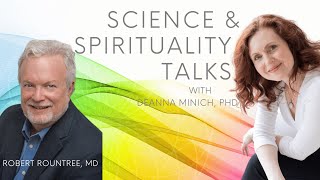
This content was created by extraordinary-journal. This content was uploaded by extraordinary-journal. This is a YouTube long-form interview titled "Science & Spirituality Talks with Robert Rountree, MD" (created 2025-06-04T01:37:03Z; last edited 2026-01-21T20:17:49Z). The excerpt records a conversation between a host (labeled SPEAKER A) and Dr. Bob Rountree, MD, covering his personal path into medicine, intersections of science and spirituality, consciousness (including psychedelics, meditation, and mystical experiences), functional/systems biology perspectives on autoimmune disease and environmental toxins (mycotoxins, PFAS, microplastics), the mycorrhizal/mycology literature, collective mind concepts, and brief thoughts on AI in medicine. The tone is an in-depth interview/discussion mixing personal narrative, clinical insight, and philosophical reflection.
Chapters
Hello, everyone. Today I am here with Dr. Bob Rountree to talk about science and spirituality. And I must say I've been really looking forward to this conversation because I have known Dr. Roundtree for probably, I don't know, 15 years, a long time. And, you know, we have lots of conversations about detoxification and all kinds of different environmental health related issues, sometimes a little bit more philosophical. He and I both like plants, but this time around, we're going to have a conversation about science, his personal take on science, and how that maybe has shaped his professional path. And then we're going to get a little bit more personal talking about spirituality. So welcome. Bob. Good to see you.
Hi. It's great to be here.
All right. So, you know, in my mind, I call you the Wizard. You know, you have this archetype of being very curious and expansive in your views. So I'm just kind of curious if you can kind of carve out for everybody what was your path as it related to medicine and science? Because you actually became a medical doctor a little bit later after you were doing some other things. So just kind of carve that out in terms of what piqued your interest with science and medicine.
Yeah. Where did it all start? I mean, for me, I think it started with love for nature at a very young age. I always loved camping, being out in the woods, being out in wilderness. There was just something about the natural world that enthralled me. And I never thought of it in a scientific context. Right. I never thought, hey, I want to be a scientist or a doctor or anything like that. You know, I probably thought more about being a wilderness guide or a forest ranger or something like that. So that was really kind of the genesis of my. My interest in biology, the natural world. And I'll be perfectly honest with you, I didn't head straight into medicine. It was kind of a circuitous route. That actually brings us into the bigger topic you wanted to talk about later. So I think I'm going to cut to the chase and tell you what happened, which is that I was brought up in a very conservative religious framework in the South. And somewhere along the lines, I started reading about what was happening out in California. You know, the human being movement, the use of psychedelics, people exploring consciousness. And something inside me said, I want that. I don't know what those people are doing, but I'm really curious about it. You said, I'm curious. Yeah, I just have that natural mind that's always asking why. And so I'm reading about people having These experiences. And I thought, okay, how do I do that? And eventually that led to me taking psychedelics in high school, which I would not recommend to anyone, you know, because I really think they're powerful drugs. They should be taken in a therapeutic context. So I wouldn't recommend doing what I did, which is just hanging out with friends, going to Grateful Dead concerts and Jefferson Airplane concerts. And, you know, all that was fun. But the reason I was doing it is because I had this burning desire to understand the universe more. So as a result of that, I came across the teachings of a guy named John Lilly. Now, John Lilly was an MD, PhD. I think his PhD was in biophysics or something like that. And he was doing research in deprivation tanks. So he would take psychedelics, go into a deprivation tank where there was no external sensory experience, and he would have these very profound internal experiences. Internal or whatever. Where do they come from? We didn't know. At the same time, he was doing research on dolphins. You know, he would take psychedelics and then go swim with dolphins, you know, with the belief that you could somehow communicate with the mind of the dolphin. So he wrote books on the mind of the dolphin, and he wrote books on states of consciousness as achieved through sensory deprivation. So my friends and I would get together and talk about what this meant. In particular, there's a book called Programming and Metaprogramming and the Human Biocomputer. I'm reading this in the 11th grade, right? So we would talk about these different states of consciousness we were achieving. We had no idea what we were doing, right? We didn't really have any kind of guidance or anything like that. But I thought, I want to do that. So I went off to college in Massachusetts to study biophysics because John Lilly did biophysics. And I thought, that's what I want to do. But then when I got to college, I realized, oh, this is all technical. It's very dry. You know, I didn't get it on the same level that I expected, and so I got really disillusioned. That was also during the Vietnam War. And so there was a lot of political tension in college, and I dropped out. I just didn't know what to do. So I dropped out of school and I kind of hung out and did construction, did all kinds of, like, working class stuff for a while. And I'm not sure exactly when the change occurred, but at some point, a person handed me the book Be Here now by Ram Dass. And I read it and I thought, this is it. It's all about consciousness, right? I'd never read anything that spoke directly to my experience. And so I really got into studying consciousness on that level and totally moved away from taking a drug or, you know, doing anything that would alter my consciousness. But I got more interested in meditation. And then somebody handed me a book called Herbs the Magic Healers. And, you know, that was all about plant medicine and how plants could basically affect health. And that just lit me up.
I thought that's what I wanted to do.
Paul Twitchell.
Okay.
And I think the book is still in print. It was. I just thought it was fascinating because growing up in the south, where you eat crap for food, right. And you don't know any better, you know, the pork chops and black eyed peas and fried food, fried chicken, steak. And that's all I knew about health, is you were hungry and you ate.
You know, I'm surprised just listening to you that this started so young and you were in an environment that really didn't foster that kind of mentality, but yet you still have friends that you could talk with about these topics.
Yeah. And, you know, in, in the college years, you start, somehow you gravitate towards people and. And some of those folks I'm still in touch with, you know, my whole life essentially been in touch with them. They were all explorers. People were, you know, looking into all kinds of avenues for consciousness expansion. You know, one of them became a Sufi. And, you know, I learned a lot about Sufism. Basically I started learning about mysticism. Right. Of all types, that every religion has got a mystical order, everyone has got its mystics. And that's what I was drawn to, was kind of the mystical side, the sense of a great mystery. So with interesting to me, I'm reading this book on herbs and I thought, okay, I want to study biology, I want to find out more about that. And the first time I ever looked into a stereo microscope and I saw cells and I saw them dividing, you know, I think it must have been the same sense of what happened with. And I never know if I'm pronouncing his name right. Leeuwenhoek. Lee Hook. The guy that he didn't develop the microscope, but he, he perfected the earliest form of the microscope. And he looks underwater and sees these animalcules. Right. Well, that I had that same kind of aha. Experience. Oh, my God. You know, this is what's happening on the cellular level. And it was so interesting because it was like the perfect convergence of my mystical spiritual experience of life. And then biology and science, they just converged. I Thought these cells dividing, this is a mystical experience and I want to do that. So that's how I got directed towards medicine as a profession, because I wanted to do applied biology. Right. I saw the potential of what's going on and then I thought, well, how can I use this to be of service? Right. So it's not just a fascinating thing that I'm studying off on my own. Right. That I'm actually applying it.
Right. Yeah, that makes sense. Very hands on. Although I do have a question. I'm thinking about you, just kind of imagining you growing up and it kind of seems like this was already imprinted in you to the point that probably no matter what you did, you, you would have found consciousness.
Yes. Yeah. I still remember having very spiritual kinds of experiences out in the woods. I remember camping with a group of friends on a cliff overlooking this area in North Carolina called Linville Gorge. It's this beautiful, rugged, rainforesty kind of gorge up in the Blue Ridge Mountains of North Carolina. We were camping on this cliffside and that night a storm came in. And after the storm cleared, the gorge was full of clouds. So we woke up and we're basically floating in the clouds, sitting outside of our tent. And I just remember being overwhelmed with the awe of it, you know, And I wasn't articulating this as thinking, oh, you know, this means that I'm being visited by angels or anything like that. It was more just this internal sense of awe and wonder and amazement at what the universe could create.
Yeah, I'm almost there with you. I'm envisioning that. Right. And just to bring it even back to science, there's science on the power of awe on our brain chemistry.
Yeah, right. And absolutely. Like, what is it? You know, on the one hand we can say, oh, it's dopaminergic pathways being activated. Is that all there is to it? Right, right. People that have like near death experiences, they're trying to go, oh yeah, that's just because of activation, a certain part of the brain. Well, I don't know if that's all there is.
So how do you draw that line as a medical doctor between something that is science based and where we could actually pinpoint the biochemistry of how certain things are happening? And then when does it become a spiritual experience? Or how do we see them in, in this integrated whole? Like, how do you reconcile that? Because you are so consciousness focused, but yet you have an appreciation and a depth of knowledge of biochemistry. So how do you decide which framework to use?
Well, it really depends on the individual that I'm working with, you know, I try to meet the person where they are.
But in your mind, are you thinking something else?
I'm always thinking, okay, we're somewhere in between the quantum and the macrocosmos, right? I mean, what. What is a human being? What is an individual being? It's an energy interference pattern, right? If you take a calm pond of water and you drop two rocks in it, the waves start to emanate out from where the rocks drop, and eventually those waves converge. And if it's happening consistently, right, then you get a standing wave. And that's what we are as individuals. We're standing waves of interference patterns. So, you know, even if I've got a person sitting in front of me that's suffering, and they have a really specific kind of issue going on, I still think, well, this is a dynamic, fluid situation. You know, how does that translate? What do I mean by that? In conventional medicine, we often get stuck on the diagnosis, right? And you know, our mentor, Jeff Bland, he talks about that. The disease delusion that people have this delusion that they have this disease. They have rheumatoid arthritis, right? And then they identify with that, and that becomes rigid and dogmatic, etc. But I think this is just a dance somehow. This is an energetic dance between the person's immune system and what they're eating, how they're living the conditions of their life. And so, on the one hand, there's this seemingly rigid thing. Here's this person with this disease, and I want to meet them on that level. Like, I want to know, what's their ICD10 code? I got to know that first. And I also want to know, well, how would a conventional doctor treat this? What's the main way this would be dealt with in mainstream medicine? So I start with that. It's like I'm acknowledging that static reality. And at the same time, I'm thinking, hey, this person's on a continuum. They're on a continuum, and everything is malleable, dynamic, changeable. Anything can happen. And if I get challenged on that, if a person says, well, wait a minute, you know, this is what the. My specialist said. This is what's in the textbooks. Then I just ask them, have you read any quantum physics recently? You know, of course, most the time they haven't. Except in Boulder, Colorado, I actually run into physicists all the time in the hot tub at my health club, right? The guy's talking about quantum entanglement. You know, I hear this, you know, really kind of Straight up conventional kind of guy. Suddenly he's talking about quantum entanglement. And I think, oh, my God, do you realize what the implications are of quantum entanglement? What does that imply about our reality? The fact that particles are non localized? That something could happen to a particle in this location that's also simultaneously happening thousands or millions of miles away. So you bring that in to a conversation about what a person should be taking, right? What, what drugs should they be taking. At the same time thinking, quantum entanglement, right? Of course you are what's going on? Or, you know, you can go to the microcosm on quantum mechanics. You can also go to the macrocosm, you know, which is this whole idea of repeating patterns and fractals and that sort of thing. You can't look at a flock of birds flying around and not notice that they follow patterns. And the patterns are happening so fast that it can't be consciously coordinated by the birds. The same thing with, say, a ball of fish. You know, I've been scuba diving in a ball of fish, and you watch the fish move around and it looks like they're the solid ball, but stick your hand in there and the fish move out of the way instantaneously. Well, that's got to be an energetic interaction, right? That can't be explained by the fish going, oh, I better move, because there's Bob's hand. So on the one hand, if you're thinking about quantum mechanics, you know, all the kind of mystical implications of that, and at the same time, these macroscopic patterns, the fractals, chaos theory, all of that stuff, if that comes to bear on this energy interference pattern in front of you, all kinds of possibilities exist.
Beautifully said. And I've got some questions for you. Let's just go back to rheumatoid arthritis for a second. I want to go back to what you said about the standing wave. Like if each of us kind of has our own energetic imprint particle wave, you know, we have this resonance, right? Then you see somebody with a disease like rheumatoid arthritis. Do you believe or know that every person that you would see with rheumatoid arthritis has a similar disturbance in their quantum resonance? Is it the same? Is it like some kind of dysfunction in that pattern that is shared by everybody with that diagnosis? Would you venture to say that it's not the same?
It's not the same. Perturbation? I think that's the word that, you know, a lot of people who are studying these phenomena, studying disease, you know, on A. On a larger level, you know, now it's all about metabolomic disruptions and, you know, immuno metabolic disruptions, like what's going on. It's not the same for everybody, but I think there's. It's fair to say there's some perturbation there that has set these things into motion. So it's that idea of the butterfly effect, that the butterfly flaps its wing in Texas and it could set off a tornado in Brazil. Right. Well, where's that butterfly flapping its wings on a person with ra? It could be in the lungs. Right. Or it could be in the gut. And what might the flapping of wings be? It could be that they're exposed to certain pollutant. Right. And we know that certain chemicals in our environment, especially from burnt organic material, can activate certain cells, epithelial cells in the lung. And those cells can produce an enzyme called the PAD enzyme. Right. And what does that enzyme do? It citrullinates tissue. It substitutes an arginine for a citrulline, and that creates an abnormal molecule. I call it a freak molecule. Right. It's. It's a neoantigen. And the immune system says, well, that's something that shouldn't be here. And it starts reacting. Well, a lot of times that reaction can go on for a while and die down. But then what if the person gets Epstein Barr virus? Right. Or gets Covid, you know, gets some other secondary hit to the immune system that flares it up. So you've already got this other perturbation that's going on. Then you have a secondary perturbation. Suddenly things are just rolling away. Does that make sense?
That makes sense. Yeah. Yeah, yeah.
Track on a scientific level and then parallel that with what's going on. On an energetic level.
Yeah. And also, what I'm getting from what you're saying, a personalized level.
Yes.
Right. In one person, it's lungs. In another person, it's more at the gut level. But maybe the process is similar, but the target is differential. What about. I'm kind of curious. Some. So many people, at least maybe in the more esoteric or spiritual sector of things, would say that we're living in very different times.
Different times.
Like in the way of, like, you know, a lot of tumult. So whether planetary energetically, it's kind of like we're being called to action. And it's kind of like in some way, it's like we have different syndromes and diseases and different things that would seem to be cropping up that we haven't talked about, I would say, like, in the past. Like, look at the rise of, like, talking about mycotoxins, or look at the rise of talking about mast cell or, you know, just there are some odd or just some more unusual or unique conditions for our time. And so I'm just wondering, are we morphing and evolving as a species and kind of seeing this change in how we're exhibiting what we are picking up? And is that manifesting in different types of syndromes, diseases, and is this truly a unique time to live in, or is it just like you talked about the Vietnam War? Are we just in a very. Is it just another period of time where there's tumultuousness? So I guess I'm trying to connect the dots of, number one, are we living in a unique time that is calling us to more spiritual awakening? And number two, are we seeing kind of the rise of physical conditions that would tell us, like, we need to push in terms of certain frameworks of evolution physically?
Yes. Well, from a systems biology perspective, and, you know, we call functional medicine applied systems biology. But, you know, when you look at the research in, in systems theory, what it predicts is emergent patterns, right? In complex adaptive systems, dynamic systems, when certain molecules interact a certain way or larger systems, immune cells interact in a certain way. If those interactions occur over and over and over again, you start to see a pattern emerging from that. So it isn't that the. Some of these diseases are brand new, like rheumatoid arthritis. It's not brand new, but it does appear that autoimmune diseases are increasing, right? So in particular, autoimmune diseases are increasing. Cancer, I think, was found in dinosaurs, right? So cancer is not brand new. But what is cancer exactly? It's, you know, undifferentiated cells that have lost their way. There's cells that have lost their way that have gotten misdirected. And so the regulatory mechanisms are out of whack. When you talk about the tumultuous times we live in, one phrase you could use to describe that is loss of tolerance. What is the fundamental principle in autoimmune disease? Loss of tolerance. So autoimmune disease is kind of a reflection of what's going on in society as a whole. A loss of tolerance.
That's very insightful. That's a great parallel. And it really speaks to the micro and the macro, right? So what is in one is in the whole. And it really takes us back to what you said about the school of fish or the flock of birds. Do you think that the sense of collective mind, whether we're thinking of Rupert Seldrake's magnetic resonance, when one bird knows how to open the milk bottle, then all of the birds learn how to open it. Do you feel like that's where healing resides?
The hundredth monkey, Right?
Yeah. The hundredth monkey. Is that where do you feel like the issue of the day is fragmentation and individualization and we've lost the sense of collective, whether the hive mind, the bee mind, the ant mind. It's kind of like, I think for people that relay their psilocybin experiences, there's so much of that connection into that collective mind. So I'm curious what your thoughts are on collective mind and healing. Do we need to tap into that more?
Well, it sounds like you're talking about Carl Jung, right? Talked about the collective unconscious and. And the power that comes from tapping into the collective unconscious. You know, I was just talking to a patient yesterday who has been struggling with a cancer diagnosis for many years, and she was talking about how isolated she feels, right. That she's living in a place where she doesn't really have support. And she's going to see these doctors who say, well, this is how we're going to treat you. See you later. And they don't really give her any context for what she's dealing with. And I actually recommended that she go to a place you know about called Harmony Hill. Right. And I was like, I know just the place for you, because I think going and getting that group support and knowing that you're not alone, you know, having other people you can reach out to, I think will be incredibly helpful. So clearly that that group mind has a potential to be very healing. It's. It's funny you mentioned Merlin Sheldrake, because not long ago I read his son's book, the Entangled Life. Merlin Sheldrake. So Rupert Sheldrake, the father, the physicist, the. The son is a mycologist, and he wrote a book called the Entangled Life, which is extraordinary. Extraordinary. And it's basically about how the mycosphere is influencing our lives in these really profound ways. So we know that if you're walking around in a forest, that the trees that you see are just emergent properties of the forest, but underneath the soil is the mycosphere, the mycorrhizal universe. Right. So on one level, I hear people talking a lot about mycotoxicity, and they're worried about mold. On the other hand, if you read Merlin Sheldrake's book, you think? But humans have coexisted with mold since the beginning of time and were actually symbiotic.
That's what I try to reconcile sometimes too. It's like, but we need mold. Mold is needed.
You can't have a forest without mold. You can't have a garden without mold. Plants don't exist without fungi. Right. So the question is, well then why people become intolerant of something that is essential for our survival?
Yeah. How do you answer that?
On the one hand, you think, well, here these big agricultural chemical companies that are trying to get rid of all the mold in the soil, right? Let's just spray fungicides and chemicals. We'll make the soil, the soil sterile. The soil, the sterile soil, the stoil. Right. So you can't even call it soil anymore. It's dirt, it becomes dirt. So we have this mentality, all mold is bad, let's kill it, let's go after it. And I think that is manifested as people who have gotten super sensitive to it. And I certainly see that in my practice. You know, that person can walk in a room and tell you that there's mycotoxins in the air.
Well, and maybe it's the altered composition of the mycotoxins. You know, I remember Jeff Bland talking some years ago about, is it gluten that's the problem, or is it a modification of gluten or a saccharide of the gliadin.
Yeah.
Compound that is problematic. Or do we have the wrong target, in other words? Right. Or is there some modification? Just like modified DNA becomes a reactive component, but not DNA, it's the modified portion.
Right. Neo epitopes would be the word in immunology. Like we've developed neoepitopes. And I think the other part of the problem and part of the reason why we have all these emerging patterns of not new diseases, but an increasing amounts of diseases, or maybe there's actually some new autoimmune diseases out there that never been seen before. But I think it has a lot to do with our total body burden of synthetic chemicals, which has never before been seen in the history of humankind. So you know Bruce Ames, who is one of our mentors, right. He used to say, hey, the body's detoxification, biotransformation abilities can handle anything. So we're overly concerned about these synthetic chemicals because we already have this built in ability to tolerate things. But on the other hand, Dr. James Duke, who. I know you know who James Duke was, James Duke said our bodies adapted to broccoli over a very long period of time. So even though broccoli contains chemicals that are potentially toxic, we've had a chance to evolve, to deal with that. We have not had a chance to evolve, to deal with pfas. Right. Forever chemicals, forever. We have not had a chance to evolve, to deal with microplastics. And I think the consequence of this ongoing daily onslaught, this daily exposure to these unknown chemicals, well, that's a major perturbing factor in our energetic fields. Right. So if you've got a harmonious field, the whole universe is kind of resonating with that field. And suddenly you introduce these new chemicals on a regular basis. It really stirs up the pond. And now those energy interference patterns become erratic.
And like you said, it might take time to actually evolve our system so that we can deal with pfas and other chemicals, but we're so new into this that it's very disruptive right now.
It's going to take a long time to evolve to those things. Right. I hope we don't end up in a universe like the Wall E. Remember that movie, like, just fill up the planet with trash and we all go live in spaceships on Barca loungers.
Yes. No, we definitely don't want that.
We don't want that. We need to, you know, to steer the ship in another direction.
Yeah. And I think we're going to have to for our survival. So let me just turn the conversation just a little bit back to you. I want to get more personal with you, Bob, in the way of.
Let's get personal.
Let's talk about spirituality. Because, you know, in functional medicine, spirituality lives in the center of the matrix. We have mental, emotional, spiritual. The way that we define it in functional medicine is a sense of purpose and meaning. So it's a very secular definition. And that could mean a lot of different things to different people. But I'm just kind of curious, you know, just on the heels of this, what sounds like an apocalyptic type of tone that we were headed towards, just what is your sense of spirituality? Like, how do you define it for yourself?
Well, I define it as different than religion. Right. Although I would say I'm religious about my spiritual practices. Right. But, you know, religion is something that you kind of do in a formal way. It involves dogma almost always that, you know, certain set of set beliefs, they're written down. Whereas spirituality to me is the. Is experience of life. Right. Is how. How you approach your daily experiences. And the question that I ask myself Every day. And you know, our. Our good friend Dr. Dan Lukeyser. I've had this discussion with him many times that it's not unusual for me to wake up in the morning and to go through a mini existential crisis. And the crisis is, I ask myself, does life have meaning? Right. Is what I'm experiencing part of a bigger picture, Part of a larger narrative? Or is it all just meaningless and random molecules bumping into each other, creating Brownian motion? Right. And, you know, I would say over and over again, I come back to the decision that I make. And it's a decision because I can't prove it, but the decision that the universe is conscious. Right, Starting with that the universe is conscious. Is it anthropomorphic or not? I don't know. I don't care. I don't think so. I don't really dwell on, you know, whether there's a God sitting in a chair that's making conscious decisions. That's not what I'm talking about. I'm talking about whether the universe around me knows that I'm there. You know, and that might sound a little flaky, but that's exactly what the quantum physicists talk about. You know, the whole notion that if you observe a particle moving, the process of observation actually influences whether that particle, you know, whether it acts like a particle or a wave.
Which is why it makes it hard to study consciousness, because we need our consciousness to study the very. So you can't. It's kind of a conflict.
Right, Right. So I. I have to go through this little thing every day and say, okay, is. Is life more than I can see? Is there more going on here than my mind can comprehend? And over and over again, I come back to, yes, there is more than I can see. Yes, I think the universe is alive, and I think it's conscious. Maybe not conscious in a way that it's thinking thoughts, right? But that there is an awareness that all particles have particles. I didn't say even molecules. I said elementary particles have consciousness. And then what happens when you put all that consciousness together? Right? Then you get this collective consciousness, what you were referring to before. And then the question for me is, how do I tap into that? Right? That's maybe the question. How do I tap into it? One way is with meditation, which I do every single day. And I don't do it because it's good for you, because I read that it's part of the modifiable lifestyle factors. It's an mlf. So, yeah, I should meditate because it's, it's a good thing. It'll lower my blood pressure, my cortisol, you know, it works on that level. And with some clients I have that discussion because I can see that if I start talking to them about tapping into higher awareness and consciousness, they won't go there. But if I say, hey, if you do mindfulness based stress reduction every day, the data shows, the evidence shows that this is good for you. That's good enough for a lot of people. But for me, it, it's an avenue into a higher state. It's always about being able to tap into a bigger world than who I am as an individual. That to me is kind of the quintessential issue in life. So it's a good starting place to say, what's my purpose? I can always ask myself, what's my purpose? Well, it's to serve, you know, to try to be of help to people that are in need or struggling. And then where does that go? Right, that takes us way up on Maslow's triangle.
Self actualization.
Self actualization, yeah.
And I'm just thinking of you. Do you think that we are scientifically wired to think in these ways? Like, are there certain snips that. That would make people like you at a very young age start thinking about consciousness? Why doesn't everybody think like you? You know, so, like, is there a scientific or biochemical basis for this? Like, I don't know if you remember, Time magazine many years ago had a whole thing on the God gene.
Yeah, yeah, yeah, right.
Like certain snips. And there's even literature looking at certain serotonin receptors and self transcendence. So do you think that you might be wired in a way that is making you think this way?
Wow, I never even thought about that. It reminds me of the author, Tom Wolfe. Thomas Wolfe, right. Look homeward, Angel. You know, very famous southern author. I think it was in Asheville. And he talks about being conscious when he was born, right. Coming into the world and like, you know, having all these memories of like, his brain was awake and this is what he was seeing and this is what he was feeling. And so you can't help but ask, was there something different about him and his mind that made that happen? So in terms of single nucleotide polymorphismorphisms or insertions or deletions in the gene, like, do I make more or less dopamine? I don't know how we begin to quantify that. I think when I was a little kid, I was hyperactive, right? I was Kind of hard to control. I mean, I was just everywhere and into everything.
And you can imagine you were the curious kid. Right.
And so in our society, what happens when we have kids like that? We think they need to be medicated. And I'm so glad they didn't have Adderall or, you know, Methenidate, you know, anything like that when I was a kid, because I would definitely have been medicated. And it may have medicated out that curiosity. Was it George Leonard, remember George Leonard that wrote a lot of books on spirituality and he. I remember him talking about kids being able to see energy and that. So you might have a kid that's learning words and they look at the mom and they see a blue aura and they go, blue. And mom goes, no, you know, no mother. Right. So that the kids can see these things and feel these things. I mean, they've done research on kids that seem to be recalling past life experiences.
Yeah, right. And the telepathy tapes. Right. Like these kids with, we would say asd, Autistic Spectrum Disorder. But it's like, are these kids tapped in, in a way that we are only now starting to understand their psychic abilities, their abilities to remote view?
Yep. So how do we cultivate that instead of medicating it out? And I, you know, I have to say I'm grateful that my parents were kind of clueless about how to deal with me. They just kind of let me go. Like, you go run off in the woods, you know, you're gonna. You're gonna burn out your energy running around the woods. So we're gonna send you off to summer camp, you know, and I loved it. I just love being. Being out there with, you know, the other kids running around in the woods, looking at things, etc. But nowadays, you know, we have kids like that, they don't ever get out in the woods. There's even a book on that, I think it's called Last Child in the woods or something along those lines that, you know, talks about how kids don't have exposure to nature therapy. They don't have anything that kind of cultivates that curiosity and awareness. I've got to say that this word woke has become a bad thing. It's bad to be woke. And I'm thinking, well, if you're not woke, what are you? You're asleep. So really there's all notion of, well, you shouldn't be woke. Instead, we want you to be asleep. Okay, well, that doesn't work for me. I can't go back to sleep.
Well said. Well, Said, you know, and you are such a great case study of a child where. Super curious, lots of energy in the perfect environment that created more expansion and learning for you. Like nature. Nature was your teacher. So it's really nice for people to see your life as it has been because it has been so fertile and beautiful, like your path and all the people that you've connected into. I mean, people marvel at you when you're on stage and imparting wisdom. I mean, you really tap in. So it's just beautiful to see your path and where you've been and tapping into that sense of consciousness and nature and sense service.
Well, thank you for saying that. I mean, it's. There's a price to pay, which is that it's hard for me to sit still. And so, you know, if I'm on stage for an hour, that means many hours of sitting in front of my computer. And boy, you know, that it just. If there's only a way I could put together PowerPoints where I'm out hiking, it would make life much easier. So, you know, I. We love to be able to cultivate this stillness, you know, in terms of the five rhythms of life. You know, I'm. I'm more inclined to get into the chaotic kind of flow of things. And it's great when I've got the outflow if I'm on stage or even when I'm working with a client, there's an opportunity to get that energy moving through. It's more of a challenge to do. Do it quietly and alone, you know, in intimate situations. So, you know, it all works out in the long run. And I do think it's made me a good physician.
Yes, yes, absolutely. And teacher in so many ways. And as my dad would say, if you stop moving, you start dying. So maybe you're like the epitome of life because you're like these particles that don't stop moving.
Yeah. I think if I animated.
Right. Yeah.
If I was like hanging out with Gabriel Roth, I'm sure she would just have a way to direct me around.
You know, you're like one big ball of chi.
Yeah, yeah. It's happening all the time. So, you know, it takes a certain amount of discipline to be able to channel that. It can be difficult. You know, when I go to a training and I hear something and I think that just doesn't sound right. Right. I hear some presentation on a, you know, some new supplement that's come out and how wonderful it is and how it's going to change our life. And a part of me is going, I don't know, let me see the data. I want to know about the research. Are you sure this is safe? You know, I've seen so many things come and go over the years where people get excited about it and, you know, there's all the sales hype, etc, and then suddenly you realize nobody's talking about this anymore.
It's true. It's a shiny object of the day. Yeah.
So I've learned to be a little bit more circumspect and a little bit more hesitant about adopting new things. You know, when I get asked, are you early adopter? I'm kind of in the second or third tier. I want to wait and see what other people have done first.
Well, that's your wisdom talking, your experience. Right. I mean, you know, it's, it's just like I asked Jeff Bland years ago, I said, why isn't it that you never take a position on a diet or like, you know, and he said, deanna, when you've been around as long as I have, you know, you see things come, you see things go. And I think that's what happens. As you get older and have that wisdom, you start to see the middle path.
I'd say the best example of that is what you've written about a lot. And I was thinking about it quite a bit, and then one day we're having this conversation and you said, you know, people are getting overly concerned about, quote, anti nutrients. And you know, I had been having that. That thought had been gestating in me for years where I just would scratch my head and go, I don't get it. Like all these people are saying, lectins are bad for you, phytates are bad for you, oxalates are bad for you. And it seemed like kind of a knee jerk reaction as opposed to stepping back and saying, well, how does all this fit into the big context of nature and the natural world? And you know, how people have eaten foods for millennia? You know, what's the big picture here? What's the quantum? What's the system? You know, how does this all fit? And I thought you did a beautiful job of just saying, hey, wait a minute. We don't have compelling science that says all lectins is bad and so you should be afraid of certain foods. Like, I'm just kind of mind boggled by that.
Yeah. And even some lectins might even be immunomodulatory and beneficial. Good for you.
Yeah, yeah, good for you.
Well, let me just go back in our final moments here, I just want to ask you a question about what you said about, you know, not being able to sit still and having so much energy. I want to talk about just briefly, AI, you know, because if we think of science and spirituality, what do you personally see as a role for AI to help people to take away some, some of the mundane in their lives and allow them space for maybe more of doing what they want to do? Creativity? Or do you feel like AI can get in the way of kind of our development and our spirituality? What's your take on artificial intelligence overall? In the way of every. Everything from a ChatGPT to maybe AI use in surgery or in medicine. Just. Do you have a strong view about the role of AI and where we're going with technology?
Well, I think it's an amazing tool. I mean, there's no question that's an amazing tool with amazing potential and that it's going to transform our society, right? So, you know, that's, that's my first take. That was not how I felt about it initially. Initially I thought, oh, God, here we go again. You know, people are really overrating this. And then I started using chat GPT and in another one that I use called Functional Mind, that was developed actually specifically for the functional medicine community. You know, at first I don't need this, right? I don't need this. And then out of curiosity, there goes my curiosity. I would just ask a question and I would get sometimes much more elaborate responses than I expected. And then I found myself in a dialogue. And what I mean by that is I didn't just accept what I was getting as my initial response to the prompt. And that's, that's what's important is if this becomes part of a dialogue, then I think it's helpful if people start looking to AI like, you know, that's the answer. Well, it's only a machine. It can't think, right. It's just using large language models to put together things that look like sentences. And it makes sense and it's helpful. I mean, I'm saying this from the perspective of someone who used to go to the library at the university once a month and spend the entire day in the library going through articles. Things would lead to things. I would have to go to the copy machine, make big stacks of articles. And I still have some of those articles, right?
I see them behind you.
They're still there like, oh my God. So hours and hours and hours of time that went into trying to distill information down into some Basic facts or thoughts or concepts. And now with AI can do that in one minute, right? So it's, you know, similar to what's happened with computers is that, you know, I've got a, you know, Little portable drive, 256 gigabytes, right, which you can never imagine that, you know, that would be so compact. So that whole thing about Moore's Law and like, you know, being able to condense the computing power over and over again. Well, now people that write software are able to use AI to write the software. So it just means it. It gets exponentially easier and easier to write software. Well, so what, so what is. What if you've got an MRI of a certain part of the body and there's maybe a mass or maybe an anomaly in a blood vessel and the radiologist can scratch his or her head and go, I don't know, this could be this or that. Maybe I'll get some colleagues, we'll talk about it. But AI can look at that MRI and give you a probability. So especially in the world of radiology, this is not going to obviate the need for radiologists. In fact, I just read an article about how they're doing research with AI in the radiology department at Mayo Clinic and that they said in the beginning they were afraid of AI, or at least some people were expressing concerns, AI is going to replace radiologists. And Mayo Clinic said, well, maybe not. Instead, let's invest in AI. So they invested in a whole team of AI experts, informatics experts. And what they found is that the need for radiologists has actually gone up. It's gone up because again, you can use AI to come to quicker conclusions and to, you know, to help you sort through the data instead of spending hours in the library. AI can summarize all the stuff in the journals. But still, you need a human mind, you know, which AI. I still, I don't think the singularity is happening anytime soon. I know a lot of people talk about the singularity. Kurzweil, people like that say, you know, really, it's going to happen next year. The singularity where humans and machines are indistinguishable. You know, the Turing Test will make that very clear. Well, I don't think that's going to happen, but I think AI is going to make life a lot easier for us in, especially in the world of science and medicine. You know, it will help us get to discoveries. But it's, it's really hard for me to believe that AI can, can produce innovation, right, that can Be creative that can take us to the next level. So that AI is going to give us the freedom to go to the next level. Which is not to say AI is without risk. I mean, I've gotten responses from the AI assistants that were wrong. And if I didn't know enough about the subject that I was inquiring about, how would I been able to discern that? I couldn't because the, the Chat GPT response was so lucid and so well organized that it sounds compelling. It sounds right.
Right.
It sounds right. And then I would come back and say, I don't know about that. Really? Are you sure? Please check your sources. Which I've done. And I've had the assistant come back and say, you're right, you're right. And sometimes it says I fabricated the response. And I go, oh my God, you admit that you fabricated the response. Like so that's the risk there is that you have to know how to use these tools.
Right.
In a thoughtful way. In the same way that if, you know, if you get an electric vehicle that can go from zero to 80 miles per hour in 15 seconds, you know, that's a powerful tool and you better know how to drive if you're going to use it.
That's true. And you know, maybe with time it'll get smarter because of your queries and other people's queries and noticing these, these mistakes. Right. You know, it'll, I think we'll co evolve, so it'll be interesting to see where it goes.
Here's a fun thought. It's like I, I went on Chat GPT not long ago and I asked, what is the ultimate nature of reality?
And what did you get?
It gave me, it said, well, basically asked me to qualify my question. It said, are you coming from this perspective? And it summarized all the world's religions, like in a couple of paragraphs and said, well, are you thinking about it from more, you know, Eastern perspective or a Western perspective? Are you thinking from Judeo Christian perspective? Like when you ask this question, I just want to know what you mean. And it actually turned into a very interesting dialogue that helped me clarify my own perspective. And it kept coming back and saying, I want to know what it is you're looking for. Which I thought was fascinating. So it's a, that's an exercise that I would encourage everybody to do is to ask those kinds of questions, you know, not because I think AI's got the answer. Or, you know that book, the Hitchhiker's Guide to the Galaxy?
Yeah.
Computer says the answer to the universe is, what, 53 or something? I've got the answer. It's 53. So that's a. It's a fun way. If you want to know, well, where is AI going? Ask these kind of ultimate questions about, you know, what's happening, or ask about complexity theory or quantum dynamics. And. And you will get some very interesting responses.
And I wonder if it would be different if I put it in, because my chat GPT knows me in a different way than it knows you, so you get that personalized response. So I'll have to compare notes with you.
100%, yeah.
Oh, Bob, this has been a great conversation with you, science spirit. We went all over the place with quantum entanglement and nature. It's so great. Any final comments for everybody listening before we. Before we close?
I don't know. I would just say wake up.
Stay awake. Right?
Wake up. That it's not bad to be woke. That I think, you know, suddenly people are shying away. Oh, I'm not woke. No, not me. I could never be woke. You know, I. I've. There's a Tibetan master. I. I actually looked this up because I wanted to quote Jogchen Tantra. And the poem starts, as a bee seeks nectar from all kinds of flowers, seek teachings everywhere. And that, to me, is something to live by. It's like, there's truth everywhere around you. There's truth in AI. There's truth in your interactions with clients. There's truth in a podcast. There's truth in the birds and the. And the fish swimming around and complex circles. You know, what is it telling us? If the universe was conscious and it's talking to us, but not talking to us in words, what is it saying?
Beautiful. Beautiful. I think that's a great note to end on.
Cool.
Thank you so much. What is the universe telling us? All right, well, thank you so much for sharing your wisdom, your insights. This has been such an enriching conversation.
Great. Loved it.
Thanks so much, Bob.
More from Deanna




Gut Health, Stress & Sleep: The Truth About Supplements and Real Detox with Dr. Deanna Minich




"99% of Melatonin Is Made From Petrochemicals" Dr. Deanna Minich & Lara Pizzorno Interview (Part 2)



🎙️ FMP Essentials Show: Balancing Menopause Naturally with Phytochemicals | Dr. Deanna Minich