7-Figure [RETRO] Facebook Ads & Ecommerce Funnel Strategies (2018+)
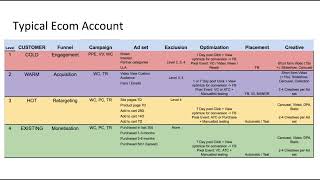
A four-layer Facebook Ads funnel for ecommerce: cold audiences with broad targeting, warm audiences using pixel events and video retargeting, hot audiences with 7-day to 28-day retargeting windows, and existing customers with upsell sequences. Budget roughly 5-10% testing, 10-11% retargeting, 84-85% cold acquisition.
Chapters
In this video, I'm going to take you through a typical funnel strategy that we use for e-commerce. Now, it's important to note that when it, when it comes to funnel strategies, you have to tailor it for every website, every eventuality. The products are different, categories, the spend values, etc. So this is a typical funnel, and what I do is when I start working with an e-commerce site I use this as a template to then determine whether it's the right approach, whether we need to tweak things slightly, etc. But you know, one of the key things here is we're following a structured process of 4 key layers of our customers. So from cold and warm to hot and also existing customers, and then really thinking about the right campaigns for these customers and the targeting, and then all the way through to the kind of optimization and the creative as well. And I want to talk through the 4 layers in a bit more detail of how we we would approach this for an e-commerce account. So at the top layer, you have your cold audience targeting. The 3 key campaigns that I'm playing with here are page post engagement, video views, and website conversion. I see a lot of e-commerce Facebook marketers using website conversion, maybe overlooking page post engagement, video views, etc. That, that for me is a big failure because the audiences that you're playing with, whether they're in the hundreds of thousands or tens of thousands or millions, are made up of multiple different people who are in different buying states and buying cycles. So you may have an audience of, you know, 1 million and you create an objective for page post engagement. There are probably buyers in there or people that can be converted into buyers that Facebook otherwise didn't realize are ready to take a conversion to buy, for example. And also I use this as part of my testing strategy. So if you've been through the Graduation Framework, page post engagement is an important part of that as well. One thing to note is page post engagement and the video views objectives are very similar in the way they operate. So at the core, they're both after engagement. What video views offers you are additional tools to make the video creative a lot more optimized for that objective as well. And so I usually run these 3 together in cold audience targeting. And this is where I'm bringing in broad interests, partner categories, lookalikes, behaviors, etc., etc., and running website conversion campaigns to try and generate sales, to scale up, to bring traffic into the site, and using PageVox engagement for testing. And video views is a combination of both, so it really depends on the type of product and the average order value that we're working with, but if I'm looking for a cold audience and I want to sift out the right people and I don't really have a strong avatar, then the video view campaign is a great way of doing that where you can actually run a video and you can retarget people based on 10-second view or 50% or 75% viewed and create a much warmer audience that we can then target off the back of that. So going down to that level 2, that's one of the examples of an ad set that I'd run there. So against a website traffic, website conversion or a traffic objective, I might run a video view custom audience campaign where I'm retargeting people that have viewed a percentage of the video, or it may be fans that have not purchased, or emails I've grabbed off Facebook or from the website of people that have not purchased. Well, why am I using traffic at this level? The traffic objective is looking at your audience or your pot of data and just finding people who are likely to click on the ad. Now the difference between that and website conversion is you can optimize that activity further down your funnel. So typically for e-commerce, you have different stages that you have set pixel events for. You might have one for your product page, which generally people use as view content, one for add to basket, one for your visited cart, initiate payment, payment page, and, and confirmation page. And so if you have a website conversion campaign, you can optimize for those different objectives and try and get Facebook to find people who are likely to land on one of those events. What the traffic objective does is it goes a few levels above that and actually just gets people that are likely to click off the ad or click on the ad. And what that does is it puts less of an onus on you to get conversions in to make the algorithm work. So recently Facebook upgraded their, requirement for conversions in a given week from 25 to 50, which has made it a lot more harder for small spenders, small stores to actually start to generate enough data for website conversion to work really well. And then you have to play with different layers. So you might have a website conversion campaign that's going for purchase, but there's just not enough events firing. So Facebook can't find the right people. This is prevalent, especially for when you're starting out an e-commerce store and when you don't have much spend going in, what the traffic campaign allows you to do, especially for a warm audience. And, you know, bear in mind if they are already fans, if they're emails that are on your list and they haven't purchased, get them onto your website. And this is where sometimes a traffic campaign can do a good job. Alternatively, you might wanna use the website conversion campaign with a landing page objective or optimize for view content, for example. And what you wanna do at the warm stage is just get them back to the site. So there's different creatives you can play around with. Generally at this stage, I would start to kind of play around with a few more placements. So at the cold level, generally I'm testing with Facebook, may start to introduce Instagram and see if we can actually bring some traffic in. You might wanna consider splitting your placements depending on how you're messaging your proposition. If you're starting out, I would generally group the placements together, but as you start to scale out, and we'll go through this in the scaling video, you can start splitting those placements out and seeing if you're getting better performance with pushing budgets into different placements as well. Then the third layer down is retargeting. Now with this, there's 3 key objectives again that I'm using: website conversion, product catalog, and traffic. Again, from testing within e-commerce, I often see that when you run website conversion and traffic together, especially when you're not running product catalog, you can get some really good performance, actually blended, they give a good blended performance. What happens is with website conversion, especially in retargeting when you're trying to get people back to purchase, Facebook may or may not get it right. So it may find the right people that are ready to buy, sometimes it doesn't. Combining that with a traffic campaign allows you to widen that pot. So it allows the website conversion campaign to go off and try and find the best audiences that are likely to convert, and traffic shores up the rest of those people in that audience that may convert. And it's something to test and to test those running together. Some people just like to run traffic because at this stage, you know, you might have a smaller part of hundreds or thousands of people who are highly likely to buy, and therefore you just want the traffic campaign objectives to just bring them back to your site. If you have a product catalog, you know, 9 times out of 10, it will, definitely perform better than just running normal ads. Being able to set up your catalog in the background with all your products and actually once someone visits your product page, getting that, those products back into their newsfeed with similar products generally outperforms anything else as well. I push this into people that have viewed a product or added to cart and that generally works well, but also looking at the timings as well. So you can, you have to play around with the targeting rules, but as a general preference, I will start retarget people that visit the site but not product page for 7 days, people that have viewed a product page but not added to cart in 7 days, and also the add to cart sequence of 7 to 14 to 28 days. And these timings need to be tested for every e-com store, so I would take this rough setup or this draft setup, test it and see what kind of reaction I'm getting. Now, when you're starting off, you probably don't have enough volume of people to separate your add to cart into 7 days, 14 days, 28 days, in which case group it together and just have one ad set, which is people that have added to cart in the last 28 days, and let Facebook optimize to get the right people into, back into your website as well. And also, when it comes to optimization, you can play around with the kind of 1-day click, 7-day click. Generally, if it's a low-ticket value item, then the 1-day click, if you're getting good volume of sales coming through, is better. So it gets Facebook to just focus on the people that are likely to convert within 1 day and have converted over the last 24 hours. The 7-day post-click I find works better when you know that the consideration process takes a bit longer. So the advantage of that is, let's say you have an item that's selling at $200, and you know that it takes 5 days on average for people to convert, you want, you want more data for Facebook to take into account. So that's where you'd start to use bigger optimization periods as well. And when it comes to creative, it's about testing which formats work. Definitely go for dynamic product ads for retargeting if you can. Then the fourth layer down is for existing customers. And this is part of the kind of process which has been left out by a lot of people that run e-commerce stores. Is with Facebook's cost per thousand impressions increasing over the last few years, and probably going to continue to increase as more competitors come on board, and as fewer and fewer placements are made available, monetizing your existing customers is crucial. So I would highly recommend that you focus on your lifetime value as much as you do on cost per acquisition and return on ad spend. So for example, let's say that you break even on that first purchase. Let's say your margin is 50% on the product and your ad spend is whatever it is. If you make 150% back in terms of return on ad spend, and you can pay off your ad spend and you can also pay off your cost of goods sold, then for me that is a good outcome if you've got a strong post-purchase sequence set up. So the post-purchase sequence could be immediately after the sale on your website, so you deliver them a one-time offer, Maybe it's multiple one-time offers. Maybe it's an email sequence that goes on afterwards, but also consider Facebook ads as well. So for those that have purchased, can we retarget them and bring them back in later on down the line? There is actually a study that's been applied on buying behavior and actually where the peak moments are to sell. So the first point is after they've purchased something for you, from you, they're on a natural high. And so that's a great time to actually hit them up with a new offer. Also, after they've received their product, they're on another high as well. So shipping could take days, it could take weeks depending on what type of product it is. Hitting them at the point that they receive the product and actually use it is another high point as well. And then maybe then thinking about what the product cycle is. So if, for example, let's say you're selling a perishable, whether it's, I don't know, shampoo or something like that, and generally you know that it takes 6 weeks for a typical customer to properly use that item, then start serving those ads up 6 weeks after the first purchase, maybe even 5, 7 weeks, test this out and try to get them into the resale. You'd imagine to have an email sequence mirroring that as well, but Facebook is another way to actually bring them back with a much lower cost per acquisition as well. Also with Facebook, one of the other opportunities is to use dynamic product ads for those existing customers as well. And what that allows you to do is you can create a sub catalog of your main catalog. And let's say, for example, you're running multiple categories. Let's take jewelry, for example, and the customer's purchased a watch, then the subcategory might be bracelets or chains or necklaces or something like that. And you can start to run retargeting ads to existing customers knowing that they've purchased one particular category to try and get them to purchase a different category as well. And so they're just different techniques you can use to build up your account setup. So in terms of an example of how you— how this might look in terms of a campaign, this is a campaign which we're running right now actually, which breaks out those different layers. So you can see the layer 1, 2, 3, and 4, and we've labeled it as cold, warm, hot, and existing. And what I've done here is to also put the objectives and also the country targeting here. There's different ways of setting this up. You can bundle all your countries together. My own preference is to bundle— to keep the country at the campaign level. Sometimes depending on if it's a general store or a multi-category store, I'll also have the category at campaign level as well. So looking at how that looks within a typical campaign. So this is a campaign we've been running recently, and you can see that the structure is here that we've been applying. But one of the key things to point out is when I set up the structure, I'm not expecting to use every single campaign and objective all at once. I'm testing, I'm learning, I want to see how customers are reacting, how the account's performing, etc., etc., before starting to dive really deep in and playing around with all the different objectives, but I prefer to have it set up from the start. So when I need to use something, it's there. One of the things just to point out, and a common question I get is, you know, how much should we put into cold audience targeting versus testing versus retargeting? This is a typical e-commerce account. And for example, here, I think around 84%, 85% of our targeting is going into our cold website conversion targeting. Here I've got around, I don't know, 5% I think of the spend going into testing, and my recommendation is always to have 5 to 10% in your testing. It really depends on where you are with growth and where you are with testing. If your growth is fairly stable, then your testing might fluctuate between 5 and 10%. If you're scaling, then it may drop down but in this example we've got 5% here, and here for retargeting we have about 10-11% going into retargeting, and this is the example where I gave of running the traffic and website conversion campaigns together, and this is— we've seen some kind of fluctuating results here, so with a cost per acquisition overall target of $35 at this stage, we've seen that website conversion sometimes brings in a lower cost per acquisition, Sometimes it's traffic, but running them blended actually gives us the best results, and that's something worth testing for your e-com setup as well and see if— see whether running the objectives together works out as well. And going back into the setup, just to kind of reflect back, this is kind of the setup that I've taken, which is taking our vanilla approach to account setup and just applying it into the account. So you can see this is the way it relates down all the way through hot and through to existing customers. This is a typical account setup. My recommendation would be to use something similar as your kind of start base and to test and iterate as you go along, as you start to understand what works on your account and what doesn't. There is no kind of set structure that this is the absolute best way of setting up your e-commerce store. It all comes back to getting the basics in place, making sure that for whichever level that you're currently targeting, you are pushing the right creatives, the right optimizations in place, and funneling people down through each part of the funnel, and then closing that sale out.
More from Depesh
[Q&A] $4.3Million from $270k Ad Spend using The Ascension Path Model (APM) [AOA Podcast Part 2]
How I Made $4.3Million from $270k Ad Spend using The Ascension Path Model (APM) [AOA Podcast Part 1]
AI BUILDS FACEBOOK AD CAMPAIGNS 10x FASTER (Real Account Walkthrough) - The BPM Method
I Built a $1,000 Ad Landing Page in 10 Minutes Using AI (PRINT Money Using This)
60 Meta Ads Created & LAUNCHED in under 15 Minutes (Without Touching Ads Manager!)