How More Clients Is BREAKING Ad Agencies (And What To Do Instead)
Depesh Mandalia argues that chasing more clients breaks ad agencies and offers the CALM framework instead: focus on fewer clients, automate with AI, increase lifetime value, and optimize pricing. Rapid hiring and poor onboarding tank margins and team culture.
Chapters
Here's why more clients might be the worst growth strategy for your agency or freelance business in 2026. Hi, I'm Depesh Mandalia. I've been running my ad agency since 2017 and been freelancing from 2014 and contracting as well. So I've been in the game for some time, grew my agency, exploded it, grew it again into 7 figures, and settled on a way of running an agency that doesn't consume my mental space and doesn't cost me my physical health as well. And growing an agency that's actually fun. So today I'm going to talk about some of the things that I believe you should be considering for 2026 and beyond as well, to get your agency into a position where you're able to run a business that you're happy with, you're fulfilled by, and is highly profitable as well. Now, the first part of this is a lot of agency owners, a lot of freelancers, the biggest thing they talk about is lead generation and getting more clients. If you go into any of the forums, most of the conversations are about more clients. Very rarely do the agency owners and freelancers talk about how do I get these clients good results? How do I manage my P&L? How do I hire good way? How do I plan my hiring and things like that? The problem with the situation with the agencies that just want to get more and more clients is they don't foresee what's going to happen and the trap that you get caught up in. So here's the thing. When I was acquiring clients for my business in 2017, I was in the same space. I'm not saying I'm better than you, or I bypassed this step because I knew what to do. I'm telling you from experience, I made the mistake. So in 2017, I would bring in as many clients as I could and then just figured out the rest on the way. So initially, it was just me and my business partner, and we were fulfilling clients we had 3, 4, 5 different clients. Then we were getting good results. So we said, alright, get more clients in, got to 6, 7. And then I'm like, hey, I need help here. I need to hire people. So we brought in media buying help for our ad agency. Then we brought in a client manager to come and manage the accounts and things like that. Then we needed some design help and some copywriting help. And before you know it, I was caught between getting more clients in and actually building a team. Don't underestimate how difficult it is to build a team up, especially when you're doing it on the fly. So it's not like you can sit there and really plan and think things through, especially when you're growing and you're getting more clients in. You don't have the time to think often, and we got caught up in this. We didn't have time to think. I needed to bring in more and more hires because we were growing. Like, lead generation wasn't the problem at the time. We needed more support in getting the clients results. So as we start to hit 10 and 12 and 15 clients, I needed to think about business structure, I needed to think more around revenue margin, I need to think about team management, because when it's you and a business partner versus when it's you plus 10 other people, you now have HR, human resources things to think about, right? It's not, it's no longer a case of just get the job done. You, you're the expert, you're running the agency, you know what to do. Now you need to think about onboarding your team members. Forget onboarding your clients, you need to onboard your team members. You need to make sure that they're trained and they're able to do the work to your standard. You need to make sure that you're considering their very human needs. So they might need time off, maybe they get sick, maybe they The cat is sick or something. There's always things going on in their life, right? Then you need to think about, are they doing a good job? How do I track? How do I make sure that my time utilization is where it needs to be for every client, for every team member? That was a huge learning period for me. Like, it took 6 months and some external help to figure out that we weren't doing things optimally so that, like, when you're thinking about growing more and more clients, there's going to be multiple breakpoints of, we're going to need more help here, we're going to need to bring in more people to get the results for these clients. And then often what happens is the results start to take a little decline. We had this as well, where you're trying to build the standards up for the entire team. It's very hard. The more people we bring in, like our breaking points were probably higher number 5, higher number 10, higher number 20, higher number 25, 30. There are different breakage points because as you're trying to formulate the— as a business owner, you think about logic and process and things like that. Then you start thinking more about team culture. Do we have the right people in the right roles? And how are people working together? Hey, I just wanted to quickly interrupt this to say that we're running a workshop in a few days' time. The link is in the description. Where we'll be breaking down exactly how I build a CALM agency. So if you think about the chaos of early stage growth, of growth and instability that comes with the unknowns, I'm going to be showing you how we've built our agency towards CALM. CALM is an acronym, C-A-L-M: Clients, Automation, Lifetime Value, and Monetization. And they're the things that helped me to enjoy my agency, to enjoy the profits, to enjoy working with the clients, to enjoy working with my team, and enjoy the experience of actually growing a business and not being chained down by it, getting the benefits of it as well. So the link is in the description below, or it might be above depending on where you're watching this. Go ahead, sign up. If you can't make the live, you can grab the replay, and I'll see you inside. So I do football coaching, soccer, for North Americans. And often we talk about the chemistry between the players. So if you have your defenders, you have your goalkeeper, they need a really strong chemistry and they need to bond. Then you have your defenders and midfielders and strikers and things like that. And everyone needs to work together towards one unified goal, which is to score a goal and to win the game. Same thing happens in your business. I've hired people that have absolutely disrupted the flow. People with big egos, people that like to argue a lot or are overly opinionated and don't want to take other people's views into account, or maybe are just very hard to communicate with. When you start to bring all these different characters into your business, it becomes a bit of a disaster. And I've had to fire people who were otherwise very good at their job, but were disrupting the flow of how we are managing our clients and how the team was developing. And it's happened multiple times. It can be hard to get that right. So when I look back and say, is getting more clients the right thing for you right now? A lot of it is looking at what your growth path is. Now, for example, let's say you've got 5 or 6 clients and you're making $10-20K a month. Why do you want more clients? Like, answer that first. Why do you need more clients? If all you're saying is I need more clients because I want higher revenue, you are leaving 80% of the decision-making out. Okay, 20% of why you want more clients is more revenue, but then what? Okay, so let's say you double your client count from 5 to 10 and you've doubled revenue from, I don't know, to $20K or $40K or whatever it ends up being. Now what? You do want to double it again? And do you want to double it again? Because I can tell you, your problems don't just double. They compound. So when you go from 10 clients to 20 clients, your team has to grow with it as well. Your processes have to grow with it as well. Your— even your hiring. Don't discount how hard hiring can be as well. And you have to put in the time. You can hire external help if you've got the cash flow to do, but certainly when we were at $10K and $20K a month, we were not able to afford someone to come in and just do hiring. Later on, when we start to hit 6 figures a month, we could bring external people in to help out. But certainly at the earlier stages, hiring— I'm going to tell you this right now— hiring is the hardest thing to do with growing a business, like finding really good people that are just going to plug in and do what you need to do. That's why I'm all in on AI as well. If you haven't heard about the work I do with AI, I'm building AI systems to complement everything I'm doing. I don't think right now we're at the stage of taking over things completely. But when I look at the different roles in the business, I'm talking about mine as well. As the CEO, when I look at what I'm doing, I look at how effective am I being and what else could I outsource? How could I use AI to complement what I'm doing? So to give you an example, when I'm looking at my P&L, my profit and loss report, I could go and read it, I could go and analyze it, I could ask my accountant to give me a summary. But you know what, it's so much easier and faster for me to just give that data to AI and to get AI to interpret it, especially when I give it additional information. And that's something which I talk a lot about. When you're, when you're bringing AI in, don't initially expect it to start thinking at your level. You need to coach it and train it just like you would with a new hire. Don't think that AI is going to come in and just magically tell you what to do. Think of it as a new hire. So when I'm thinking about growth, when I'm thinking about my agency, when I'm thinking about more clients and the stress and strain it's going to bring in, I'm starting earlier with AI and looking at how I can actually grow my client base, grow my capability, without giving me more of a headache with AI. So like, when you're thinking about the layers that go into growing a business, there's clients, there's leads, there's operations, there's finances, margins, there's how do we retain clients, how do we grow our team, what does our team look like? There are all these layers that start to stack up, and I've learned a lot of this the hard way before I really hired external help, probably about 3 years into my agency, which allowed me to actually bounce ideas off someone with a lot more experience than me. And that gave me feedback to look at what I was doing and to make sure it made sense. So for example, I remember in 2020, we're making really good revenue. And I was like, I want to hire this person, I want to hire that person, I want to bring these systems in. And my coach at the time said, okay, where are you offsetting the extra costs with revenue and profit? And I was like, yeah, it will just come. And no, you need a plan here. Because I have made those mistakes where I'm like, growth is coming, we're going to get more clients, it's going to be fine. You don't know if it's going to be fine. You can't predict. If the leads are going to close. And especially right now, a lot of your clients are already using AI and they're asking AI the questions that they'd expect an agency or freelancer to answer. So you're up against so much more in 2026, which means you also have to step up and elevate your position and how you're pitching against your competitors and against AI as well. Like AI is friend and foe here. Don't think for any moment in time that AI is yours and you can keep it away from clients. Most of the clients you speak to, I pretty much guarantee this, you can get them on a call and say, hey, how are you using AI right now? Or are you using AI right now? Probably 100% will say, yes, we are using AI. But I can probably also guarantee that the majority don't really know how to use AI properly. And that's something that I focus heavily on is AI itself is not the advantage. It's the implementation and how you're layering it into your business. That is the big advantage. So I'll give you an example. We use AI to support our lead acquisition, our client onboarding, managing our clients, our media buying, our operations, our profit and loss. So AI is layered across everything we do. I can't imagine ever running my business again without AI. If tomorrow something happened and the world decided to switch AI off and it's just costing us too much water or whatever it ends up being, I would be lost. Not that I couldn't go and hire people and things like that, but I truly enjoy working with AI. I love working with people and we've trimmed our team down over time, not just because of AI, because we've also found a lot of efficiencies as well. And we realized we didn't need so many people. But AI does the repetitive and also the very boring things that otherwise you'd bring a VA in. I remember speaking to a business owner and she had 20 VAs out in the Philippines and the whole team was just doing data processing. They were tracking every part of her business. I think it was a $20, $25 million a year business. And they would track everything from ads and marketing and socials to lead generation and call bookings and closing and client management. Everything was tracked by this team of 20 VAs in spreadsheets. And I found it confusing at the time as to why you need 20 people and like, why not just use software and things like that? And she's like, it's worked and we don't want to break it. But then I look at that and think, how inefficient is that? Like even just managing a team of 20 doing data, someone has to manage them. People will make mistakes. That whole thing could and should be replaced by AI, like 20 people down to literally one person managing it and just using AI to grab all that data in. We, we built our own operating system in the same way. We have AI pulling data from all these sources. I now have my own app with lead gen, with call booking data pulled in, with client management, with our marketing, our email sends, our socials, our ads. Everything's in the one platform. And that's all done via AI, including the insights as well. So it's telling me how the business is performing. So let's say, for example, you've got your ad data in there, the client, the client wants to know how their ads are performing. The AI can tell you that. Yes, you can go in and look at your ad account, you can have a finger on the pulse of how your client's results are doing because you're keeping a close eye on them. Or you just get the AI to tell you and I'm, if you look at where 2027, 2028 is going to end up going, AI can only get more powerful. Whether that becomes a tipping point where it's just too powerful and things like that's outside of the scope of this video, but it's only going to get better. So get— what does getting better mean? It means for us as business owners, it will do a lot more for us, but it will also mean our clients can do a lot more without us. And I'm talking about us as agency owners and freelancers. Why does the client come to us in the first place? They either need help because they don't know what they're doing. Or they need help because although they know what they're doing, they need resources and they don't want to tap into a big team. So if you take it from a client's point of view, they're going to fall into one of these two pots. If it's because they've got a good business and they don't have the resources to grow it further, they'll bring in an agency because the agency will give them copywriting, design, video, funnel help, things like that. So they're expanding their marketing capability. If they don't know what they're doing, then they're going to come in a lot earlier. And then, you know, they want to offload growth. They're two very different types of clients. And you have to be careful about the type of clients that you're bringing in based on that as well, because they need different things, you price them in different ways, and you approach them in different ways as well. But until you're clear about which of those clients you're after, where they are in their growth stage, and that how you're going to deliver them operationally, getting more clients, especially right now, it could break you. Honestly, I've been through that where I felt like I just want to close the agency down and go back into affiliate marketing or just try and revamp my e-com stores because it's really stressful when you've got 12, 15, 20 clients, all, you know, giving you different kinds of pressures. To get them results. And you're managing so many things as well, where you're worried about the hiring, you're worried about the firing of your team, let alone your clients, and you're working on process, and you're still trying to stay on the cutting edge of everything that's going on. Honestly, I don't think most clients fully understand how difficult it is to run an agency, or even if you're freelancing on your own, how difficult it is, because you're not just working for the client, you're working for yourself as well. Your business needs you as well. The business needs oxygen. The business oxygen is you operating to your maximum capacity and bringing in cash flow, not even revenue, cash flow. We talk about margin, we talk about profitability. I didn't pay attention to that really enough for the first 12 months of my agency, and it broke me. Because if you're worried about revenue, over everything else, it's very hard to get your clients their results. It's very hard to show up on a Monday morning to your team and show them the things they need to see from you as a business leader and lead them in the right way as well. And that's another thing that which I try and get my agency clients, so when I work with agents and freelancers, to think about is you are on a pedestal within your team and also from your clients as well. They look up to you. Therefore, it brings a different responsibility. And you therefore need to be at the highest levels of energy. And your mindset needs to be clear to deliver those results in the best way as well. So my biggest advice right now is not to continue chasing leads and new clients and new revenue until you've really thought about what that actually means to you and what impact it'll have on your business and plan ahead. Beyond that, be thinking about the AI layers that are going to help you to create stability for your own business, let alone for your clients as well, and create something which is going to be positive cash flow for your business. That's going to be giving you the positive headspace and allow you to be healthy and strong to deliver all the results that you want for your clients and actually enjoy what you do day by day as well.
More from Depesh
[Q&A] $4.3Million from $270k Ad Spend using The Ascension Path Model (APM) [AOA Podcast Part 2]
How I Made $4.3Million from $270k Ad Spend using The Ascension Path Model (APM) [AOA Podcast Part 1]
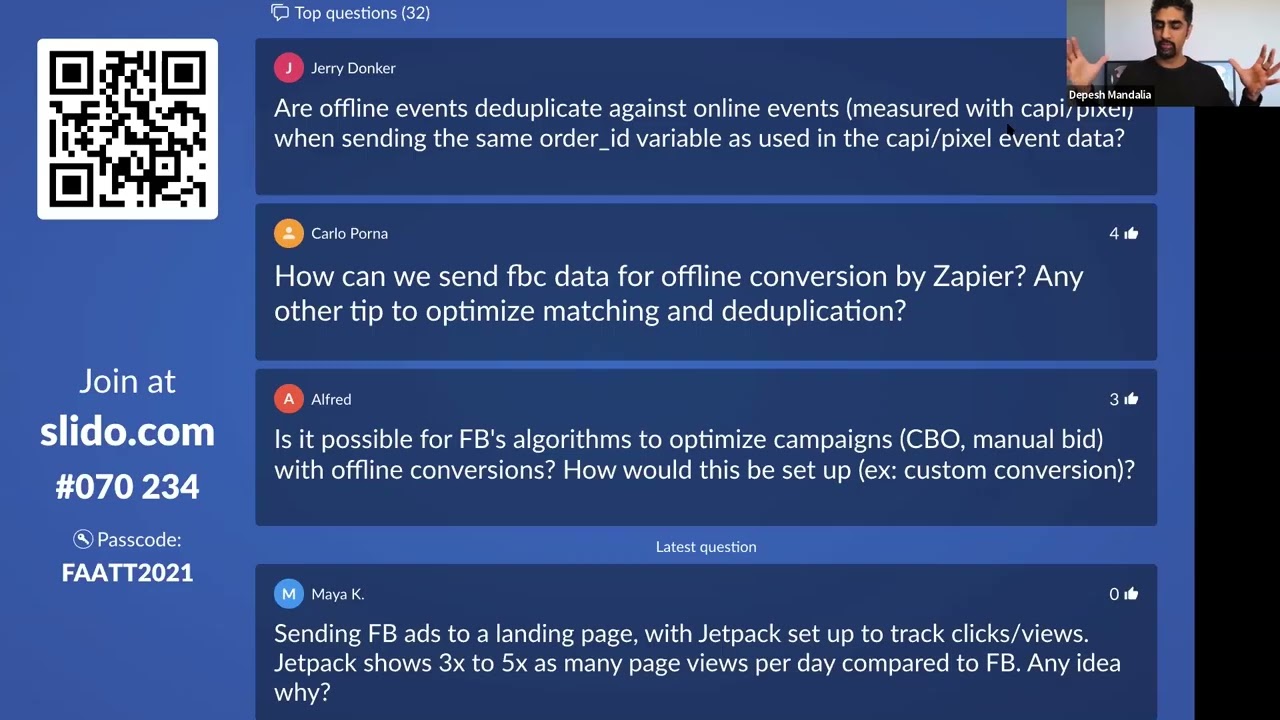


AI BUILDS FACEBOOK AD CAMPAIGNS 10x FASTER (Real Account Walkthrough) - The BPM Method
I Built a $1,000 Ad Landing Page in 10 Minutes Using AI (PRINT Money Using This)

60 Meta Ads Created & LAUNCHED in under 15 Minutes (Without Touching Ads Manager!)