The Facebook Ads Attribution & Tracking Trinity (FAATT) Framework - Q&A
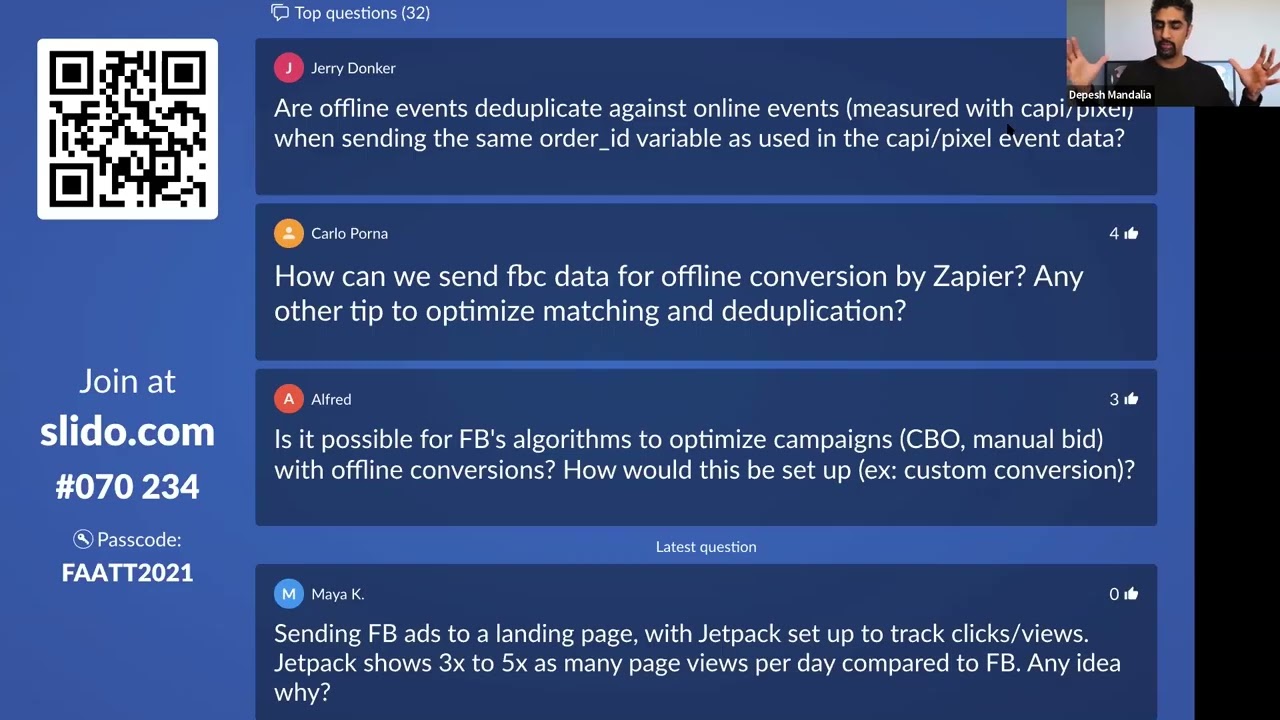
This content was created by Depesh Mandalia . This content was uploaded by Depesh Mandalia . This is a YouTube video titled "The Facebook Ads Attribution & Tracking Trinity (FAATT) Framework - Q&A" (uploaded 2026-08-27). The content appears to be a Q&A session focused on Facebook ads attribution and tracking using the FAATT framework. No transcript or speaker names are provided in the excerpt, so individual participants/hosts are unknown from the provided data.
Chapters
Hey guys, I'm just waiting for a few people to join. I can see the attendees count is growing quickly, so we'll give people about 30 seconds or so to grab their seats, grab their drinks, get ready for the show. Whilst we're waiting, I like to do a sound check, so just tell me where you're calling in from. And also one thing that you're looking forward to from this as well. I know some of you have submitted your questions already, and I appreciate that because I will go through those questions on our Slido tool. But you're also free to ask questions here at the end as well, so I'll come back to those as well. Matteo, hello. Thad in Los Angeles. Nuno, Portugal. Jason, Malaysia. David, Portugal. Malaysia must be quite late there, I think, or maybe early morning. Harrogate, UK. Little Rock, Arkansas. Appreciate the support, Thad. Hey, Jason in Winnipeg. Yep, so figuring out to use Google Analytics part of the training. Hey, Richard from New Zealand. So I think you're in, you're actually at tomorrow now. You're at Friday, I think, and we're in Thursday. Mark, Northern England. Casey, South Carolina. Looking forward to keeping, keep learning more about GA not offline. And I know there are some, there are some gaps in kind of the understanding and the knowledge. I'm most frustrated by Facebook's lack of support and knowledge on this. So as much as I'm learning as I go, and we've got years of experience of using things like offline and GA, there are always going to be some slight questions. And I know, for example, some of the questions were around how the deduplication works between offline and online. We'll go through that as well. James in York, Dushan in Switzerland. I look forward to making whole tracking working together. And, you know, this is a big thing that I want you guys to have in play now over the next 2 weeks and be confident of going into 2022, because it's going to become so much more important regardless of what you're advertising on, whether it's Facebook or something else, to make sure you've covered the bases of attribution and decision-making as well. I haven't really watched the training yet. Looking forward to the Google Analytics side of things. Good stuff. You're in Toronto. Jason, 3 AM here. This is important. Can I appreciate that? Jason, will you have access to the replay? Yeah, absolutely. So the idea for this is we'll cut it and slice it and put it into, into your membership area. So the way I like to do these Q&As when we launch a new program is to have this— have you— give you an opportunity to go through the program, have the Q&A. The questions have been submitted as questions on our Slido tool. we'll then take the videos with the kind of questions and the video answer, question video answer. So you'll have those in your, in a new section in your training under Q&A. So it's easy to reference. I know if I, you know, this is going to be about 60 to 90 minutes, you don't want to go through a whole 60-90 minute replay. So I'm going to share my screen. I'll go through the questions that have been pre-submitted. And if you have questions and you're on the live, just submit them in the chat and I'll come back to those after. So I want to give priority to the people that have already submitted their questions. I'll go through those one by one. If I need to expand on it, I've got my drawing utensils and things like that, so we'll cover those things off as well. Cool. So here we are. Let me just full screen that. So the way I like to do this is I'll go through each question, I'll answer each question as it is. They have been prioritized by the likes as well, which is quite handy. This is why I like using this tool as well. If you're on the live, you want to get your question into this portal, you can go to slido.com, type in the ID and also the passcode. It's only for the guys that are on the live. So I'm going to go through these. If you've got questions, as I said, put them in the chat as well. So starting off with Jerry, are offline events deduplicated against online events measured with CAPI and pixel when sending the same order ID variable as used in the CAPI pixel event data? Yes. So I know a few people have said, you know, when I'm uploading my offline conversions, I'm still seeing duplicates. And, you know, one of the challenges with this is there's very little documentation from Facebook that really explains exactly how this works. Now, this is— I'm only using this based on my experience of using offline conversions for the last 2, 3 years and kind of looking at those match rates. Where it doesn't deduplicate, it means that something hasn't matched. So order IDs, absolutely important. The time and date stamp, the name, the email address, things like that are all things that we're trying to do to match up a click to a sale or a lead from our offline conversions. At the same time, we do want to make sure they're deduplicated as well. So for example, on my own Shopify store, we have offline conversions And it does dedupe. So offline conversions is sending all the orders, but we only see one or two come through now and again in the offline conversions column, but most of them are captured for our store on the website pixel. So the short answer is yes. The long answer is I'm still trying to understand exactly why sometimes it may not match. I don't know if it's something on Facebook's end. For us, it's pretty much the case that when we have the order ID there, it's fine. For example, we also have offline conversions for ClickFunnels, and whenever we have funnels and things like that, we're uploading offline conversions there as well. That becomes a slight challenge to match up because with something like ClickFunnels, it doesn't necessarily have a unique ID that gets surfaced in the purchase pixel, and that's something we're working on. So whatever platform you're looking at, I talk a lot about Shopify because that's what most of our clients are on. Shopify makes it easy. You know, you have your standard CAPI install, your browser pixel, that the order ID is passed from Shopify back to Facebook. And then with offline conversions, you have to make sure that's passed back as well, whether you do it manually or automatically. If you're doing it manually, go to the orders part of Shopify, download those orders, not by customer but by order. Make sure the order ID is there, make sure the time and date stamp is there as well. And then when you upload that, it should deduplicate against the data you've got there as well. So the next one, how can we send FBC data, Facebook Click ID data for offline conversion by Zapier? Any other tips to optimize matching and deduplications? You can't. This is a bit of a frustration. As far as I'm concerned, you can't do that right now. Maybe in future it changes. The Facebook click ID, for anyone that doesn't know what it is, when you click any link from Facebook, you'll see in the URL fbclid= and then some kind of random characters. That's the click ID. So the idea behind offline conversions, if you could capture that and pass it back, it'd be amazing. Now, can you actually do that? Yes, you can. So in Shopify, for example, and other platforms may also do it, Shopify captures the landing page URL when you visit any Shopify page. So for example, if you go into Zapier and you, you kind of follow the Zapier template I've got, there is a variable that's passed from the Shopify API back to Zapier that has the full URL. So it'll be, you know, yourshop.com/product, whatever it is, and at the end it will say FBCLID. It does get captured. At the moment, there's no way of easily pulling that out and pushing that back to Facebook. And also FBC data is based on cookies and things like that. So it does get a little bit more complicated. What's the benefit of passing this? Well, the benefit is if that— if, for example, and I'm using Shopify as an example again, if I have that click ID, if I know that this click ID is associated with this visit on Shopify and this purchase, and I can pass that click ID back to Facebook, That's 100% match in, you know, CAPI and the Conversion API. And the same can then apply for offline conversions. So one thing to understand is the Offline Conversion API and the Conversion API, I don't think that the teams working on them work and communicate completely on it. Because if they were, then they'd update them both at the same time. It'd be fairly similar and things like that. Maybe, maybe not. I think the offline conversion API has been a bit, a little bit neglected. So just kind of bear that in mind when you're working with offline conversions, Zapier, and things like that. I would always recommend if it's your first time working with offline conversion, do it manually first, get used to the process, understand how it's working, what's working, and things like that. And then go into optimizing that via Zapier, Integromat, anything else that can connect your backend system to Facebook as well. So Alfred, is it possible for Facebook's algorithms to optimize campaigns CBO manual bid with offline conversions? How would this be set up? Example, custom conversions. So yes, you can have it optimized by offline conversions, but at the moment it's either offline conversions or pixel. In a perfect world, if I could influence Facebook, I would say, Use both, why not? But at the moment, when you go into your optimizations, you can only choose one or the other. So the downside of just using offline conversions is you probably wouldn't get as much data because it's kind of deduping and doing things like that. So there are software tools out there which encourage you to test it. And I'd say test it and see what happens, but I wouldn't recommend doing it. And I've seen lots of data from this particular tool where people have gone in and used— so they've created a brand new pixel. They've taken data that the third-party software has provided, and that goes into this new pixel that's been set up. And they've optimized that versus just a standard pixel. And each time, you know, every case study example I've seen, it just hasn't worked as well. So I don't know the exact detail as to why that might be. But what I can say is, right now, the pixel When you want to talk about browser pixel and server pixel, that is far better for optimization than using offline conversions. There's probably some cases where the opposite is true. Maybe you actually do have a brick-and-mortar store and you only capture offline conversions. So 100% of your sales are offline, then yeah, absolutely optimize for offline conversions. But if you're an online seller or whatever your business is, I would rely on the pixel and use that for my optimizations. Arafat, have you tried promoting Facebook ads targeting Android devices only? If so, how will the data compare to before? Is that something to aim for scaling? Every time I've done this for testing, I've tested separate ad sets for Android and for iOS. Every time I've done this and I've used our attribution to track what's actually happening, I would say 8 or 9 times out of 10, iOS performs better. And the problem with this is, you know, you have to think about the profile of people visiting your store or your business, your website. And, you know, just from historical data, iOS users generally convert better, spend more. It's a generalization. It's not the same for every single country, by the way. I'm talking more about the kind of bigger markets, the US, the European markets, etc. Generally, iOS performs better. Test it. And this was one of the early test cases we did in September 2021 before we decided to put the framework together and start seeing if it's something you guys could benefit from, where I literally did this. And I can't remember if it's included in the training as a mini case study, but we split that data. We looked at what Ads Manager was showing, we looked at what Google Analytics was showing. And in this example, we also went back to Shopify. This store wasn't running any other traffic. It was just this test that was running. So I didn't have any worries about, you know, email or paid search or anything else dirtying the data. I just knew all the traffic coming in was through Facebook. We drove 4 sales in total, 2 on Android, 2 on iOS, from as far as Facebook showed. Google Analytics showed exactly the same, but Shopify showed iOS had generated 3 sales and Android had 2. So Shopify is the source of truth. We only actually generated 5 sales as showed by Shopify. Google and Facebook missed one sale out each. So more than likely that iOS user has opted out and could not be tracked for whatever reason. So that's kind of how I would recommend you approach as well. Test it, use the FAT framework, see what the data actually says, and then decide if that's something you want to use. And I'm yet to be convinced that running Android only is the right thing to do. I would rather run all the devices and then look at my data and attribution. If you'd prefer to, you know, have more accurate data, because even in that test, we were seeing more traffic into for our e-commerce funnel, view content, add to cart, initiate checkout on Android versus iOS. And that's obvious because people are opting out and you're missing out on that tracking. So maybe from a testing point of view, and this actually we do. So talking about testing, and this is something we're introducing into our testing frameworks is if we're confident that the user isn't that much different on Android and iOS, test on Android only so that when you're doing your— and if you follow the BPM method, if you're doing your graduation testing and you're looking for those early signs of success, testing Android only will reduce your guesswork. You don't have to use the fat framework so much for testing. So that's something we do, but not for optimization and scaling. Are you testing GA4 besides UA? Do you think it's It's all will be useful. Will you follow up training on GA4? I posted about this in the group. I will also add a link to that in the training as well. So my view right now is that you should stick to Universal Analytics. GA4 is definitely the future and the path for Google Analytics. Right now it's not baked well enough. So, you know, if you're going to start using GA4, you're taking it out of the oven quite early. You can definitely make use of it if you put the time in to set it up properly, understand it, optimize it, and things like that. But honestly, as someone who's also a business owner who's got agency clients, who's got his own e-com and info products and things like that, I don't have the time to go deep into GA4 to set it up properly. I don't want to bring a consultant in to do it and things like that, 'cause myself, my team, and things like that, we'll have to learn a whole new way of running analytics, 'cause it is a new way. Yeah. Sessions versus events and the lack of kind of custom reports and setups and things like that. I personally would recommend you don't spend too much time on GA4 unless you have a website and an app. If you have a website and an app, it does a much better job of stitching that data together. So you can see user journeys. So let's say you're doing mobile app install campaigns, you can see that journey better from a website click into going into the mobile app. So that's my recommendation. Mid-late 2022, we'll be spending a bit more time on GA4, but right now it's— I don't think it's worth the time. If a customer journey touches on more than one campaign before purchase, does offline conversions match up more than once, i.e., to multiple clicks? If not, which? Short answer is no. Offline conversions work the same as Facebook it will only attribute to the last click. So if you have a typical funnel, top of funnel cold audience, bottom of funnel hot, and that hot campaign has the last click, then offline conversion will just attach itself to there. So that's the kind of basic setup there. Matteo, how to implement FAT in case of ShineOn platform, no Shopify store? ShineOn platform requires the use of UTMs in a different format for their analytics. This is absolutely a problem because if a platform is asking for specific setup of your UTMs and, you know, that helps to make their platform work better and gives you better analysis and analytics, then it will kind of clash with our approach. Now it doesn't mean that you can't use the Google Analytics reports and things like that, you know, at all, but you have to make some modifications. So for example, you The Google Analytics template that I've shared with you guys, it uses campaign, ad set, and ad structure, same as Facebook, and we use the UTM campaign, UTM content, and term or keyword in order to have that same setup. Now, I don't know what ShineOn's own platform UTM instructions are, but you may have to reposition that. So if you go into edit your report, you scroll down to the bottom of that report, you can see that I've selected particular UTM tags. There's a green section and they're stacked on each other. You can literally just drag and move those around, save the report, and just see if it works again. Now, if for any reason you screw the report up, just delete it and import it again. So that's, that's how I'd kind of deal with that as well. Can you provide a fat Google Sheet to connect to Revealbot to ensure individual ad sets and ads can be switched on or off following attribution under reporting? So we haven't actually looked at that. It's been at the back of my mind because I know that RevealBot some months ago did release the ability to use Google Sheets and you can kind of inject data in there. I think that's an amazing use case of being able to use additional data. It's not something we've looked at yet. It's been on the backlog for about 3-4 months to maybe see how we might use that. At the moment, we don't have anything for that. We're relying less on— less and less on rules. But we're also building rules that are using other means of execution as well. And we'll update those rules soon as well, just in terms of how we use that for the BPM method and things like that. But it's a good use case. And if and when we do that, we'll definitely publish that out. What impact— so What impact of iOS 14 update has been so far on Google Analytics results? In future, when web-based tracking will be very low, how reliable do you think GA4 will be? So I think the future of Google Analytics will rely on server-based tracking. So Google Tag Manager installed on a server and then handling all the analytics side of things, that's where I think it will end up going. Because it's not just the iOS 14 changes, there's also browsers and cookies and other privacy things going on that 2022, 2023 it may be the case that cookie becomes a thing of the past. You know, cookies have been around for about 20 years already, and it isn't— it is a very old technology. It's not necessarily the best, but at the same time, from a tracking point of view, there hasn't really been something that's come out where people have said, right, this is the ultimate way of tracking, it's so much better than cookies. So I think it will evolve in 5 and 10 years' time. I wouldn't be surprised if there'll be no cookies and there'll be a different way of tracking and Attribution. One thing that we are spending a lot more time looking at is kind of zero and first-party data. So being able to have your own pixel on the site, being able to collect your own data and stitch that anonymous data to a known user. So there's a concept, CDP, where you can actually— I can't remember what it stands for, but you can actually look at anonymous data. And this has been around for like 5, 10 years, but it's become more prominent now because of iOS 14 and things like that. So there are ways that you can have a collection of anonymous data. So you can say, right, this particular user, here's the anonymous ID, this is what they did. Then at whatever point you can stitch that to an identifier, then that whole journey stitches together from being anonymous to being a customer. So let's say they purchase, then you now have their email address, order ID, and things like that. You can stitch it back to their anonymous journey. So there are ways to make this work. And I think that will be— I think this customer data platform, that will be a lot more prominent where businesses that can afford it and can set it up will be collecting their own data and pushing that into their own CRM and creating their own, you know, custom audiences and lookalikes and things outside of Facebook so they can enhance what they're doing as well. And, you know, we'll be talking a lot more about that in the coming months. Is there any CAPI equivalent for Google Analytics, or will that be necessary now or future? Yes, I mean, using Google Tag Manager server-side is probably, I think, the equivalent of CAPI on Facebook. So by default, I don't believe right now or in the near future Google Analytics will be a server-only install. It's still, you know, based on the old urchin technology for anyone that's been around for 15 years or longer. But right now, if you're looking for Google Analytics to be similar in setup to CAPI and be able to track more people, then Google Tag Manager server-side is the way you want to go with that. Alfred, how do we set up multi-channels, email, SMS, other social platforms, etc.? UTM parameters for GA. To work with that, assisted conversions, conversion paths, etc. So this one's not that difficult. Let me just see if I can come out of this screen. So, you know, the way we've set up our UTMs, so if I go into the UTM part of the training, so I believe in here. So if I load up the template, for example, just to give you an idea. So as a recap, we use UTM source Facebook, UTM medium is CPC, UTM campaign, etc., etc. Now, the changes here are— it's important to understand what does actually source mean and medium and things like that. So source is the platform essentially. So one of the things that we'll be updating in the framework is Facebook have released the ability to also automate the source as well so that going forward you can have the source as Instagram or Facebook or Messenger and things like that. But at the moment we just pin it down to Facebook. This tells us that this has come from this particular platform. It could be Google, it could be Pinterest, it could be TikTok, it could be email and things like that. So when you're thinking about the source, that has to change based on the platform where the traffic's coming from. Then the medium is, again, we use CPC. It's an old way of doing it and not necessarily the best, but other people use ads, paid social, paid things like that. It doesn't matter. But the medium is often, is it paid? Is it organic? Is it something else? So that gives you an idea of kind of where within that platform where the traffic's coming from. So you can have Pinterest organic, you can have Pinterest paid, you can have Facebook organic, Facebook paid. So So for example, let's say you're posting out content on your Facebook page or a Facebook group. If you are tagging your URLs up, then you'd have Facebook and then UTM medium equals group or equals page or equals organic. So that when you're looking at your analytics, you can see the click path of what's coming through. So that's really where you're making those changes based on what you said, when I've got traffic from different sources. Let's say TikTok, UTM source equals TikTok, medium equals paid or CPC, cost per click, or whatever it is. Then these parts here, these brackets are automated specifically from Facebook. So I don't know if that's always gonna work for other platforms, but you can just override that. So for example, in ActiveCampaign, when we send out emails, these sections are prefilled as well. So the UTM campaign parameter is the actual name of the email we create in ActiveCampaign, and that's automatically sent out. The content is taken— I can't remember exactly. I think that's some subset of the email. It might be a subject line or something like that. Some platforms do allow you to automate. Klaviyo, for example, will allow you to automate. Others, you'd have to just hardcode it. So let's say, for example, and I don't know, but maybe something like Snap Ads doesn't have these parameters where you can automate, then you might have— and you just might manually type these in. So UTM campaign equals, you know, top of funnel such and such placement. UTM content is something that's descriptive for you, and the term could be the ad name. Now bear in mind, this is the other thing about this: when you set these tags up, if you make any change on existing ads or links then you're going to create duplicates of that in your Google Analytics. So for example, one thing that you might have is you're running this on Facebook, but then you decide to change the name of your ad. If you do that, then Google Analytics will see it as a brand new ad. It doesn't stitch it back to the existing ad. Now, one of the things that we're actually looking to— looking at reviewing is adding things like the ad ID and things like that to make it even more unique. So that Google and Facebook can match up better. But, you know, specifically on your question, that's kind of how you can bring all these different channels together. So you can actually have a better view of how those paths are interacting and working together as well. And next up, Claudio. So with aggregated events, Facebook tracks just the higher event, but in which time range? I can act now and buy 6 days later. When does Facebook decide to record and report the event? So by default, Facebook will not go longer than 7 days. So by the default, you can go up to 7 days as far as the pixel is concerned. With offline conversions right now, it goes up to 28 days. And this is one of the biggest advantages of pushing that data in. And this is why— and I think this is actually one of the reasons why people see a disconnect between the data they're seeing and kind of what they're expecting. If you're looking at Ripple and Facebook is showing that 7-day window, but you're seeing what seems like higher conversions than you've actually seen in your backend, it could be because that click happened 2 weeks ago and now they've just purchased and Facebook's attributed it to that conversion, that campaign. So now that campaign looks like it's performing far more than actually what you're seeing in your backend, but it's because of their attribution window is different as well. So So by default, Facebook in aggregated Events Manager won't go beyond 7 days, but then that also depends on what you're reporting and optimizing against as well. So whether it's 1 day or 7 days as well. Lee, for lead generation campaigns, have you noticed Facebook reporting more leads than actual leads that show up in your CRM? So we've actually switched a lot, yeah, a lot of our lead gen, our own lead gen, from using landing pages and signup forms to using Facebook's built-in lead gen campaigns. And a big reason for that, so previously when I've tested this, there have been some kind of questionable quality issues. So when people before would go through a Facebook form and submit themselves into your signup funnel, if they were using the same email address that Facebook defaults, which maybe they set up 10 years ago and no longer use, there was a problem with quality. But we've run some tests recently where We have run lead gen. A, the numbers in our lead gen campaign did match up what was in our active campaign list, and B, the quality of the traffic coming through was actually really good. So we were getting 25 to 30% open rates, good engagement for the sequence of emails. And the reason I'm happy about this is with the pixel-based issues of iOS 14 and cookies and things like that. If you're using lead forms in Facebook, you're bypassing all that nonsense. So Facebook are, you know, in response to iOS 14, they've changed things with the pixel. So if you don't do anything with the pixel, i.e., you use lead forms or, you know, you use instant experiences or use videos for remarketing, that kind of stuff still works. And that's a big part of what we're trying to get people to understand with the change in strategy for 2022 and beyond is think about where the data is that you can have more control and visibility over. And optimize your top of funnel for that. So for us, lead gen using Facebook Forms is far more reliable because the data is closer to what we'd see in the pixel. Therefore, we can make better optimization decisions. And from what I've seen, there's in most cases 100% match between what Facebook has reported and what's been sent back from Facebook. I think we use Zapier and we push it into ActiveCampaign. You can also download it yourself from Facebook. Just to see what's coming through. If there isn't a match, just check that your automation hasn't, you know, missed something as well. So just download the full list of emails and compare that to what's been captured in the backend as well. Lee, how confident are you that Google Analytics is accurate or close when reporting Facebook AdWords and sales data? It's not 100% accurate. I know that. Hopefully you should know that as well, because Google Analytics, by default right now relies on browser. So unless you've gone into the server side, there is gonna be a disconnect. So, you know, I've done many, many comparisons over the years where I've looked at ads data from Facebook and Google. I've looked at data in Google Analytics and then I've compared it to our backend. And time after time, there's never 100% matchup. But, you know, now that there are more and more cookie blockers, ad blockers, all that kind of stuff going on, and possibilities for Google Analytics to not fire on the page or not be able to collect that data, then yeah, it's not 100% perfect. So I'd say, you know, in response to that, as we move more into the server world, it should enhance and improve it. And then as GA4 kicks in, I would expect that the accuracy will improve as well. Is there another way to implement and track for WordPress site? Could you add the bonus Fat Framework course on the ideal setup process. So to be honest, I don't really use WordPress more than for my blog and some of our kind of landing pages, but we kind of stitch that together in Google Analytics. So the thing is about the WordPress side of things, if you're using that to collect leads and sales, let's say you're using WooCommerce or you've got lead forms that go into WordPress and you want to push that out, That's that's kind of outside my wheelhouse. That's not my expertise area as well. So the thing is, like we can try and add. I've had lots of requests: Samcart, WordPress, Kartra, this, that, the other. Many of these tools I don't use. So for me to then create solutions for that, I wouldn't really be the best person to do that. And what I try to do is show you my stack. So my stack is predominantly for sales and leads, ActiveCampaign. ClickFunnels and Shopify, and they're the things that we'll be focusing on in the FACT framework, and that's what we do. We're going to release some ClickFunnels-based templates as well for you guys, so you can understand how to use ClickFunnels and also ClickFunnels copy. So we'll be covering that off as well as we get more on top of how that process is working with ClickFunnels and also any other systems that we end up using. And that's why I use Zapier as well. So we do have an integrator in Integromat installation as well. But I show you the Zapier setup not to say you have to go and install Zapier, but to show you how it can be done. Because, you know, the FAT Framework was designed to minimize your ongoing costs. Obviously, Zapier, you have to pay a monthly fee. I would prefer if you can't afford it that you do it manually and you learn the process of doing it manually. If and when you're ready, you pay whatever it is, $80, $100 a month for Zapier, but then you can automate it within that. Or the other option is, you know, you get a developer, or maybe, you know, you're big enough to have a developer in-house and get them to just code it yourself. And that then means all you pay for is a server, and then ongoing is just maintaining that as well. Which data would you give priority in decision-making, offline or pixel data? So priority for me always goes into pixel data. The problem with offline is it's not 100% foolproof. So for example, we have client installs where we can see that offline is actually giving us far better data, especially in some of the instances where we use third-party software collector software data for attribution. We can compare that to what's coming into Ads Manager and what's coming through the framework, and we know that both of them are matching up quite well. So that's good for us. If you're, you know, I would go through that learning phase of understanding how offline's looking against your pixel data. If, for example, you know, you upload offline And it's constantly matching what's in the pixel. So, you know, your offline data shows 100 sales this week and pixel shows 100 sales this week and, you know, your backend, you've not really made 200 sales. That could mean that there's obviously a matching problem there as well. So then you can't really use offline for knowing that this ad set generated these sales beyond what the pixel had done. However, the offline conversion still gives you breakdown data. So That still enables you to make some good decisions, even if there's zero deduplication. At the very least, you can still have your breakdowns. And for me, that's still powerful. So I can see, you know, these sales came from Instagram, these came from Facebook, these were the— if I've got it, these are the ages and genders, these came from mobile, this came from desktop. So you can at least see some additional data. So I'm still using it. I would still give priority to the pixel in terms of spend optimization, optimizations. And data. If the offline is trustworthy, I can also use that as well. So for example, we have some ad sets where we run campaigns and we know that, you know, if it says 0.8x ROAS with the offline, it says 2x or 2.2x ROAS, and we have confidence in that data, then we know to continue spending on this ad set. Without the offline data, we might decide to kill the ad set because it's underperforming. So that's kind of the balance that you need to try and bring into that as well. Arthur, what KPIs today are you typically looking at to make good decisions across all your brands? Still the same ones. Like, if I'm running e-commerce, I'm still looking at CPA and ROAS. If I'm running our info products, I'm looking at cost per lead, I'm looking at cost per call, cost per purchase. So the KPIs don't change, it's just the way we look at that data and how we match that into our decision-making to figure out if we're making the right calls. So for example, you know, I'll tell you straight up, we have different ad sets for our different programs. So for example, the Cookbook, BPM Elite, etc., have different ad sets, different accounts for each of those programs. With the Cookbook ads that we're running, and all we run is ads, there's no organic or anything else going for the Cookbook, often Ads Manager doesn't report many sales. Through the pixel and through CAPI. Offline does. But I also look at our overall sales and decide whether to continue pushing our spend or not. So this campaign, these sets of campaigns were set up pre-iOS 14. So I know the campaign structure that I've got, cold, warm, and hot, generally has been working well for us. So now that the data is lacking, thanks to iOS 14, We still have situations where we're hitting two, three, four x ROAS based on looking at overall sales generated on on CookBook through ClickFunnels. So even though I fly a bit blind in terms of the data, I don't overanalyze it from my perspective because I have trust in knowing that you know if I'm spending a dollar here, it's generating three dollars in ClickFunnels. So I keep on spending. I keep on increasing the spend. I might might not know. Which particular campaign, ad set, and ad is working. And that's where I use obviously the other data points where I can look at offline conversions, I can look at Google Analytics. But for certain things like that, I'm still looking at overall e-ROAS, estimated ROAS, or marketing efficiency ratio as other people use, which is how much money did I actually create? So the revenue, how much money did I spend in marketing overall? So Cookbook only has Facebook ads, Google search ads, Google display ads. So I know the overall spend for that is far lower than what we're generating revenue. So we keep on spending there. And, you know, that allows me to not overly stress about the minute detail of which particular ad is working. I can't optimize like I could in 2020 and 2019. But I still know we're making money. So it's a fine balance between Is the business performing well? Are we spending a good amount of money in marketing? Are we still profiting? And if you're not, that's obviously where you need to now drill into the details. Maybe something's not working as well. That's when I'm then going into those other metrics. So, you know, how does cost per click look? Cost per 1,000 impressions? CTR? What does the conversion rate look like through my funnel and things like that? So I can actually look at where the opportunities are to keep optimizing and tweaking. But where possible, and you'll know this from the BPM method and kind of what we talk about in Elite as well, I'm trying to reduce my stress and burden in day-to-day Ads Manager management. So this is why I, you know, I rely on CBO so much, because if it means that CBO is set up, it's primed, it's working, and I don't need to optimize so much, I'm taking that route because I don't have time to sit in Ads Manager and tweak and optimize. You know, that's why we relied previously so heavily on Revealbot, because if I can get the bots to do 60% of my media buying based on increase spend, decrease spend, pause, unpause, and things like that. I'd rather have that time back. It's not necessarily the best use of my time. I want to spend time on creatives and campaign ideas and events and, you know, bringing in other marketing ideas. You know, we've talked about running cookbook TikTok ads for cookbook and things like that. That's where I want to spend my time and attention, not tweaking Facebook to try and get, you know, marginal gains and things like that as well. Mike, how to tell if events are being deduplicated properly for offline events? Looks like it's over-reporting. Event Manager only shows deduplication for CAPA. Yeah, that is part of the problem. And this is why I think offline events has been neglected by Facebook. They, you know, I can't remember when it came out, 2015, give or take. And it was seen as a solution for brick-and-mortar stores. But even back then, we saw the opportunity to try testing. I think probably when did we first start testing? Maybe 2016, 2017, to see if we could load additional data maybe missed by the pixel. And we could see that it had potential and it was doing so. But the interface, the API documentation, the insights, the support, it's just never been there from Facebook. And I think they've just seen it as we've created this solution for brick-and-mortar stores. Brick-and-mortar is like a tiny percentage of our overall revenue. So therefore we don't really need to pay too much attention to it. I'm pushing our reps to try and escalate this more into Facebook to give better support, to show them the FAT framework, show them how we can enhance decision-making. I would love for Facebook to take offline conversions a lot more seriously because I think there's a huge opportunity they're missing here so that we can see more data and see deduplication and help us optimize and things like that. So you can't really use, you know, the Events Manager and things like that to see what's happening. The only thing I'm looking at is to run, and this is why I did it on an e-commerce store where all we had running was Facebook ads. And I knew what was coming through in terms of like Shopify, what Ads Manager was reporting, and then injecting offline conversions through to see if there was deduplication going on. So for example, in that particular store, we saw that offline conversions was adding maybe another 15, 20% of sales in terms of revenue and purchases. what we're already seeing in Ads Manager. So that gave me confidence that deduplication is happening because if we were generating 10 sales a day and offline, let's say Shopify showed 10 sales, Facebook showed 10, and we uploaded offline conversions and now we show 20 in Ads Manager, that tells me something's wrong. Granted, not everyone can run that kind of test, but that's kind of what we're doing to try and calibrate and figure out what's going on. Apart from that, as long as you're passing unique identifier exactly the same as what's passed in the pixel as you're passing it offline. So for example, in Shopify, it's usually the order ID. If it's all been set up properly, then that should deduplicate it as well. Sending Facebook ads to a landing page with Jetpack set to track clicks and views. Jetpack shows 3 to 5x as many page views per day compared to Facebook. Any idea why? First of all, I don't know what Jetpack is. So I don't know why that would happen. So show 3 to 5x as many page views. So when you're looking at page views in Facebook, I'm assuming then you're looking at pixel event like view content, or you're looking at landing page views. Now, first of all, as Facebook will tell you, landing page views is an estimated metric. It was never designed or supposed to be 100% accurate. So that's one thing. Secondly, if you're driving traffic and iOS 14+ users have opted out, then if your aggregated events manager has been set up properly, then the pixel that we tracked will be the highest priority. So I don't know what your funnel is, but let's say it's lead gen, someone lands on the page, they fill out a form, then you got to have a reg complete pixel. That could be another reason as well. So Yeah, I'm not too sure what Jetpack is, but hopefully that gives you some idea of kind of what to analyze there as well. Dushan, what's your recommended system to make the tracking work on WordPress for Facebook Pixel, GA, deduplication, etc.? Do you use GTM or on-site? My preference is to use GTM. So we use WordPress for our blog and for some of our landing pages on top of ClickFunnels just for speed reasons. We're migrating, we're in the process of migrating it all to GTM and eventually get it to server-side as well. What do you think about HiROS? Does it solve the current tracking and analytics challenges, or is it just hype? Good question, Dushan. So I've posted about this in my group. I can probably make sense to have an FAQ section in the FAT Framework, and I can add it there as well. I tested HiROS, worked with WikiReports, worked with Elevar. I think they're all good tools. Various levels. I'm a big fan of Wicked Reports, but I don't believe that most businesses need any of them. I don't, and this is why I launched the FAT Framework. I what I wanted when I started this process early 2021, I wanted to find a third-party solution that we could use ourselves and that we could recommend to agency clients and our students and things like that. And we spent six months testing and testing, and ultimately, especially with Hiros. There are probably a few things that maybe are a bit unique, but I couldn't really find anything that Hyros did that the FAT framework couldn't. Yes, there's a Chrome plugin and it's cool to see your data that's captured by Hyros, which by the way is offline conversion as well, and seeing that versus what the Facebook CAPI and browser pixels picked up. And there's a few things around charts and things like that. And I'm sure a lot of people have had success with Hyros and that's great. But I'll give you an example. When I first started to see case studies on Hyros, a lot of them came from the ClickFunnels community that were running call booking funnels, and rightly so. They were not seeing as much data in Facebook as they could have and should have. What I believe Hyros has managed to do is plug in offline conversion data, collect it, and plug it back into their ads. Can you do that yourself without Hyros? 100%, you can. And that's something which we are doing as well. So If you have a call come in, and I took a different mastermind group through this as well. If you generate a call lead, let's say for example, you know, we used to use Calendly. You can plug in Calendly into Zapier. From Zapier, you can plug that back into Facebook as an offline conversion event for a lead. If let's say 2 weeks later, someone converts on the phone, or even on that call on the phone, how do you stitch back someone that's landed on a lander, who's booked a call maybe in 5 days' time, who then either that day or the week later then ends up purchasing. How do you tie that back into Facebook? Well, Hyros solved that for a lot of people and it was just simple. It was install Hyros, do some config, and it all works. We actually found that through offline conversions you can do exactly the same thing. How does that work? Well, offline conversions, you can pass lead, you can pass purchase. So in this funnel, when a Calendly lead comes in, we can inject that back in through offline conversions. So that if it's not captured by the pixel for whatever reason, then it's brought back in. One example of this is if you run, let's say you run lead gen and your lead gen funnel like ours has a series of emails. If that click came in, but that lead booked a call 8 days later, guess what? The pixel doesn't see it. So by using offline conversions, you make sure that the Ads Manager can actually report that. And then let's say they then make a purchase. Again, we're using offline conversion data to push that back into Ads Manager so we can see the attribution. So we can see that, you know, we spent this much on lead gen, generated this many calls, this is our actual cost per call, and this is how many sales were generated off the back of it. So I'm not here to knock HiROS. I know a lot of people have had success and that's amazing, and hopefully those guys continue having success. But what I'm looking at is Does Hyros— and everything we work on is mainly aimed at the kind of small to medium-sized businesses, the ones that don't necessarily have the technical knowledge or the time to go deep into setting up something like Hyros, or maybe not the budget, but still want similar solutions. So at some point, and this is something which I talk about in the FAT Framework, when you're doing $3, $4, $5 million a year and you've got multiple channels running, then you do want additional tools and widgets. For example, Elevar, which uses Google data servers and tracking, and it can give you like a 10-20% boost in your tracking. But the lower levels doesn't really make that much difference. So we've worked with clients that have got Elevar and looked at their setup and things like that. And again, like when you understand UTM tracking and using Google Analytics, you've got offline conversions, optimizing your pixels, I don't think you need those kind of tools right now. So, you know, we use for our e-com, we just use the FAT framework. For most of the work we do on our lead gen and our info products, we use the FAT framework. There are some instances where, for example, Wicked Reports is a lot better for us because we can go back 90 days, 180 days, and look at click path data. You can't do that in Facebook right now. Google Analytics, you can do it, but we collected that data later than we installed Wicked Reports, which I think was 2019. So I can see going back, for example, we have people on our email list, they join, they go through, you know, emails and go to the Facebook group and things like that, and then 6 or 9 months later they become clients or students, and I can see that journey in Wicked Reports. That's powerful for us because that works for that specific setup, but for media buying We don't really use Wicked Reports right now. We use it more for looking at cohorts and longer time periods. So I think it's a needs basis. We did test Wicked Reports versus Hyros. Wicked Reports was for us far better as well. Are you aware of Facebook forcing you into using traffic goal instead of conversions if it assumes your audience is too small or budget is too low? Not aware of that. That'd be interesting, but I don't think they'd do that. Maya, so we're essentially exporting back into Facebook all the PII that customers opted out of tracking in iOS, right? Is that going to violate privacy requirements? So here's the thing. When people opt out of iOS-based tracking, the whole idea of ATT, Apple's App Transparency whatever it stands for, um, App Tracking Transparency, I think it is. That's all to do with the Facebook Pixel. So that what, what you're— what Facebook have agreed with Apple and every, you know, provider that has an app on Apple has agreed on is if someone clicks out of the app, we're not going to track them on our website. So that means that if you've got offline data that you have collected and doesn't use their online behavior to link to, because Essentially offline data is this is now our data. This is in our database. This client's given up this data. It belongs to us. That doesn't come under right now Apple's rules. Now maybe Apple changes that going forward because they realize that there's loop. I wouldn't even call it a loophole, but there's another way to collect that data. So right now, if someone's opted out of iOS 14 tracker tracking, that impacts the pixel. So that's why we can see offline conversions and we can plug that back into. Ads Manager as well. You mentioned keeping as much on Facebook as possible. Is Facebook and Insta Shop something you are using and we should be thinking about? Facebook seemed to be pushing it, I think you mean. I'm definitely looking at Facebook and Instagram Shop. I still don't see it overturning something like, you know, Amazon or Shopify or anything like that. But what will be interesting is As these kind of data and privacy wars go on, Facebook wants to build its own wall. Apple wants to continue raising its wall. Other providers will start doing the same as well. So what Facebook wants to try and do is they know that e-commerce and e-commerce businesses provide a lot of their ad revenue. Now, they also know that a lot of that data has been missing, and they're trying to think about ways of how they can better protect the data. Now, If you're on the Facebook app, you see a Facebook ad and it loads up a Facebook Shop, that iOS— sorry, Apple can't impact. So that means your data should be a lot more accurate, your targeting, your retargeting, things like that, the data collection, everything that Facebook's learned from websites and pixels, it can do within the app itself. So I think from Facebook's point of view, they will be naturally pushing this as much as they can. The problem is, And for anyone that's tried Facebook Shop already, it's it's not a great solution. The best thing I think Facebook could do is try and connect up with Amazon or with Shopify or WooCommerce and things like that, and find some way of connecting that back into Facebook that makes it super easy to work, but also makes the interface good as well. And I think at the moment, this point in time, it's not great. I think they'll put a lot more time and effort into this, and. Be interesting to see how it goes. And yeah, we'll be definitely tracking that. What should I tell my low ad spend client who wants to launch right now in the run-up to Christmas? They want lots of leads. We spend $100 a day on 23K audience. Appreciate the question, but this is attribution and tracking. So I know there's been some questions on strategy this, strategy that. I wanna 100% focus on attribution tracking to be fair to everyone else that's on the call for the FAT Framework as well. Carlo, if I use offline conversion as event conversion, I will only put— I will have only purchase event data, or Facebook algo will be able to use page view and other event from pixel? Yes, only offline, you'd only have purchase event. That's right. So by the way, if you can collect other hits, you can actually build that in. So like one of the things we were looking at was if, for example, someone's gone through cart abandonment, we've got their email address, can we actually pass that back to Facebook? But right now, if you're just using the offline conversions as is, then it's just the purchase pixel for that purpose as well. Anthony, how important do you think leveraging first-party data will be for the future of advertising? That's a great question. Something I covered recently on a mastermind call, and I'll be spending a bit more time on this as well. It'll be hugely important. I think we may have a situation going forward where where we've relied on advertising platforms to give us pixels and data collection capabilities and stuff like that, that there might be a time where the businesses themselves are using these CDPs, customer data platforms, to collect their own data and then sharing that with ad servers and things like that. And I think that makes more sense because that's your website, it's your customer, it's your browser or whatever it is. Your prospects, you should be collecting that data. Now the problem is technically you want that to be as simple as possible. There are some CDP solutions that we're looking at that are super simple to set up and things like that that integrate with other platforms. I think they'll continue maturing to the extent that what I would like to happen would be that Shopify and ClickFunnels and WordPress and all these platforms automatically allow you to set up your own CDP. So almost like where You have a Shopify setup and it says enter your Google Analytics code, enter your Facebook ID, and it just does everything for you. I'd love to have a situation where it's like enter your CDP provider or ID and it just does it for you. So I think that can happen. I'd like to see that happen. But first-party data is going to be essential, I think, going forward. And then you look at where the future of advertising might be going, digital, metaverse, all those kind of things. It's going to be so much more important as well. Rami, hi, Deepesh. Thank you so much for providing us with the FAT framework. Already been a game changer for us. That's awesome. And like, keep that feedback coming because, you know, one of my hesitations of launching this was how can we build something that's going to work for everyone that takes the program? And that kind of feedback just keeps us going in the right direction. If we get feedback that, you know what, this didn't quite work, this didn't make sense, that helps us to improve it for you as well. So Rami, I appreciate that feedback as well. Anna Cherie, what is the best way to see offline conversions in GA for non-Shopify stores? So offline conversions are specific to Facebook. So if you're trying to get into GA, I know in GA you can push refund data. I don't know if you can push sales data in. If you can, then wherever your sales database is, you plug that into Google Analytics to enhance what's already there. I have a feeling that's in Google Analytics 360, which is their paid platform. I'm not sure if you can do it in the free tool. But in Google Analytics 360, when I looked into a few years ago, you could inject all your sales data and Google Analytics would try and match it in the same way it happens on Facebook as well. Hi, Dipesh. How can you avoid on GA the issue of not having tracked the traffic source? Many times on my GA appears direct or no set as traffic source. First of all, why does this happen? Number one is there's no UTM tracking, so there's no data for Google to pull out. If there's no tracking and let's say you're running ads from Facebook or you're running traffic from Facebook, Google can see that it came from Facebook. It just won't know if it's paid or non-paid, doesn't have a campaign, doesn't have this, doesn't have that. So the best solution for this is to make sure any place that you put a link, organic or paid, it has proper GA UTM tracking in place. If it doesn't, then sometimes GA goes dark and it can't see it. Other times, you know, if someone just types in your URL, then obviously they're not going to get— see the UTM parameters, or if there's a cookie blocker, an ad blocker, and that data is not available. So where you can control it, 80-90% of the time, make sure your traffic sources have UTMs installed. Now, There are situations where adding the UTM parameter creates an ugly URL. So it could be yourwebsite.com/product and then question mark UTM equals this, that, the other, and all of a sudden you've got massive, massive string and maybe you don't want your customers to see all that. I have used Bitly links in the past, bit.ly. There has been some concern about whether Facebook will trust a third party URL shorteners. Bitly at the moment seems okay, and that's what we use. You can also set up your own URL shortener on your own website as well. So for example, Facebook do it themselves as well. So rather than typing in facebook.com, you can also type in fb.com. So if you've got your own personal URL, for example, you know, mine, whatever it is, fb.com/mrdepeshmandalia will take you to my page. That can be set up on your own server as well. So whatever your URL is, you can always create a shorter version of it and use that yourself. That's on your own server. That builds more trust. That goes into a more technical space as well. But that's just a small insight to some of the ways around that as well. Eros, in the top conversion path in GA, a lot of conversions are shown as referral PayPal. Is this normal when using PayPal as a gateway? Yes, it's normal, and it can be fixed. Very easily. So what you need to do is, and I can't remember the exact steps, in your settings, and I would search this on Google, and maybe we'll add a link into the training as well. But you need to go into your settings for your property or your view in Universal Analytics. And there's a section down there on referrers that you can ignore. What that means is In the case of PayPal, someone clicks an ad or clicks something and lands on your site. When they then disappear out to PayPal, Google Analytics sees that as someone's now left your website. And when they then come back, they're like, oh, someone converted from PayPal. Great. PayPal is an amazing platform. You should run more traffic there. The reality is Google's not stitching that together. So what you do is in your settings, you put paypal.com and tell Google Analytics to ignore this. And what happens is Now when someone visits your site and they disappear off to PayPal, Google still sees that someone's come through this UTM tracking. They then go to PayPal and come back and buy, but Google ignores that. Now attributes the click and the sale to the right channel as well. So you can do a search for Google Analytics PayPal referral exclusion. It will show you exactly how to do that. Cornell, I can't see any revenue in my GA report when I'm using the custom one. Providing calls. Does that make? Does that mean that GA didn't track any sales, or I did something wrong? So first thing to do is go into the standard reports. At the moment, it's under conversions and e-commerce. If you're seeing revenue data there, then it means that something in the UTM tracking wasn't attributed back to sales, or for whatever reason Facebook hasn't been attributed to sale. So first of all, is GA e-commerce installed properly so that you can actually see sales data? If it is. Then you have to go back into that report and see if you can actually see any traffic data and sales data coming through GA. The other way to check that is if you go into the acquisition section of Google Analytics, click into, I think, source and medium, find Facebook there and see if revenue is coming through. If it's not, then Google Analytics is just not attributing sales to your campaigns. And that could be because, you know, ultimately most people purchase through another medium or source where Facebook is driving the traffic, but the ultimate conversion as far as GA is concerned comes from somewhere else. And, you know, on that topic, GA uses last click that it sees. So if someone clicks a Facebook ad and then converts through email, email is getting attributed that sale. So then you can go into your conversion paths and you can actually see that journey as well. Mike, do you have a good solution for tracking for other platforms? WordPress, Squarespace, ClickFunnels, and for other ad channels? Yes, for ClickFunnels, we'll be publishing that into the FAT Framework very soon. So with things like this, I like to test them a lot before I share it with you guys, because the thing is, I know how to do it and I could share it with you guys right now, but I don't want you then finding, oh, you know what, this case didn't work. So we try and extensively test those things before we share it. But But we have solutions for ClickFunnels, WordPress, Squarespace we don't. But again, with these solutions, I'm trying to get you to see how we solve it so you can solve it for those other platforms as well. For other ad channels, TikTok, Snap, Pinterest, that's also coming as well. So yeah, definitely. Mike, is there a way to improve event match quality, i.e., phone number showing 33%, server external ID not matching, or pixel external ID? FYI, using Shopify, first of all, in your pixel setting in Events Manager, go and make sure that you've ticked all of the data collection boxes. Beyond that, you don't really have that much control. So for example, on add to cart, your match rates will be super low because you don't have a telephone number. In the cart, it should be higher, but it depends on them entering the telephone number. So that's a limitation often of the platforms. If you're on a higher version of Shopify, you could maybe add a message there and something that says, please give us your telephone number because we'll also give you tracking IDs and we'll keep you updated and things like that. So if you can try and give the user a reason to give up that data, then obviously Facebook can collect it as well. Best way to use and set up first-party data, would this be where GTM+ Google Cloud would be best to use. I wouldn't say it's the best, but it's definitely a good solution. So if you can use Google Tag Manager and you can set up the server base, which by the way, at this moment in time is not the easiest to do. I also tried to hire someone to do it and they couldn't do it either. At some point, I'm sure it'd be a lot easier. You can take first mover advantage, you can set it up. But yeah, I haven't really found an easy way to do this yet. So using Google Cloud means that it's literally a CAPI. Like someone asked earlier, What's the Google Analytics equivalent of CAPI? Well, this is it. Google Cloud with GTM installed, and you put all your pixel data there as well. So yeah, I think if you can get it set up, it'll be great. I don't think at the moment it's the easiest to do. How much can we really trust UTMs since there are lots of scenarios UTMs get dropped? Are you concerned with this? Is there a solution? Also dynamic versus manual. UTMs can get dropped. They're cookie-based. The best way to overcome that is to make them server-based. So that's the first thing that I would be focusing on. Yes, the UTMs are not 100%, but they're far better than using just Ads Manager. So where I'm looking at this is, is using UTMs better than not using them? 110% it is. Are UTMs perfect? No, they're not. Can we make them better? Yes, we can. So it's almost like a decision tree. How do we make them better? We use server-side GTM and server-side UTMs. So UTM capture going forward when GA4 comes out, maybe there's different ways of actually capturing that data. But yeah, at the moment UTMs are not 100% foolproof. I gave the example earlier of the Android versus iOS test that we did where Ads Manager and Google Analytics both showed that there were 2 sales in each campaign and Shopify showed 3 versus 2. Shopify doesn't come under the same limitations that Google Analytics and Ads Manager and things like that come under. So it makes it a bit easier to just use. And that's why I call it the Trinity, because in that particular example, we have 3 areas that we can look at that data and cross-compare. Andrew used the Fat Zap but removed CAPI as we already have that set. Once launched, Ads Manager over 1 billion ROAS on some ads. Yeah, we actually noticed. So when we published that Zap, we noticed that on the Shopify line where it says the revenue number, the revenue number to send back to Facebook, it had line items. That was incorrect. It should have been total revenue. And the problem with line items is if you have more than one item purchased, let's say $49.99, $49.99, What Facebook was doing was not summing them up. It was just figuring out, right, these are numbers. We'll ignore the dot and the comma and we'll turn that into a number. So all of a sudden, 2 sales at $49.99 looks like $490,000 or whatever it is worth of sales. So that was a problem. We did fix that and publish it before the FAT framework went out. But for some reason, Zapier didn't update that template. It is now updated. So if you go and use Zapier, So the quickest fix is just change that one element from line items to total revenue, or just use the latest Zap and it should be working there. We did retest that as well. Mike, seems there is a delayed attribution with offline events, takes 2 to 3 days for things to show up in Attribute. Seems like other solutions are instant. I've not seen that. That's interesting. I wonder if there's So first of all, I don't know if you're doing it manually and automatic. Manual should be fairly quick. Auto, if there's— I've noticed sometimes with Zapier that there are delays in data sending, especially for us, we have such high volumes. That's something which can happen. I'm not so sure about 2 to 3 days, but there can be a delay of many hours. But if you're doing offline, if you're doing manual and uploading it manually straight into Facebook, that should be a lot quicker as well. Maybe that's something you can test as well alongside whatever method you're using, assuming you're using automatic, and see if it uploads quicker. So I think with Hyros and things like that, they're probably like, they're not relying on Zapier, right? They have their own connector. That's part of the reason why you pay a fee. That's the only thing I can think of as the issue there as well. So Dushan, for people in the infopreneur business, do you think Quora ads is a good traffic source? Not sure what the relation is to tracking and attribution, so I'll skip that, skip by that because this is a tracking attribution thing. Mike, sounds like in an ideal world, if you can, you want to have a browser pixel plus GTM G Cloud set up for CAPI with additional data points and offline events and UTMs. And yes, and you also want Google Analytics on the G Cloud, so Yeah, I'd say I'd agree with that. And the only problem with that right now is the G Cloud setup. A, it does cost money, and you know, for most people, or for many people, that won't be a problem. Some people it would be. And secondly, it's not yet super easy to do. I think at some point, I'm sure, uh, the whole setup will be easier. Um, there's a guy called Simo Arvo that I follow as a Google Analytics pro. Another one is Avinash Kausik. They're the 2 go-tos for me to learn Google Analytics, and I've been following them for many years. And I would say when they've come up with a solution and it's been adopted widely, I imagine it'd become a lot easier to do as well. So Dushan, does Quora ads have the same tracking challenges than Facebook since it's not much on the line of fire? So Quora app will have the same problems with iOS that they need people to opt in. Quora, if they're sending traffic from the app into your pixel, will have the same things as well. Now, I've talked about this a lot, especially since I went deep into this late 2020 and understanding what the impact would be Apple versus Facebook. Facebook, I believe 100%, I believe that Facebook went over the top. And I can look at it from my point of view and say, well, Facebook, you didn't need to go so far into making sure Apple were happy. Other ad platforms haven't done the same. So for example, TikTok, I don't believe, have gone to the same extent as Facebook. Quora, maybe, maybe not. And, and what that means is I think we've lost out as advertisers more on Facebook. Now, why did Facebook do that? They're a huge business. They were absolutely in the line of sight. Like, if Apple could shoot down one ad platform and that's all they could do, they want to eliminate Facebook. So Facebook had to make sure that they not only followed what Apple needed, but they went above and beyond, and they absolutely did. Did that. I don't believe that other platforms like TikTok, Snap, whatever cared as much. They were like, right, what are the basics to get this done? Let's just follow the basics. I'll give you an example. So I know a lot of people that are running some high spend ads on TikTok. And when they're comparing their data of what's collected in TikTok Ads Manager versus Facebook is far more accurate in TikTok, same audiences, similar kind of campaigns and things like that. But they can see a lot more data and the optimization is better and things like that. So I would probably say, assuming Quora haven't gone to the extremes that Facebook have, then the tracking should be better. Thoughts on Elevar versus custom GTM Google Cloud setup? So Elevar, if you can afford it, seems like a better solution because it's just out of the box. That said, when I've seen Elevar set up, there have still been issues. So for example, one of the issues if you're on Shopify is that Elevar like to hardcode a lot of things. Guess what? Hard coding is not the best way to sometimes do things because page templates change. People are playing with themes and landing pages and stuff like that. And I've seen situations where people have got Elevar installed and Google Analytics is losing 30-40% of traffic compared to what's in Shopify. And that's because sometimes the setup isn't as fluid as it needs to be. So Use GTM Cloud setup if you can. If you want an easier life and you can kind of accept that there are going to be some cases where LVR isn't quite working, but you're aware of them, then LVR can be a quicker route to get that done. Mike, so you're not seeing delayed attribution with offline events, but Facebook as a whole usually has delayed attribution, I think, or you're not seeing that either. So Facebook usually has delayed attribution. So for pixel-based events, yes. For offline conversions, not as much. So with the pixel-based, you have delayed reporting plus you have modeling. Doesn't seem to have impacted offline conversions as far as we can see. Does optimization delivery algo use offline data together with pixel data? No, not right now. I'd love for that to be the case. I don't see why not. At the moment, it's not the case. Cool. All right, so that's the end of the Slido questions. We've got how long left? Got 15 minutes. So let me go through questions on the Zoom as well. That one's done. That's done. That's done. So there's a lot of general kind of optimization questions on campaigns and things that are not related to tracking. I appreciate you guys trying to get in and get those questions in, but this is wholly dedicated to tracking and attribution. Here's one here. So Dina, can you clarify when viewing in Ads Manager the purchases that appear as offline purchases, are you saying that as much as possible Facebook is deduping these purchases from pixel and CAPI purchases? If it shows up in places, where does the attribution default? So if set up properly, we've seen it deduplicate. So yes. So what we're looking at is total purchases, website purchases, and then offline purchases, and look at those numbers comparatively as well. If it shows up in all places, where does the attribution default? The default from what we've seen will always be the pixel. So that's kind of how that fits there as well. And let's go back to the chat and see if I can catch up here. So if we don't use Shopify, do you recommend ThriveCart? I don't have much experience on ThriveCart, so I can't say on that one. So, Thad, there was a thread in the group about Hiros. Yeah, absolutely. So go to the Facebook Ads Experts Academy group, do a search for Hiros and my name. I did share my mini case study and my findings, and there's a good number of comments there as well. So appreciate that, Thad. And maybe I'll link that in the training as well. Hasn't Google said their intent to prevent pixels in their Chrome browser by 2023 or thereabouts? Yes, so cookies, as you mentioned, they're going to be phased out sooner or later. Initially, it was going to be taken out of Chrome in 2022. Google then created this kind of bucket and segment-based model. It wasn't very good, and I think they realized that. So bear in mind, Google are on 2 sides of the fence here. On the one side, they're an advertising business that needs you to advertise and spend more money. On the other side, they have a browser So they're kind of stuck in a rock and a hard place. So obviously Chrome will want to take the lead and follow what others are doing. And yeah, I imagine by late 2022, early 2023, or some point thereabouts, we'll be talking about how the browser pixels are not even a thing. We're all using Conversion API. We're using offline data and things like that. So yeah. Jason somehow set up GA a long time ago. It doesn't seem to work when I simply import. How do I set up Google Analytics to begin with from scratch? That's, I think, did I link into it? If I haven't linked, I'll link into a guide on how to do that. So yeah, I mean, it's just a case of installing the pixel, sorry, signing up to Google Analytics, installing the pixel. And then in your setup, I think you create your property and then your view in Universal Analytics. It is fairly straightforward. To be honest, I haven't— when did I last create a Google Analytics profile? I haven't done it for a while because a lot of ours are already created. Clients come with them already created. My team will create them if not, if needed. So I'll link to something on that and then that should help. That's been answered. So Reggie, 301 redirect for WordPress does exactly that. Yes, absolutely. So your domain, yourdomain.com/something short can redirect to something else. But yeah, absolutely make sure it's a 301 as well. It just helps search engines and bots as well. So Reggie, when using the custom report from FACTS, make sure your medium matches what you used in Facebook UTM tracking. Yeah, absolutely. So I did try and cover that off in the training, but Yeah, there are. It's okay to use variances of that, but just make sure your tracking matches up there as well. Dushan, thanks for the complete answers, helped a lot, and your fat framework finally gave me a bit of clarity I needed. That's awesome. Lee, thanks, killed it, appreciate your time. I enjoyed it too. Thanks, Lee, for the continued support. Nuno, with Facebook tracking, only the last event for iOS 14, how can we test using BPM method, look for metrics like cost per add to cart, et cetera. So again, that's where we are now using Android more. So we were going to update the BPM some months ago with a new way of testing, but we've now found even newer ways. So this is the way we try and do it is I don't get too excited and say, I'm going to share this with everyone. We want to make sure it's working and working consistently. So right now, if we are in doubt, we put the test into Android first. And we know that the data is a lot more reliable, and we can make better decisions with it. And then we're going to go into phase 3 and into optimization. We include iOS as well. Let's see. All right, cool. I think I've covered off all the questions. Is it true Apple and Facebook have come to a truce regarding privacy? How will that affect tracking and attribution? I don't know where you got that data from. Shocked if that's true. Apple are working very hard on their own ads platform so that you can advertise to— guess what— iOS users. Apple have a lot of money to be made from this. At the same time, if they do this, they will probably have antitrust lawsuits against them as well. So who knows where it's going to go. It'll be a shock if Apple turned this back and said, oh, by the way, you know, we're going to turn back this tracking That would make them look bad to their users who they were told were being protected for privacy reasons if they say, well, actually, we got it wrong. I can't see that happening. So I'd love to see the source of that and how true that is. If they do come to a truce, there has to be some common ground of the companies finding a commercial benefit from this because it all comes down to money at the end of the day. Apple, Facebook don't really care about your privacy. They'll care about it if they have to. So Yeah, that's unfortunately the fact of life as well. Have I heard of Comet Lee? No, I haven't. Here's a link to an FT.com article. I can't click it because I don't have an FT login. So Apple reaches quiet truce over iPhone privacy changes. That is true. That's amazing. I'd want to see a few more publications talking about this. But yeah, I'll have a look into that as well later. That sounds awesome as well. What have I missed here? So do the pixel events that slip by unreported actually make their way back to the pixel and help to optimize better or not? So I don't know. That's the thing. We're told that Facebook's not allowed to track them. You can't see it in Ads Manager. But guess what? If you go into Events Manager, you can actually see the data is there. So I'm guessing Facebook are not allowing you to see in your reports. They're not allowing you to see it in your retargeting. Or using your retargeting. Maybe they are using it for optimization. I wouldn't be surprised. Will you have a Q&A or an update about the VPN method in time? Would really love that. Post iOS specifically. Yep, I don't see why not. When on top conversion GA says social network times 8, does it always refer to UTM tracking problem? Not sure what you mean. I don't quite follow that, unfortunately, because if it's attributed to social network, then it means it has been captured. So I'm not entirely sure about that. Nuno, appreciate you, appreciate that. Reggie, thanks as well. Is there an ETA on BPM update? Probably by the end of December. So we just want to make sure we've— so we're actually sifting through the whole BPM Method program right now. Deciding what needs to also be removed, what needs to be updated, what needs to be added, things like that. And we've got some big plans for BPM as well, so that's all in motion. Cool. All right, I think that's it. Appreciate you guys joining. As I said, we'll publish this recording out, we'll slice the videos and include all the ones specifically. We'll probably have the whole recording as well if anyone wants to refer that back. But we'll try and cut out the main questions that are going to help with the analysis of the framework and also implementation. But yeah, great questions. Hopefully that's helped you. Keep the feedback coming, good or bad. I want this to work for as many people as possible. I want this to be a game changer. If it's not, it's not worth me doing this. We use it for our own stuff. If it's not working for you guys, that means that I've not done as good a job as I need to. Anything we do publish is with the intent of really giving you a massive step up. That's why you invest in this. That's why you invest your time and also your money into these programs. And, you know, by the way, the money aspect, that's really for you to hold yourself accountable and make sure whatever you put in, you're going to 10x that or more as well. And to hold you accountable, this is, you know, these kind of things I have shared for free in the past, it just leads to inaction. And I really want you guys to take action. I want to see you guys win with this and post that back and, you know, fuel our fire to keep doing these kind of things and keep giving you more as well. So guys, appreciate you. I know some of you it's quite late, others it's fairly early. We'll push the recording back out and I'm sure we'll get to speak again soon. Cheers, guys.
More from Depesh
[Q&A] $4.3Million from $270k Ad Spend using The Ascension Path Model (APM) [AOA Podcast Part 2]
How I Made $4.3Million from $270k Ad Spend using The Ascension Path Model (APM) [AOA Podcast Part 1]
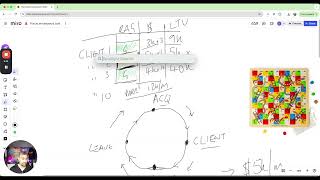

AI BUILDS FACEBOOK AD CAMPAIGNS 10x FASTER (Real Account Walkthrough) - The BPM Method

I Built a $1,000 Ad Landing Page in 10 Minutes Using AI (PRINT Money Using This)
60 Meta Ads Created & LAUNCHED in under 15 Minutes (Without Touching Ads Manager!)