How Depesh Mandalia Scaled from $800K to $26M with Facebook Ads*
Depesh Mandalia scaled a personalized children's book business from $800K to $26M using Facebook ads, conversion rate optimization, and strategic reinvestment. He shares how understanding customer psychology, thumb-stopping creative, and building AI-assisted buying tools drove growth across multiple e-commerce brands.
Questions this video answers
From about $800,000 to roughly $26.5 million (over ~18 months; breakthrough year noted as 2014).
1998.
Around 2013–2014 (consulting started ~2013/2014).
SM Commerce.
At peak he mentions running ~£250,000 (or $250k) in a day across accounts in November (year around 2014); the agency managed up to ~2–2.5 million in ad spend in a month (≈25M/year).
Chapters
Welcome back to the unofficial Shopify podcast. I'm your host, Kurt Elster.
Jack Nasty.
And joining me today is Dipesh Mandalia, who is a Facebook ads expert. There are many, but this particular ads expert has 20 years of E commerce experience and has done quite a job scaling. He scaled a company from 800,000 to 26 and a half million in 18 months and started an agency that's handled 100 million in client revenue and came highly recommended from a previous guest, Greg from Empire Flippers, who taught us about selling businesses. And so I take those recommendations seriously. Reached out and talked to Dipesh and I said, I gotta have you on my podcast. What do I gotta do? And luckily for all of us, he said, yes, sir. Welcome to the show. How you doing?
Yeah, very good. Thanks for having me.
Let's start off. You've been doing this a long time. How did, how did you get into this industry? What are you doing here? How'd you start?
Prior to joining online marketing? 20 years ago, I went into software development. So I built my first website in 1998. So I'm dating myself here and I enjoyed that experience. And then I got into kind of coding and backend and front end and all that kind of stuff. In 2003, no, 2005, a job came up and it said website project manager. So I applied for it, thinking, I know a bit of project management, I know a bit about websites. Let's see, see what happens. And the long and short is the website project manager was managing content management system, cms, managing landing pages, managing on site SEO, search engine optimization and analytics. So that was my first kind of entry point into the world of online marketing, really kind of getting deep into it and then everything just, you know, blew up from there.
And so, I mean, good timing. What year was that when you. And how did you get involved with. With clients? Like, when did you start consulting on. On Facebook ads?
Yeah, so that started consulting started around 20. Trying to think now, 2013, 2014, give or take. And it was an unfortunate turn of fortunate events that led. Led me there. So 2009, I was made redundant from that role in that hotel company.
The world was under recession in 2009.
Yeah, all the crazy stuff was going on in the world, so like, half the team will let go. And it was through that that I kind of decided, I don't like this experience of relying on an employer and, you know, doing really well. We'd grown the revenues massively, but then like, just like that, your job's gone. And that felt so Uncomfortable. So I started to do some freelancing, some contracting work, and I enjoyed it. And I enjoyed the fact that I could do three months here, six months here, pick up this experience, work with this company, go somewhere else. And then eventually, as I started to learn about Facebook ads, I started to go deeper into that world as well.
And you had a background in CRO and SEO. Do you think that changed your approach.
To Facebook ads 100%? Yeah, because that was my starting point. So some people come into it from, hey, I've done Google Ads and now I'm learning Facebook. Some people are offline advertisers and they go online. For me, my starting point was conversion rate optimization. So that stuff at the heart part of everything I've done, whether it's been Facebook ads or Google Ads, I've run TV ads, I've done print advertising, everything for me has run off of conversion rate optimization and learning for the. From the likes of Claude C. Hopkins. Like, I think his book was one of the first I. I read on scientific advertising, written like 100 years ago or whenever it was. But the principles are still sound today. It doesn't matter how you're selling. The. The principles are still there on split testing on human behavior and psychology. Even back then, he was doing split testing using coupons. So you push one print ad with one coupon, another print ad with another coupon, and ask the stores to tally up which coupon work best. So 100 years ago, they were thinking about this kind of concept for us. It's now easier to do split testing, but the principles are still the same.
Who was this that did this, that wrote this book? What was the book?
Scientific Advertising.
All right, I'll make sure to add that one to the show notes and check it out.
Absolutely.
And did I hear that you had a background in affiliate marketing as well?
Well, that came in 2009 when I lost my job. I couldn't find one for three months because all of a sudden half of the UK was in redundancy. So every job I'd go for, first of all, there's like over 100 applicants. And secondly, everyone's having to drop their salary expectations because they're just desperate for a job. And that's what led me to how can I make money online? So everyone's got their own story of how they did that first search, and that led me to affiliate marketing. So I knew SEO. I was learning WordPress, and I put the two together and made money through SEO and kind of using the blog format of WordPress to generate traffic. And I actually grew that. We hit a million in sales for our affiliate partners by 2012. And at that point I was ready to ditch my contracting work and go full time into affiliate marketing. But also in 2012, Google changed the rules and I didn't realize what was going on. So there's an update called Penguin, another one called Panda, they changed the algorithms and we went from tens of thousands of visits every month to zero. It was like a flat line. So if you imagine, you know the beats, we were dead. And I didn't know what to do because all of a sudden I was relying on all this free traffic because I knew how to work the SEO system and I had nothing. So we had generated good money from affiliate marketing, but now I had no business. And that's what led me into Facebook advertising because I needed another platform. So it's like, how can we get traffic? I tried Google Ads, but it was too expensive for me to bid on the keywords I needed to. We fell into Facebook. I didn't make any money, but I found a new platform and I went deeper into it as well.
So tell me about your first big bait. Tell me about your first big breakthrough with Facebook ads.
Yeah, that was 2014. So 2012 to 2014, I wasted a lot of my own money and I didn't make any money on Facebook. So 2014, a guy reached out on LinkedIn. He said, hey, I've seen your background. We need some help with CRO, some traffic stuff. We sell children's book. We can sell it through our affiliates. Affiliates are selling it really well, but we'd love to see what you could do for us. And I remember at the time I was in between contracts and he made an offer of something like it was like 150, 150 pounds a day or something really low. And I looked at that and thought, I can get three to four times that just based on my experience. But at the same time, there's something about this where I thought there's an opportunity to learn as well. So I said, look, I'll help you out for a few weeks. And when I met the team and I got deeper into it, I really, really enjoyed it. So I worked with them for about four to six weeks initially. In that time I did get a full time job offer somewhere else. But in that time I saw that they had something working on Facebook. And what that, what I mean by that is they'd spend a thousand and maybe make 800 back, maybe they'd spend 2000 and make 1500 bucks. So they were making sales more than I was doing before. And my start point was actually I didn't touch the ads so much. I did work on conversion rates, so landing page and funnel and cart and things like that. And I started to see an improvement. Then I thought, right, what's actually working on Facebook? So I started to look at campaigns and setups and stuff. It was a bit of a mess. And I think it was May of that year we managed to spend a thousand and make 5,000 back. And that was like a mind blowing thing for me at the time, for them as well. Just to prove that you could get $5 back or £5 back for every pound you put in. And, and then, you know, you just took off from that.
So is that like the moment where you realize that this strategy works?
Absolutely, absolutely. And, and very quickly, I think the next month we went to, we went and spent 10k, made 50k back. So it was, we'd proven we could make money and then we proved we could actually scale it. And, and those two things just, you know, helped us to take it to those crazy numbers 18 months later.
And this product was a children's book, Children's personalized book.
It retailed for 20 pounds, about $26 at the time. And it was a very hard proposition to get across because you had to key in your child's name, let's say John or Jonathan, whatever it is. Then the book would be customized based on the letters of their name. So the story is different for everyone. But at the same time, it was an amazing experience for a child. And we had to get that proposition across in the small ad on Facebook and get that whole process across on the landing page. So it wasn't an easy thing to explain. But the breakthrough for us was actually when we managed to increase our average order values because we talked more about gifting. Now one of the things I talk to E. Comm. Stall sellers all the time is speak to your customers and find out what, where that product is placed in their life. So for example, we did some outreach to our customers. We had our customer service people go out and call up our customers and say, what made you buy this book? What other things were you considering? What ultimately made you choose this? So those kind of questions, and more often than not, people were gifting the book to other children. So as parents, we were targeting parents, but they weren't necessarily buying it for their kids. They just saw it as a great gift idea for another kid, for a birthday party, for Christmas, for Whatever it was. And then we realized we were talking to parents about their kids, but we weren't talking to gifters. Now all of a sudden, when you talk about the gifting market, it's parents, but it's grandparents, it's uncles, it's aunts. It's like all of a sudden there's a whole massive new demographic that we didn't even think about. And that helped us to tap into a whole new level of growth for the business as well.
What's interesting is your success with Facebook ads. You're like, hey, we started with optimizing the funnel so CRO work on site work. And we needed to understand why our customers buy. We need to understand who they buy. You wanted to know that that audience and customer psychology, that's very interesting. That's quite a different approach than like, I'm going to make a bunch of ads and see which ones work and just go through that.
And the funny thing is when I started looking at their ads like the very first, and this is in the book I'm writing on, kind of how I learned how Facebook works. When I looked at their winning ad, it was written in a style that I felt was very amateur. And it was like, so the company's name was lost my name. So the text was something like, hey, we lost my name. We've created a new book. We think it'd be cool for you to have a look. And it just felt very tame. It wasn't because I come into this as a CRO conversion rate optimized based copywriter. So for me, I'm thinking about every word matters and, you know, structure psychologically and all that kind of stuff. So when I tried to compete with that ad, it wouldn't work. And I couldn't figure it out until I realized that ad felt so natural in the newsfeed for Facebook because when I was writing ad copy, it felt like sales copy, whereas the way this customer service person actually wrote this, she wrote it in a style that you'd write to your friend. And that's how Facebook works. And then I started to flow with that and I realized where I was going wrong and where I needed to act a bit more friendlier, like I'm writing to a friend and things like that. And that made a huge difference.
You. Yeah. Your approach to it wasn't wrong, but it read as sales copy versus this other method which felt wrong but wasn't, was based, felt natural in its context. It felt native to a Facebook feed and in that way made it disarming. Where you went. You actually read it and went, well, maybe this is interesting to me as opposed to just skipping over it because you registered it as an ad. Interesting. The. So you helped when you helped scale. Lost my name. Where did, where'd you peek at? Facebook ad spend. Because you what you said, you know, spend a thousand, make five thousand clear.
Like, yeah, so that sky's the limit.
Keep going.
Absolutely. And in 2014 we ended at $8 million. So for us it was just phenomenal that in 2013 the company made 800,000 and we 10x that in the period of 12 months. And I'd only been working with them since April, May of that year. So that, that scaling was phenomenal. Now at that time I think we were spending maybe give or take 4 or 5k a day on ad spend. And I thought like I was one of the biggest ad spenders out there. Like, it felt a wild number. Now coming into 2015, we then started to translate the books into German, into French, into Spanish. So we're now tapping into non English speaking markets and we needed to expand our team. So it was around March, April of 2015, I was hiring for media buyers to join my team. One media buyer. So at that point we're spending 10k a day. So there's me thinking I'm a high flyer. Like, I can't imagine you can spend more than 10k a day on Facebook ads. I interviewed a guy from a company called King. King are a gaming company that own games such as Candy Crush, which a lot of people know. And as he was talking about. So you know, I was interviewing him and saying, and I said, you know, what's your experience with ad spend? How much ad spend have you managed? He goes, well, the team we're part of, we spend about half a million a day on Facebook data on Facebook ads. Whoa. And I had to just stop and ask him, 500,000 a day on Facebook ads. And he goes, give or take is up or down based on performance. I'm like, I just couldn't get my head around it. Like, here's me at 10,000 a day thinking I've capped Facebook. I can't imagine spending more than that. This guy comes into an interview and just blows me out the water. And that really, that was on my mind. I couldn't get my head around this thing. So from the period of May to September or October, because Q4 being our biggest selling period is for many e commerce stores, it was just stuck in my head, how do I get more than 10k of ad spend a day. We did manage to scale it and we got it to 20k, to 30k, to 50k. And it was a scary time because if you imagine spending even $50 a day, spending $500 day, whatever it is, every change you make, positive or negative, has an impact. So you might gain an extra $50 of revenue or lose $50. That gets amplified because now you're spending 50,000 a day. A change, good or bad, could cost you 5 or 10k in revenue a day. And that's. That's a big, scary thing for me as, you know, as a marketer, that I'm responsible for that for the company. And it was, you know, you start to maybe think about things differently. And it occupied my mind 24 7. Now, going into October of that year, we did continue scaling, and I think in November, we hit about 250,000 in a day on Facebook ads. And we were running in. We were running maybe five or six different ad accounts. I had four or five media buyers helping me. We were. I think at that time, we've done some analysis, and we'd sold to almost every company country on the earth. Every country we could deliver to. It was literally a wild experience. Majority was. Our top markets were uk, Canada, Germany and us, the four big markets. But we were literally selling everywhere and anywhere. And it was just at that point, I was working seven days a week because you cannot manage that kind of budget and take weekend weekends off. Like, you just. You just can't. So it was super stressful. It wasn't a fun experience. I don't think we had the proper systems in place because I'd never done that before. And I like, who do you turn to to go, hey, I need some advice on how you spend 200. Even Facebook couldn't help me. And I'd ask them and say, can you tap into, you know, what should I be doing? And they're like, well, here's some advice and here's some things and stuff like that. But yeah, it was. Looking back, it was a great experience, but it was also really stressful.
I'm glad you mentioned just the reality of the stress of that. Friends, of course, with other Facebook marketers as well, people in the same position where they're marketing managers for clients. And there is no group of people in our space more stressed out than the Facebook marketers. I mean, there's. I don't. You're like, I was losing sleep. I'm working 247 working. That's a lot of them. And it just Seems brutal.
Absolutely. And you know, when I made that transition into the world of agency, that became amplified because now where I was contracting, for example, for lost my name, it was me working for one client and managing their ads and scaling and, you know, doing crazy stuff. Then you have two clients, then you have three, then you have 10, then you have 15 clients. Essentially your responsibility is 80, 90% of the that that business owner's success. Because for us, we were a Facebook ads. Well, we are a Facebook ads, primarily Facebook ads agency. The companies that come to us are also spending 80, 90% of their budget on Facebook. So therefore, whether we're spending a hundred dollars a day or $10,000 a day, we're taking a huge responsibility for growing that company. And I think that's one of the major stresses for when you are in the client services game that you're taking on your client's burden as well. Because that store owner, for example, is relying on you to not only look after their cash, it's not my money is their money, but to also grow it. So you're like an investment manager, like a fund manager. You have to make sure you're making the right decisions on where that money goes. All the things that you do. It is. And by the way, in 2007 I studied the kind of forex markets because I was doing currency exchange and I was learning how to do trading and a lot of that went into Facebook. In, in terms of learning how trading works is very similar to how the auction works. So for example, in trading, if there's you know, a major update, let's say in a few weeks time, presidential elections, it has an impact on economies and stuff like that that plays into the foreign exchange markets. So you have to be able to read the markets and understand what investments to make and when to pull back. Same thing happens with Facebook. So let's say we're entering Q4. We all know the costs go up, competition goes up, but there's more ad inventory because a lot more people are looking to buy. So you have to look at all these signals and decide, how do I spend, where do I spend? For example, our Q4 strategy starts in August. We start in August with our planning. We start with promotions, audience building, list building, seeding into September and October so that we can have the biggest success in November. So all those kind of things play into those kind of huge spends and huge revenues as well.
And all right, what, I should have mentioned it or asked, what's the name of your agency?
SM Commerce.
Okay. And you're managing 100 million in ad spend. Knowing what you know now, what's your approach to handling those large ad accounts?
Yes, I mean so the most we've managed in a month is about two, two and a half million. So it's about 25 million give or take in ad spend a year. I think maybe we picked at 50 million. The only thing I'd say is ads management becomes easier the more you spend. So when we were managing clients, when we first started off and we were managing clients at $100 a day, thousand dollars, there's a lot more variance there. Because you don't have a proven offer, your funnels are not stable. There's so much work needing to be done on construction as you start to spend 10,000 a day and 20, 20,000 a day, you've got proven offer, your funnels are working conversion rates good at that stage, you're spending more time on creatives and offers and therefore it's actually easier to manage. So for the first 12 months of our agency life, we struggled with stability of our own systems once we'd built those and built repeatable processes that we can farm off to the teams. That's when we started to find ads management easier and also managed to find out our niche in the market as well. Because not every agency is the same. We realized that our strength is working with seven figure ecom agent businesses and growing them to eight figures. Like that was our niche. That right there. And you know, if clients, if prospects came to us and said hey, we've got this idea for an E comm store, we could do it. But we weren't. It wasn't our forte. We didn't enjoy it. It wasn't. There's a lot more stress and other people can handle that. The ones that are beyond 8, like the beyond 10 million for example, they need something else because if you're at the 10 million mark and you're approaching an agency, usually you've got an agency you're looking to replace or a team that needs help. We actually built different services for them. We built consulting services where we would bring in the power of the agency but we would support an in house team. So we started to learn how the ecom growth model looked and where our place was and started to offer different services based on that as well.
What are some of those services?
Yeah, so like for example, when. So a lot of the Ecom store founders that were hitting seven figures, these were people that were learning Facebook ads doing it themselves had taken a course. Maybe mine or someone else's and they had success but they didn't know how or why. So for example, one of the clients that joined us in 2018, he'd been studying my material for six, seven months before he'd hit a million dollars. But he didn't understand why and how it was working. So when I looked at or when the team looked at his ad account at the time it was a complete mess and all the best practices and stuff, nothing was in play there. So I looked at this and said, well, if he's doing a million without doing some of the fundamentals, this is going to be great for us. At the same time, why was he successful in the same way as Lost My Name, he was writing ad copy that really connected with his prospects. His Shopify store sold the proposition really well. So he did some of the harder parts which we found other clients were struggling out. For us, the easy part is coming in and fixing your ad account like that's bread and butter. Getting a good offer and messaging and template for your product page and things like that, that takes a bit more time. He fixed all of that. So then we came in and I think by 2021 we'd scaled him to, well scaled the business to over 10 million. But the fundamentals were there and I think we found that we looked at that kind of customer and said we want more of those. So you know, econ founders that have maybe one person helping them, small team that grown to high six figures or seven figures that were ready now to pass the baton on to further grow now for example with that company, when they got to about 3, 4 or 5 million by that time would actually help them hire an in house media buyer, train her up and support her. And she took on all the ads and very quickly she was managing 10k a day in ad spend. And although they didn't need us to run the ads, they still needed our brainpower on strategy and growth. So our role evolved. So it was less running the ads day to day. It was, here are the next three moves to make. We're working with logistics on the orderings for Q4, working on growth strategy on brand, how to get more traffic sources. So we realized that our, our own growth as an agency can complement the growth of the clients. So it wasn't a case of, you know, this client's going to ditch us in six months because they don't need us anymore. It was okay, they don't need us anymore. How else can we add value? So for those companies we consult, we provide strategic growth Insights, we do analysis from our perspective. I've got a community of over 20,000 people. I've got clients. I'm learning from all of those and bringing them to this particular client. So that's valuable for them as well. So we realize there's different parts where we can service. And for those people that had new stores or weren't really up to speed on Facebook, we created standalone courses for them. So the idea was we can help people at every, every level and hopefully if they make money, they're ready for the agency and then we can help them further, further along, down the line as well.
It's a great approach to expect like an agency or professional services business because you don't really have to hard sell. You don't necessarily have to do cold outreach. You are giving, you're like, we know who we can help and we're giving them the resources to assist them. Yeah, it's take it or leave it. But that high pressure sales goes away when you structure things around education and around understanding the customer and helping them.
Absolutely.
So in your experience and that coaching and agency work, what are the common mistakes you keep seeing over and over again?
I think it's one of the things that you mentioned early on where you said, for example, we came in and fixed the conversion rate. The funnel we worked on, aov, for example. I think people hack Facebook ads too much and they expect too much of Facebook as well. So it's like, should I run three campaigns, Should I run campaign budgets? Should I do ad set budgets, Should I do manual bid, Do I do image versus video? And that they're so fixated on the Facebook platform that I would argue 8 or 9 out of 10 prospects that come to us and say we need to help with Facebook ads. Facebook is not the problem. It's your offer, it's your funnel, it's your landing page, it's your proposition, your messaging, your avatar. The things that maybe people don't think about and certainly Facebook don't help you to think about are generally the problems. So even talk about Avatar. We had a, a guy come to us, he was selling some kind of keep fit thing. It was like build your abs and all that kind of stuff. And he was, his, his ad was something along the lines of buy this product limited, start, get x percent off. And that was his thing. And there was just some images and videos. And I said, you're appealing to people that already know what the product is and already know what the solution is. So you think about Maslow's not Eugene Schwarz's stages of awareness. So at the very top you have people who are not aware of problem or solution or anything like that. They're just in the market. They can be influenced but it's harder. So for example, if someone's got it in the back of their mind, I'd like a new tv. They're not looking for it, they haven't researched it or anything like that. So it's going to be, you can tap into that market but it's going to be harder. Then you've got people who are my TVs on the blink now I need to get a new tv. They haven't researched but they're in that mind frame that I do want to find out more. Then you've got people who have actually actively searched for a TV but don't really know what one they want. So maybe they have an idea of the size. I know I want a 42 HTV. I don't know the difference between LCD and LED and all these kind of things. Then you have the market that are super aware. So they know they want the Sony, they know they want the 42 inch, they want all the digital programming. So there are all the different levels of awareness. And the problem is an ad that, you know, talks about a discount and talks about limited stock and doesn't really explain anything else. That's the very bottom of that triangle. So at the very top you've got lots of people. At the very bottom you've got a few people. And if you're playing there, you're competing on cost and you're competing with everyone because they're the low hanging fruit, they're the people that are ready to buy, everyone wants them to. How do you step up? So then when we started to look at who they're targeting and their prospects and stuff, we said, well, okay, we're coming into summer. If people are going on holiday, what do they want? They will look great on the beach for their partner, for someone else or whatever it is for their incumbents. Let's talk about that. Let's talk about Beachbody. Let's talk about how this product's going to help you get that Beachbody. And you know, it came with a 90 day trial. For example. Let's talk about, you can do this. Get the 90 day trial, get the video series, give them value, give them a reason to want the product beyond just the price and the fact that there's limited stock. So now all of a sudden you change the game and you're playing a Different game to what everyone else is trying to do on Facebook, which is you're not selling the product and saying, hey, this is good to build your apps. Why do you want to build those apps? Let's go a step further and you go deeper into funny out there needs and desires and you can actually start to convert more people and increase your margin as well.
What's so clever here is there are so many levers and knobs to, to mess with in Facebook ads and everything you talked about goes back to customer psychology. Where are they in that, that decision funnel of making a purchase decision. And that's just so important to understand. And I think that's the thing that separates someone who may have, who's read a lot on the topic and like really tried to educate themselves versus just like I'm going to dive in and try and figure out Facebook ads and then wonder, okay, why can't I scale these?
And that was me in 2012. So when I first started with Facebook, we've all been there, we've all been there and I'd already done some Google Ads for the company I was at before. So I came into Facebook thinking if I can get the lowest cost per click and I can get a low, a high click through rate, then I'm going to be, you know, doing amazing. And that's what I focused on. So I was really heavy into the Facebook ads platform trying to get low costs and doing lots of tests and throwing lots of things at ads manager and nothing worked. I lost thousands of thousands of dollars trying to figure it out. Until a few years later I realized it's not about me. It's not about the ads platform, it's about the prospect. How do I get deeper into their mind and how do I convince them that I've got something worthy for them? And, and that's why I went deeper into the psychology. So think about Maslow's hierarchy of needs. It's another model I use which is if you think about the lowest level of Maslow's hierarchy is the human basic needs. So sleep, drink, eat, things like that. If you're explaining a product that's related to eating or sleeping or drinking, you don't have to explain why you need to sleep, why you need to eat, why you need to drink. That's, that's common knowledge for every human on earth. But you do have to explain why your product related to that is different to someone else's. So if I'm selling water, for example, very hard to sell water. However, if you've got a mechanism that you can tap into. Now the made up example I use is imagine there's a water that supports ketosis. So let's say you're on a low carb diet, you want to do keto and all that kind of stuff. Let's say there was a water that enhanced your ketosis so you could work on your physical conditioning and stuff like that. Now all of a sudden I have an edge. So I'm selling water at the end of the day, but now I've got a different edge if I'm selling something at the top of Maslow's hierarchy of needs. They're things where people want to be inspired, they want to inspire others, they want to be creative. Think about selling things around mindfulness. So when someone's selling, let's say a mindfulness course or you know, the rock lamps, I think I've got one of those rock lamps up there. I didn't turn it on. I forgot. There are things that people talk about, can help you feel better, feel more energetic. Energetic, feel more positive. You need to explain why that's relevant because water you need to survive. But why do I need to be, why do I need mindfulness? Now if you talk about entrepreneurs and the stress of running Facebook ads and the stress of running e commerce, now all of a sudden you can tap into mindfulness. So it's just finding those edges as you're trying to advertise that makes the biggest difference. Focusing on that. If you did 80% of your time focusing on the psychology, the placement of your product, how it solves a problem, and then just 20% on ads, you'll be hugely successful.
And you know, the one thing we haven't discussed here is ad creative. Right. I don't think it's come up creative. Feels like that's, that's such a crucial element of this. How do you approach creative development or what's your advice for us and how we should be doing it?
Absolutely. So I remember I ran a survey back in 2015 and we selected a group of customers that bought through Facebook. We've been tracking through Google tracking. And we sent them an email and said, here's a set of ads that we run on Facebook. You may have clicked through one of them, you may have seen something similar. Can you tell us what made you stop to take note of the ad and then what made you click the ad? Because what I wanted to find out is beyond just split testing and seeing what worked. What was it about the ad creative itself that kind of resonated I think like 93, 94% of people said the visual made them stop and take notice. Then the rest of them said it was the copy below the image. So that is the headline image or the headline text below the image or the video. And then the rest said they just read the copy and then decided they would click. Now what we kind of gathered from that was when we come up with our creative testing number one is how do we get them to stop in the newsfeed. So Facebook call this thumb stopping content, the thumb stopping, all types of techniques. You can use different colors, different ways of standing out. You can use humor, you can use unexpected creative things like that. So we spend a lot of time thinking about that, but in context of our avatar. Then we think about the headline. So the headline that appears below and then we work focus on the first few lines of the main body copy. Now when we do our testing, we test heavily on the creative first and not the copy. Because if no one clicks the read more to expand down the, you know, short or long copy you've written, then it might as well not exist. So the first step is, and this is our testing process, what creative is going to stand out? How can we do something unexpected? I'll give you an example. We launched an ebook for our business earlier this year. One of the creatives we just launched as a test has a picture of the book and a 1 out of 5 star review with a big quote that says, this book is so grammatically poor because it's a funny refund request we got back, which was the material looks okay, but the grammar's terrible. So I want a refund. And I'm like, you know, we're teaching Facebook ads and you know, that's irrelevant if you feel like the grammar is so bad that you don't want to go through the Facebook ads training, that's not on us. And so what I wrote in the ad copy was, and the copy says something like, I didn't really do well at school because I didn't, you know, English wasn't great, but I am a good copywriter and I put that in there. I said, somehow my copies help to make $100 million my clients. And that's what I packed into this e book. So if you care about grammar, ignore this ad. If grammar's okay, go and, you know, buy this book or whatever. So like that creative did really well to get click through rate and get attention because now we're using a negative reviewer in a positive way. So it's Just thinking about things like.
That as well, you know, it's unexpected. And also I sincerely doubt the grammar was that bad.
I don't think it was that bad. But I mean some people are. Yeah. Different.
Well, I think they had had a bad day.
Absolutely.
So. But what you did with it was very clever. And so with. Well, you've done this long term. And so I want to know what is the. Some of the core differences you see between brands that thrive long term and the ones that don't?
I think a big part of it is how they're reinvesting in their growth. So at every stage of business, any business, but especially for E Comm, I see this a lot as well. You get to a stage where you're now making some money and you have to make decisions on how you're going to grow now. So a lot of the E Comm store owners, when they're starting off, they're take. They're wearing many hats. Some people focus more heavily on products and fulfillment and things like that. Others will focus a lot more on marketing. Whatever it is, at some point you need to let those hats go and you need to prioritize those hats as well. So for example, we had a client that joined us also in 2018. He was wearing a lot of the hats, but the hat he held onto was the ads, the marketing. Because he'd grown his business, it was a skiwear company and product fulfillment, customer service wasn't his thing. So they're the things that he started to outsource. Took his company to about 2 million a year in revenue, but he held onto the marketing. However, he realized he was a bottleneck because he couldn't grow it any further. They were just plateauing at 2 million a year. For a lot of people that's great. But he wanted to grow. He wanted to actually step out of the day to day running of the business and he wanted to expand his product line and do more. That's when he approached us. We took on the advertising and you know, we. That was another amazing scaling story where they were on 2 million a year. We hit 16 million in revenue in five months. Now what he brought to us was an amazing product, amazing funnel and things like that. We did some magic in the Facebook ads account on a product and offer that was doing really well. The extra money that came in, he reinvested it into future growth. He actually built his own internal team, built translated websites, developed a new product portfolio. He kept reinvesting it. So he was a model example of doing things the right thing at the right time and letting go of things and developing and growing. Whereas I see a lot of other people there. Some people come into it scared like they've never done, never done this e comm thing before. Now they're making 20k a month. Now they're making 30k a month. They want to take profits out. They want to go and buy a car now they want to go and go on that holiday now, which is fine. Like, I'm not here to say how people should run their life, but if you're serious about business growth, and I went through this myself, you really have to think about where your money's going. For the first 12 months of my agency, I didn't take any income from it. It's not that I didn't need it, it's just that I felt that my business needed it more than me. I needed help, I needed to invest in the growth of the business. And therefore, me taking a salary out would have meant I can't hire another person or two people or I can't go and do this or do that. They're the decisions I think some business owners struggle with and a lot of them just don't have the support and advice they need as well.
No. Yeah. Well. And it's tough when the, the flip side to being your, your, your own. The flip side to being your own boss is you don't have. You're making all the decisions, you know, who do you have to talk to, who do you have to bounce ideas off of? Right. That, especially like as a solo founder, that just compounds it.
Absolutely. And by the way, on that note. Sorry.
Yeah, go ahead.
So. So on that note, because of that, in 2019, as my business started to grow, I reached out to an old friend of mine who I knew was a business coach and I said, look, this is where I'm at. I feel I need to be held accountable because the problem is as we start to grow our team. In 2019 and 2020, I became the go to person for every question, every major question in the business, but no one would question whatever I came up with. So it's like at the end of the day, I don't know if we're doing the right thing. It feels like the right thing, but no one's challenging me. So I felt like I needed someone to do that. And he became my mentor in the business Business mentor would meet weekly with, you know, chat on WhatsApp and stuff like that. He would challenge me and he'd make sure that I'M thinking about the different angles of my decision. So I'm like, I want to hire this person. It's going to cost 5k a month. We've got the money, we should do it. And he's like, but if you're spending 5k there, don't forget you're going to have to support them, train them. They're reporting to you now. Do you have the time? All right, yeah. I didn't really think about that. I'm quite stretched for time right now. But they're the things that I'd otherwise just go into because I felt like it was the right thing to do. And then actually a friend, another friend of mine, recommended I read a book called Rocket Fuel. Highly recommend for any business owner that, like me, is a bit of a maverick in the sense of you get an idea and you just want to do it and needs accountability. So what Rocket Fuel made me understand was there's the kind of creative leader in the business and then there's someone who needs to rein that person in and also make things happen. So the way they split the role is there's a visionary. Most business owners are visionaries. They know where they want to go. They have ideas for what they want to do, but they need an integrator. An integrator is generally an operations person. That led to me hiring an ops director for my own business. And she came from a much bigger business business doing 25 million a year. That's where I wanted to get to. So she would come into it and hold me accountable, but also support me in getting things done. Because delivery isn't my. My biggest strength when it comes to big business and stuff. Because I'm so caught up in new ideas. For me, it's fun. Let's launch this new thing. Let's go and do this new thing. Should hold me accountable and rein me in as well. So, for example, same scenario if I say, hey, we should go and hire this 5k person. Or for example, I think there was a project I wanted to run to develop our own software tool. And she goes, we can do that. The team have the capability. But if they're doing that, they're not doing this. Have you thought about this? I. Oh, I didn't. So she's now managing and tempering my expectations, still cares about the growth of the business, but is helping the team by me. Because the thing is, if I say, hey, team, we should do this thing, they'll be like, okay, the boss says we should do this thing. So definitely we need to do this thing. Not always the right thing. So building that accountability is really important. That's actually what led me to developing my own accountability for agency owners. So now I work with agency owners as their accountability partner in the same way because I feel like business owners need this kind of thing as well. So when my agency will come in and do coaching and consulting for E comm businesses, I personally do that for agencies as well so that I can hold them accountable just as I was. So they don't make the same mistakes as well.
Which do you find to be the most rewarding? Right. There's several things you're doing here with different audiences.
Yeah.
Essentially I just ask you, who's your favorite child?
Absolutely. So first of all, throughout this whole journey, the biggest thing I found is I love coaching, mentoring and teaching. I never knew I'd go into this, never even thought about it. I love working with business owners. Selling online and stuff is fine. We have our own e Comm store. We're not doing so much with it right now. We run ads on Facebook and we can acquire customers and do all that kind of stuff. The thing that brings me the most fulfillment is working with business owners directly. So whether it's E comm or agency owners, because it's a human to human relationship and you're influencing someone's life, you're having an impact on their future goals and where they're heading. And I can bring my learnings into it. You know, first 12 months of agency for me were not great. I can do well in terms of my own health, my own mental state, profits. It was all over the place. If I can help someone skip that, then great.
Isn't that just part. Don't we. We just really gloss over that part of the entrepreneurial journey or.
Absolutely.
We sugarcoat it. We're like, yeah, that's. You're just living the struggle. It's so great. Well, it is part of it. But also, if you could skip it, please do.
Absolutely.
I ate so much ramen well that.
For me it was chocolate. So. Yeah, I mean, whatever you're doing, there's going to be a net negative on things. Like when you spend so much time on the business and you stop exercising and you eat junk. It's a recipe for disaster.
Absolutely. Yeah. You gotta, no matter what, you got to prioritize your health best you can.
Absolutely.
Easier said than done, of course.
But.
So what's next for Depeche? What's. What's on your radar?
So for me, I'm focusing more on myself. And my time right now. So right now I work three to four days a week. Fridays, I'm generally offline. I'm doing work with AI. I'm heavily invested in learning AI. We have our own AI Media buying assistant. So what I've done with my agency, knowledge training, SOPS templates, we've fed all of that into the AI. And my goal is that this AI media buying assistant can take the, you know, the load off people that want to learn Facebook ads and get Facebook ads results. So I think there's a huge opportunity there and that's why we're trying to develop the tools for people to get a lower cost of entry into getting great Facebook ad results. Because for every new client we take on in the agency or coaching or anything like that, there's tens of thousands that need the help that can't afford us or don't have the means to access that level of support around the world. And probably hundreds of thousands. And that's who I want to help.
You know, I love it. Anything that democratizes the tools that makes lowers the barrier to entry, that makes these things more accessible to more entrepreneurs is a good thing. Depesh, where could we learn more about you?
So me personally depeche mandalia.com more about the business bpm method.com so brand driven marketing, that's the thing that I developed when I realized that I was a performance marketer. I was all about the numbers, the metrics, optimization, the funnels. It wasn't until I understood brand marketing that I started to make successes with Facebook. And that's where the BPM method idea came about, which is how do I take the best of brand marketing, understanding avatars and profiles and things and merge that the best of performance marketing. And that's been a big part of our development and growth.
Dipesh Mandalaya, thank you so much. This is really, I've enjoyed this.
More from Depesh
[Q&A] $4.3Million from $270k Ad Spend using The Ascension Path Model (APM) [AOA Podcast Part 2]
How I Made $4.3Million from $270k Ad Spend using The Ascension Path Model (APM) [AOA Podcast Part 1]
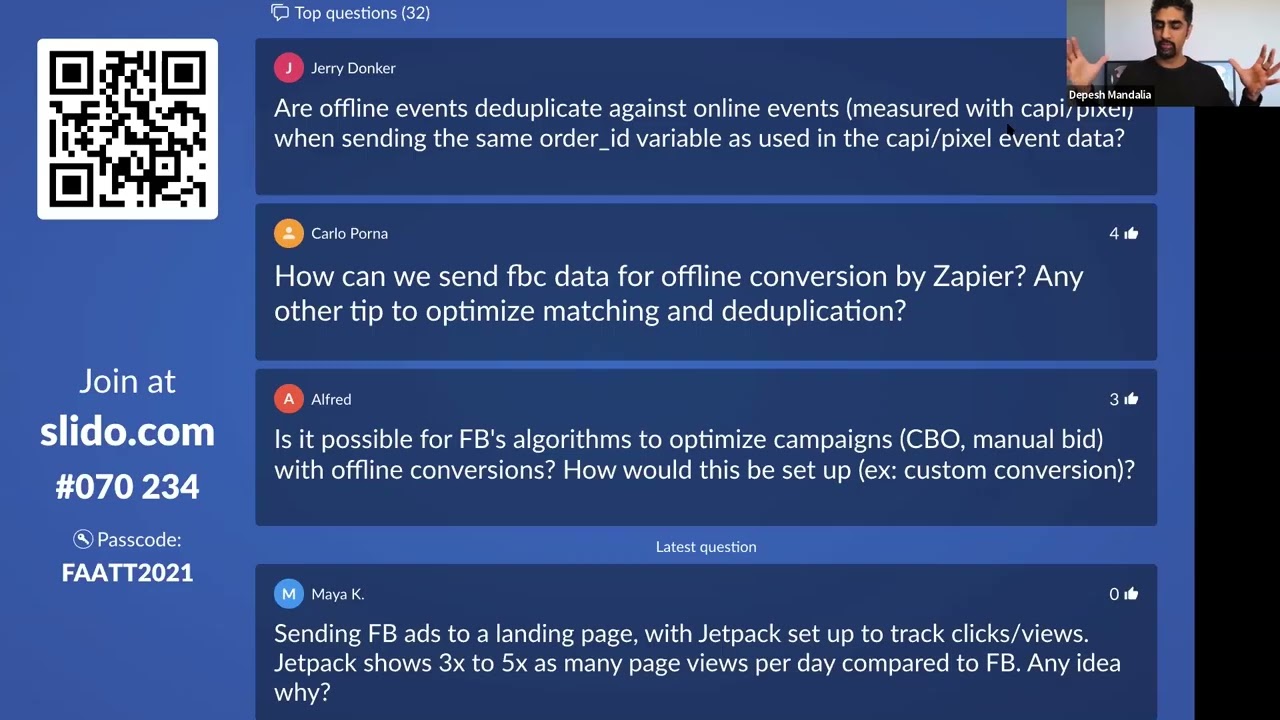
AI BUILDS FACEBOOK AD CAMPAIGNS 10x FASTER (Real Account Walkthrough) - The BPM Method
I Built a $1,000 Ad Landing Page in 10 Minutes Using AI (PRINT Money Using This)
60 Meta Ads Created & LAUNCHED in under 15 Minutes (Without Touching Ads Manager!)