Money Mindset Coach Workshop - Day 1
Emily Williams and Megan Huber teach coaches where money blocks come from: core beliefs, family patterns, society, and identity. They map six common blocks like scarcity and fear of success, then show how they show up in your client work around sales and retention.
Chapters
Great. Okay, you can start welcoming people. Hey, ladies. Welcome. We'll give it a quick minute. Is Coach Jill your friend at mari? Okay. Hi, Jill. Nice to connect with you again.
Hi.
Nice to see you. Nice to see you. Thanks for being here. And Blaze. Yeah, I'm excited. This is our favorite topic, so we'll dive in in just one second. Where are you located again, Jill?
I'm in Calgary, Alberta.
Amazing, Canada. And Blaze is here. Hi, Blaze. Nice to meet you. Natalie. Hello. Hi. Is it Natalie Fox?
Yes, it is.
Hi, Natalie. Welcome.
Thank you.
I'm excited. Okay, so I'm gonna go ahead and dive in just for the sake of time, because I know we have a hard stop on the hour and I love to respect everyone's time. So I'm going to share my screen here. Amazing. Okay, so this is the money mindset coach workshop. So we are going to be together over the next three days, one hour each day, and Megan and I are going to kind of co teach. I'm going to be leading this and I'm going to turn it over to her at some of the important parts that are really her mastery and just to get more of her input. And we'll introduce ourselves in just a second for those of you who are new to our world. But as you guys are jumping on, would love to hear a little bit more about where you're tuning in from. I'm also going to ask that you definitely are engaged and putting things in the chat, anything that resonates and lands for you throughout our time together, because that's super helpful for us and obviously just bring some amazing energy to the group. So thank you in advance for that. And we're just going to go ahead and dive right in. So I am Emily, Emily Williams, and I'm the founder of I Heart My Life. That's one of my brands, and I'm a money mindset expert. I've been featured in Forbes success, etc. I'm going to go a little bit more into my story in just a second, but I'm so excited to be here because this is truly one of my favorite topics and it was never part of the plan, which I'll tell you about more in a moment. But it's a topic that has completely transformed my life and something I've been talking about for the last 11 or so years. And I'm. I'm truly just so passionate about it and it will really change your life and your business, which is why I'm so happy that all of you are here and Megan, how about you? Why don't you introduce yourself and I'm going to go to your slide here so you can just share a little bit more about what you've been up to over the last few years.
Awesome. Thanks so much, Emily. It's so great to meet all of you. My name is Megan Huber. I live in Nashville and my claim to fame is that I'm a retention strategist. I've been in the coaching space for the last 15 years. Prior to that I was a business education high school teacher. And to be really honest, I learned how to do a lot of what I do today, teaching 16 year olds in a classroom because it is really, really similar. I have worked with thousands of mostly coaches and consultants at this point on the retention side, I have, I've worked with dozens of Companies from Low7 figures all the way up to $45 million in annual revenue and have completely helped people turn around their companies by helping them keep their clients longer. So I love that work. I love client success. I have a podcast called Built to last with over 250 episodes and yeah, I think that probably covers it.
Emily.
Amazing. And Megan and I actually met in 2014 when I was a part of the program that she was basically the director of. She was running the show, she helped create all of the content. And so when I started my business, I literally had no idea what I was doing. And so I jumped into this coaching program and thank goodness Megan was there and the other coach and I really learned how to build an online coaching business. And although I came for the strategy, the thing that really transformed everything for me was the mindset work, especially the money mindset pieces. And so I again hit the ground running in 2014, went from nothing all the way up to seven figures in my first 18 months. And over the last 11 years, I've worked with thousands of ambitious women all around the world, from entrepreneurs all the way up to multimillion dollar CEOs. I have a podcast just like Megan. It's called the I Heart My Life Show. I created signature money mindset program programs, in particular my I Heart Money program, which thousands of women have gone through over the last decade or so. I've spoken on stages about wealth and identity and like I said, I've been featured in some of the top publications, in particular, as you see here, money, which again was never part of the plan, but is a topic that I'm super passionate about. And for those of you who are kind of the OGs like Megan and myself in the coaching space. There was a point in time where women in particular didn't talk about money online. And so I remember being super nervous to even put out what I was making in my business. But I knew that I wanted to inspire people. I knew I wanted to show people what was possible, especially with this work in the coaching space, but it wasn't the norm. And so at very early on, I had to get used to talking about money and make it less taboo, not only for myself, but also for my community. And so we're going to talk a little bit about that today as well, because I know it can be a very charged topic, but that's one of the things I love about it, because when you're able to move through that, everything else is so much easier. So, again, we're so happy to have you guys here today. All right, so today is day one. Understanding what's beneath money resistance. And so, just so you understand, this is not a sales training. This is not about scripts or putting pressure on yourself or your clients. This is really about understanding what's actually happening when money feels charged, not just for you. Maybe, maybe you get a little sweaty in those sales conversations or when you're looking to renew somebody, or when you're telling somebody what your price is. It feels energetically charged, but it might also feel feel charged for your clients. So we're going to talk about that. So I want you to take what resonates, leave the rest as it is. With all of our trainings, this is meant to support you, and it's not one size fits all. You know your business, you know your clients, but we're going to give you some specific tools that will really help you and help you not just when you're selling, but also in the midst of delivering your coaching or consulting or whatever your practice is. And also with the piece that Megan teaches, which is around client retention. Okay? So all of those are super important. So this workshop is for coaches, mentors, and practitioners, people who already have money coming up in client work. Anyone who wants to feel more grounded and ethical leading money conversations. Like I said, this is not about scripts or putting pressure on anyone or talking anyone, anyone into things. It really is about being ethical in this work as well, which I think is really important to mention. And it's also for people who care about how decisions are made, not just if they're made. So you really want to support people in getting to their truth. All right, so let's get oriented before we dive into part one of this workshop again, I'D love to know a little bit more about all of you. You're welcome to type in the chat box. Or even better, if you're willing to open up your line, we'd love to know a little bit more about the work that you do and how money conversations are currently feeling for you. Again, whether that's in the sales conversations in the midst of your coaching containers or when people are renewing. So is anyone open to sharing? I'm gonna pull up the chat as well.
I don't really know what to share.
But I'll share a little bit.
Okay.
It's like I'm in between space of. I have multiple clients who just renew because they like what I have to offer, so it's not even really a conversation. And then a whoa. I need to find new and bigger, higher paying clients via like the corporate industry. And so learning right now how to shift from having a money conversation to an individual to having a money conversation to a corporation.
Great. Okay. Amazing. Thank you for sharing that. Awesome. Anyone else I can share? Great.
My name is Blaze and the kind of work that I do, I'm a coach. I'm an empowerment coach and somatic facilitator. And those two really go hand in hand in my container. And I would say one word for how it feels is. I mean, maybe it's two words just not happening in this moment. I feel like the conversations aren't really flowing in this moment. I've kind of been on a little bit of a hiatus with health stuff and feel like I've had this business in the back burner and had clients come and go, but I haven't had that consistency in a while. And I've like, that's what I'm looking to build and why I'm here.
Okay, great. Thank you. Anyone else? Feel free to put in the chat as well.
Hi, my name is.
Hi.
My video isn't working. I'm working on getting it fixed so I'll show up once it does. I'm a digital marketing strategist and a money mindset coach. And I love the topic that you're talking about today because I feel like this work is never done and I'm really looking forward to those pieces of like, mastering the thought process and the approach when it comes to the conversations and getting confident with presenting my offer. So that's what I'm doing here today.
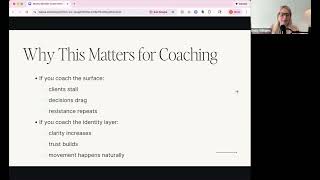
Thank you. Thanks, Natalie. Yeah, Natalie's one of our certified coaches. So excited she's here. Amazing. Okay, so I've been in every single scenario that you described. Like I said, I started my business from nothing, from my kitchen table. There was a period of time where I went through 54 no's in a row. So Megan saw that first. It was literally 54 people saying no to working with me on call after call after call. And what I ultimately realized was that I was uncomfortable talking about money. I didn't know how to have the sales conversation. And so that was coming across. And ultimately it was doing a disservice not only to myself and my business, but also to everyone on the phone, everyone I was coming in contact with. And so today we're going to talk about the different types of money blocks. And I didn't know all of this in that period. I just knew that I needed to get comfortable quickly and I did. But what I've done over the last 10 years is really observed the types of blocks that come up for people. And so I'm going to give you a little bit of education around that so you can identify what's actually happening. Because what I did learn during that time was that it's very rarely about the money. There's always something else going on beneath the surface. And so you get to become really masterful of about helping identify that, helping other people identify that for themselves so that they can actually move through it. Okay, I also want to mention here that not only did this work serve me as I was building my business and looking to make more money, there was a point in 2022 where I lost a lot of business and had something happen in particular in my company that was very challenging. And so I had to rebuild over the last three or four years. And this work has been so essential for me to never give up and to just keep moving forward and to tune in to what's aligned for me. And so I wanted to mention that because regardless of where you're at, again, whether you're new, whether you're seasoned, whether you're pivoting, reinventing, this work is very powerful across the board. Right. So like I said, the real issue that we want to talk about today is that money stuff that comes up is rarely about money. It's about safety, it's about identity, it's about self trust, it's about permission. And most coaches are trying to solve this basically at the surface. And they're essentially believing people when they say, I'd love to, but I can't afford it, or I'd love to, but my husband doesn't support me or whatever the excuse is. And what I realized very Quickly is that, again, it's not about the money. And in order to really serve our clients, we have to be willing to go a little bit deeper. Okay. And so we're not talking about getting more logical here. We're not talking about more information. We're not talking about putting more urgency into your offers. We're not talking about being someone who has a lot of pressure when it comes to making a decision. We're talking about getting to the root of what's actually coming up for your students so that you can help them move through that. Okay, so before we go any further, I want to talk about where money blocks actually form. So there's four different levels of money blocks, and I'm going to go through each of them, and you guys are going to get the replay of this. So you can obviously take notes if you desire to, but don't feel like you have to. All right, so the first type of money block is at the core level. So essentially, these are the early experiences that shape your money blueprint. So essentially, what you heard about money growing up, how money was talked about, or maybe it was completely avoided in the conversation with your family, what earned praise or approval. So, for example, many people are have the hard work wound, essentially, which basically means that they only believe they can make money and create wealth through hard work. And so maybe you were praised for that as being a hard worker in your family. Right. So even think about this for yourself, not even talking about the clients at the moment. What is coming up for you as you think about money blocked or money thought processes during your. Your childhood? Right. Because most of this is formed before the age of eight. And so it's what we hear from our family, what those core wounds actually are. And then oftentimes our clients mirror that, which is why I love to work with people on the client level, but also on the personal level. Okay, all right. Family level. So these are inherited belief systems. So these are essentially thought processes. And as it says here, belief systems that your family adopted as truth, that is true for family unit. Like, we believe that we're not those people who can get rich. We believe that money causes problems. We believe that you have to work hard to deserve it. We believe that, you know, our culture, in our culture, it's very challenging to create a lot of wealth. So again, for your family, was there like a family motto around money or lack thereof that you're still adhering to today that you know is not serving you? And again, we're talking about you as well as your clients? But we want to get clear on what is their family belief system that they're bringing to the conversation then societal level. So this is cultural or systemic conditioning. So what women are allowed to want guilt around earning or receiving fear of being too much? I mean, there's a lot of beliefs for us as women because we weren't allowed to do much until very recently. We weren't allowed to get a mortgage without permission. We weren't allowed to have credit cards, cards. And so this stuff runs really, really deep and we have to take a look at again for ourselves. Where are we adhering to these societal belief systems in a way that's not serving us? Maybe it's weird for you to think about making more money than your spouse. Right. These are just some examples. And you know, even for me, like I mentioned earlier, when I started talking about money, it was strange to see somebody online, a woman. I was in my 20s when I started my business talking about money. Now, you know, so many more women are actually talking about it, which is amazing. But there was a lot that came up for me personally that I got to work through around what it meant for me to be talking about money. And you know, there's still a lot for many of us around being good with money. We weren't taught that women do math, little things like that. It seems like they're, they're small, but they actually hold so much weight. Yeah. So Blaze said the last one on family level is part of my family belief system. Yeah, Amari, the economy is bad. I hear that one. So much people aren't spending. Exactly. Yeah. So it could be current day societal programming as well that's coming through and you might be hearing that on your sales calls. Well, no one's investing and you know, they might have a belief system. They might have family members who are literally telling them the economy is bad and hold on to your money and people are actually putting fear into them as well. Okay. And then ultimately money blocks form at the identity level. So this is really the most important. So this is the level of which you're the identity that you've adopted, that you believe is necessary in order to feel safe and loved. So maybe you're the caretaker in your family. Maybe you're the achiever, maybe you're the over giver, maybe you're the one that holds it all together. Who are you in your family unit and just as a person now, like who is your, who's the basis for the way that you show up and the way that you do life and Your business. And that will support you in understanding what is allowed for you in terms of finances. So let me give you an example. So maybe the caretaker, right, A lot of women are. Have that sort of identity around the caretaker. And so everyone else comes before them, that includes their clients. So they're not necessarily thinking about the money. They're thinking about, what can I do, what can I give, how can I show up more, how can I add in another bonus. And for many coaches, the idea of charging a lot of money feels really icky because they didn't get into their business to charge a lot of money. They want to help people, and for them, those two things don't go hand in hand. And so the identity of the caretaker overtakes the identity of the successful entrepreneur who knows, knows her money, knows what's coming in, going out, raises her prices, stands firm with what she offers, has boundaries, etc. Okay. And so this is really important to identify in your clients and be able to talk through and, you know, obviously share with them when it's the right time to do so, to be able to get clear on what's actually coming up for them. When they say, I'd love to, but I can't afford it, or when, you know, Megan and I talk about this a lot during the actual coaching. When, say you're a health coach and you recommend somebody invest fast and supplements, they say, oh, I'd love to, but I'm not, you know, I can't do it. I don't have the money. Right? Like, that's not a money issue. That's a worth issue. Okay. So there's more going on that meets the eye than meets the eye for all of these conversations. And that's why these blocks, understanding them are really. It's really, really important. Okay? So again, why this matters for coaching. So when we coach on the surface and we essentially take what our clients tell us at as truth, you know, I'll share something really quick before I dive into this slide. One of the things that really helped me was I just honestly stopped believing anything anyone was telling me, especially on sales calls. And I just came in with this belief that everyone has the money. And I had this little sort of metaphor or reminder for myself. I basically went in believing that everyone had a rich grandma. And for some people, that was their credit card. Some people it was their 401k. Some people, it literally was an inheritance that they got that some people had a spouse that they could borrow money from. But I literally just rewired my brain And I was like, you know what? I found the money for the thing I wanted to do, even though I was, you know, 30 grand in credit card debt, $90,000 in student loan debt when I started my business. And so I'm gonna believe that other people have the money as well. And so I want you to kind of make that switch in your mind. Like, if you literally believe that everyone has the money and can find the money, how would things change for you, even in your own life, if you believe that for yourself? Okay. And so I have that mindset when clients stall, when decisions drag, when resistance repeats. I believe, you know what? Like, this actually isn't about the money, because they have the money. There's something else going on there. And so my job is to get to the root of what that actually is. Okay. Because when we coach at a deeper level, like the identity layer. Right. Or the societal level, then they'll get clearer. There will be trust there because you've actually helped them. And then movement will happen more naturally. They'll see, oh, this is why I'm holding myself back. This is what's actually coming up. This is the truth of the situation. Because previously, at least for me, and, you know, would love to hear if anyone else has experienced this. When people told me, I'd love to, but I can't afford it, like, that was basically the end of the conversation. I didn't know what to say after that. It was like, okay, no problem. Bye. You know, I'm gonna respect that. I'm not gonn too deep, but I really, truly realized that I was doing them a disservice by not going deeper and not going below the surface and getting to the root of what was going on. Okay. So I want to open it up to the community to. To you guys here. And I'm curious to know, where do you currently see these patterns within yourself, and where do you see this with your clients? And before we do that, I'll give you guys a chance to think about this. Megan, I'd love to see where you see money patterns coming up, especially with the people you work with, because I know it's a pretty wide range of people from, you know, entrepreneurs all the way up to multimillion dollar, you know, CEOs. Yeah.
And don't think that even though someone's making 20, 30, or $40 million a year in their company that they don't have some sort of money block or money issue. I've seen it at every single level. I think at the higher levels, Emily, there's just a lot more money that they're dealing with. There's just a lot more pressure and a lot more responsibility. There's more team, but it's a lot of the same things, whether someone's making under $100,000 or they're making, like, $100 million. You know, most coaches don't realize that, you know, you talked a lot about identity. Most coaches don't realize that they're operating from an identity that pre decides their money outcomes. That's the key word. Pre decides their money outcomes. So, for example, I worked with a business coach who could not understand why she kept attracting clients who needed payment plans all the time. Like, nobody was paying in full payment plans. They were asking to do trades. They were asking for discounts, or they would totally disappear after the first call. And when we dug in, we found she was still holding the identity of the helper. The helper, the person in her family who was the rescuer, the hero. And she was rescuing everyone in her family financially. Her subconscious belief that was running the show in her business was, my value comes from being accessible and probably overly accessible and never making anyone uncomfortable. And if you resonate with that, I certainly resonate with the one of, like, oh, my gosh, you know, I don't want to be confrontational, because I think sometimes in conversations, whether it's a sales call, it's a coaching session, when someone comes with, like, a block or, you know, just a no, it's like, sometimes you'll feel it. Maybe you feel it in your stomach or you feel it in your chest. You're like. You almost, like, tense up, or it almost, like, takes your breath away, and you're like, okay, I don't want to, like, get in an argument here. I don't want to be wrong, or I don't want to push the person. If you have ever felt that way, like, raise your hand or put it in the chat, because I certainly did in conversation. So even though this particular client of mine wanted premium clients, her energy, her positioning, and her sales conversations were all broadcasting this message of, I'm here to make it easy for you, even at my own expense. And, Emily, I think that one is a really, really common, subconscious belief that is running the show. But what we tell ourselves on the surface, the conversation we're having with ourselves, it's a different conversation. So the clients that this particular client of mine was attracting weren't the problem. Her unexamined identity was really the problem. And once she shifted from the helper identity to the Trusted guide who holds standards. See the difference from the helper to the trusted guide who holds standards. Everything changed. She raised her rates, she stopped offering discounts and suddenly she was attracting clients who paid in full and showed up ready to work. Like ready to say yes. That is where the identity level work comes in. It's not about what you say in sales calls. It's not about following a special script that's going to work every single time. It's about who you believe you are when you're having those conversations, whether it's a sales conversation or it's coaching session. And here's the thing, most coaches are trying to fix their messaging. Constantly trying to fix their messaging or constantly trying to fix their offer or come up with with new offers are all the time. Maybe people will buy this. Maybe I need to change my rates. When the real issue is they haven't claimed the identity that matches the business that they say they want. So that, that is what I see over and over. And I've seen it over and over for the last 15 years, no matter how much money anybody's making.
Yeah. So good. I love that. And such a good reminder because it really starts with you and your clients are going to feed off of your energy and what you're projecting and what your belief system actually is. And that's why I was saying even that simp shift of believing that everyone has the money or access to it makes a huge difference. And I often ask my clients, I'm like, would you like me to get on a call and you know, completely buy your story of I don't have it. I'd love to, but I don't have it and just hang up the phone. Or would you like me to say, hey, do you want me to help you find the money? Right. And actually believe that you are capable? No one's going to say no to that. And that's actually what I started saying back in the day was helping people literally find the money and get creative with it. It everyone wants you to believe in them. They have more than enough people out there who don't believe in them. And so you getting to the place where you have an abundant mindset is very, very powerful. And like Megan saying, you have that identity of somebody who is a successful businesswoman, somebody who does have boundaries, someone who does, you know, they're, you're not over giving with every step, everything that you're putting out there. And so it's really important to identify, you know, where do you also get to shift and step in step into that strong identity as well. Let me go back to these questions. So let's see. Natalie, love that message. Megan, be the trusted guide who holds standards claim the identity of the coach you want to be. Okay. Beautiful. So we're going to do something really quick. We are going to. Let's see. Because we have time. I'm going to put you into breakout rooms because I want you to connect with each other and then you're going to come and report back. But I want you to answer these two questions and let me share my screen again. Where do you see these patterns with clients and where do you notice them in yourself? Okay, so we're talking about the different levels of money blocks. Where do you see them in yourself and where do you see them with your clients? And then you're going to come back and report to us and share what came up for you. We'll do about 10 minutes in the breakout room. So we're going to put you into groups of two here. Okay. Add a room. Okay. Sorry. I'm gonna add one more room here. There we go. We might need.
Cool.
Mario, are you cool to participate as well? Then we can have even rooms. Okay. All right, I'm going to open up the rooms for you guys and I'm going to time us at 10 minutes and we'll put the questions in the chat again if you forgot.
Okay.
The rooms are open. How is that for you ladies? Good. Cool.
It's always a good sign when people come back from a breakout room and there are smiles on face.
I know.
That's how you know is a good one. And are they smiling?
Yeah.
Cool. So we have one more group coming back, but we'll just go ahead and dive in real quick. So give me what was kind of the consensus, what came up for you and your group, Natalie or Jill?
Something that came up for me was that if somebody doesn't want to work with me, I go okay. And mainly because. Because I'm a tough coach and I want people that are all in on the stuff that I do. But through the conversation, I realized, like, well, maybe it's not just an okay. Maybe it's a let's help them understand why it's a no. Because then even if it's not necessarily me as their coach, it can give them some sort of tool or resource or direction to go and get help elsewhere outside of working with me for sure.
Yeah. And it's also good feedback for you to have. Have the data around why it's a no. And, you know, Maybe then you can see, like, there's a bunch of people coming from this area and they're not aligned for me. And so I'm going to shift my marketing or whatever in a different direction. Love that.
Yeah, that's great.
All right. How about you, Courtney? Were you with Blaze or Amari? You're with Admari? Yeah. What came up for you guys?
It was really good.
So I think both of us, this kind of took the spectrum of, like, ourselves meaning, like just that, you know, we have our own stories that we work through, and sometimes they still creep in, but it's the recognition of it is much quicker and that, you know, we don't spiral like we once would have. I think for clients, they're also similar as well. Like, you can just. Like she said, you can literally see their. Your body change when it's time for the investment. So it's like a worthiness standpoint. And I was sharing that because I'm in a business where it's technical skills. I think that worthiness comes into play because if they're not learning a new technical skill, they automatically assume this is just my view take on it. That they like that it's not a valid investment in themselves, if that makes sense. But we all know if you can't manage $5, you can't manage 5 million. So. So, you know, it's. It's a different type of skill that they need to learn and have never been taught.
And.
But I just don't think that they realize that it's so valuable that. And I don't think they want to go through the muck of it. Like, it's hard. Right. It's hard to face your stories and challenges and come through it, but.
So. Right. They'd rather stay on the surface. Got it. Thank you. Marin and Blaze, how about you?
I kind of talked about. Yeah. Starting with myself and realizing some of the things that Megan brought up felt very ring. Very true for me of not valuing my skills enough. And they're always being like, one more thing as a reason. I think since I've had such a hiatus in between clients that being like, oh, there's one more thing that I need to accomplish before doing that. Even know I have the website. I've coached a lot of people. I've been doing it for three years. But since there hasn't been that consistency, it's like I let those beliefs kind of go and get into that kind of helper mode when it is a no or a maybe of like, oh, well, maybe I can find a way to discount it, give them the payment plan, go through that. And I think it ultimately comes down to the practice. And then it also comes down of like having those conversations and then also the belief of, of not wanting to make other people uncomfortable, not wanting to put them in an awkward position and like having to sit with those feelings. And then ultimately too, not knowing some of those like, key points that you went through of being like, I know we're just on the surface here, but I don't even know how to get into the roots of this conversation because I don't know how to get into the roots with it of myself. And I feel like that's something I've been navigating. So I feel like it's starting to get easier. And then with clients it's usually, I, I mean, of course I can't afford it, I don't have the money, I need to talk to my partner. And from there kind of going like, okay, how do we, how do we even navigate this? Where do we go? And so often I find, because the work that I do kind of almost can come across, oftentimes people will be like, are you a therapist? Because of like my mental health journey and the things that I love to like, really touch on. And I'm like, no. And so oftentimes I'm working with people who are kind of navigating some mental health recovery or aren't in a position where they have a higher paying job. So it's like, okay, there's no way I can afford that. Instead of looking at it from a mindset of like, maybe you do have a rich grandma or credit card or a way to do this. So, yeah, that was something that came up.
Amazing. Thank you for sharing all that. Beautiful. So I'm going to share my screen again. I'm glad that that was supportive for all of you. And like I said, you'll have these, this replay to go back and, and go through and see if anything else comes up later on. But one of the things I wanted to make sure to cover today as well, because tomorrow we'll actually go through the different scenarios and how you coach people through, especially on sales calls. You know what to say when they say, I'd love to, but I can't afford it. I have to talk to my spouse, etc, and then talk more about the coaching sessions themselves. But I want to make sure to cover six of the top money blocks that I see. And I'm also going to give you a handout later that you can Use. It's just a Google Doc that you can make a copy of to go deeper for yourself. Because today is really about awareness. Awareness of what comes up for your clients most often, but also what's still coming up for you even if you're someone who's done this work. Because oftentimes our clients are a mirror and they're helping us to see what still gets to be healed and processed for ourselves. So the first block, you guys have already named it a lot throughout our time together so far is this scarcity belief. So there's this constant fear that there's never enough money. And like Megan identified, sometimes this even comes up for people who have tons of money. We've all heard of the millionaire who is scared to spend money or you know, the multi millionaire or the billionaire who's like super cheap. Right. And there's this ultimate like scarcity belief running the show that there's never enough and it's going to run out, out even when there is. Okay, so scarcity belief is one of the top blocks. Number two, the hard work wound. That's what I like to call it. So basically believing that you must suffer or overwork to earn money. This is a big one for a lot of women, a lot of high achieving, ambitious CEOs. Because we believe that the only way to get to the success that we want is through grinding, working all the time. We have to earn it it. Otherwise it's not, it's not, you know, we're not worthy of it unless we've like literally run ourselves into the ground. Okay, so hard work wound. Next block is the avoidance pattern. So oftentimes again I see this with women. We've been taught that we aren't good with money and so we avoid our finances. Maybe we don't want to look at our bank account. I remember for me that was a big thing. We avoid it because we have guilt around spending or maybe we feel like we're confused around the numbers. We don't actually want to look at it because we're scared. So again, as I'm going through this, just kind of self identify. Do any of these land for you as your current blocks or habits, ways of thinking or do you see this with your clients? Okay, number four, the receiving block. So again, feeling safer giving rather than receiving. This happens for a lot of people in the coaching and consulting space because they're naturally givers and helpers and so they feel safer giver giving than receiving. And maybe you were brought up. I know my mom is a big Giver. And she loves to give gifts. That's her love language. But also it's kind of like this thing where she doesn't know how to receive in the same way that she gives. Because giving is something that she's always been praised for being a really generous person. There's nothing wrong with that. But we're talking about when people take this to the extreme and it causes them to not create the level of wealth and abundance that they desire. Okay. And again, this could come up on your calls really quick. So maybe you do have a client who has a rich grandma or a spouse who's willing to fund their investment, but they feel uncomfortable receiving that money. I've had clients who, when I worked a lot with entrepreneurs and CEOs building businesses, I've had people come and say, well you know, like my husband said that he'll give me the money to do this, but that feels really weird. I don't know if I can take that. Or my parents said they'll be investors in my business. I don't know if I can do that again. Because there's this block around receiving. Next one is the worthiness wound. So struggling to feel deserving of true abundance. And this could be deserving of rest. Maybe you don't feel worthy of rest. So then that feeds into the hard work wound. They all kind of come together at some point. Or maybe there's a couple that are the top ones for you. But really asking yourself like, do you feel deserving and worthy of money? A simple example. Do you feel worthy of sitting in a first class class seat? It's amazing. But that question and that scenario brings so much up for people around. You know what they're actually worthy of. Do you feel worthy of going into the stores that you love to shop at? Do you feel worthy of raising your prices and selling six figure packages? Do you feel worthy of the next level client who you actually want to be working with? Okay. And then expansion edge. So this is a big one again that I see where people are scared of success. It's essential essentially fear of success.
Success.
So fear of what will happen when you become wealthier. So for example, if you make more money than your parents, for a lot of people that's a very uncomfortable feeling. Even though they say they want to make that level of money, when we get to the root of it, there's this fear around being more successful than parents or spouses or friends. Because ultimately, ultimately it comes down to this fear of no longer being loved. Right. I'm going to be ostracized. If I make a ton of money, I'm going to be weird. I'm going to be the weird one in my family. People won't know how to relate to me. I remember my parents growing up. The big thing was my uncle who lived in Beverly Hills. He was a producer. He has a star on the Hollywood Walk of Fame, all the things. And he was this, like, kind of black sheep of the family because he left Ohio, moved to California. No one really heard from him. Like, it wasn't that he was unkind. But my mom, you know, had this thought in her mind that, you know, you don't leave your family and, you know, who does he think he is? And. And all of that stuff. Right. And so you grow up hearing about these successful people who your parents know or your neighbors or whoever it is, and there's all these scenarios and negative energy around it. And then of course, you have a fear of being successful because what is that going to mean for you and the people in your life? Is all this making sense? Yeah. Does anyone see within yourself one of these blocks kind of running the show? So expansion, worthiness, receiving, avoidance, hard work, scarcity. 2, 3, 5, and 6 are my top. Thank you for being honest. Yeah, yeah, two. Hard work for sure. That's the one that. That is my work consistently. Yeah. Thank you. Cool. Okay, so like I said, I'm gonna give you. Or I don't know if I said this so far, but I already. I'm gonna give you a worksheet so you can go deeper with this. Later on. You'll just make a copy of it. It's a Google, and basically it'll help you go deeper with what your blocks are. So there's some reflection prompts below each of the blocks, and so you'll get to answer those. I highly recommend that you do it tonight, at least for your top ones, so then you'll have that clarity as we go into tomorrow's session. Okay. Okay, cool. So your Clients are normally 1, 3, and 6. Good to know. Perfect. And then again, you can see how this will help you during your conversations where you don't just take it for surface surf at the surface level and think, oh, you know, like, they really just don't have the money. You could take a look at. Okay, so which of these blocks could be coming up for them? And you can even go deeper on the call and be asking them. And again, we'll talk about the verbiage around that tomorrow. But I just wanted to get your wheels Turning and have you have some, some language to put towards what it is that you're actually saying. Okay, no worries. Just Jill. All right, so let's keep going here. So day one, integration. So what I want you to take away from today is that awareness is going to come before action. So you want to have awareness around what's actually going on in these conversations before we get into the action steps of what we're actually going to say and how we're going to coach people through this. Seeing the pattern in yourself and your clients is massive. It's huge progress. And as Megan and I developed our money mindset certification, which you'll hear about on day three, we realized that people aren't teaching this, this in this way. Coaches are not educated on this topic. And it's to. It's just doing everyone a disservice because it comes up across the board in every stage of the coaching journey. So even you just seeing these patterns is really, really huge and will help set you apart in the coaching and consulting space. And like I said, tomorrow we're going to talk about how we respond when all of this comes up. So I'd love to hear in the chat box or if you open up your line, that's great too. What was your top takeaway from today? And I'll give you a second. Feel free to type in the chat or you can open up your line.
I think for me it was helpful to go through these blocks. It's like I've done so many, like money exercises, but I feel like I actually really wanted to take notes during this because I'm the type of person where I am so busy I won't watch the replay. So I'm like, I really want to be present with it in this moment, even though I'm aware of all of these. And I think it was helpful to go through them and have the awareness and know that tomorrow we're going to get into do more of that instead of trying to force and doing all of it and being like, let's make this a three hour thing and go into all of it. It's being able to spread that out. And I think one more thing I'll add that's a little bit different that I didn't even realize in my breakout room, I actually wrote right as I left as money things with myself as a coach of realizing like, oh, I do have a fear of working with somebody who's smarter than me. And then that makes me question my prices because my very first client was someone who Was, I think not quite 20 years older than me, but 15 years older than me. And I remember wondering, why the hell did she just hire me? And like, does she even want to pay my prices? And so it was really interesting to watch that resurface as something I wasn't even really aware of of like, oh, that's going on underneath the surface. That's really interesting. Yeah.
Oh, thank you for sharing that. I know a lot of people can relate to that.
Yeah.
Yeah. Thank you.
Thank.
You. Natalie said the thought process that isn't about the money because they have the money get to the root of what the issue actually is. Great. Courtney says came late, but diving more into my client stories and then Jill. Yeah. What you said above. Okay. Amazing. Marin, how about you? Amari. The layers of beliefs was eye opening for me as a way to self identify and also notice in clients. The stories can also feel real for us. Beautiful. Yeah. The different kinds of blocks. Great. Okay, cool. So I'm going to put in the chat box here. This is the document that you can have access to that has questions on it just to go a little bit deeper with your own reflection. And again, you can also look at what comes up for your clients and you can go ahead and make a copy so you can type directly in it. And I'll put this in an email when we send out the replay as well. Are there any burning questions for today that we can cover in our final few minutes to support you guys? And if not, we will meet same place, same time tomorrow. But just would love to know if anything's coming up for you that you feel you want to ask to day. Nope. All complete. Cool. Amazing. All right, well, thank you so much for being here. Looking forward to seeing everyone tomorrow and just enjoy going through that workshop. Megan and I really think that this is fun work. I know it can bring up a lot, but honestly, it's just so interesting and eye openening and just observing this for yourself will really open up doors for you in a way that I promise it'll be life changing. So give yourself a few minutes to go through that worksheet and then we'll talk more about that tomorrow.
Cool.
Well, thanks everyone. Thank you for being here. Have a good day. Bye.