Enrique Salem | AWS re:Invent 2015
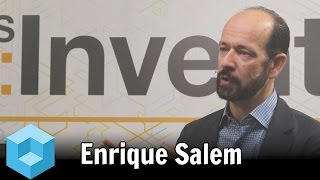
In a SiliconANGLE The Cube interview at AWS re:Invent 2015, Enrique Salem—Managing Director at Bain Capital Ventures and former Symantec CEO—discusses the sweeping shift from traditional, monolithic data‑center IT to shared, cloud‑based infrastructure. He emphasizes that agility, simplification, and the move from CapEx to OpEx are reshaping how enterprises operate. Salem outlines his focus on three core infrastructure pillars—security, storage, and networking—and how software‑defined approaches are busting legacy silos, merging DevOps and SecOps. He explains the total cost of ownership benefits of elastic cloud services, the importance of compliance within the shared‑responsibility model, and the rise of highly informed buyers who demand technical depth from vendors. Salem critiques the competitive landscape, noting Amazon’s push up the stack and the need for other vendors to offer cross‑platform, low‑friction solutions. Finally, he details Bain Capital Ventures’ early‑stage investment thesis: backing entrepreneurs who can deliver low‑friction, high‑velocity go‑to‑market models, exemplified by companies like Atlassian and Evident.io, and outlines the formula for building an enterprise‑scale unicorn.
Chapters
Live from the Sands Convention Center, Las Vegas, Nevada, extracting the signal from the noise, it's The Cube, covering AWS re:Invent 2015. Now your hosts, John Furrier and Brian Graseley. Okay, welcome back everyone. We are live in Las Vegas for Amazon Web Services AWS re:Invent 2015. This is SiliconANGLE's The Cube. This is our flagship program. We go out to the events, extract the signal from the noise, and share that with you. I'm John Furrier, the founder of SiliconANGLE. I'm joined by my co-host Brian Gracely, cloud analyst at Wikibon.com. Our next guest, I'm psyched to have on, Enrique Salem, the managing director at Bain Venture Capital, industry vet, former CEO of Symantec, among other things, tech athlete, certainly been around the block, seen multiple ways of innovation cycles.
That's right.
Welcome to The Cube.
Thank you, great to be here with you.
So I want to get your take on this. Obviously we've heard the announcements, obviously impressive. It's kind of got the AWS getting their own reputation, cadence of Jassy's Law, I call it. Moore's Law, I mean, obviously kind of a joke on that, playing that. But you're seeing the cadence of a new model of software innovation that integrates the concept of integrated stacks with open source, with DevOps, offering application developers just great performance. This is the cloud, right? Economic benefits. It's changing the dynamics. EMC's got to be shaking in their boots. Oracle's got to be looking at this. IBM, Cisco, everyone's looking at it. The big whales are like, oh my God, Amazon could potentially put them out of business. That's right. But yet the startups are blooming.
Well, here's what's happening, is you're really seeing a huge shift away from what I would call traditional IT, where you had the monolithic data center that's now moving to the shared infrastructure, that's moving into a world that is highly about how do you move much more quickly, how do you simplify, how do you reduce complexity, and the world is moving towards, it's all about agility, and what Amazon is proving is that even at a big company and at large scale, you can be very agile, and so everybody who moves to their platform, it is about simplification and agility.
So I gotta ask you, you've been on both sides of the fence. You've been an innovator, an inventor innovator on the company side, you've led companies, led teams, product teams, now you're on the investment side. So you're now, you're in the front row balcony looking down at the stage of innovation, where you got to make some bets, write some checks, partner up with other guys. We'll get Jerry Chen on later, we'll see him, Frank Gartale among others, give us their lay of the land. But you got to bet on the future. What is that thesis? What is the thesis that you're operating on? Okay, go a little deeper. Is it the streaming? Is it the data? Who owns the data? What about open data? And the role of open source in all this. The world has certainly changed.
So here's how I think about it. I'm very focused on infrastructure. My job is all about how does the infrastructure move into the future. And so I look at security, I look at storage, I look at networking. And so my three big areas are all about how does the infrastructure get transformed from what was traditionally very monolithic, very brittle. So if you wanted to make a change, if you wanted to work in the network, you had to know the alphabet soup of, you know, BGP and OSPF and all this junk that, quite frankly, a modern infrastructure shouldn't have to care about. And so from my vantage point, it's all about removing friction, it's all about better security, and it's all about how do I enable companies to be much more agile. And so security, storage, and networking are all being transformed.
So let me follow up on that. So a lot of companies moving towards software-defined, a lot of, you know, net new companies, they're software-defined storage, software-defined networking. One of the things that we hear from them is, as we're doing research, we're talking to clients, is a lot of times those vendors will ask us, they'll say, who do I sell to? Because if I'm doing software-defined networking, for example, the traditional networking team doesn't necessarily want that. Are they, are they trying to sell into an application space? Is it a DevOps team? What's the, what's the customer landscape looks like that loves this, this model that you're investing in?
Well, I think what's happening is you really are seeing some of the silos that that lived inside of IT, where you had folks that did app dev, you had folks who ran operations, you had folks who did security, all of that's converging into the two worlds of DevOps and SecOps.
So silo busting kind of thing?
It's absolutely a silo busting thing, where what's happening is you are really in a position where if those groups don't work together, you will perish. You will not be able to function and be competitive. And so you're absolutely right, Brian, what's happening and is what we're investing against is this simplification notion that The silos definitely have to go away, and what will happen is we will become a company, or we will become users of technology that it's all about how do I serve a line of business, not technology for technology's sake. One of the biggest theses we have is that traditionally the run cost of an enterprise was 60 to 70% of their budget. In the future, that should be going down. It should be 50%, 40%. Free up lots of money for innovation, and that's what it's about for businesses to be successful.
I'd love to get your take, 'cause this is an interesting conversation, because it's so awesome, and we, I mean, I love this marketplace right now. I gotta say, I'm 50 years old, and I've seen the enterprise grow and change. It's just so exciting. But now we have a couple dynamics I want to get your take on. Two separate topics. One, global consumption. So now you're seeing things like our contract global consumption has a lot of kind of new SLA kind of features to that. So what does that mean? And two, the role of cost of ownership. Okay, now if you're renting or having some sort of on-prem and/or hybrid, the cost of ownership equation starts to change. You kind of teased that out. So let's take that. The global consumption, what's that landscape look like? What do you look for firms that configure, how should they organize to be globally consumable from a product standpoint or technology, and then ultimately, what's the total cost of ownership equation look like?
[Speaker] Yeah, let me take the second one first, because that's one we're very focused on. The notion of the total cost of ownership, you are seeing a move from, from CapEx to OpEx, which I think is an important shift. And so instead of having to buy infrastructure forward, you actually have more elastic infrastructure. That is a huge benefit to IT. Before, we over-provisioned everything. We don't need to do that anymore, right? So now from a cost of ownership perspective, it was actually much more complicated to forecast and to predict what it was going to cost you. Now today, because of the new infrastructure, you're able to move and say, Yeah, this is what it's going to cost me today, and this is how much more it's going to cost tomorrow.
So elasticity is key, but now you got people costs.
That's right.
App costs. So back to the silo question, how do you shake that out?
Yeah, I would tell you, let's think about the most important thing here is to let's get rid of the notion of we have to own and operate everything that we run our applications on. And if we move away from that concept, we have just reduced our total cost of ownership dramatically, because from an operational perspective, Now you don't need people dealing with the bits and bytes of the network, of the storage components, of the compute. It's all simplified.
We said on theCUBE, Jeff Frick said on theCUBE two weeks ago, DOA, don't own anything, is kind of the philosophy, or dead on arrival, however you want to look at it. Data centers are, infrastructure's changing, but by not owning anything, it shifts the variable costs on the scale piece, scaling becomes also the other factor.
Well, I think scaling is simpler. Now, the thing we haven't talked about is what happens to security. So what does it mean for a company? We are in, you know, Bain Capital, we're highly regulated. We have to comply with a number of regulations like FINRA and other things. And so what you want to think about is what happens to compliance, what happens to security as you move to this new shared infrastructure. And so part of the thing that we're investing against is how do we help companies as they move to something like Office 365, or they move to AWS or Azure, what do we do to make sure that they can still run their business in a compliant, secure way? You know, one of the things that Amazon talks about is their shared responsibility model. That means they take responsibility for securing the infrastructure. You still have to own securing your application. And so we're trying to figure out how do we help app developers secure their applications.
Changing gears, what about the Amazon announcements? What are you most excited about? When you hear Andy Jassy again, he's got a spring in his step, he's proud papa, bringing his kids into the equation, talking about, you know, just kind of being the cool dad versus the naysayer. CIOs kind of have that same mindset. What about the announcements, in their announcements, that get you excited?
Yeah, look, I think the ability to have visibility into everything, everything that's being run on AWS, is going to make it possible for us to do a better job securing everything. So we talked about the agents that will now be available that will put out information. That's huge. I think the second thing that's important is, you know, the world is all about data, and some of the new announcements around big data, how you'll be able to ingest data more quickly, how you'll be able to do better analytics, I think that's very important.
Yeah, let me ask you, so part of your role in being a VC, advise your clients on how to run their business, be successful. You're in the infrastructure space, it's traditionally been very CapEx-centric. As it moves to being more OpEx, it's going to change their sales, it's going to change how they market. Talk about that shift in mindset that has to happen for the CIO of that company, and how do we think about it as analysts of how well these companies are doing?
Look, I think what you're seeing is the rise of the very well-informed buyer. So everybody has to rethink their sales force. You know, when I ran sales Salesforce at Symantec with 4,000 people, what really happened was you sold everything. You had salespeople and technical resources. The world is going to move to customers want to talk to technical people about what is being utilized or will be utilized in their environment. And what that means is you're going to have to change how you think about the buyers. Buyers will be much better informed. They will be much better prepared. And if you walk in and you don't understand their environment and what you're trying to sell to them from a technical perspective, you'll be DOA.
And we love that too. The informed buyer loves theCUBE, loves our Wikibon free research, and I think that's what the social networking, the connected internet of things, of people, they're getting information from multiple sources now, and they're making decisions, they're talking to their peers. So that's a new dynamic on the buying side. So that leads into my kind of final question for you is, How does these other vendors compete with Amazon? I mean, the wall, the differentiation, the barriers to entry is becoming just the arms race of technology innovation. They're commoditizing and innovating at the same time.
I think what has to happen is you have to look at the whole stack. And so, so far what Amazon has done is they've built infrastructure, and now they're trying to move up the stack and deliver some of the other applications on top of that, the utilitarian functions. How do you do analysis? How do you do databases? How do you have a whole new set of tools? But I think the application market historically has been the big, big opportunity, and they still haven't capitalized or taken a lot of ground in that area. So I think if I were coming in and thinking about where do I go, I think about one, thinking cross-platforms, and two, I think about what happens as you move up the stack towards the rest of the applications.
[Speaker] So it's certainly a competitive world. Final, final question. Talk about Bain VC. What are you investing in? What are you looking for here? You're scouring the floors. What's the secret formula that you're looking for in an entrepreneur or a company? Is it growth? Is it that kind of sales delivery model? And what are you guys investing in? Share some numbers.
I think a couple things that's really important here is Bain Capital Ventures is very focused on early-stage investing. That's something that people don't know about us. We sometimes write the very first check, a seed check, a Series A check, and a lot of people think of us as more growth or buyout folks. The second thing, as we look at it, Bottom line is, we are looking for, do we have the right people? And so it's all about the entrepreneur who wants to change the world, who sometimes, I use the phrase, they don't know how thick the wall is, and they're willing to run at it really hard, because they're willing to take more risks than your, you know, 30-year-plus—
And they don't need a lot of capital with the cloud, there's a lot of efficiencies.
Awesome, no, absolutely. So, I would say, from our perspective though, how do you remove friction from everything that customers want to do. So that's an important part of our thesis, because if you have a high-cost sales model, if you have a very complicated deployment model, those things are not things we're going to do.
Okay, final, final, final question. 3 final questions, because I always do this when I get on a roll. A unicorn in the enterprise looks different than a consumer unicorn. We all know what Airbnb and Uber look like. That's a high flyer, not many of those there. That bubble's kind of softening or bursting, as I say. But the enterprise is booming, a lot of underlying technology change. What is the formula for an entrepreneurial venture architecture for that kind of unicorn? What do you see for that?
I think the most important part is the velocity. You have to have a high velocity distribution model. And what that means is you have to have a way of getting to customers that becomes more efficient as you scale, that doesn't require you to necessarily hire another 100 salespeople. So that's an important part. Part of really creating an enterprise unicorn. And so what you've seen, you've seen companies who have done that. You know, I'm on the board of a company called Atlassian who has perfected the notion of once they get a solution in market, it builds momentum and it expands throughout the enterprise. And so for us, it's low friction, it's high velocity. You know, companies like, you just had Tim from Evident.io. This is a company that it takes 5 minutes to get their product up and running. And so if you're going to build a new enterprise-scaled company, you better have a very low friction model.
All right, low frictions, integrated stacks, horizontally scalable, vertically targeted, big data, all happening. A lot of goodness here at Amazon. This is theCUBE. You're watching here live in, in re:Invent in Las Vegas. And watch theCUBE, we're going to be all over the, all over the tour this fall. We're going to be broadcasting live at the Grace Hopper Women's Celebration coming up in Houston. We're going to be at Dell World, Oracle OpenWorld. We're going to be on the Cisco booth. This is The Cube. Look for us, continue watching. We have more VCs coming, more thought leaders, CEOs of companies, and certainly folks from Amazon. Stay tuned, we'll be right back after this short break.