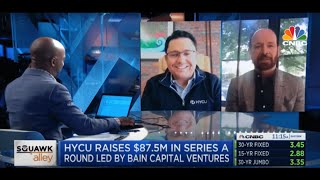
In a CNBC‑style interview, HYCU (formerly Haiku) CEO Simon and Bain Capital Ventures partner Enrique Salem discuss the surge in ransomware attacks and how HYCU’s multi‑cloud backup‑as‑a‑service addresses the growing need for reliable data recovery across on‑prem and public clouds. Simon explains that legacy data protection tools are cumbersome, whereas HYCU’s native integrations simplify protection and reduce attack vectors. Enrique emphasizes that data is the core asset of modern enterprises and that the true value lies in rapid recovery, not just backup. The conversation shifts to market dynamics, noting heightened interest from VCs, PE firms, and SPACs, and why HYCU chose to raise a traditional round with Bain Capital Ventures instead of pursuing a SPAC. Simon highlights HYCU’s traction—over 2,000 customers in 70+ countries—and the strategic fit with Bain’s expertise in data protection, underscoring confidence in the company’s growth trajectory.
Chapters
When I see, uh, Haiku and how it's framed, I think about ransomware, and I think about more and more what I'm hearing about, uh, enterprises hedging their bets across multiple clouds. How does this play work uniquely in this environment?
Yeah, no, it's a great question. Thank you very much for having us on. We're thrilled about this round. Um, you know, to your question, over the last sort of year and a half, especially during COVID there was a massive rise in ransomware attacks across the world. And I think one of the challenges is, you know, backup and recovery has always been kind of a second-class citizen in the world of IT. So you had a lot of companies that were using very legacy, very old data protection software that was very complicated, hard to use, hard to implement. What Haiku has built is a real multi-cloud backup as a service that natively integrates with every single cloud, both on-prem and in the public cloud as well. And I think those native integrations and the simplicity make it easier for customers to operate and really stops the bad guys from getting in the back door. And that's really one of the name of the game these days with all of the criminality and that major rise in ransomware attacks.
Enrique, you've been in the enterprise game and security game for a long time. When I look at this multi-cloud environment, I'm trying to figure out where the value is gonna be. What are the applications? What are the services that are gonna demand profit and growing profit over time, not just top-line revenue. How does Haiku address that question of where that value and growth in value is going to be over time?
I think what you want to think about, John, is that everything is data now. And if you look at, you know, your meeting invite, your phone entry, a video, it's all data. And so what we're trying to do here, as Simon was just saying, is We need to protect that data. And, you know, I've been in the backup industry for a long time, and we talk a lot about it being backup. What really matters is recovery, because you can't run your business if your data is not available. And so the value really comes from making sure that when you're trying to get something done, you have access to what you need— your email, your calendar info, but anything that you use to run your business. And so that's where the real value comes from.
Simon and Enrique, good morning. It's your dress. Simon, a question for you. I think you were quoted somewhere else saying that you received a lot of interest, not just from the traditional VC and PE people, but also from SPACs. Can you talk a little bit? Were you surprised by this? Why did you decide to raise a round instead of, you know, take advantage of this pretty hot market that we've seen over the last few months?
You know, Deirdre, I'd be surprised if my mother doesn't create a SPAC one of these days soon. Everybody I know has a spinoff. So from my perspective, I think, look, you know, Haiku waited to raise its first A round. We wanted to make sure we were successful in the market. We've now got over 2,000 customers in 70+ countries. We wanted to partner with a tier 1 firm that understood data protection, not just today, that had done it not just in the past but had a clear vision for where it was going. And we certainly found that with Enrique Salem and Bain Capital Ventures and couldn't be more thrilled to be partnering with them.
Enrique Salem, has your mom started a SPAC yet? And broadly, what do you think of what's been happening in this space? I did— I said that the market has been red hot, but certainly in terms of SPACs, it has been cooling somewhat over the last few weeks. What's your take?
Yeah, you know, it's interesting is my mom will be giving me feedback on this. She'll say, why didn't we invest $100 million is what she'll be telling me after this program. But look, I think the market is continuing to evolve. I think there's a lot of capital available and a lot of great companies that can take advantage of that capital. You know, Haiku is special because it is in a massive market. That is what we're so excited about at Bain Capital. Is that specifically we can partner with Simon early in this company's journey. And every business in the world needs what Haiku is doing— protect their data from both a security and a data protection perspective. As far as SPACs, I think there's going to be a lot of companies that previously couldn't have been available to public market investors. And so I think that momentum will continue. Will it be as hot over the next 12 months as it has been for the past 12? I don't think so, but it will continue for sure. Shepard Smith here. Thanks for watching CNBC on YouTube.