ICW Week Close 2026 The Future of Coaching
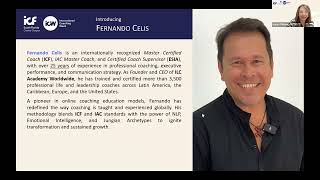
Fernando Celis, founder of a bilingual coaching school that trained 3,800 coaches, argues AI is a tool, not a replacement. The coaching market is worth $6 billion and growing 11% yearly. Celis shows how his school uses AI tools to free coaches for deeper human connection.
Chapters
Fernando Celis.
Okay, I've made all.
Welcome, welcome everybody, welcome, welcome.
Nice to have you all. Welcome.
Let's put a little music before, you know, a couple of minutes to let everybody, you know, just a little bit while they start coming in. And I see some familiar faces. We got Mr. Fernando Francisco, and he's in Panama. Katia Talavera. Narcia Morato is from Bolivia as well.
Oh, Hi, nice to meet you.
Yep. And we got Najiba Al-Halabi. I think she's in the Middle East, in Morocco. Caracas, Maria Luisa. Well, we got a bunch of friends in the house. Let's see, let's see them come in.
If you can write in the chat, where are you joining from?
Yep, right in the chat, where are you connecting from? I know Francisco's in Panama.
Nahira, if you're a coach, if you could tell us what type of coach are you.
We got some PCCs in the house. We got a couple of PCCs. Oh man, this is excellent. Thank you very much for coming. And turn on the camera so I can see you. Merdula, how are you? Excellent, excellent. We're closing ICW. Yeah, so let's give a couple of— we'll do one more minute.
And we have people from Argentina, Argentina, Santiago de Chile, Medellín, Colombia, Panama. Indianapolis, Indiana. Marcia, you're from Bolivia, right? I'm from Bolivia as well, so it's quite an international—
Narcia is from Cochabamba, Narcia.
Thank you.
Maria Elena. Okey-dokey. So let's—
so we have a great international community you attract, Fernando Celis. Okay, so do we start now?
Yep. And since Dorothy Richardson's coming in, turn the music off, DJ. Okay.
Was it on purpose that Michael Jackson?
Yeah. Everybody's listening to Michael Jackson now because of the movie.
So you have to show us the moves.
No, no, no. I'm the only— stand up and I'm the only Latin American and I'm the only Venezuelan in Miami that doesn't dance. I don't know how to dance because I'm timid. I'm shy. I grew up shy. That's why I went into coaching. But anyway, Katya, the floor is yours. Start with your intro.
The beginning, only, only the beginning. Okay.
Yep.
So if you allow me to share. Okay, so, so we are here in the last session of the International Coaching Week. We've had 5 wonderful days of coaches, influential speakers, and Fernando Celis, you're going to make the closure today. What an honor. Absolutely. So if you're not part of the ICF South Florida famous chapter, this is a great opportunity to get in contact. And Dorothy Richardson is here so you could contact her. She's going to put her email soon. And we wanted to mention some of the membership benefits. It's— you'll save in member rates. If you're not a member, it would probably cost you like $25 per session. You get visibility. You would be part of the coach directory. You can earn more than 50 CCUs throughout the years. We have tons of programs, really. We— you could have a full-time job if you want in ICF South Florida. We have now, uh, the barter coaching, which is wonderful with Fernando Celis. We have some business programs, uh, master coaches. So you name it, you have it. You can keep learning from coaches from a global community that comes with different specialties. You will learn, share ideas, tools, and industry trends, and you can meet the right people. We have some events which are virtual, like Coffee and Connections, and also I know that a chapter is doing more and more in-person events. So we had two this week in different parts of Florida, and you also have the opportunity to give back. There are many volunteer programs like the We Evolution, we have Coast to Coast, United Way, so there's tons of possibilities. You could get in contact with Gaston from the outreach community. Fernando, who is Fernando Celis? Fernando Celis is from Venezuela. He says he's very shy, but I don't believe it. I, I think it's part of your marketing, uh, Fernando, because I've met you and, and I don't see you as shy. So who is Fernando Celis? He's an internationally recognized MCC. He's an AIC Master Coach Certified Coach Supervisor. He has more than 25 years. I know you're a great surfer and you connect coaching with surfing, which I love that, that metaphor when you share it. And you have your own school. How many people have you trained so far, Fernando?
Uh, in the past, uh, 13 years that we've been, uh, coaching education provider Providers, we have certified, we have graduated more than 3,800 coaches. And a lot of them are in the, in the ICF chapters in Latin America, have become PCCs, they're working in BetterUp, they've pulled out books, you know, they're, they're doing keynotes. I mean, we really provide an education of coaching that can guide the coach towards the avenues where they feel success. You know, there's so much to share and it's a great thing. It's been a great—
and your courses are mainly focused for Spanish speakers. And I understand that you're planning to start the English version of your program. Is that correct?
Yeah. Yeah. We serve the Hispanic community. So we started out in Venezuela. You know, I ended up here in Miami. I was raised in D.C., you know, in Now I'm an American citizen, you know, and the whole thing. So I'm legit. And, um, we have always served the Hispanic community, but, you know, ever since, you know, we formalized our Level 1s and we have 2 Level 1 programs, uh, we have the, the school in place and everything is ready for the English program. I mean, all, everything has been translated, all presentations, all manuals. And the only thing, what I'm trying to build right now is the academic team because our academic team is fluent in Spanish and not many of them are bilingual. So now we're going to need a team of native speakers, not only for USA, but for Asia, which is growing exponentially. You know the Chinese? I mean, yeah, the Chinese, you can say it. It's the, the statistic is 10 million Generation Z that right now are responsible for leading teams of between 5 to 10 people. And they're desperate for, for, for leadership skills. And they've discovered coaching. And you know the Chinese, when they find one thing, they cling to it. And, and then they're really, really into the the formality that ICF provides. It's one of the most growing areas, you know, Asia and EMEA. It's incredible.
And Fernando, I understand you are international. You've been to Colombia, Chile, where else? You're based in Miami, but you—
I'm based in Miami and based in Miami because, you know, Miami International is the perfect for Latin America. So we've delivered in Chile, not only Chile, it's Santiago, Viña, Concepción, under the Universidad Nacional Andrés Bello. Then we went to Ecuador, Guayaquil and Cuenca, wonderful people in Ecuador. We've done like, those were like 40 programs between those two. And then it was Bogotá. That was when it was all done live. It was 3-day sessions for 3 times during 4 months. So we could do the whole certification process. And then it was Colombia. And then we did El Salvador and I'd take like 3 days off so I could go surfing and Costa Rica and then Miami, Puerto Rico, um, Orlando, Houston. We did a couple and it, and then it was Mexico and it was flying. It was 2019. I was all over the place in the planes. I had like 300,000 miles. And all of a sudden, you know, I was about to make the tour to Mexico and to Ecuador, Chile. I did some like t-shirts, like in the concerts with all the dates in the back. We had everything ready and I got the call and they said, we're not doing it. There's this flu. There's this flu from China. That's what they said. And so we got stopped in the tracks and we had to do We had to coach the company to transform itself and reinvent it. And so we went online 100%, and we have grown more from 2020 to 2025 than we did in the past 8 years before that. And then because it became the proper channel for the mentoring process of the Level 1s, you know? So it's been a fantastic ride. And so now we're in 2026. We just went back to Colombia where I was the keynote for the Congress of ICF, and now I'm going to Chile. So we're traveling again, but I'm going to travel with a mask because every time I get on a plane, I get a cold. I catch a cold.
So this is the shy Fernando. Do you believe that? Tell me, tell me, raise your hand if you think that Fernando Celis is shy.
No, no, please, I'm, I'm, I'm introvert.
You have a microphone if you can say.
Yeah, nobody introvert.
That's, that's your limiting idea.
No, no, I was just—
Or it's part of your marketing. Let's leave it there. Okay, so the floor is yours.
Thank you very much.
We're all really happy to be here for you.
Thank you very much, Katya, and thank you all for being here. The energy, the presence on a Friday afternoon. A lot of you guys would be, you know, on the way to the Keys. And no, we're here learning because we're coaches. And today we're closing the ICW, the International Coaching Week. It's been a wild ride. We had like 4 programs for our school, and today it's very special. And, and for me, it's, um, Something is very close to my heart. This is practically the keynote that I've been delivering to ICF in the past year. I was involved a lot with the AI. I was obsessed in 2025. We developed coaches. I was into it, you know, like everything when it happens. And out of my surprise, I found a lot of resistance among coaches, especially when it was starting. And a lot of resistance and a lot of bias. And, um, it got me thinking, you know, about the future. And of course we have all this technology, but we also have data. And I started receiving the data and started studying where, where coaching is going. And, and I discovered that we're doing okay. You know, the coaching industry is fine, thank you. What's confusing is a certain resistance that's indicative of change. And you know that the way the psyche works, when you discover something When you have an insight, when you have a breakthrough, the feeling inside is, 'Holy sh— I didn't see that coming,' right? Because we work in a way that our inner resistances hide. You know, I always say that the phantom of the psyche hides in the alleyways of the mind. Doesn't want to be discovered. So we might not see the opportunity because we construct a threat. And I'm here to expose a point of view where we can make sense together on the future of coaching and the impact of technology and AI for sustainability. Is that okay? How we doing? Claudia, Leslie is here. Let me see your faces. Rodrigo Basalto, caramba. Sergio, come le vai? Barbara Di Toma, Barbara from Rome in Miami. Yes. And South Florida is in the house. Is South Florida in the house? Dorothy, Yes, yeah, yeah, it's good, it's good. And I see others that I, I don't see your faces. If I can see them, that would be great. So I'm going to, um, let's see, let's see. Merdula! And I'm going to, um, share the screen because I, I read this, I designed this for ICF specially for you. And thank you and welcome to The Future of Coaching: AI, Ethics, Impact, Sustainability. And this is the art of bringing our vision, our vision of the future to the present. I'm Fernando Celis. I'm an MCC. And yes, I grew up here in the United States and I was very introverted, totally introverted. I'm the youngest of 6 children. And I was the youngest by a long shot. I mean, even my dad's friends were saying, what the hell happened there? They said it was the last load of Lieutenant Celis. And I grew up as a little kid in Washington, D.C., very introverted, into art. And then my family were diplomats, and when they went back to Venezuela, you know, that was a major culture shock. All my friends stayed here. There was no internet. There was nothing. There were letters. And I became more and more shy. That's why I went into surfing when I was 14, because it's the sport where you don't need anyone. And in my 20s, I started looking for help, because, you know, as I say, I'm the only Venezuelan that doesn't know how to dance. And everybody expected me to dance, because I couldn't. I would never stand a rejection. If I asked you to dance and you'd tell me no, I'd jump off a bridge. So, um, I found help when I was in college. And one night, 1 o'clock in the morning, I saw a fella talking about personal power, and I ordered the 24 cassettes of the Tony Robbins Personal Power Program. And when I listened to— when I heard the first tape, my— the back of my head blew open. And I decided, you know what, I'm going to learn everything that this guy is talking about. And that's when I started my route towards discovering all that, everything that was happening here in the States in the '80s. I was— I went to school in Daytona Beach. Daytona Beach Community College. And then I transferred to FIU. When I went to FIU, the big mall was the Mall of the— it was the Mall of the Americas. That was like the big mall. And anyway, I started understanding myself. And that has helped me to be a speaker and what I do. But if you put me on regular conditions, Like if we go out to a restaurant at night, I'll be the guy in the corner looking at the phone all nervous and stuff. Things don't change. Anyway, I'm going to start out with this because AI is in the panorama. So there's a lot of talk about change and technology. And I want you to interact with me. So I'm going to ask you a question. Because I hear that there are people that are claiming this, these thoughts that are collective. Information overload, cognitive decline, job displacement. Ah, they're taking away the jobs. The dilution of knowledge. Oh, we're diluting knowledge. Ethical concerns. There's an ethical aspect of this that is happening. We're talking about change. Lower academic standard. This is lowering the academic standard. Anxiety about uncertainty. This cannot be happening. Where do these— what do you think these refer to specifically? This is what people say. What does it have to do with? Write it in the chat. What do you think it has to do with?
It's fear.
Fear of what? What are they talking about? What are— fear of what? Where— what is this attributed to right now? And I see the first one: AI. AI. Oh no, let me tell you something. This— these claims happened. In 1440 with the printing press of Johannes Gutenberg. Those were the claims, exact same claims. In fact, there was one that said the printing press will kill the word. That's what they said, that it was going to kill the word. Yet the printing press ultimately ignited the Renaissance, accelerated the Scientific Revolution, and transformed human consciousness forever. And people were freaking out when they discovered that you could write a Bible and everybody could come in contact with— Oh, they said that the monks were gonna go out of business. You know, the monks. And the monks are still around. Anyway, another fella that was around in those times was Leonardo da Vinci. And I remember back in the day I was a sales trainer and coach for my company and we had our client, our biggest client was Compaq Latin America. Compaq. Compaq Computers. And one of the speakers that Compaq had going around on tour with me was this guy Michael Gelb. He wrote a book on how to think like Leonardo da Vinci. So I would have dinner with the guy when we were delivering our keynotes for the— we both were in the same leadership program. And he really studied da Vinci and he lived in Italy and he knew a lot about him, gave me a lot of stories. But one of the ways of the book, he has like different ways to think like Leonardo da Vinci. One of them is curiosidad, curiosità, curiosity. Leonardo da Vinci quoted, "To live is to remain in a state of wonder and questioning." That's Leonardo da Vinci. He would ask questions. They say that he would ask 100 questions every morning. Questions to program his brain for what was going to be done during the day. And as coaches, I ask you to be curious today. And curious about AI and very curious about our craft and our clients. I feel that to discover a client is a state of wonder. And I think this whole fascination with how people think and the questions and the wonders comes precisely from my introverted childhood, you know. I'm still introverted, you know. I, when I'm tested in the MBTI, the DISC, but I have had to develop new skills. When I was a kid, I wouldn't speak. I was always inside, and I would really question and wonder, how is it that these adults speak out and they they tell jokes. And because my, my house was full with full of people, I was the, the kid of the house. I was 5 years old and my brother was 12 and my sister was 15 and, and my other sister was 18, the other one was 19. And there were always a bunch of people in my house. And it was the '60s in Washington, D.C. So sometimes there were a bunch of hippies in there. And I was just, you know, like, what is it that they do? I started really studying people. It was weird, but it was to develop curiosity. So it's about curiosity. Curiosidad. So if we look at coaching, we're seeing practically an antidote for sanity. For insanity in our times, because we are not living in an era of change. This is a change of era. I mean, the lizard is shedding its tail. That's a metaphor that Genesis uses in a song called "Watcher of the Skies" that has to do with the expansion of consciousness of man. He doesn't say that humans evolved. He says the lizard shed its tail. That's why I use it in my logo. It's a symbol. We're living in a change of moments, of era, of moment. And we're here at a crossroads, at a crossroads where it's not about competing with AI. That, that's, that's just madness. I mean, AI is a machine. Uh, it's about remembering what makes humanity irrepre— irreplaceable. And in terms of coaching in companies, in organizations, you know, if you guys are in BetterUp, Ezra Torch, Bonham Coaching, companies focus on achieving better results, driving KPIs, or OKRs. You know, companies pay us for achieving results. Google is paying BetterUp hundreds of thousands of dollars for coaching because they know it improves the bottom line and improves workplace culture. But the real challenge for us is, OK, to support both the goals of the organizations, yes, Your people are going to sell more. But we also confidentially, and this is why I believe that coaching is like, it's like I don't know how businesses accepted it. It's because it works. Because within our coaching sessions, which are totally confidential, we handle the human reality that people are facing today. We got these executives that were the guardians for exhaustive burnout, emotional fragility, identity fracture, anxiety, imposter syndrome in the highest echelons of the food chain of huge organizations that nobody will know about, nobody knows about. And we're sworn, what is it, Katya, code of ethics? We're sworn to secrecy that we can't say what goes on in the session. Or somebody's going to visit us at night from ICF. The future will not be defined by the speed of change, but by the integrity with which we choose to move forward. Does that make sense? How we doing? Sinua?
Wonderful.
Okey-dokey. So in the age— and this is something that it'll have to go— you'll see where this is going because right now we're in the age of AI and intuition matters, but data is the big king here. Data matters too. Data. All these companies, they eat data. BetterUp, Ezra, Torsh, they're obtaining data from the coaching sessions. You know, from millions of coaching sessions. I remember BetterUp is, I think it's around 3 million sessions that they have already positioned since they started. And you know, no data, no credibility. That's the mantra if you're working in organizations, if you're statistics, if you're investigation, if you're in Research. If it's not measured, it's mythology. If you have no data, you have no credibility. In Spanish it's different because it rhymes. Si no hay dato, es relato. Y si no se cuenta, es cuento. You know, it's a, what do you call it, word game. But if you're working in marketing, in digital marketing, you know what I'm talking about. Everything here has to be measured. So we're measuring the impact of coaching as well. And these are reports from ICF and PricewaterhouseCoopers from 2024. And there are some that haven't come out yet that are in research, but the world is calling us to evolve. We're a growing industry of $6 billion in expansion. If you look at the report of last year, it was $4.6 billion. $1.4 billion. The annual growth is still 11% compound. There are 13% more coaches. There's a coefficient of optimism of the coaching industry at 62, and that is very, very favorable. That is very, very good data. And unlike many industries that declined after the pandemic, Coaching continued to grow, driven by increasing global demand. And I have tons of research on this, and, uh, the numbers are playing for us. You know, back in the day, everybody wanted to get into BetterUp, and it was getting difficult to get into BetterUp, and they only wanted the PCCs. They're taking ACCs that I know. I've had graduates going into BetterUp, and then Ezra came up, and BetterUp came up, Bottom Coaching in Spanish. There's another one that just came out. I apply always, every 2 months I apply, I apply. If they reject me, I apply again. Eventually you get a couple of cats. Sometimes you get a lot, big load, low load. But that's my, that's my retirement plan. You know, you don't have to do marketing. You get your clients and stuff. But so, but what happens as these companies start growing? They need more coaches. The data that they have indicates that the coaches that coach these leaders in this company produce this level of increment. And when they look back and they see which coaches they were, who do you think were the ones that made the, made the grade? The ICF coaches. Because it's the only federation in the world that requires a bunch of sessions, you know, 100, 500, education, mentoring, the, the freaking, um, that, that video you have to send, you know. And it's not easy. MCC was in my day 3,000. Now how many sessions? 2,500 hours? Is it something like that?
2,500.
Yeah, 2,500 sessions. You don't make that in a year or 2 years, not even 3 years, unless you're sessioning from 7 o'clock at night to 8 o'clock. That's developed over years. 5, 10 years. So we have the DNA of the competent coach, which does the job. And this is why the numbers are working for us. Coaching, the industries get the data. We need coaches. We need the ICF guys. We're only 60,000. Credentialed. Do the math. They need these coaches. And as Asia starts incrementing and they have coaching in English, we're in a great position to be, you know, we're considered the best of the best of the best. And I have been seeing lately those little thingies in the bottom when you apply. ICF credential preferred. ICF credentialed only. I saw in a website for the federal government, you know, in the, in the Biden administration, uh, for, uh, for coaching in Washington, DC. So, you know, something to look into. So what I see is the perfect storm for coaches because on one end we have the platforms, BetterUp, Coach, Ezra. These are just some. Bonhomme Coaching, very good platform in Spanish. Korn Ferry is having a— woof, their division of coaching is powerful. It's prestigious. And then there's ASAP, which is— I like that company. Because one of their clients is the, the companies of Elon Musk, you know, Starlink and SpaceX. And, and I, you know, I'm not breaking any rules. These are in the blog. BetterUp has, uh, NASA, dude. You know, I'd love to get a, a client in NASA. I don't care if it's the woman that opens the door. I mean, the, the guy that's in the, the booth for the tickets in the, in the parking lot. I've always loved, you know, NASA and the astronauts and stuff. So we have a chance to working in these companies. And on the other side, we have resources that we have never had in our existence. All these apps from AI that can make our life more livable. Because they do the time-consuming stuff that we don't like to do and leave our minds for creativity or for spending time with the people that you love. So it's a great time to be independent, to be a coach, to learn. And I, I invite you to apply to these companies and don't worry if they reject you at first. It's, um, it's, they usually have an AI, but when they land these cohorts, because they have something that's called the cohorts. The cohorts. Oh, we just nailed a client. Microsoft wants coaching for 5,000 executives worldwide. That's the big cohort. And so you'll see that they open up recruiting. And so if you fall into that place, and it's happened to me a couple of times, it's like a lottery. Um, boom, they call you for the orientation. And then in orientation, if they like you, you know that then you're in and you have patience. All of a sudden you Your calendar is open up, 2 sessions here, 3 sessions here, 4 in a week. Okay, well, you know, 7, 10 sessions, you know, it's for the household income. You know, Carmen is happy, everybody's happy. We can maybe go out to dinner in Miami one night because I live in Brickell. It's just ridiculous going to a restaurant around here. It's too expensive now because everybody, you know, all the rich and famous are moving down here. Anyway, so what happens with AI? Where's the resistance coming from? Here we have Amy. All these platforms, these are billion-dollar platforms. You know, BetterUp is valued at $4.7 billion. So we have Amy, the world's first conversational AI coach from CoachHub. It cost like $7 million to make its brain. It has 7 brains, and they were— they deployed it to democratize coaching and, and have Amy deliver coaching to the high executives. Okay, so everybody's freaking out, like in the printing press from Gutenberg. And so BetterUp didn't stay behind. They pulled out all kinds of AI. They even have one called Ask Marty. Marty is Martin Seligman, the guy from Positive Psychology. So, ask Marty. And you ask Marty and he responds. And wow, that's nice. And then it went mainstream because this one, I paid the $99 for this guy. Tony Robbins, you know, he has, it's a phone call, it's a telephone. And you call, you press the phone and Tony Robbins answers in his voice with your, hey Fernando, how you doing? How you doing? It's Tony Robbins. Yeah, what's going on today? Yeah. You know, and then he has a conversation with you and then you hang up and he tells you Tony Robbins stuff. And then you call him the next week because it's coaching and he remembers what he spoke about in the last call. Hey Fernando, how you doing? How's your marketing team doing? Yeah, you know, let me ask you a question. So what's your marketing team doing? And then you answer and he does his Tony Robbins stuff. Okay, that's fine. It was fun for a month or two. Um, and you know what happens with these AIs? At the beginning, it's a lot of fun. At the beginning, the executives love it at the beginning. They get tired of it quick. And still people are freaking out. AI is going to substitute the human being. And what you resist persists. If that's your focus of attention, you are going to disappear. Because the reality is And this is a report that came out of the circle of AI, Katya. I think it was Jonathan Passmore, Jazz Razoul. These are people that are invested. And this happened in one of those companies. First month, brilliant. I love the AI. It's like speaking to a human being. The millennials, you know, oh, love it because we don't have to expose ourselves. Second month, very nice. Little decrease in engagement. Third month and fourth, give me back my guy. Give me back my guy. Especially high executives. No, no, no, no, no. I want José Ramón again in Zoom at 7 o'clock in the morning on the Wednesday. I don't want no machine because Something was missing. Yes, AI has all the competencies down. Oh man, to re— you know, establish the agreement, he has the questions, he has the rephrasing, he can look at patterns. But it's a cyborg. It starts— it starts feeling something. So, you know, when you look into it, because if you're focused on this, that's what you're gonna get. And I see it because I had to participate in several forums on AI, and I had to respond these, what they call it, these surveys. And I see that all the questions are biased. And I know that's unconscious, an unconscious bias towards defining AI as something unethical or something wrong. And so it's not the tech and it's not the AI. It's like everything that we work on in coaching and personal development. It's not the boss. It's not the system. It's the feeling. It's how you're dealing with it inside. How are you responding to change? And I, the only way I can explain what's going to happen to, to survive massive change from AI is from my own map as a surfer. It's the way that I can explain things metaphorically, and I think I can make myself be understood because I've been a surfer since, man, I surfed Hurricane David in Florida from pier to pier in Daytona Beach. That was in '76. During my college years, I traveled a lot. Lived in Barbados for a while, at Bathsheba. 2004, I already had my school. I wasn't delivering the coaching certification, but we did all our programs in the island of Margarita. They have a huge corporate training center there. It's like NASA. And they have great rooms and they have Harvard-style amphitheaters inside. That's where we used to do our training. And it was in the island of Margarita, and I would stay in front of the beach and surf. And this was a couple of years ago, with a couple more pounds on me, in Oceanside, California. And you learn a lot from surfing. You learn a lot about life, about patience, about mindfulness, about decisions, about fear, about certainty. And this is the one scenario that I want to point out. Right here we have a wipeout, and, uh, this is not a good place to be. If you wipe out on a, on a wave this size, it will take you under for a while, sometimes a minute or more, and it will shake you, and you won't be able to know where's the surface and where's the, uh, the bottom. And sometimes you're, you're, you're really crushed to the bottom. You can't leave. I mean, the leash is the only indicator of where is up. And you might say that's a bad scenario, but the worst scenario is this: the guy that's paddling out and got caught inside right there, he, he is looking at the wave and he's paddling. And if that is the scenario for you, your arms are going to become spaghetti arms. That's what we call them in surfing. You know, the, the fear makes your arms soft. It's spaghetti arms. You can't paddle because you're paralyzed. I think it's the worst one. So what does the surfer learn to do? Because that happens. Usually when you surf, you have to position yourself outside, so behind the breaker. But every day, or every 40 minutes or so, you're going to have a set wave— means a wave that is twice the size of a normal wave— and it usually breaks a little bit outside. So if you're not well positioned, and if you're not out on it, you, you can get caught inside. But the surfer found a solution, and it's called the duck dive. Right before tons of water are going to fall upon you, you dive headfirst. You sink the, the, the, the point of your board down, and the force of the wave will suck you like a current, and you'll be able to be spit out on the other side. That is using yourself as an instrument. You're using yourself as the instrument so the natural flow of the wave can take you under, over, above, and out. It's called the duck dive, and it's the path of least resistance. You don't have to paddle or anything. You just have to hold on and use the current of the wave that's going outside. Not towards the beach. Huh. That is what we do in coaching. We use ourselves as the conduit of understanding. That is what we do in coaching. We use ourselves to understand what the client is saying and what he is not saying. To understand his model of the world. Very good doing it to others. Very bad when we have to conquer our own fears. So if we look at this from a coaching point of view, AI for coaches, When you look at AI, and this is one of our AIs, Liz, what need is progress, technology, and AI meeting? Because we are wired to meet needs. I know that Tony Robbins talks about the 6 needs, but, you know, Tony found this from Carl Jung, from need psychology of Maslow, Burton, Moore. You know, we all have a need for certainty to overcome uncertainty in our lives. We all have the primal need of love and connection versus the fear of becoming isolated. We all have the need for significance and feeling important. Versus not being seen and being insignificant. And we all have the need for passion and for variety and for the new stuff versus routine. So what need are we meeting? Or what need is your interpretation of AI trying to take away. How does AI compare to human interaction? It's— this is simple because the art of coaching is an exchange of energy that creates a space, safe space of vulnerability and deep reflection. It's, it's, it's a field generated by the human and it works live and online and in Zoom and in the telephone. Coaching is an energetic and relational exchange. And I do, and I am convinced that's a field that emerges between coach and clients through presence, deep attention, acceptance, safety, and appreciation. Within that field, people find the freedom to move forward with courage, clarity, and dignity. And transformation does not happen through advice. We know that. Advice comes to the short-range memory of the frontal lobe. Thank you for the advice, but tomorrow I'm eating hamburgers again. It happens inside a human field of presence, trust, and courageous truth. That is what the human being brings to coaching, and it cannot come from a machine. The same way that— can anybody here tickle themselves and laugh? No. Yes. No, no, you can't tickle yourself. You can't tickle yourself with one of those machines that— is there a tickle machine? If there was, you wouldn't laugh either. You know, one of these vibrating toothbrushes or something. You can't tickle yourself. Yet, when you are in a relationship, a fun relationship, and the other person comes close to you and doesn't even touch you, he does like this. Haven't you been tickled without being touched by someone? You know, in a nice, fun, maybe romantic relationship? Raise your hand. Yeah? Yeah! And with your kids. Barbara, capisce? Sì, certo. You know, we can't tickle ourselves. And coaching is something that, it's a phenomenon that happens with the interaction. Katya, you know, tickling yourself, I get that from Marsha Reynolds. The first one I heard that you can't tickle yourself. And Marsha talks about that field of energy, of energetic exchange. Correcto? So, let's go on and see where this takes us. I don't know where this is. So staying focused when change is happening takes enormous presence, courage, truth, and conscious choice. Through any kind of adversity, I'm convinced that what we do, the way you are inside, you are outside. That's what we are. And how does AI compare? It's all about feeling the vibe, understanding that we're here for something special. So why is this resistance? Why is it that I see these comments in groups that I'm in? Oh, Fernando Celis, you're dehumanizing coaching. If you look at it through compassion, through our coaching model of the world, I see 3 major fears, natural fears. The threat of losing value is a human fear. You know, it's a strong one. The threat of losing love You can't imagine what it does to a human being. When a person is fearful that love will be taken away unfairly, it's physical. And I think the worst of all is the threat of losing identity. A man, and I'm talking about the male the male of a species. A man will prefer to die than to lose his identity. It's that strong. So, rather than resisting AI, the conscious coach chooses to integrate it. Not as a substitute for wisdom, but as a mirror for deeper awareness. And I think the questions are: How can this help me serve with greater presence? What is the technology asking me to become? And what resistance within me is being exposed through this moment in history? And start reflecting on how to give back to the world with the use of this. If AI can help me contribute more, we win. AI can process information, only humans can create meaning. AI is excellent and it can accelerate cognition, but only conscious curiosity can ignite creativity and talent. AI can imitate conversation. Oh, excellent. Only authentic presence can generate true human connection. And artificial intelligence may amplify our capabilities, but it is human consciousness that gives direction to the future, to our future. And I'm just going to point out how we at our school use it. We have Liz. Liz420, it's our academic support. So our programs and our Level 1 programs are what we called AI-enabled. Every module where you find your webinar and your manual and the presentation for that 2 hours of synchronic training has resources that have been curated by Liz. And it would have been something that would have taken me months to design and create videos, PDFs, infographics, and prompts, little prompts or questions that you can copy and paste in the LizGPT, specially tailored and curated for that module of learning. About active listening, about creating rapport, about establishing the agreement, you know, about the archetypes, about beliefs, about values, about purpose. Then we created Biz. Ah, Biz is about business and it's commercial support. It gives you commercial support. It's— its brain is full with marketing of the best of the best of the best in the world. It has all the processes of the best marketers, of the best programs, of our Extreme Selling Program step-by-steps, so you can have your value proposition, ideas for posts, copies for LinkedIn, for Instagram, for Facebook, letters, proposals, ideas. It asks you questions. It can help you, you know, design your marketing and your sales and, and help you. And that's for our students of the Executive Coaching Program. And then we created Mizz. Mizz, Mizz is full of our group coaching sessions and, and Strategic Intervention Program. So Mizz can design and support creatively when you have, when you want to design group coaching for a specific topic, like I want to have a group coaching to empower women, divorced women, 45 to 65, and Ms. will design 6 modules, 4 modules of group coaching with activities, with openers, with icebreakers, with ideas, with a presentation based on the group coaching methodology of ILC Academy. And it's very powerful. It can design keynote speeches. And then last but not least, the chain. I used the chain as a board of advisors, you know, um, and it was for the company. It was for ILC Academy. I wanted something that could give us, um, a, uh, a new way of, of, of strategizing. So what you did with the chain was give it the, the mind, the history, the behavior and decisions of key figures that I wanted to be in my board of advisors. Each document was like 30 to 40 pages long. And so you curated so the brain of the chain could use that as part of a board of advisors that works like a like a board of advisors. You know, it has a roundtable and it has strategy. I gave it all the information of my company, and the people that I chose to do was Steve Jobs, okay, Tony Robbins, Jay Abraham, the big consulting guy, Sam Altman, the CEO of, um, you know, of, uh, of ChatGPT, um, Russell Brunson of marketing, Brian Tracy in sales, Leonardo da Vinci and Adam Grant and Simon Sinek. Ah, the 9. So that's the chain. And so you, I ask them stuff and they do a strategy which is the most beautiful strategy, pricing things, different viewpoints, and then he says, "Steve Jobs lens," and he positions your product in a way that it's fantastic. That's how we launched our CEO, our executive, Our executive coaching program, which hasn't been a big seller in the past 10 years, we launched it this year, helped by the change. It's in July. We already have 27 students.
Ah!
So this is the chain I'm talking about. This is the change I'm talking about. So to stop, I'm gonna give you a gift. Here is Liz on ChatGPT, so you can mess around with it. And if you have the time and you're quick, because we're about to finish, I just have a couple of minutes, I'm going to give you this prompt. This prompt, I'm going to copy it and put it in the chat of this Zoom. And what you're going to do, you're gonna go into Liz, copy it and put it on a piece of paper somewhere. Not now, because then you're gonna get distracted for the close. You're going to copy and paste it on Liz, and then tonight maybe the back of your head is going to explode. And that is where I want to leave the future of coaching, to understand our role. Our role, and just to finish with this one story, it's like in Leonardo da Vinci, I mean Michelangelo Buonarroti, the other Renaissance artist. You know, Ludovico Buonarroti was part of the guild of financiers, of bankers in Florence, and his son was Leonardo da Vinci, I mean Michelangelo Buonarroti. Ludovico was the father, Michelangelo, which was the creator of the David, was the son. Ludovico was part of the guild of bankers, and he says, "My son is going to be a banker." And he wouldn't let Michelangelo create art. He said, "No son of mine is going to work with his hands." And yet Michelangelo went on, studied at the studio of Verrocchio, and became the greatest artist in the world. So when they unveiled the David and they said, "How did you do that masterpiece?" Michelangelo Buonarroti said, "From the moment I took the stone out of the quarry," David was there. I only chipped away the stone that was covering his brilliance. And that's what we still do as coaches. And that's how we differentiate ourselves from any technology and any machine. Thank you very much.
Gracias, Fernando Celis. They're asking for Liz QR first, if you could put it. Ah, and then I'm gonna put back again the QR for the feedback form. Okay, so could you put that QR?
Yeah, Liz 420, and it's 420 because it was born on the 20th of April. Somebody was saying that that was, uh, because I'm a surfer. Because there's some rumors that surfers are— which is totally false. Okay, you got it?
Yes.
And I'm gonna put back again the QR.
Okay, please.
And I think Sergio— are you clapping or you're raising your hand, Sergio? Ah, you're clapping.
Okay.
So thank you, Fernando. It has been wonderful, and I think we're short of time.
And I see Madame Presidenta Valesca.
Thank you so much, Fernando. I couldn't imagine a better way of ending this fantastic week. It was only possible because of you guys who are speakers for us this week and all the volunteers that organized. And I have to say, you are closing with the gold, gold lock, gold key. Amazing. Very, very good. Thank you so much.
Thank you. And we have a— for ICF South Florida, we're having live events, right? We've been doing café latte.
We did. We had two in-person events this week, one in Coral Gables and another in Boca Raton. It was very good to connect with people, connect in person. I think everybody needs that. The desire of being more connected with each other is there, and we will do more. Please pay attention to our communication. We will be doing more because that is the humanity, is the humanity, and we want more and more of that.
Yeah, and we need to be present more and be open to life. I'll be flying to Chile for the Congress Latinoamericano of, uh, of coaching for ICF Chile.
Uh, when is that?
When is that? When is that, Fernando?
July 31st and August 1st. I'll be representing Miami, Dorothy. Uh, you know, ICF South Florida represent.
Yeah, yes. Well, very well represented.
Thank you, Fernando Celis. We can't— that's awesome. Thank you so much.
Thank you.
And if somebody's not part of the chapter, you can contact Dorothy here, the VP of Membership. Yes. If you can go ahead and send an email or something to membership@icfsouthflorida.org and we'll help you out with any questions you have.
Yeah, you get 50 CCEs during the year by being member.
55.
55. Yeah, we gave 57 last year. And the two big events that will be coming is we'll have for the first time in ICF South Florida history, we are planning a town hall in June. So a meeting for all of you and we want to hear you, we want to listen, we want to see see what you are thinking and what do you want and what we can give more to you. And in October, our in-person conference, Luminous. So on October 9th here in Miami. So you can start planning your— making your travel plans if you want to be here with us. It's going to be amazing. As if you've been following ICF South Florida, you know that this year we very focused on business building. So we want our coaches to be successful and have thriving businesses. So this is one of our focus, and Luminous will be focused on that. We have Angelique Brewer's token, Sophia Casey token. So we'll be— I will save that for, for later. So leave you curious with that. But it'll be amazing. Thank you so much, everyone. Thank you so much. It's very successful, very beautiful to see this participation. You know, we had— when I joined this session, was 42 people attending. That is amazing. Congratulations, Fernando Celis.
Thank you. So to stop, I usually say, put, you know, Get the cameras on so I can take a picture and we'll leave with some music. Is that okay?
Yeah. Michael Jackson again. Awesome. You're going to show us. He wants to be in the picture.
Fernando Celis. Fernando Celis. Give me 1 and a half. Here are the cameras. Marina, 2. Lily, I see you. Álvaro, Stephanie. Thank you. 1. 1, 2, 3. Thank you. Thank you, South Florida. Thank you, Valeria, Dorothy, and Gloria, Katia. And thank you all for being here. Thank you all.
We want to see you dance.
No, I don't dance because I'm shy. I'm timid. I dance if you give me a couple of mojitos. Thank you. Oh no, that's a, that's a drink I respect. I stay away from the caipirinhas. I once had one and I woke up in Vegas. Thank you very much.
Thank you, thank you everybody.
Thank you.
Nice to hear people really like it. Hi, thank you. Yeah.
More from Fernando

Master Life Coach Tu próximo nivel de desarrollo y fluidez de Coaching, inscríbete ahora

ON Coaching Temporada 2 Episodio 14 Neuroconsciencia Expansiva con E Coach ACC Nurvick Villegas

ON Coaching el PODCAST de ILC Academy Temporada 2 Episodio 13 junto a Amarilis Herrera PCC

Graduación de la Cohorte 38 ONLINE #121 GLOBAL, de la Certificación CLC DE ILC Academy

ON Coaching Temporada 2 Episodio 12 con PCC Patricia Iannone E Coach SEnior y Mentora MCS de ILC