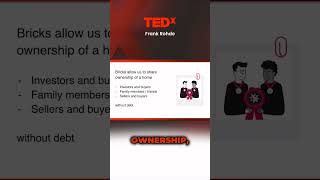
Ownify divides homes into 10,000 "bricks," membership interests that residents can buy monthly at fair-market value. A couple in Raleigh-Durham made fixed payments over two years, buying more bricks when prices dipped and fewer when they rose, growing their equity from 2% toward full ownership without a mortgage.
Chapters
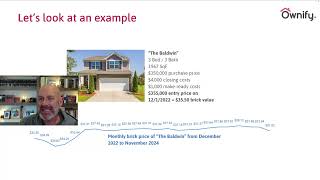
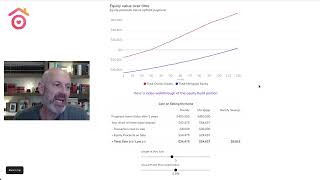
Hey everyone, just wanted to spend a minute explaining what bricks are. So we've talked about this concept of fractional ownership. We're fractionalizing the title by placing it into an LLC. So bricks are really shares, or more accurately, membership interests in that LLC. So in our model, the LLC holds title to the home, the LLC issues 10,000 shares or bricks, and the customer then owns those bricks starting with 200, working their way up. And every month we value the home. We establish the fair market value of the home. We'll talk in a second about how exactly that works. So a brick is always a representation, a legal ownership of 1/10,000th of the value of the home. So take an example. We have a $400,000 home that we purchased. We divide it by 10,000. A brick or a share is worth $40. The customer buys it for $40. We sell it for $40. If we wanted to buy it back, we would also pay $40. So really core to the concept of fractional ownership are this notion of bricks or shares in the LLC that holds title to the home, meaning the value of the home divided by 10,000 represents the value of the bricks. So if you think about that concept, right, a brick can be owned by the customer, it can be owned by an investor. And if it's owned by the customer, meaning someone who lives in the home owns bricks, owns shares in their home, obviously they wouldn't pay rent on those bricks. However, if those bricks are held by an investor, we charge rent and the investor gets a fair market value rent on those bricks. So really bricks are shares that generate income for investors, but once they're bought by the customer, you know, it doesn't make sense for a renter to pay rent into their own pocket. So effectively the rental payment just goes away. What's important in this whole construct is that again, this is an equity-based path to ownership. It does not involve debt. There's no mortgage, there's no principal balance, there's no borrowing that happens, there's no interest rate. This is not a debt obligation. It is really a share of the home through this LLC structure that allows the customer to own equity without having debt. Alright, so just a little example here. Again, as I mentioned earlier, the value of the home is always 1/10,000th of the brick. So we buy a home for $350,000 and we pay, you know, let's say $345,000. We have closing costs, we have make-ready costs, and at the end of the day, our total entry price for the home is $350,000. At that point, the value of a brick is $35. Now, you may ask, what about a month later? What about 2 months later? If the customer is buying bricks every month and we're selling bricks from the fund or investors, so this trading mechanism of bricks or shares in the LLC going back and forth requires that every month we evaluate the, or we set the value of bricks, and we use 3 independent valuation providers to do that. So all 3 of these, Clear Capital, Cocoon, and House Canary, you can see at the bottom here, are 3 independent large companies that do this for a living. Been in the business. They're used by thousands and thousands of institutional investors, and those companies create what's called an automated valuation model, or an AVM, which is really establishing the fair market value of the specific home— not the market, but the specific home that we're talking about. So that home that we bought for $350,000 last month might be worth $348,000 or $352,000 a month later, and we use the 3 different valuation providers to pull those numbers. And then we triangulate, we basically average— there's a little bit more involved in that, but we basically average the 3, those 3 numbers to say, here's the current market value. And that's a really important point because we, Ownify, don't establish the value of the home. It is the market that establishes the value of the home through, you know, all the transactions that are happening for similar homes in that zip code or in that market. And those 3 valuation providers have built the models and the assessment and the, the, the process, right, to pull all that data and establish an accurate valuation. And for the types of homes we buy, generally those valuations are accurate to within 2% or so of the actual market value. So you're not going to get a better assessment from an appraiser or a broker price opinion or some other, you know, mechanism And that, that's really what allows us to sell homes through bricks, right? And allow the customer to buy the home through brick purchases because we have a very good methodology of establishing the actual value of that brick at any given point in time. So now what does that mean? Well, the customer makes a monthly payment every month. We are selling bricks from the fund, right, to the customer every month. At market value. So here I've put an example. Let me move myself out of the way a little bit here. I've put an example of the Baldwin, which was one of the first homes we bought and we financed for one of our customers. It's in Raleigh-Durham, and Zach and Skylar, who live in the Baldwin, um, are buying bricks every month and have been for 3 years now, um, always at market value. So when we bought the home, we paid $350,000 all in. Actually, we paid $350,000 purchase price. We paid $4,000 in closing costs. $1,000 was make-ready costs. It was a little bit of cosmetic repairs. It was a fairly new home. And so really what that meant is that the value of the home or the entry price was $355,000 when we bought it. So the customer, Zach and Skyler, contributed 2% to that $355,000. And then they bought and it started buying bricks every month, always at market value. So what happened is we started out at, you know, $35.50, which is that $355 divided by 10,000. And then a month later, the value of the home fell a little bit, so we sold bricks at $34.99, and the customers bought bricks at $34.99. And then it fell a little more to $33.82, kind of came back up at $34.20. And so on and so forth. And so really, it's just like a share price of any company that you might see on the New York Stock Exchange. The value of this home changes over time. We mark to market every month based on these 3 independent valuations, and that really allows us to then sell or buy, um, bricks, i.e., shares in that home every month. And so this is the monthly brick price as it has evolved over that first 2 years from December '22 to November of '24. Now, Zach and Skyler, who live in the home, have been buying bricks every month. And so what you would expect is they're accumulating equity, and we're going to show on the next page exactly what that looks like. So, you know, they make a fixed monthly payment and buy a certain dollar value of bricks every month, which really means that when home— when the value of the bricks is slightly lower, like right here, $3,382, they buy slightly more bricks. And when the value of the home goes up and they're buying bricks at $37 or maybe even $38 over here, right? At that point, the value of the home has increased and they're buying, you know, at a higher price, which means they're buying slightly fewer bricks, right? Because imagine you're making a $500 investment every month into these bricks, right? You're actually buying more at the $33 price than you're buying at the $38 price. And that, by the way, is called dollar cost averaging, right? And if you're a financial advisor or an investor, you know that that's exactly what you do when you put money into your 401(k) or into a mutual fund or any other investment vehicle where you're making a recurring investment. And you always buy slightly more on the dips and slightly less on the peaks. And that's a great way of accumulating equity. And when you look at what happened to the Baldwins, right, Zak and Skylar, living in this home, they started with $7,100. That was their down payment, their 2% contribution into this home. And then every month as they made incremental equity purchases, as they bought incremental bricks, they increased their equity value. And it's a very nice diagonal line, which means in a very safe fashion, right? They're building equity, they're building value, they're building their nest egg in this home on their journey to eventually taking it over with a mortgage. So that's a core concept to the fractional ownership model and this ability for the customer to buy shares, right, buy fractions of the home as shares in this LLC over time. Thank you guys for listening. I hope that was useful. Please subscribe to our channel. There's content for you as a first-time homebuyer. There's content for our realtor agent partners, and there's content for investors, all neatly organized into different channels and different playlists. Thank you.