Frank Rohde, CEO of Ownify, says the average home costs 4.3 times median income, the highest ratio in 77 years, while institutional investors now own 25% of single-family homes. His company proposes fractional ownership: buyers purchase initial "bricks" and accumulate more monthly while renting the rest, eventually refinancing into full ownership.
Chapters
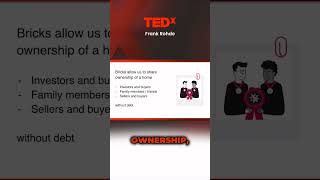
I want to talk about housing and housing affordability. There is a big problem that we have in the US. It's really a global problem, which is that homes are more expensive than they have ever been. And first-time buyers in particular, young people entering the market, are facing the toughest environment in over 50 years. And I think everyone kind of knows this anecdotally, but I want to take you on a little journey into some of the underlying reasons and then discuss how we can potentially solve for this. The average house in the US, the average home in the US today costs 4.3 times the average income. That compares to 1.9 times the average income in 1970. And it's the highest number since we have records. We have this data going back to 1946. That's 77 years. Houses are more expensive now than they have been in 77 years. If you live in San Francisco like I do, it's even worse. Most of the coastal cities, this number is significantly higher. So not just San Francisco, but places like Raleigh-Durham and Nashville and other cities have this problem. We also, in addition to home prices, now have the highest mortgage rates in over 20 years. The 30-year fixed-rate mortgage, which is the traditional First-time buyer product just topped 8% last week. We have a regressive tax policy that was enacted in 2018 that basically did away with the mortgage interest tax deduction for first-time buyers. This is a little-known fact that most first-time buyers do not qualify for the mortgage tax deduction anymore. So what used to be support from the federal government via interest tax deduction is no longer available. We have student debt that's putting pressure on first-time buyers. And as you all know, in October, this month, after 3 years, student loan repayments have started to kick back in, putting again more pressure on budgets. And we have institutional buyers, basically Wall Street, buying about 25% of single-family homes in the US and turning them into rentals for investor benefit. So in that environment, The ability for a first-time buyer to go out and graduate from renting into owning even a starter home, a $200,000, $300,000 home, has significantly decreased. We did a deep dive here in Raleigh-Durham, our launch market, and we looked at the win rate for the average first-time buyer, which used to be roughly 15% in 2017, has gone down to 2% last year. So 50% of first-time buyers get help from family. And these folks, quite frankly, don't need our help. What about the other half? What about the people who don't have generational wealth to help them buy homes? And then you look at the effect. Homeownership has been regressive in the US for a number of years. And we're stuck. We're stuck with a homeownership rate and a system that favors generational wealth and disproportionately disfavors minorities, recent immigrants. So why do I care? I spent 15 years as a CEO of a software company here, venture-funded, selling a pricing engine to mortgage lenders. So I spent 15 years in the bowels of mortgage pricing, which is super exciting if you care about it. And one of the things I learned is that the system doesn't really isn't really engineered to support first-time buyers, and there's really no incentives in the system to solve this problem. So I sold this company, moved on, started a new company, and we tried to sit down and said, why should we solve this problem? Why should we all care about ownership? Ownership is the single largest contributor to wealth. And I'm not talking about, you know, independence and huge wealth. I'm talking about the nest egg of the average American is largely contained in their home. Homeowners have better access to schools. So there is, in our educational system, a progressive effect here where homeownership actually allows parents to have better access to schools, which benefits their children. And we have crime rates, whether that's correlation or causation, you can argue, and I'm happy to do that. Crime rates are lower in areas with higher homeownership. And it's also part— a deeply personal part of the American dream. People like to own their four walls. So how do we solve this problem? It's a massive generational problem. We can solve it with socially conscious capital. And the opportunity, we think, is somewhere around 1 million people per year, first-time buyers who are entering the system, who need help. So what we've challenged is the traditional choice between renting and buying, and we've basically created a path in the middle, an in-between that we call fractional ownership. So the ability for first-time buyers to buy a home, not the whole home, but fractions of the home over time. We calling it Buy Your Home Brick by Brick, Zero Debt, No Surprises. So how does that work? Well, You can pick a house, any house on the market, and we turn it into 10,000 Bricks. Bricks are ownership shares or interests in that real estate. The customer buys 200 Bricks on day 1 and then progressively buys 13 Bricks every month, and he pays rent on the Bricks that they haven't bought. So looking at the single home here, I can own a fraction and I can rent a fraction, but I have the perfect flexibility to decide how much I want to own, how much I want to rent. And the innovation here is that we can turn a brick into a security under an SEC exemption. And a security becomes a tradable instrument that any individual can invest in. So what we've done here is we've created liquidity in an otherwise illiquid asset. And we have bricks that are being bought by family members, circle of friends, the community, church, other folks who are interested in helping that individual. Bricks generate rental income, home price appreciation, and therefore become— there's an incentive baked into the ownership and the investment in those bricks. So we're effectively creating a crowdfunding mechanism for purchases of single-family homes in the United States. Thank you. Now, once an owner has accumulated enough bricks, they can qualify for a traditional mortgage, buy out the remaining investors, and own the home the traditional way. And what that does is it puts homeowners and investors on the same team, effectively having them jointly own the asset. And that has a number of benefits, savings for the first-time buyer and then return for the homeowner— return, sorry, for the investor. So being on the same team means sharing the rewards. And one of the things that we're very proud of is activating socially conscious capital in the markets where we've started. So, for example, we have a UNC professor who is funding homes for refugees in his community in Chapel Hill. We have other folks who have social mission and objectives around funding homes and funding BRICS for individuals that they care about. So we've raised a bunch of money. We're live in Raleigh-Durham. We've had a large amount of traction early on. We're looking for capital to fund homes, and if you want to Join us in giving first-time buyers an affordable path to homeownership. Please take down my information, contact me, happy to talk.