Ownify's Homeownership Solution for Realtors #realestateagent #buyersagent #firsttimehomebuyer
In this 26‑minute accreditation video, Ownify CEO Frank Rhoad explains the company’s fractional homeownership solution designed for first‑time and "missing‑middle" buyers. He outlines the mission to improve housing affordability, the underlying business model (Ownify purchases single‑family homes, places title in a single‑property LLC, and issues 10,000 private‑security "BRIC" shares), and how customers (called "ownies") acquire equity brick‑by‑brick with a low 2% down payment and a fixed monthly payment that combines rent on the unowned portion and a purchase of additional BRICs. The valuation of BRICs is set monthly by averaging three independent AVMs, creating a dollar‑cost‑averaging effect. Rhoad compares this structure to traditional mortgages, rent‑to‑own, and other low‑down‑payment options, highlighting benefits such as payment certainty, built‑in equity, covered repairs, taxes, and insurance, and protection against home‑price depreciation. He details eligibility criteria (single‑family homes $200‑$750k, minimum 2‑bed/1.5‑bath, credit score ≥600, income verification, fraud checks) and the agent’s role: qualifying clients, submitting property eligibility, and earning commission through a three‑party buyer‑agency agreement with Ownify’s LLC. The video walks through the suite of agreements (participation agreement, lease, LLC joinder, equity‑share agreement, memorandum of option) and the end‑to‑end workflow—from online application, $500 non‑refundable fee (credited toward down payment), offer preparation, inspection, closing, to post‑closing monthly payments and the five‑year term options (renew, buy out the LLC at market value with a 5% floor, or exit early with a buy‑back of equity subject to a relisting fee that tapers from 4% to 2%). Finally, Rhoad prompts agents to complete a quiz to gain portal access, marketing assets, and the ability to submit buyers. The video equips agents with the knowledge to present Ownify confidently and help clients become homeowners with reduced upfront costs and ongoing equity growth.
Chapters
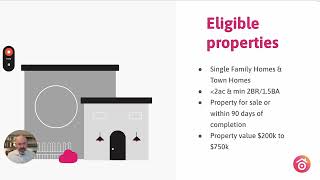
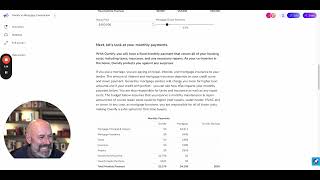
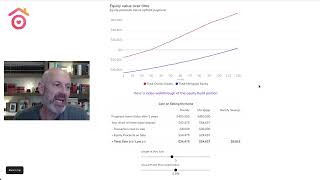
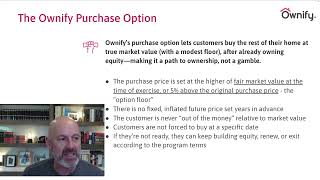
Hi there, welcome to the Ownify agent accreditation video. My name is Frank Rhoad, I'm CEO of Ownify, and I'm gonna take about 25, 26 minutes to walk you through how the program works, all the ins and outs, and make sure that you are credible and educated and knowledgeable when you present this to your potential clients. All right, so let's get going. All right, what is Ownify? Our mission is to help rebuild the path to homeownership for first-time buyers in particular, and people who are struggling with a down payment, the monthly payment today, just generally housing affordability. I think we all know the problems, see the problems, and we've spent a lot of time thinking through how do we solve this. Now, the backdrop to this is that myself and my co-founder Ben spent the last 20 years in and around the mortgage and real estate space. I ran a company prior to this that built the pricing engine for a lot of the large mortgage lenders in the US, Canada, North America, and got really deep into mortgage pricing, mortgage math, understand how that product works, and quite frankly, where it doesn't work. And then Ben has bought about 5,000 homes, single-family homes in his career. So we bring together that expertise of mortgage lending financing as well as real estate operations. And that's what led us to start Ownify with a specific focus on helping first-time home buyers. So what is Ownify? Ownify is a fractional homeownership program. That's important to understand. It's not a mortgage. It's a fractional ownership program that allows customers, we call them "ownies," to buy their home brick by brick and build wealth with an affordable upfront payment and no debt and affordable monthly payments. This is targeted really to what we call the missing middle. So people who have good income, they have good credit, they haven't saved the down payment. Why haven't they saved the down payment? Well, they live in expensive places. They have student debt, they might have young families, and so they are— they should be qualified, but they can't afford the down payment. And today, quite frankly, with mortgage rates— this is November 2024— mortgage rates where they are, the monthly payment is a big hurdle as well. So, so really focused on people who, you know, maybe 5 or 7 years ago were qualified to be homebuyers but have been squeezed out of the market. So how does it work? Unify buys homes on behalf of our customers and we make all cash offers. So these are homes, and we'll talk about eligibility in a second, but we buy single-family homes for our clients once they're qualified. Once we purchase a home, we place the title into an LLC, limited liability company. So this is not a fee simple purchase where you pledge title to the lender, which is the traditional mortgage-based path, but what we're doing is we're placing title into the LLC and the customer becomes a shareholder. Or a member of that LLC. So there's one LLC per home, that's important, and the customer is a shareholder on day one. They buy 200 of the 10,000 bricks or shares that the LLC issues. So today there's a 2% down payment that might flex up or down in specific circumstances, but that's the entry price or the down payment, if you will, for the customer. So on day one, the customer is a shareholder of the LLC that holds title to the home. He's also, they're also a tenant of that same LLC, and the way that fractional ownership program works is that every month the customer makes a fixed monthly payment. So let's say it's a $2,500 or $3,000 payment, and that payment splits into two pieces. One is an occupancy or rent payment that goes to the LLC, and it's charged only on the fraction of the home that the customer hasn't bought. So on On day 1, the customer is renting 98% or paying rent on 9,800 bricks. And as the customer makes their monthly payment, they're also buying bricks equity every month. The way the math is dialed in is that we get them from 2% to 10%, roughly, at the end of 5 years. So as the stack of bricks that the customer owns increases, their payment that goes towards rent actually decreases. But it's important to understand that The payment for the customer is fixed over the 5 years, so they have visibility and a certainty around that budget. So again, Ownify is not a mortgage. There's no debt, i.e., there's no obligation to ever buy the whole home or pay off a balance. There's also no interest payment. There's a rent payment on the fraction of the home that they haven't bought. And then there is the equity purchase or the brick payment that is included in that fixed monthly overall payment. Now the BRICs, this is an important piece, BRICs are private securities, they're membership interests in an LLC that holds title to the home, and the value of these BRICs, if we issue 10,000 BRICs, the value of a BRIC is the current valuation, the current value of the home divided by 10,000. So in, let's say we buy a house for $320,000 in this scenario, At that point, in that month, the value of a brick is $32,000. $320,000 divided by 10,000 shares or bricks means a brick is worth $32,000. So the customer is buying bricks at $32,000. If we were to buy them back, and we'll talk about that later, we will also pay them $32,000 per brick. Let's say the next month the home valuation goes up to $323,000, so a little bit of home price appreciation. At that point, a brick is worth $32.30, right? Again, $323 divided by 10,000. Now a brick is worth $32.30. So the customer is buying bricks at that value in that month. And let's fast forward and say another month later or 6 months later, home prices have fallen a little bit, and they can go up and down, as we all know. The home valuation is $312,000. In that month, bricks are worth $31.20. So the brick is a security or a share, a membership interest in that LLC that fluctuates in value. Now, how do we establish the value? Every month we run AVMs, automated valuation models. We use 3 independent parties and we average the 3. So it's not Ownify establishing the value, it is 3 reputable companies that we use and we average the value. So it's third party, it's independent of us. And what's important to understand then is because the customer is making a fixed monthly payment, but the value of a brick varies over time, they are really buying a variable number of bricks every month. And in fact, what they are doing is on the dips they are buying slightly more bricks, on the peaks they are buying slightly fewer bricks, and that's dollar-cost averaging, which really means they are building equity in a very safe fashion over time. Okay, now how does that compare to a mortgage? So what we try to do is really combine the best of the mortgage world, the rental world, and the rent-to-own world. And one way to think about Ownify is it is like rent-to-own only with real equity ownership along the way. So the most important thing, and quite frankly the biggest benefit to the customer, is they're making a fixed monthly payment, they're building equity, so there's equity ownership which you don't have as a renter, right? You also have payment certainty. When you talk to people who rent, the thing, the two things they don't like is one, I'm not building equity, and two, my landlord can increase rent every year. With Ownify, you're getting a fixed monthly payment over 5 years, so you have payment certainty, right, which compares favorably to the rent. You also have the ability to renovate and remodel. Now, major things require Ownify approval. We have a process for that, but you own a fraction of the home. You are a shareholder in the LLC and you should be treating that home like it is your own. So if you want to renovate, if you want to remodel, you can do that and we encourage it. As I mentioned before, it's an affordable upfront commitment, right? Because of the equity structure, we're actually lowering the risk and that allows us to lower the down payment and lower the monthly payment. Importantly, in that payment, we cover repairs. So if anything major happens to the home, you know, we've replaced an HVAC and we've repaired roofs and things like that, that is covered by Ownify or by the LLC. So it doesn't, there's no surprise to the first-time buyer in that scenario. We also cover and include insurance, property taxes. So if you compare this to a mortgage, a lot of times what people, excuse me, forget is that with a mortgage you're paying principal and interest, but you also have to budget for property taxes and insurance and repairs, and all of that is included. So we really focus on making sure that the customer has one single payment that covers all of their housing needs. One of the things you'll see in your agent portal once you're done with the accreditation is a link to a detailed calculator that allows you to run these scenarios for your clients side by side to say, how does Ownify compare to a conventional 30-year fixed rate mortgage? How How does it compare to an FHA? How does it compare to maybe a down payment assistance program? And really what we're focused on here in this, this is an example, $400,000 home, you know, comparing against other low down payment options. So if you compare this against a 30-year fixed rate mortgage with a 3.5% down payment for someone with a 640 FICO who's planning to stay 5 years and you assume annual home price appreciation of 3%. You know, we look at what is the upfront cost, what is the monthly cost over that 5-year horizon, what is the equity gain that you have, i.e., as home prices appreciate, and then therefore what's the total housing cost, meaning your payments, your upfront payment, your monthly payments, whatever equity gain you have, that's your total housing cost, if you will, over 5 years. And so that's the way we look at how do we generate savings for the customer relative to to other options they might have. And, you know, please reach out after you've become accredited and we can walk you through how to use this calculator with your, with your buyers. All right, so what's eligible? This is focused on single-family homes, townhomes, less than 2 acres, a minimum of 2-bedroom, 1.5-bath, and the property has to be on the market for sale or be within 90 days of completion if it's a new build or a renovation. And generally right now the buy box is property values between $200,000 and $750,000. And then there's a long laundry list of very detailed eligibility criteria that we're happy to share with you. But this is kind of at a high level, the box. So how do we help clients? What's— and what's the benefit for you as you take this to your potential buyers? Well, one, we can take people off the sidelines and turn them from renters into buyers. And we give them the ability to own equity, be a homeowner from day one. We give them the ability to increase that equity ownership by virtue of buying these bricks over time, but the hurdle to get in is very low. It's 2%. That's the down payment today. And again, that can flex up or down in specific scenarios, but you know, very easy way to get started. 2% is not a whole lot more than the security deposit on most rentals. As I mentioned, you know, we cover repairs. It's a fixed monthly payment. And importantly, You are, as a first-time buyer, with this structure, you're actually protected against home price depreciation as well, right? So if you think back to 2009, 2010, 2011, when home prices actually fell, what happened to a lot of folks, especially the folks with low down payment mortgages, is they were underwater on the equity in their home. And the Ownify structure prevents that from happening. We call it evergreen equity. Happy to walk you through it, what that means in more detail. So, at the end of the day, what, you know, the real benefit though is cost savings for the customer. So, if you look at the early portfolio, some of the homes that we bought for our customers, they're beautiful single-family homes, again, starter homes, $300,000, $400,000, $500,000, and the portfolio has been performing really, really well for our investors, but importantly, our customers have saved about $33,000 on the down payment, And right now they're saving about $300 a month in their monthly payment as well, again, given where mortgage rates are. So how do you introduce Ownify to your clients? You perform your buyer consult as normal, and then you should establish if the customer fits into kind of the target categories, right? There's the, the renter who's on the sidelines, who doesn't think they can be a buyer or a homeowner, and we can get them off the sidelines. There is the kind of person who's on the fence. Maybe they could buy with a mortgage today, but they're worried about mortgage rates. They're worried about, you know, risk exposure. They're worried about making the wrong decision. And that's a classic persona, right, that does really well with Ownify. And then you have people who want a better deal, who don't necessarily want to put $50,000 or $30,000 down on a down payment with a mortgage, or want to save on a monthly basis. And again, back to the calculator, we can structure a better deal for them and get them off the sidelines. Qualifying the customer, not everyone is eligible. Today we are looking for, we're underwriting towards a minimum credit score, FICO score of 600. Obviously there needs to be enough income, household income to qualify for the monthly payment. And we do fraud and identity checks to make sure we understand who we're working with. It's a very straightforward process. You send customers to the website and you can do that through your agent portal. And when you invite someone to apply, that individual's name gets tagged with you as their buyer's agent. So if they close and if we close with them, you qualify for commission. The process itself takes about 15 minutes. It's all online. It's very straightforward. And importantly, we can take someone from not qualified to fully qualified within, you know, 15, 20, 30 minutes, and we can have them make an offer on a home a day or two later. So we're not stuck in this mortgage world of, you know, 2, 3, 4 weeks of underwriting, close time. So to the extent that you have someone who, you know, wants to make an offer, has seen a house, and they want to get going, we can accommodate that. Now, What's important with the NAR changes in particular is you are the buyer's agent. Who is the buyer? The buyer is an LLC set up by Ownify. So really what we're structuring here with the buyer agent agreement is a 3-party agreement where you are signing a buyer's agency agreement with Ownify and on behalf of that particular client, right? And you're representing in this purchase process the customer and Ownify, which means Ownify i.e., the LLC managed by Ownify, makes the decisions around what's the purchase price, you know, what's the due diligence amount, etc. and so forth. Now obviously that's a consult and a conversation we're going to be having, but it's important to understand that this is really a 3-party agreement. So the agreements that the customer signs, and this is important because you're ultimately the one working with the customer and helping them understand this, there are kind of 2 major agreements or 2 groups of agreements. The first one is a participation agreement, which is relatively straightforward. It's 2, maybe 2.5 pages depending on the state. It's during the application phase. It outlines at a high level how the program works, and it governs the application process and the application fee. We'll talk about that in a second. And then there's a separate set of agreements, which are the actual purchase agreements that will have to be signed 3 days prior to closing. So the participation agreement gets signed to enable the customer to start shopping and potentially make an offer, the O&E agreements are signed 3 days prior to closing. Now, those agreements really are 3, at the core, 3 different agreements. The first one is a lease agreement where the customer, the client, is a tenant of the LLC, right? Again, LLC holds title to the home, the customer is a tenant of that LLC. The customer also joins the LLC, so this is the LLC joinder, and what that establishes is the customer technically becomes a shareholder of their own landlord, which is an interesting structure if you think about it. But the customer joins the LLC, they have a lease agreement with the LLC, and then they sign an equity share agreement which governs the purchase of the bricks over 5 years, right? So every month The customer makes that monthly payment, buying bricks, the equity share agreement governs that. And then lastly, we have a memorandum of option, which gives the customer the right to purchase the home from the LLC at future market value at any point. And so those 3 agreements, right, the lease agreement, the LLC jointer and equity share agreement, and the memo of option really work in conjunction here. All of those will be signed electronically, and we manage that process for you. So back to what happens first. You submit a customer, they come to the Ownify website, they start the application process and qualify themselves. At the end of that, if they're qualified, they get a budget, and that budget says, "Dear, dear Oni, you're qualified for a home purchase up to $450,000, $500,000, $300,000, what have you." At that point, they are presented with the participation agreement, which outlines the terms of the program, and they need to sign that PA, that participation agreement, and pay a $500 application fee. That application fee is not refundable, but it does get credited towards the down payment once we execute on a home purchase with them. So that really sets you up as, you know, at that point, searching for a home. Going to open houses, visiting, you know, showing houses individually. And as the customer then narrows in their set of choices with you, we have in the agent portal functionality to say, submit a specific address, right? To say, is this home eligible? And that runs through our entire list of eligibility criteria to make sure that this specific property is eligible. And it will also give you an indication of potential valuation. Now, this is important. Prior to making an offer, the customer has to fund their 2% into the LLC. So this is really to protect us as we'll be putting out due diligence and earnest money, and we're going to go through inspection process, et cetera. So before the offer is made, that 2% needs to be submitted. And time and time again, we run into this where you go out with your client on a Sunday, you see a bunch of houses, they get excited, 5 o'clock on Sunday afternoon, they want to make an offer. Well, they haven't wired their 2% and we can't make an offer until that happens on a, by, you know, Monday afternoon or Tuesday. So, to the extent that you know you have someone who's ready to go, make sure that that 2% gets submitted upfront. Now, once you have the 2% and you and your client are excited about making an offer, that's a process where we sit down with you to discuss valuation terms, and structuring the offer. Again, it's an all-cash offer, so we have some leeway here to, you know, strike a good deal for the buyer and, you know, negotiate aggressively with the seller. So that offer process, right, really is a joint exercise where we sit down with you, with a customer, and then come to agreement on this is what we expect, or this is what we would like to submit. Now, part of that obviously will be an inspection process. We expect that you will have seen the home. We will then run a proper inspection process post-offer. Two outcomes on the offer. One, obviously, the offer is accepted. Great, we'll wire due diligence money and start the inspection review due diligence process. We'll run inspections through our partners. We'll keep you informed on that process, but it's really a process that's driven by Ownify. If the offer is not accepted, obviously we might give it a second try, a third try. But if the, if that particular offer doesn't get accepted, the customer now has a 2% down payment that they've wired to Ownify, and they can either get that back at that point, or if the scenario is, well, we're going to look at this other house in 2 days, with the agreement of the customer, we keep that in trust until the next property is identified and we make an offer there. So now if we win, obviously we go through the inspection process. And what often occurs is that we find things that need to be fixed. So that could be a seller concession. It could be something that we pay for and roll into the purchase price. But that's again a discussion point with, with you and the customer to say, you know what, this is what this home requires. Here are the quotes for potential repairs and here's how we're going to execute them. Now, it's important to understand that we don't buy fixer-uppers, right? The goal here for Ownify is really to buy nice single-family starter homes. We understand that every now and then there's something that needs to get fixed. And, you know, we've done renovations and replaced windows and worked on roofs and kitchens and things like that. And we will do that up to a percentage of the purchase price, probably around 5%, maybe 6%, right? It's a little bit of a flex there. And again, subject to discussion. So, pre-closing, as I mentioned before, 3 working days prior to closing, the owner needs to sign final agreements, which then outline the specific property, the specific purchase price, plus whatever make-ready costs, right, for repairs, etc. It includes the final payment schedule, the final settlement agreement, etc., and so we close. We do e-signature whenever possible on the day prior or on the day of closing, and we ask that you do a final walkthrough of the property on the day of closing. So closing itself, you obtain the keys from the seller's agent. Obviously you've done that hopefully a number of times and will jointly celebrate the oni and help them, you know, get started with their new property. The after move-in, the oni is now part of the LLC, makes their monthly payment. One of the things that's important to understand is that the monthly payments don't start until the first of of the following month. So if we close on the 15th of a given month, right, the first payment is due on the 1st of the following month. And the owner at that point has access to the Ownify customer portal where they see, you know, their monthly payments and they have visualization of how their equity is growing, how they're buying bricks. And that is an important piece because at the point where, you know, in 3 years and 4 years and 5 years, at some point in the future, if they want to go out and get a mortgage and buy the home from the LLC, that portal establishes the provenance of the down payment, right, and effectively serves as the record of how they've built equity and how they've bought these private securities over time. Now, at the end of the 5-year period, which is the initial term of the agreement, the ONI has a couple of options. The first one is to just renew, right, and keep going with Ownify in 5-year increments, again, at a fixed monthly payment. And that's a way to, you know, stay with the Ownify program, not get a mortgage. The second option is to buy out the remaining equity or buy the home from the LLC. So this is really the point where the customer says, I've been in the home 3 years, 4 years, 5 years, however long, I've built up enough equity and I can now qualify for a mortgage. Maybe mortgage rates have down a little bit, and the right financial decision for me is to effectively kind of refi out Ownify or buy the home from the LLC. So that's the first option here. And again, the purchase option that the customer has is at whatever future market value. However, there's a floor of 5% above the entry price. So that's to protect our investor pool. So effectively, the customer has a purchase option at the the higher of 5% above entry or market value in the future. Customer can also move out at any point, and if they move out, what we do is we buy back their equity. So let's say someone has accumulated, you know, $40,000 worth of equity, again at that AVM, at the valuation that is set by the 3 independent AVMs, we will buy back their equity at that point. We do charge what we call a relisting fee. And the relisting fee is really the equivalent of a brokerage fee that the customer would incur if they had bought the home with a traditional mortgage and then sold it, right? And they would hire a listing agent and probably be on the hook for 5% or 6%. So the relisting fee that we charge is 4%, which compares favorably to that 5% or 6% for a traditional brokerage sale, and it reduces down to 2% in the second half of that 5-year term, so it melts away over time to really give the customer the ability to exit and keep a big chunk of their built-up equity. All right, we're at 26 minutes and 30 seconds. That's about as fast as we can run through this. The next step for you is to get accredited. There's a quiz that's below on the screen. Please take that quiz, and once you pass and ready to go, you'll get access to your portal. We have a bunch of marketing materials. You have the ability to order signs and riders and make flyers for your properties if you're a listing agent. You have the ability to submit customers if you're a buyer's agent. And I look forward to meeting you and working with you and helping more first-time home buyers. Thank you.
More from Frank

How to Save 5-7% on Your Home Purchase. #firsttimehomebuyer #homebuying #buyersagent #mortgage
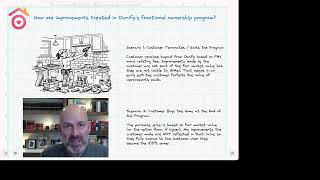
Ownify University: how does the purchase option in fractional ownership work?

Claude MLO Agent boosted homebuyer engagement by 8x! #mortgageloanofficer #mortgageloanoriginator
Wall Street vs First Time Homebuyers Understanding the Housing Market #housingmarket

Homeownership: Your Ultimate Wealth Builder Explained by Frank Rohde #housingmarket