Emotional Sobriety Chalk Talk
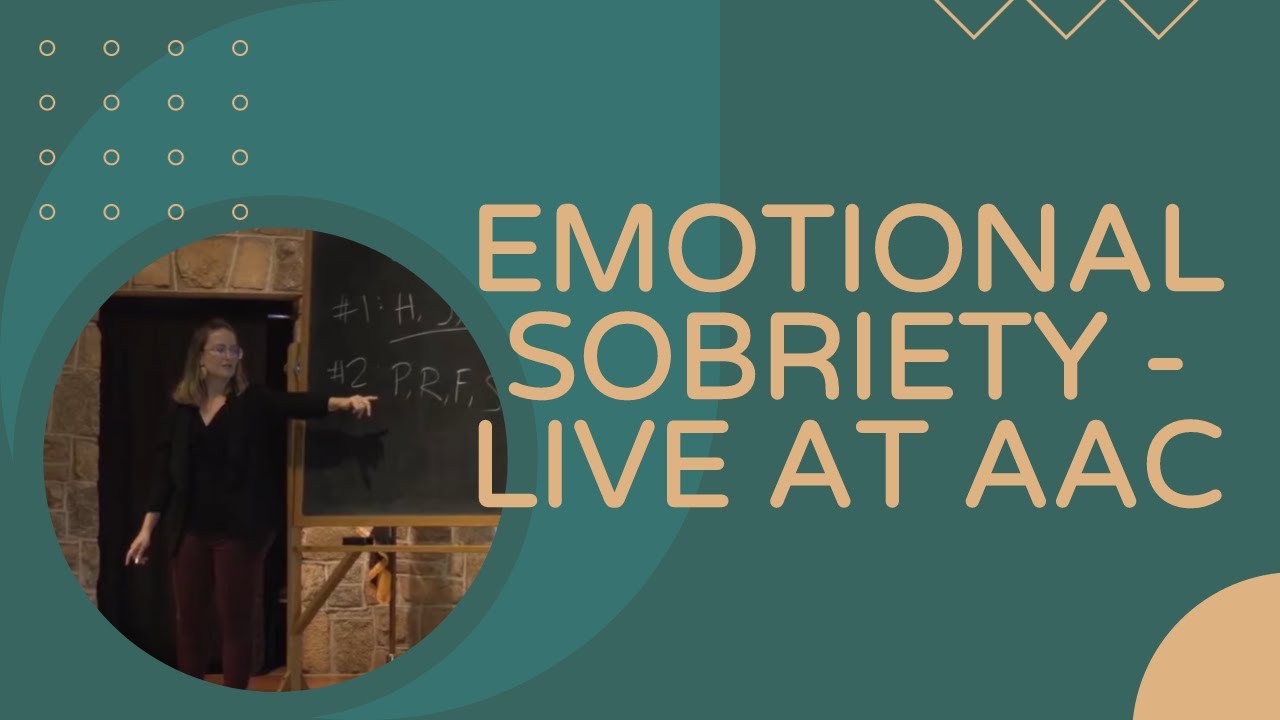
This content was created by Hannah Rose. This content was uploaded by Hannah Rose. This is a YouTube lecture-style recording titled "Emotional Sobriety Chalk Talk" (posted 2019-10-11) in which Hannah Rose (introduced as an anthropologist and relapse counselor) delivers a public talk to a patient/community audience about emotional sobriety and recovery. Mark serves as the host/introducer and interjects occasionally; other people are referenced (Robin, David, Dr. Burke, Stacy) and an audience participates with show-of-hands and reactions. The talk covers symptoms of sobriety versus alcoholism, myths about emotional sobriety, barriers (fear, control, resentment, shame, imposter syndrome), therapeutic frameworks (Big Book references, Brené Brown, Rumi, The Four Agreements, narrative therapy), and CBT/REBT’s ABCD model, with personal anecdotes from Hannah’s recovery and counseling experience.
Chapters
Jay graciously agreed to help us out and made a donation, so today's modern version of Chompton is presented and sponsored by Jay and Maria Eliskin.
So thank you so much.
And this person who's going to be presenting today, We have an interesting relationship. We, um, I was at her 1-year anniversary, her 1-year sobriety anniversary. Am I allowed to talk about that?
Sure.
So I was at her 1-year sobriety anniversary when I was in a halfway house in Bel Air. And fast forward 3 years, I started working at Ashley, and I went to RIOP, and Hannah was a counselor there. And I was like, "Hey, I was at your anniversary." She didn't remember me. And I was living in a house after a bad first relationship in recovery. They say don't get in a relationship in the first year. I didn't listen. So I was living in a house with 2 bedrooms by myself, and Hannah asked if she could move in, and I said no. And I think I called her a day or 2 later and said, "Pack your stuff and move in," and she did. And we've been friends ever since— platonically, I just want to make that very clear. Hannah and I have been friends ever since, and I've seen her— she used that same line on me a couple weeks ago. Um, but I've seen her grow and really become a great presenter, and she's the only person that I can think of that can do Father Martin justice. And really excited to turn the mic over to Hannah Rose to present a modern version of Father Martin's famous Chop Tops. Hannah Rose!
Hi everyone! Thank you, Mark. My name is Hannah Rose, I'm an anthropologist.
Hannah Rose!
I was gonna hold this as a prop to make me less nervous, but it's not doing anything at all, so I'm gonna put it down. Alright, so I like to start every single lecture I do, and I'm treating this as a lecture that I would do for our patient community one Friday a month in this room, by saying the same thing if I ever feel this way, which is, similar to what Robin said, I am so uncomfortable right now. I'm really nervous, and it's interesting because often when I lecture, I talk about emotional sobriety. Just by a show of hands, who has been to at least one of my lectures? Okay. Alright, so that makes me significantly less nervous, uh, because you know a lot of what I'm going to say. And emotional sobriety is not about me coming up here and feeling 100% confident. It's not about me coming up here and saying, "My name's Hannah Rose and my life is perfectly put together, and here I am with my professionalism because I'm a professional." That's just not emotional sobriety. So much of what Robin and David talked about, I was joking during their spiels, they both killed it, but I said, um, you know, that's like my whole Chalk Talk in a nutshell. It's like my whole Chalk Talk is taking off the mask, acknowledging your true self, leaning into the discomfort, and identifying what is blocking me from being authentic. So, for those of you that have heard me lecture, you know that I don't really prepare. I don't really prep. I don't really have an outline. And I also tend to speak pretty quickly. Not just when I get nervous, because that'll fade in approximately 37 seconds. But when I get really passionate about something, not only do I yell, but I have what we call in the clinical world pressure of speech. So that means that I'm going to get super pumped, and if at any point I'm moving too much and I'm speaking too quickly, just raise your hand. Let's try that out. Oh, sorry. Okay, alright. So I'm going to try to settle down the best I could because, based on Jay, no pressure at all, this is being professionally videotaped, and I said to myself I wouldn't acknowledge it, but I just did, so now it just happened. So, we are going to talk about symptoms of emotional sobriety. Now how many of you, I'm going to do a lot of show of hands, how many of you have watched any of Father Martin's videos? Talk to us? Wow, keep your hands up. I know, you just want to put it down as fast as you can for some reason, even though it doesn't require a lot of energy. Keep it up, keep it up, okay? How many of you have seen— no, keep your hands up— of you all, thanks, Dr. Burke, how many of you have watched Symptoms of Alcoholism? Okay, a lot of hands. Keep your hands up if you've also watched Symptoms of Sobriety. Okay, nice. I can hear myself now saying, "It's not us, it's you." Some of you that understand grammar got that joke. Okay, so Father Martin talks about symptoms of alcoholism, right? What does being an alcoholic look like? Now every single person in this room has been touched metaphorically by an alcoholic or an addict. So Father Martin makes tongue-in-cheek jokes that just come out the top of his head, and I realize that is part of who I am, so I'm going to keep doing it. It might get awkward, but just bear with me. So he talks about symptoms of alcoholism, and everyone in here knows those symptoms, right? They look like sometimes a physical dependency, they look like hiding alcohol or drugs, they look like blackouts, they look like questioning, right? Am I an alcoholic? Non-alcoholic addicts don't question if they're an alcoholic or an addict, right? They just don't. And so he also talks about, in my favorite video, symptoms of sobriety, because what we know from symptoms of alcoholism is that a knowledge of causes does not dissipate the problem, right? So often we want to know why. We come to treatment, I work here by the way, I should, you know, I work here, I'm not just like some person. I am a relapse counselor here, I've been a relapse counselor for the better part of my 4 years at Ashley. At first I was an emerging adult counselor for about 4 days, and then I was a primary counselor, and then I was a relapse counselor, and that's what I am today. And so I see a lot of people come in and they just want to know why. And in primary, it's often, "Why am I an alcoholic?" And in relapse, it's, "Why did I relapse?" And it's so important, right? Therapy is often about taking our tangled emotions and experiences and just untangling them with the help of someone non-biased, objective, right? But a knowledge of problems, or a knowledge of causes, does not disappear the problem. And Bob Perkins said, "If I go to the dentist for a toothache, me knowing why I have a toothache is not going to make that toothache go away." The knowledge of causes helps me to prevent it from continuing to happen again, that is true, but what is going to help that toothache go away, right? Going to a professional that specializes in teeth. And then accepting the treatment. And yet we come into recovery, often not on a winning streak, never on a winning streak, and we say, well, I just want to know why, because maybe if I know why, I'll just self-will my way to recovery and I'm not going to drink or use again. How many of you have ever thought that? Mm, yeah, okay. And so emotional sobriety is what I believe is the missing piece. There's also a chapter in Big Book called "The Missing Link," maybe? Yeah, I got one hand down, so I know that I'm on the right path. And so for me, that missing link is emotional sobriety, and I'll touch a bit on my own personal experience here and there, totally professional. In a boundary way. But the reality is that in Symptoms of Sobriety, Father Martin identifies one that is my absolute favorite: laughter. Right, someone that's in recovery can laugh about their experiences, and I think most of us know what that's like. But in Symptoms of Sobriety, he also says that an ingrate will not stay sober, which means if I don't have the capacity to cultivate gratitude, I'm not going to stay sober. And I'm going to take that a little bit further in this, Symptoms of Emotional Sobriety, because there's so many myths about what emotional sobriety is. Myth number 1— uh, write on the chalkboard. So I'm going to keep rolling. So number 1 is— I just realized I'm not going to write it all out because I don't know how Father Martin did it, Happy, joyous, and free. Ooh, nice audience participation there. Right, if I'm doing well in sobriety, and if I have what they call emotional sobriety, I should feel happy, joyous, and free all the time. Who has ever thought that? Oh, okay. Awesome. Myth number 2: I won't feel pain, resentment, fear, stress. Actually, worry is coming. When I was about 4 years sober, I told myself I shouldn't feel pain. I didn't know that I was constructing these completely irrational narratives, but I told myself after walking through a painful breakup, just like what Beau was talking about, I have 4 years sober, I shouldn't be feeling this way. One of the biggest barriers to emotional sobriety is a word that I just said, but I'm going to say it a lot of times in a way that represents we should not say it. Don't should on yourself. Don't should on yourself. Take me, yo be. Coined by positive psychologist Albert Ellis, who talks a lot about Rational Emotive Behavior Therapy, which we're going to get into in a second. One of the biggest barriers to emotional sobriety is shoulding on ourselves. And shitting on others, by the way. It's a quick way to really cultivate disconnection in our relationships. "Oh, you shouldn't feel that way." For all you lovely people who meant well and came up to me and said, "You shouldn't be nervous." Well, I am. Thank you though. I didn't say it as passive-aggressively as that, but do you know what I mean? Like, we try to take away people's pain. Robin mentioned Brené Brown. How many of you are familiar with Brené Brown? If you raised your hand about coming to even one of my lectures, you should raise your hand because so much of what I say is adapted from her. Brené Brown talks about how rarely can a response make something better, right? What makes something better is connection. That's empathy versus sympathy. Sympathy is not what to start with, at least. Empathy is how to do it, right? Oh well, at least it's only 45 minutes. Okay. Thanks. Great. We need to just show up for each other's emotional experiences. So, what is not emotional sobriety? Happy, joyous, and free. I shouldn't feel pain, resentment, or rejection, fear. I don't remember what the S was, but— Stress. Stress, thank you. No, that is not emotional sobriety. I'm pretty sure that I was told that I shouldn't try to erase, but I'm going to. Oh God. I'm not going to erase anything. So what is emotional sobriety? I often preface my lectures with this, and I'm going to do it now because I forgot. Everything that's coming out of my mouth, and I will continue to, is my opinion. And that opinion is largely rooted in both my personal and professional experience. However, I'm a firm believer that I do not have a monopoly on what is true for me. So I may say certain things that you don't agree with, and that's okay. I'm not here to stand up here in my Target chic apparel and tell you what I'm saying. I'm not! Brian knows what I'm talking about. I'm not here to do that, but I'm here to talk about my experiences, the very informal qualitative research I've done in the last 5 years working in this field, and how I think we can break down the barriers to emotional sobriety. So, that's my little, like, preface, so that I won't be held liable for anything I say. So if emotional sobriety is not feeling happy, joyous, and free, what is emotional sobriety? My working definition is that emotional sobriety is being able to show up and feel all of your feelings without reacting on autopilot, and without running in the opposite direction. So for me, emotional sobriety means that when I walk on stage and I feel so uncomfortable, I can just say it. I can feel it. I don't shame myself. I went back into that little prayer of setting intention to set aside everything that I think that I know and have the universe just kind of speak through me and say what I need to say. And at no point did I say to myself, "Gosh, shouldn't be nervous. I've done this so many times." I haven't done this so many times, by the way. This is the first. I didn't tell myself, you know, "Oh, I'm an impostor." Why did they ask me to do this? They must see something in me that's not real. Right, I don't experience imposter syndrome today. At certain points if it comes up, I'll acknowledge it and I'll create space to feel it, but I don't shove it down and say I shouldn't feel that way. This is a vulnerable question. How many of you have experienced imposter syndrome? Wow, keep your hands up please. I want you all over here. Now we've got people from all different walks of life, right? For me, the imposter syndrome was very much being young, potentially inexperienced. You know, I do a lot of— I only do counseling for adults, right? That's people in the 30 range and above. And there's a lot of marital problems, and my imposter syndrome said, Hannah, you're not married, what do you have to offer? Right, what makes you a good therapist is actually not personal experience. And oftentimes when they come to rehab and we say, well, I want a counselor that's been through addiction, yeah, that's what AA is for, right? Connecting with another alcoholic. That's not what formal therapy is for. And so if there's something in you that really wants to connect with someone that just gets it, get a sponsor. Get a therapist that knows what they're doing. And that doesn't mean personal experience. So emotional sobriety is being able to just show up and feel. And it sounds— maybe it doesn't sound easy, but it sounds simple, right? I should just be authentic and be myself. And yet, it's so difficult for so many of us. To just show up, feel our feelings, be authentic, right? Why? Because— I don't know what the number 1 was, but here's number 2 again. Things that block us from emotional sobriety. There's a part in the Big Book, and they talk about stuff blocking us from the sunlight of the spirit. I don't believe they use the word stuff, but let's go with it. And so I like to think of this imagery. I said I wouldn't finger the camera, but I just had to. So there's a sun, right? This is the sun. And on it, you can put something that you want to feel disconnected from. So for me, sobriety was a big one, right? Whatever it may be, this is the sun. So the sun's got all these rays, okay? So let's do sobriety, maybe a higher power, right? I'm gonna do HP, Harry Potter. If you were in my lecture on Thursday and you didn't think it was funny then and it's still not funny now, I'm just gonna do it. So, higher power, right? What about just connection? How many of us want to find love? Mmm. No?
Awesome.
Right? What are other things we kind of want? Spidey connection, peace? For me, being happy, joyous, and free. Requires me to stop trying to control everything and everyone. And then, I don't know, whatever you want. So the sun is there, right? Sun and the spirit, as it's in the Big Book. And so here's us. I'm not in that room. This is a sad person. This is me. That's better. So I believe that everything that we're looking for is available to us at any time, right? I subscribe to the notion that everything we're looking for is inside of us, Alright, or maybe it's just up there and it's just there for the taking, right? It says in the Big Book that God doesn't make— ooh, I don't know, it's not hard to find that. I'm looking, that was paraphrasing, it says something like that. So here's an umbrella, and this is shade or rain. Well, it wouldn't rain under the umbrella. This is shade, okay? So the solid and the spirit, right, all the things we want and are looking for— oh, I know that's a shortcut right here. Emotional sobriety. Right? It's all right there, and yet here I am standing in the shade. My task is not to find this. My task is to deconstruct what's blocking me. Which means at first I need to identify those blocks. If you've been to a lecture of mine, you will know this quote hopefully by heart, because I say it in every single lecture without fail, but the Persian poet Rumi has a beautiful quote and it says, "Your task is not to seek for love, but merely to seek and find all the barriers within yourself that you have built against it." So you can substitute the word love with any of these things. My task is not to seek God— opinion. My task is to seek and find all the barriers within myself that I have built against a belief in a higher power. My task is not to go find the perfect relationship, because I can guarantee you, if you haven't done some internal work on yourself, that perfect relationship can come into your life and you will sabotage it. Because we accept the love that we think we deserve. So my task is to say, "What's on my umbrella?" For me, fear is a big one. It's also normal to have fear. Some people say fear and faith don't live in the same house. If you're gonna worry, why pray? If you're gonna pray, why worry? I don't agree with that at all. We're human beings, which means we are wired to have fear, and it's actually healthy. And true faith for me is feeling my fear and walking through it anyway and knowing that I'm going to be okay no matter what. And to me that's the power. Right, in the wake of admitting powerlessness over substances and other people, if you're going to work the codependent 12 steps, which I encourage, then it also means I get to find out where I do have power. Which is pretty amazing. And exciting. So what's blocking me from emotional sobriety? Fear? Control? 99.999% of my resentments stem from me expecting you to act the way I would act in any given situation. I was just saying to someone earlier that was trying to help someone else, "Listen, let them whirl!" Right? And that's something a very wise woman in AA said to me, she said, "Not your circus, not your monkeys." Right? And I have to constantly remind myself of that. Is that, is this person soliciting advice? If so, I'll give it to you, but I need to be sure to not get emotionally attached to the outcome. Because it's not about me. Who here has read the book "The Four Agreements"? Ooh, yes! If you haven't, highly suggest. "The Four Agreements," the first is, "Be impeccable with your word," which stems from "yudimun srakta word," without sin. Right, so the way that I speak about myself and others Essentially, I'm constructing the reality that I live in. And that means that I'm constructing the hell I live in, or the heaven, as to how Don Miguel Ruiz puts it in his book. And so how am I speaking about myself? Right, I'm a really big fan of narrative therapy, which brings a level of awareness to the story I tell myself. Interestingly enough, Brené Brown uses that in one of her books and TED Talks. Does anyone know Brené Brown? Give her a mic. I'm just like promoting her day in and day out, she doesn't even know. And she says— I lost it— but something along the lines of, the story that I'm telling myself is blank. So if I'm feeling hurt and upset and betrayed or resentful in a relationship with anyone, instead of saying, you make me feel this way, or even as a lot of therapists like to utilize When you do this, I feel this. That's still just saying, "Baby feels bad." Then a new way of doing it is saying, "You know, the story that I've constructed in my head is that you're losing interest in me." Right? The story that I'm creating is that you like them better, or you think they're better for the job, whatever it may be, and we start to really own our experience, right? Because we construct the reality that we live in. So first one, be impeccable with your word, right? What's the story that I'm telling? I've told myself about myself. The Big Book says that we've all got our realities, and then there's the Great Reality. We all have so much emotional bias, and that's normal, but let's acknowledge that. The second agreement is— actually, before we do that, be impeccable with your word. I once had a sponsor tell me, Hannah, stop referring to yourself as sick, and as crazy, and as codependent, because you will continue to believe it to be true, and then it will be. And she didn't realize that she was hitting on such a major psychological concept. The self-fulfilling prophecies that we inadvertently create. So, if you've heard me lecture, sometimes I get a little self-deprecating, but for the most part, you will not hear me say, "Oh, I'm crazy." And we do this thing in recovery where we say things like, "God, I'm really having a hard time with this breakup. I'm such an alcoholic." No, you're just a human being. Welcome to the rest of the world, right? The only thing, I believe, that separates us from our fellows is the allergy that we have to alcohol. Which I'll talk about in a second, maybe. So, be impeccable with your word. Agreement number 2: don't take anything personally. Yeah, it's tough, right? And that means that whether or not you come up to me after this and you're like, "You are so amazing, you're so great," awesome, or you come up to me after and say, "That was completely horrible, what was that you were saying?" I don't need to take either personally Because when someone compliments me, it's still more about them than it is about me. Right? Someone's like, "Wow, your hair looks so big." So I was like that. Actually, that one is about me. But for the most part, it's more about you, right? When I compliment someone, it's not just objectively they look good, it's because I'm feeling like I want to compliment someone in that moment. Or maybe they look the way that I want to, or whatever it may be, right? And the same thing is that If I experience a strong emotional reaction to someone, that's like, let's say level 5 or higher on a scale of 1 to 10, it has less to do with the person in front of me and more to do with the unresolved wound that it is triggering. So if I'm just like, "Gah, I resent the heck out of that person!" I don't know why I'm looking at the camera. Oh, I can't stop. That person, sometimes, you know, we say in AA, "Well, it's because they remind you of you," and like, maybe that's true. But they also could be reminding you of someone that you have this unresolved wound with, right? And the same thing when I have patients that are like, "You are the best!" I'm like, "Who do I remind you of?" And that doesn't mean I can't take a compliment, okay? But it does mean that I need to not take anything personally, right? If I do my job here, if you stay sober long-term and you're killing it, as hard as it is for me to want to, I can't take that personally. I can acknowledge that I've been a stepping stone and I helped, but I'm not responsible for your success. Right. Just like, and this has happened so many times, just like Rob talked about, right? If I work with a patient and they relapse and they die, I also can't take that personally. And we know from Al-Anon, as I'm sure a lot of you do, we can't cure, cause, or control. The same goes for everything, right? So what is one of the biggest barriers to emotional sobriety? Taking things personally and convincing ourselves that our self-worth is contingent on how you feel about me and changing ourselves ourselves, right? We trade our authenticity for approval, and we end up resenting ourselves and a lot of other people because of it. The third agreement is don't make assumptions. So what do we do? We take things personally and then we make assumptions about it. It's kind of just a human experience, right? And the fourth is always do your best. And what that means is that some days my best is 100%. Some days, especially if it's like before 10 AM, I don't think. It's like 30%. But all I can do is the best that I can do in any given moment, and I need to stop shaming myself. Because I am a firm believer that I cannot shame myself into growth. And so as Dr. Rose said, Hannah, put the bat down. It's not helpful. So what's blocking you? Right? And our blocks look different. I do a lecture on core issues, and it's about how we block on our core stuff, right? Alcohol was but a symptom. If you're in here and you're not an alcoholic or an addict, it's the reason I wanted to do an emotional sobriety, because this is, I believe, relevant to everyone. We've all got our stuff. Unresolved trauma and grief, co-occurring mental issues, disorders, right? Vices, some people call them, in terms of like gambling and relationships and a lot of other things. Lack of self-worth, lack of self-esteem, imposter syndrome, a core belief that I'm unworthy. It's one of the biggest, biggest blocks to emotional sobriety. And so our task is not to seek out these things, but it's to look inside and say, "What is blocking me?" Blocks. And then we figure out how to deconstruct them. I do need to do this because I'm going to talk about one really great way to not just deconstruct the things blocking us from our truth, be it being happy, joyous, and free, which are all just feelings, not finite places that you will feel forever. And if you are one of those people that's like, yup, living the best life, I'm happy, joyous, and free 24/7, cool. But like, I'm not gonna believe you. I'm just not, you know what I mean? I think we have this thing that's really exacerbated by social media where we want to project our best selves all of the time, right? Social media is a little insidious, it's a highlight reel of the best times. And if you're one of those people that also like overshares about all the bad times, that's equally as unhealthy as being like, "I'm only gonna show how great my family is," but internally we all hate each other and fight all the time. So culturally, societally, it's really ingrained in us. It's really ingrained in us. And most people in this room— I'm trying to do a quick gauge on age. It's a good guess that that's good, so I'm gonna stop. Were brought up in generations where feelings are fatal, right? I shouldn't feel. How many of you were raised with that message? To man up, right? Keep it together, don't feel. And my generation, the millennials, woohoo! Millennials, woohoo! Alright, oh god, okay, it's fine. We'll get more gusto later. In the millennial, and then sometimes, kind of Gen Z, but it's a little more distorted, there. This new kind of wave of vulnerability and feeling, and we can, you know, brush that off to— this is super tongue-in-cheek, and I have to say it because I can't not— we can brush it off to millennial snowflakes, right? We feel too much. But at the same time, we know how to talk about our feelings. We know how to get vulnerable, right? And often, generationally, there's generational trauma, but also norms and lack of communication that trickles down. I'm getting a really fired-up head nod in the back. That's probably it. I don't know if I'm stepping over the line of what I should say, but there's no shoes here, so I'm just going to be myself. And if you don't like it, it's a reflection of you. So I'm going to talk about one way of kind of preventing these cycles of blocks, right? Robin talked about the differences between shame and guilt, which I believe is like paramount to emotional sobriety. Often we kind of rehab, sobriety, or supply therapy, right? Sit down on the couch and say, "Oh, I have so much guilt and shame." Okay, well, those are two really different emotional processes. So guilt is "I feel bad." Shame is "I am bad." Ugh, my heart. Not that like I taught all of you that, let's just— I'm not taking it personally. No, I said it. I'll set it up in confidence. So basically guilt, "I feel bad," right? I feel really awful for not being present for my kids when I was in a blackout. I feel— what, just insert anything. Shame. I am. So it's taking guilt and internalizing it whole and saying this is a reflection of me. So, I lied a lot. I am a liar or I have lied a lot. Two very different processes. How about I am a chronic relapser? How many of you have ever said that? Okay, more of you, but I'm just gonna let it slide. So, right, that is a shame-based statement, because you are saying, "This is who I am." How about, "I am a people pleaser." Anyone? I said that before. "I am codependent." You may be saying, "Well then, how is that any different than 'I am an alcoholic'?" You probably wouldn't sound like that, sorry. But basically, for me, I still say, "I am an alcoholic," because I don't have shame attached to that. I'm like, "Yeah, I am an alcoholic." Which means if I were to drink today, I don't know what would happen. Maybe it would be fine, maybe not gonna play with fire based on my experiences in the past. And I don't have shame, it's like, yeah, I'm an alcoholic and that means I know how to talk about my feelings, I know how to get vulnerable, I sponsor women, I know how to connect with people, and also I walked through hell. Can I say that? Hell. I don't know, you don't know me there, so it's fine. Right? So that's why for me, I am an alcoholic is not poor little chick. But I am bad, I am unlovable, I am unworthy. This is taking guilt and internalizing it whole. I am not good enough. Probably the most common human emotion. Emotion? Process. Thought process. I am not good enough. For who? Right? We seldom play that tape through. Who are you not good enough for? Was it because you were raised with the messages, you're not good enough, you're not good enough? Or is it because you have really high standards for for yourself. I'm a perfectionist. I hear that all the time, right? That's not fun. That sounds awful. Because you're probably shaming yourself literally all the time. So guilt is actually a healthy motivating emotion. I feel badly about this. I want to change. Shame keeps us stagnant. Shame keeps us stuck. And shame usually stays— that kid is gonna have some shame. So I want to talk about something. Now this is a mouthful, so bear with me. I'm not nervous anymore, but I need to also still have a filter. I'm going to talk about something that's a little bit of a mouthful. Also, can you pass me that coffee? Thank you. Sorry, I know there's so much water, but I don't want it because I don't need it. Thank you so much. Hold please. Mmm, oh, that's so good. So, this is Albert Ellis's I don't want to say there's no way, but whatever. So it's cognitive behavioral therapy, right? CBT, most of us are familiar. But it's a facet of CBT, like a sub— thing, and it's Rational Emotive Behavior Therapy. So we're going to do CBT space REBT. It's a lot of letters, and it's the ABCD model of combating core irrational beliefs. Okay? And so it's really easy to remember, I think it's one of the only things I retained from my alma mater, Gallaudet I was in my active addiction at that point in time. And so, now, for my current patients, who you don't have to acknowledge who you are. Never mind, I'm gonna break it up. Okay, if you were here for the thing on Thursday, you will know this. I'm gonna try not to get eye contact with any of you. A is the activating event. So think about something in your life that that phrase promotes. Of an activating event. So for me, the first thing I always think of is getting dumped. How many of you have experienced rejection? Uh, I'm so sorry. Yeah, I just— everything in my face, and I'm like, yes, that is what we're going to talk about. Another really good relatable one for some of you is reflux, right? So with an activating event, something happens. It doesn't mean something happens to us, by the way. Something just happens and we make it about us. That's a good thing to remember. Is that life is not happening to you, it's just happening and we're bringing meaning to it. And often inadvertently playing the victim even into our adult lives. That's another chalk talk. Can I set myself up for another one? Just kidding! Alright, so B is the core irrational belief that follows. So A to B feels like an automatic process.— but it's not, and it doesn't have to be. And this is where we're incorporating mindfulness, right? We bring a level of awareness to what's going on internally instead of just acting on autopilot and reacting and making a fool out of ourselves. So an activating event happens. 16 years old, I got broken up with. I usually drop this little name, I'm not about to because this is being videotaped, but this person dumped me and I felt like my life was I really did. It's easy for me as an adult to look back and say, "Oh, I was just a kid, I was 16." At the time, it felt like my world was ending, which means that was my reality. Special shout out to my stepmom, Stacy, who's here today. Raise your hand, Stacy. Raise it. Yep. Ayy! Let's just give a round of applause for Stacy. So, yeah, you know, I don't— So special shout out to Stacy, who was the only person in my life at the time that actually validated my feelings. She didn't say, "Oh, get over it. You're only 16, like, this is gonna happen more times in your life." She didn't minimize my experience. And in hindsight, I see how valuable that was. She was the only person in my life that made me feel seen and heard. Because everyone else meant well with their sympathy, which was really like, "At least, look, he didn't knock you up." Yeah, right? "You're in high school, Hannah Rose, it's really not that big of a deal." How? I'm using traumatic really lightly. Traumatic is super subjective, and it's how our brain and body react to something more than it is about the external event. For me, what was not most traumatic was being rejected and then feeling like I was crazy for feeling the way that I was.
Right?
We carry that into our adult life all the way. And so this person breaks up with me. My core irrational belief was about myself. Now just shout it out if you, in an "I am" statement, know what one of those would be. I'm unlovable. What else?
I'm ugly.
I'm ugly.
Oof.
I wasn't dead, I don't know. What else?
No one wants me.
No one wants me. Right? Yeah, so these are the main ones. I get broken up with and I develop a core irrational— so it means it might not be real, it's probably not, but it's happening— belief that I am unworthy of love. Now, it wasn't until 10 years later with some good therapy, it was pointed out to me that that is where the start of a lot of my stuff happened. Not all of it, I'm not talking about, "And then I drank because of him." No! But my relationships reflected that core irrational belief for the next 10 years. Because I accept the love that I think I deserve. Which means, let me paint a picture for you, if I am successful, I'm 16 years old, or 17, 18, I don't mind, this went on for 10 years, and I believe that I'm not good enough, and that I'm not worthy, and that I am not whole, right? I am not a whole person without you, because that's what's modeled to us, right? You're mad at a dad, that's unhealthy. And someone comes along, and they treat me like garbage, and they treat me like I'm not good enough. I'm going to accept that, because I don't know that I'm worth more than that, because I believe that I'm not.
Okay?
Now, on the flip side, if I don't believe I'm worthy of love, and this is my experience, and someone comes along and they are loving and healthy and they love me, I ask myself things like, "Why are you with me?" And I can't accept their love, so what do I do? I self-sabotage. How many of you, be it with your sobriety or with your relationships, have self-sabotaged? Yeah, it's a lot. If you have it, that's cool. But if you go therapy, you might fuck up what you have. Alright? So I get dumped. I believe I'm unworthy. C is the consequence of this belief. So that's what I'm talking about, right? I can be in the best, healthiest relationship in the world, but if I don't love myself— unpopular opinion— I don't believe that if I don't love myself, I can't love others. I don't have kids, but I would imagine that even in my state of self-loathing, I would still love my kids, right? No?
Yeah?
Yes, okay. So I don't believe that I don't have the capacity to love 100 people if I don't love myself, but I do believe that I cannot accept your love if I don't love myself. How many of you are not so great at taking a compliment? Yeah, reflection of self-worth, right? If I don't think I'm worthy of what you're saying, and I don't believe it to be true, I cannot accept that compliment. And/or maybe I've been taught from a really early age that just saying thank you means you're conceited. Like a scene from Mean Girls. I'm just gonna say it. So she goes, "You're really pretty." And Hannah Rose goes, "Thanks!" She goes, "So you're great. You can jump." And it's like, so relatable! Because we've almost been taught that self-love equals conceit and ego, and we're taught in recovery that ego is bad, and so we tell ourselves and misconstrue a lot of what's written to shame ourselves. Is that a law? Lawns. That's my only phobia. That's right. Oh God, woo! The universe is testing me. So, um, yeah. Something was happening, and we realized that something was wrong. Ego. Shame ourselves. Ego, yeah, we shame ourselves, right? And so often, I'm not gonna say raise your hand if you've ever been in my group, counseling group, but I want to, but I won't. Everyone knows that Tuesday is Shame Tuesday. Yes, don't be afraid to do it out loud. It's my favorite day of the week. But it even is because Shame Tuesday makes— it looks like a bed of roses compared to question number 2 on my daily check-in every day, which is, in 3 words, with no prefaces and no postfaces, I don't know, whatever, don't follow up with anything, "What do you love about yourself?" People would rather talk about their deepest, darkest shame-based narratives and experience than say out loud, without prefacing it or following up with anything, I am blank in a self-love statement. I have 5 minutes left? Oh my God, that's probably what this is saying. Okay, I know I'm supposed to slow down, but I'm not going to, because now in the next 5 minutes I will put it on turbo speed. Okay, so why is that, right? One reason is we genuinely don't love ourselves, but the other reason is that we've been taught that self-love is ego, ego is bad, and so I I would rather stand up here and say, "I'm a crazy sick alcoholic," than, "You know what? I love myself. I feel like I'm killing it right now, and I'm proud of who I am as a person." Right? No, don't clap. Thank you though. So, I get broken up with, I believe I'm unworthy, the consequence is that I only attract people that treat me like absolute garbage and validate my core irrational belief. Let's look at something else. I relapse. I believe that I'm hopeless and that I'm a chronic relapser and that I'm a I'm never going to get sober. The consequence? I keep relapsing, right? This is how we live our lives. I'll do something a little more trivial and relatable. You receive a text that says, "Can we talk?" Oh, okay. Right? Whoo! So bad! First of all, don't be that guy. Don't send that text. Just wait and talk to them. The core irrational belief is just, "Oh my god, I'm in trouble, they're going to dump me, someone died." That's mine, who died? Someone said to me today, "Oh, do you know doo doo doo?" And I said, "Did they die?" I'm like, "No!" Right? And so the consequence might just be unnecessary stress, right? And that sounds trivial, but all of those tiny moments throughout the day snowball to who we are as a person. So this is how we live our lives. Activating the natural reaction to a belief, consequence, repeat. Right? Wash, dry, repeat. Spin cycle. I don't want to talk about wash, dry, repeat. Okay, so Albert Ellis teaches us to dispute the core irrational belief. And this is a way to start knocking down some of the things that block us from emotional sobriety. Because when we dispute the core irrational belief, we have to pause. Replace all "shoulds" with "this." Just pause. Just pause. I have learned that when I feel a sense of urgency, anxiety about anything, like I gotta send this text or I gotta send this email to all my partners or whatever it may be, that is when I need to pause and breathe. Right? Really great breathing technique, breathe in for 4. I don't have time to do this right now, so I'm just gonna go really quickly, but do this later. Breathe in for 4, hold it for 4, breathe out for 4, hold it for 4, and repeat. Your parasympathetic nervous system will calm down. Pause, get some clarity. Normally I take people through a breathing exercise, but I'm also not breathing right now, so I'm just gonna get the rebuttal. So, so we learn how to dispute our core rational belief. Is this true? Is this real? Would this belief hold up in a court of law? Mm, Hannah Rose like that, objective. We love concrete facts. That is not the emotional experience. It's very gray. Emotional sobriety is not thinking black and white. Emotional sobriety is not thinking or living in extremes. I mean, you're going to go to the gym and eat healthy and be like a beacon of health and then become an Instagram model, or I'm just going to eat McDonald's every day. Not healthy. Emotional sobriety is not always acting as if. In recovery we're taught, just act as if and the rest will follow, and that is such a wonderful principle, but if long-term you're trying to be someone you're not, you're not, because you did this that's what you should be, that's not emotional sobriety. So we need to look at what's blocking it. And then as a result, we experience E, the effects of disputing the core irrational belief. And the effects are maybe deconstructing barriers to emotional sobriety, right?
The ab—
I'm gonna put this down. The ability to be authentic. I share this often, but for me, the first miracle of my sobriety And I got sober August 28th, 2011, and— thanks! And the first miracle was around 2 months sober, I realized that I hadn't actually wanted to drink for a couple days. I was acting out in a lot of other ways, but I just didn't want to drink. And for me, and everyone's experience is different, the compulsion has not returned. However, emotional pain definitely still exists. I was constantly putting myself in a position to be harmed, like the Big Book says, because I didn't do my internal work, because I didn't know how. So the first miracle was that the compulsion was removed. What a gift, right? Sounds like an extravagant promise, but it's not. But the second miracle that keeps me here and keeps me doing not only this kind of work, but my own work, which goes far beyond the 12 steps, was saved my life. But I need more, is that— and I think I really mean this, I was wondering if I said this if I would mean it, and I really do— is that when I'm done with this chalk talk, I'm not going to still be thinking about what I said and how I said it and if you liked it and if it was good enough. I don't feel self-centered fear the way I used to. I know that my worth is contingent on me and me alone and what I want to be.
Of it.
Whether or not my boss gives me a pat on the back— what's up, Sheila?
Okay.
Whether or not my partner says nice things to me— hey, Brian. Whether or not my parents approve of my life choices—
thank you.
Whether or not my patients stay sober and give incredible, like, speech when they say that I was a part of that— makes me cry— whether or not I leave some kind of legacy— there's a video— I have some worth today. And it's not contingent on anything outside of me anymore. And as a result, I get to be myself. And I don't know about you, I know I kind of suck at wrapping it up, this is my like end thing. I don't know about you, but if I'm in a meeting, or at like a conference, I don't know what a conference is, I don't know what I'm talking about. If I'm somewhere, and someone is like, "Here's what happened, and then I got sober and was crying my wildest dreams, thanks for letting me share." I'm like, "Okay, but what else?" Right, like what about living sober and struggling with all of the normal human things? What about living sober you're sober and struggling with your belief in God because your friends and patients keep dying. Like, I need to hear people talk about the real raw stuff. And when they do, I don't judge them and think, "Mm, they're weak." If someone gets up at this podium during a topic meeting and cries, I'm like, "Yes!" And they're like, "Why are you so happy that I'm crying?" And I'm like, "Because you're feeling, and you're ripping off that mask." Right? I don't relate to, "Look at me, I'm a professional, I have it all together, all of the and my smile is so big that it hurts. I don't relate to that. I relate to raw. And it's not always pretty, and it is absolutely not always graceful. If you were in here before this drop talk, I was just walking around saying that, I was sweating a lot. As-salamu alaykum, right? It's not going to be graceful, but it's real. And I can't truly connect with anyone else if I'm not connecting with myself. Because true sobriety is threefold: connection with self, connection with others, self and connection with something greater. And often we miss the connection with self part. What would you need to do or feel or be to be good enough? There's probably not a solid answer because I can guarantee you, just based on my experience thus far, you can get the job, you can land the job talk, you can make a salary. That's good enough, I heard. You know, you can— that's hard. You can reach all of these All these milestones I'm just talking about, what people say, "Well, I wanna make this much, and I wanna have the boyfriend, I wanna have the car, I really want the car right now." None of that is going to fill the hole, the void that is in me. Until I just stop and start to cultivate not just gratitude, but an internal awareness of self. Right? You are all miracles. Not just the people that are in sobriety, but if you're still sitting here and actually listening to what I'm saying, right? A lot of this stuff is uncomfortable because it's acknowledging we are not perfect. We connect via our imperfections, right? If I do not believe I am worthy of sobriety, I am not going to stay sober. And if I do not believe I am worthy of my life and the love in my life, I'm not going to accept it, and I will continuously self-sabotage. And so the only thing blocking you from emotional sobriety is in you, which means you actually have the power to take a sledgehammer to it and knock it down. So it has been an absolute privilege and honor to recreate something so sacred as Bob Martin's Chop Dog, and I hope you all have a great day. And if you didn't like this, fuck you.








