The Growth & Scaling Podcast
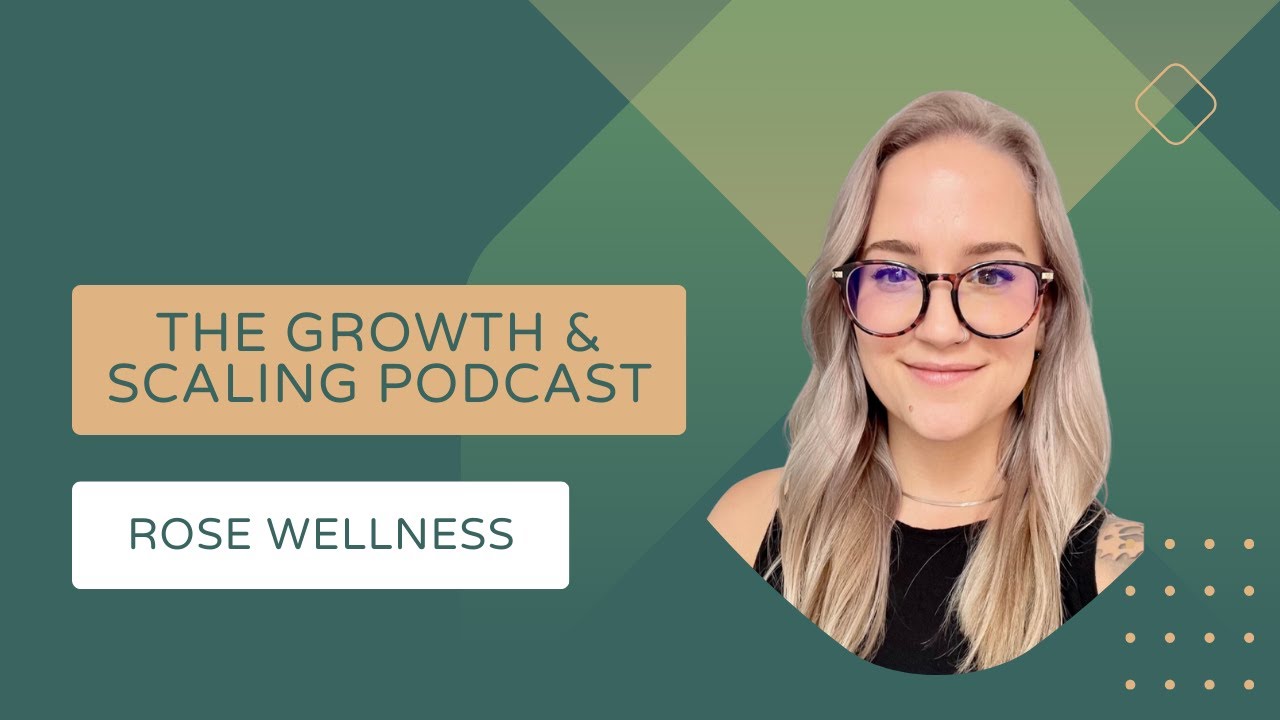
Hannah Rose, a licensed clinical counselor, scaled her mental health practice from solo to 15 therapists in a year. She discusses telehealth operations, billing and licensing challenges, preventing burnout, and outsourcing tools like Headway and Design Good.
Chapters
Hey, are you the type of founder who sometimes occasionally every once in a while feels a little overwhelmed? Well, if you haven't, then you've got some secret sauce that we all need to know about. So give me a call. Let's get you on the show. Actually, our guest today is an amazing therapist. She is someone who has been able to grow a business from being a part-time practitioner into running a business, into growing it by 15 times. In one year of being in business. Amazing, amazing founder. I love her story and I love what she's been able to do in her vertical and in her space. A lot of people in her space fail to scale. They don't know that you can take a pathway to growth and scaling in her vertical. And she has been able to do an amazing job growing in a space that is not so common to see that kind of growth. And really thinking outside the box in her development of her business. So you're going to love this episode. It's all about mental health. It's all about growing and scaling. It's all about taking a boutique business from something that's typically a onesie or twosie type person operation into something that's growing and scaling at a rapid pace. So love this episode, love this human. And I think you're going to really pull some things out of here they're going to help you know what you need to do to grow and scale your business. Welcome to the Growth and Scaling Podcast. This is your host, Todd Westra, and I am so glad you're here today because we are going to interview an amazing founder or executive who is going to share with us their decisions that they made that exploded their growth. So if you need some inspiration, you want to hear how other businesses are doing it, This is the place to be, and we are glad you're here. Enjoy this episode. Today we have an amazing guest who is going to probably put me into a state of therapy here, I'm guessing. We're gonna, we're gonna talk about her, but at the same time, I may be able to get some help myself here. We're gonna, we're gonna introduce you to Hannah Rose, who has got an amazing practice and I'm gonna let her do the rest of the intro. Hannah, tell us who you are and what you do.
Thanks so much, Todd. Yeah, my name is Hannah Rose. Um, I am a licensed clinical professional counselor here in Baltimore City, and I have a group private practice called Rose Wellness. And as of now, I'm kind of taking a step back from the one-on-one counseling and doing much more admin, being a clinical director, and continuing to grow this business that has really took off in the last year.
I love it. I love it. You make it sound like there's some people out there that might need some mental health help.
Yeah, I'm gonna stay in my lane on that one. And if people want therapy and are privileged enough to be able to afford it or have health insurance, which is a privilege and a luxury for many of us, um, then I encourage you to go seek that. But hey, I don't believe that everyone would benefit from therapy, so I'll stay in my lane over here and they can stay stay in theirs.
I love it. I love it. I love it. Well, tell us, tell us what you do. What problem are you solving and how is this, how is this kind of come about? What, why are you growing so fast and what, who are you helping?
Woo! What a question. Well, I started doing part-time private practice in 2019. I worked full-time at an addiction recovery inpatient rehab and I started seeing clients in person, you know, in an actual office, how novel that was or is now.
Nice.
And, you know, within 6 months I had a full caseload and I was on a waitlist. So I decided to quit my job, my stable, secure job, and just throw myself into private practice. And what I found is that especially for clinicians that are taking insurance, we fill up so quickly and there's such a demand. And then COVID happened and therapy suddenly became more talked about and more accessible. I was never open to teletherapy, anything telehealth. I just thought was a joke, and I was naive, you know. And our— my practice switched to telehealth, and I was getting so many more calls. And so about a year ago, about Christmas 2021, I decided to take on a couple contractors, right, a couple therapists that could see clients, because I I hated saying no, but I was full. And now we have 15 therapists and we continue to grow.
Oh my gosh.
It's like this, this whole thing.
So in one year you've 15x'd your load.
Yes.
I love it. That's, that's awesome. I mean, you're beating Grant Cardone there with his 10x. I mean, you've 15x'd it.
How could I know who Grant Cardone is? My partner always makes me watch his videos.
That's awesome. Well, this is so cool. So, so a lot of people don't really picture that type of business as one that's like a massively scaling machine, but you literally took it 15x in one year. What, what's been your favorite part about that? I mean, you started off the interview saying you started off as a clinician and now you are an admin, you're an administrator to this whole operation. What do you think has been the most fun about taking that step away from seeing the patients and into setting it up to where patients have a great experience.
Yeah, I mean, so in mental health, I mean, burnout and compassion fatigue are both really common, and I've felt myself burning out for probably years at this point. And so to have an opportunity to take a step back and be able to transition, you know, my clients to other therapists or just transition them out of therapy because they're, they're okay and they have the tools that they need is so fulfilling. Um, and then moving into more of like again, that clinical director. So I get to supervise and sometimes mentor the clinicians at the practice. And oftentimes we see newer therapists who are insecure or have imposter syndrome. We see that across the board with everyone. And it's been really awesome for me to share what knowledge I have come across in my short career and also empower clinicians to say, yes, you are a good therapist. You can do this. You can go off on your own. Hopefully Rose Wellness, which is a practice, can be a stepping stone for those who want to start their own practice. But almost creating that kind of environment makes people want to stay even more because—
I love it.
I'm like, yeah, you should go start your own practice eventually. But people want to stay.
Yeah. Yeah. Well, you're providing the environment that they feel comfortable in.
I love it. And I hope they love it.
I love it.
Yeah.
No, it's amazing. I think that if you were to ask the typical clinician, they probably have no ambition to scale and grow like you have.
It wasn't intentional. I was not actively looking for people. I posted a thing on LinkedIn. That was it. I don't have social media. I don't market like that. I think social media is the worst, but LinkedIn doesn't count to me because it's too boring to scroll on endlessly. And I just posted like, yeah, looking for a, independent contractor therapist, and people just started reaching out and then word of mouth. And then the client base just continued to grow. So we have clinicians who have different experiences, practice different modalities of therapy, have different backgrounds. It's amazing. It's a really diverse team, which I think is very important for clients to see is that you're not looking at a homogenous set of humans that look the same and are from the same background. So I love that about our practice.
Now, moving to the phone sequence, like how has that enabled you to grow and scale faster than say having everyone reporting into an office?
Oof, well, first and foremost, I think the intimidation I would have felt at high, at subletting or, you know, leasing a bigger office space would have made me not wanna do it. But the overhead—
Interesting.
When it comes to growing a fully virtual business, the overhead is nominal. Well, it's not nominal, but you know, our electronic medical records and stuff.
A lot less.
Is the big one, not rent. And so it's all of these other professional fees, like legal fees and accounting and all that kind of stuff. But there's no physical space. I do have therapists that live in different states, but they're licensed in Maryland so they can practice counseling here. Interesting. And even the interview process, I mean, hopping on a Zoom is so convenient. And a lot of the people at my practice are millennials. They don't wanna meet in person. They don't wanna talk on the phone. Neither do I. And so just hopping on, you know, shooting an email, having an interview over Zoom, it is so convenient and accessible. I love it.
I love it. This is really cool. This is really cool. And so moving forward, I mean, what's your trajectory? I mean, 15x is a pretty steep curve. What are you envisioning this next year bringing?
Oof. I have learned to not, it like expect what is exactly gonna happen or even plan it, but having these broader intentions, right? And so my intention is to be open to what comes my way and our way. And then also to not take all of the work on myself. So like I shared, I'm doing all of the billing, all the insurance stuff, all the administration, all the scheduling, and seeing clients of my own. And this week, actually, ironically, I'm starting to outsource a lot of that. And so hiring externally to, to really just ease some of that load. And so, yeah, we will probably keep growing as the current clinicians fill their caseloads and demand just continues because now Rose Wellness is like this thing that people know about. And I love it. And so they refer their friends and their family members. And so we will probably keep growing, but I will take some of the workload off my shoulders.
I love it. I love it. No, it's so cool. I love, I love what you've been able to do and I love that you've seen that vision. And I can assure you that taking that load off of you on a lot of those administrative tasks is going to reinvigorate you to just push harder. So it's exciting.
Yeah, I'm excited. And I hope that allows me to do the things that I'm most passionate about, which is public speaking and doing trainings and workshops and organizational development. And so Rose Wellness can kind of sustain itself while I go pursue my passions. And so being on podcast, even just say, satiate some of that fire in me.
I love it. I love it. Well, we're glad to satiate you here today. And you are providing value to our listeners. And one of the things that a lot of our listeners look for in these interviews is what's been your biggest challenge? You know, growth sounds exciting, growth sounds fun, but a lot of business founders really struggle when they hit roadblocks that seem impossible. Is there something that you've hit along the way that like, that kind of threw you off, you weren't really expecting?
Yes, 100%. And again, it's been like last week, and so this has come at a really interesting time, or the universe has put this here at a great time. A feeling of overwhelm and anxiety of— I like to have a short to-do list, and when something pops up on the to-do list, I cross it off right away. It's in my scope of control, I'm done with it, it's great. We've grown so much that the to-do list never ends. I can't do everything as soon as it becomes an issue. Like, oh, this insurance claim didn't work out. I can't fix it in the moment. And so for me, it's really been a practice of returning to mindfulness and meditation and grounding and really coming back to this place of what do I have control over? What do I not? Feeling overwhelmed is normal, but also how can I practice self-care more than I have in years because I haven't needed to, to this level. So that to me has been difficult, is to kind of humble myself to the workload and say, I can't do it all. Hence hiring companies to do it for me.
I love it. I love it. I would love for those listening, if you have ever felt that way, the overwhelm of business ownership and just kind of all the to-do lists piling up, give a thumbs up and seriously leave a comment below because this is, you are not alone. I think you'll be shocked to see how many other people like you, Hannah, are feeling the same way. I know that every time I'm in a growth phase, the to-do list just starts to pile. And that's when you start to find out what, how to solve it. Have you figured out how to solve the overwhelm and what are you doing to solve it?
Yes, I got a massage yesterday. She was like, and I was so, honestly, my whole, I didn't realize how much stress I was holding on my body. Which I know as a trauma-informed therapist, that's what we do.
Right.
And so physical movement, right? For me, it's exercise, it's yoga, it's walking my dog. And then talking about it. I mean, even hearing you say, hey listeners, you're not alone. I almost teared up because it's like, oh, I have felt very isolated in this experience.
Yeah.
Because I'm not friends with many people who are doing the same thing. And so then I feel like, well, I should just be grateful. And I make YouTube videos about gratitude shaming and how that doesn't work. Total BS. I don't know if I can swear.
You can say that.
And you know, so it's just interesting for me. It's like, yeah, coming back to that self-care, letting myself just cry even if I think it's ridiculous, talking about it, and hopefully connecting with more people that have experienced similar things because it does feel very isolating.
You are totally speaking to the choir here. You know, as a, as a founder and as a business owner, it, it, it's inevitable. You will always feel alone because you are the one that's supposed to have all the answers for your people. And when you don't have those answers and when you can't solve their problems, it— who do you go to? You know, what do you do next? What advice do you give to people? I mean, it's seriously, it's like, I don't know a single business founder that doesn't feel the way you're feeling, just so you know. That's so helpful. What do you do?
I needed this validation.
No, seriously. What I'm curious though, you being the type of person that you are and in the type of business that you do, what do you suggest to your clients when they come to you with these types of feelings?
Oh gosh. That's a question that I would ask a client who's struggling. I'd say, well, what would you say to a friend? So, touché. I would, first and foremost, I would validate their experience. I would normalize it.
Yeah.
Um, and if they were feeling isolated in their experience, I would acknowledge and provide some psychoeducation about how this is actually really normal and common and here's why. And if they were feeling like they're so not unique, I would point out that even if everyone else experiences it, this does not minimize their experience at all. And God, that's really helpful to hear.
And I think it's helpful for you to say it.
Yes, you can be grateful and feel that gratitude and be stressed or overwhelmed, and that they're not mutually exclusive. And sometimes I forget that, like, well, if I was just grateful, who am I to complain? I have my own business. It's like, well, it's really effing stressful and I'm grateful, and both coexist.
It is weird to see that coexist, and it is weird to feel the loneliness. You know, even in a business where you have some employees and some staff who are great friends, who are, who are really fun to be with, they don't carry that load. And I think that the load of sometimes, you know, just their payroll every 2 weeks, you've got payroll coming up, but that it always weighs on your mind, you know? Yeah, tomorrow, right? Mine's next week. I just got over it last week, but it's like, ah, there's another one coming next week, you know? And those types of burdens, I don't think most people recognize as being something that a founder has to deal with. And it hits every 2 weeks, you know, the stress of, okay, my Zoom license isn't working right, or the tech isn't working right, or how do I— the filing system somehow isn't working right. And that guy didn't record the interviews. The right way. You know, all those burdens fall on somebody, and in the growth mode, it usually falls on you.
100%. And I actually just hired like a branding or rebranding company, this awesome company called Design Good, and they're based in Austin, Texas. And part of their rebranding is— I thought it was just like, hey, I need a new website design design, but they do so much more than that. And I was like, no, I don't need any of that. But it's all about really harnessing your vision. And I had to fill out like 20 pages of Google Doc questions. And I realized how stressed out, like about the things I don't want to be doing and could outsource. And even just being asked and prompted those questions really gave me some clarity of what direction I want to go in. And I guess up until recently, I haven't been identifying as a founder. I'm— or like a creator of anything. I'm like, oh, I was just in private practice and I guess people want to work here. But it is— this is a business and it's a brand too, which is weird for mental health services in my opinion. But it is, it's this brand and it's, it's my last name. It's, it's Rose Wellness and it's a reflection of me. And so it's, yeah, it's all new experiences.
I love it. No, very cool. Very cool. Well, I'm assuming— is that your shout out? Or did you have somebody else in mind?
But shout out to Good Design or Design Good. Design Good? Yeah. Shout out to Design Good in Austin, Texas. That's not my shout out.
Well, part of the show that we love to share with people is, you know, as a founder and as someone who's been in the midst of a growth phase of their business, oftentimes that burden does come in a lot of different shapes and forms. And I know that almost every one of my guests can call somebody out that they're like, okay, seriously, this person to me, it just, they just inspire me. They keep me going. They keep me motivated. Who is that shout out aside from your design services company?
Yeah. So, um, this is a person who I actually met, a friend of a friend in from college, and they reached out to me years ago on LinkedIn and said, Hey, you're a therapist. I'm having a hard time finding a therapist through insurance. I think I'm gonna start a company. And I was like, okay, that's cute. And they said, can I interview you about that? I said, sure. And asked a bunch of questions. Years later, this company called Headway and their creator, Andrew Adams, who was this person that I was kind of friends with, um, Headway is like the most legit credentialing company for providers. A company that allows clients to find providers through their insurance. It's free for providers.
Wow.
They're killing it. I just hired them and they've got like 300 employees. They're based in New York City. It's this massive company. And I watched it go from the seed of an idea. And so when I'm feeling overwhelmed, I think of Andrew Adams and I'm just like, oh, he, he did it. And that's amazing. 'Cause he's really helping people on like a massive scale. Clinicians and clients. And so that's what I think of when I'm feeling overwhelmed.
Dude, that is an awesome shout out. And Andrew Adams, way to go. This is awesome. Hey, you know, Hannah, this is a great, great episode. I think there's so many people that are gonna, that are gonna resonate with your message and what you're doing and how you've done it. Not only your business, and I think for those of you listening, I mean, can they come to you if they're outside of Baltimore?
Unfortunately, unless you are a human in the state of Maryland, Maryland, we can only provide services, but what's coming down the pike is registering Rose Wellness as a business in other states and then hiring therapists in those states and then just, you know, there you go. Yeah, so if you're in Maryland, there you go, rosewellnesscounseling.com.
I love it. Well, we're going to put your contact info in the show notes below, so those listening and they want to reach out to you, I'm assuming you said you had a YouTube channel. Are you still active at all, other— anywhere other than LinkedIn?
So the YouTube channel exists. I haven't actually posted a video in maybe a year or two.
Uh-huh. Okay.
But I might open up that door again.
You've got the microphone.
I've got the mic. I should do something with this microphone.
I love it. Listen, we're going to put a way to connect to you down below. But I am so grateful for your time today. I think that for those who are struggling to know what their next step is in scaling, I think there's a lot to learn from this interview. Is there any parting thoughts you want to leave with them?
I think the parting thought that I need for myself that I will also share with everyone is remember to meet yourself where you are and just be gentle with yourself. How can we practice compassion and love externally if we're not practicing it internally? And this stuff is hard and it's scary and it brings up all our insecurities. So be gentle with yourself.
Love it. That's a great message. All right, we're gonna leave you with that. Thanks so much for being on the podcast today. We're grateful to have you here, Hannah.
Thanks, Todd.
Isn't she awesome? I just loved that episode. She has been able to grow 15x. I, in our post-interview conversation, I have a feeling that she's now kind of looking forward to 2023 in a way that she wasn't before. I think that now she's owning the fact that she has been able to be a founder who has grown and scaled and is ready to take those next steps. Imagine if she only 3 times what she did last, did last year. She's doing a phenomenal job at growth and scaling. She gave some good nuggets. She gave some great advice. She gave some practices that I think every founder needs to hear about how to loosen the overwhelm, how to prioritize things, how to take time for yourself, give yourself some love, and appreciate who you are as a founder. Because if you don't, the overwhelm does stack up. It does get overwhelming to the point to where you just want to give up. Don't give up. Listen to this episode once or twice. Go check out our YouTube channel, and let's see if there's some things that you can do to get yourself back on that path to growth and scaling. We love that you've been here. Like and share this episode with someone you know who may be a smaller practitioner, who may be someone who needs some inspiration to grow and scale their practice into something that's amazing. This has been Todd Westra. We're grateful to have you here.








