Mastering Affordance in Design: Understanding User Interaction
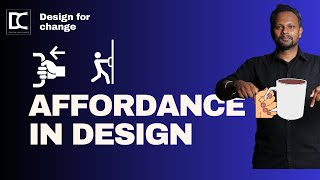
A lecture on affordance in design, the principle that objects should visually suggest how to use them. The speaker covers psychological research and neurochemistry behind user interaction, with practical applications for building intuitive products that work for everyone.
Welcome. Why certain products are not interactable There are a lot of science behind this. Understanding human psychology. Let's make it very simple. There is a concept called affordance. Many of you might not know it. If you're still wondering how to make your product more accessible, more usable, then this video is exactly for you. If I interact with this, with this headphones, the way in which you see and take it out is what is called making it affordable. Okay, if the form factor is not good, maybe if that understanding of the products shape and the interface, how it has been designed, I'm taking a physical product, but it's applicable for digital as well. The way in which it is not inviting you, you won't be able to interface with it. Okay, so what are the science behind it? What are the small understanding behind it? Let's go and see this. This term was first coined by psychologist James J. Gibson. And this person was responsible for this, even though it was polished later by don Norman in 1890s in behavioral lab at Apple. But this was the first psychologist who actually formed this term. Okay, so what is this? Affordance refers to a quality or a properties of an object that indicates how it can be used. I told you, right? How it can be used? Maybe how it can be interfaced. Three ways in which we can see this, okay? One is the physical way, like the door telling you maybe the product is not making you tell that this should be opened this way. Maybe I would be figuring out this way. Where is the opening. There is something called form, texture, color. We are going to the science behind it. But just hold on. This is the way in which a natural indication is being done. Second, buttons, sliders, like let's say when you take a user interface, sometimes you will feel like touching, sometimes you will not feel like touching. This creates some kind of a confusion. A better affordance should be designed in a way to enable the people to go and touch it out. Like let's say the color, shape, indication, whatever is there, it could be done. There is a third interesting guy which is called false affordance. When people are tricked. How many of you really felt this problem of frustration? When you go and click on an interface, it will not be clickable, it will not be searchable. Like you'll be again and again doing it. And the system hangs in and you get into a frustration. These are all the things which a designer needs to understand. Let me tell you the fact, guys, there was a research did by McKinsey at 2008. They said companies that focuses on the interface part of it very detaily. I'm not talking about only the affordance, the interface and engagement part of it. They outperform their competitors with the great revenue growth and shares. This contributes to a better design. There is no need to make a competitor analysis even if you work on this small psychological aspect. This proves that, okay, McKinsey is doing a lot of research with the industries and they have all the data. And there is another research by Forrester also 2016. Positive user interface leads to higher engagement. See, everything what we are doing is to engage the user, right? Maybe it increases the profit directly. I'll tell you why. The more you call interface with that particular product, the engagement rate is high. More people will come to advertise their product and service. More people will upgrade for the premium products of them in order to make the revenue growth happen. See how a small affordance is making the business growth grow in a very tangible way. So product with a well designed affordance are most likely to succeed in the market. This is the fact behind it. Okay, There are two types of affordances, guys. One is the perceived affordance. One is actual affordance. See, sometimes you'll be tricked. Like for me this looks like a little groove in it. Maybe I'll be perceived if I have to slide this up. But that's not the case. The real way in which it used to be open is this way. So you may get really confused. That's called perceived affordance and actual affordance. Okay, which could be actually possible. See, you can trick the users also sometimes which is needed in a product design and develop. And then we'll go to the science behind it. My favorite part in this, because many times people don't know how it is happening. People don't know why we are doing what we are doing. This is the only way to make you explain, guys, very carefully. I'm not going very scientifically, but I'll give you some basic fact. There is something called visual perception we get in mind when we see an object. Like let's say when we see this cover, our neural mechanisms will go and work inside it. And Hubel and Wiesel in 1960, they have found something called visual cortex. This formed a very significant growth in which the people in the later 1980s and 90s connected these dots. You know what they said? They said how the brain process visual information is by identifying it. So how does it exactly happen? By understanding the shape, the form, the edges, the movements. This is very, very interesting, guys. So these people have said our visual cortex is what is the Brain which makes them process it like, okay, this is the edge. This is a form. We form some connections inside it. And this was the very, very foundational research how we perceive design interfaces, thanks to these people. Or else we would be still figuring out with the old computers and interfaces which will not be very user friendly available right now. The next is Gestalt. This guy is more interesting. This guy has not framed a scientific background of it, but he found out something called grouping of visual elements. A Gestalt law of psychology. How people form these perceptions, like let's say proximity, there is something called grouping. There is something called ungrouping how you perceive. That is what is called formations in patterns, clusters. So these are all the visual elements which people really think about. It's actually founded by Gestalt law of psychology. And this guy has actually put this into a format. There is a deep study on Gestalt law of psychology. You can go and check it out. Ideally speaking, this is how the psychology is being derived. Okay, See how the dots are connecting for the small word affordance. Okay, now let's come to the interesting part. How certain products are marketed to you. How certain products are becoming more natural to you and you're using it every single day. Have you ever wondered this term called neurochemistry? Maybe if you're hearing this for the first time or second, third time. This is important when you're starting your design career from now. Okay, there is something called motor response and action which happens inside our brain. So some people say, right, hey, I used to see people interact. What is the reason for it? It's called mirroring. We use something called a mirror neurons inside our brain. So mirror neurons demonstrate how these neurons fire inside when performing an action. When we observe the pattern from our supportance can trigger a motor response, aiding intuitive interaction. Over the time, it becomes a habit. How many of you think this is light bulbs? Type out in this video, light bulb.
More from Jagadeesh




Comment “ME” if you want to join the next upcoming hackathon — we’ll send you the registration link.



Comment “ME” if you want to join the next upcoming hackathon — we’ll send you the registration link.



