384th 1Mby1M Roundtable February 1, 2018: With Gaurav Jain, Afore Capital
Gaurav Jain, Managing Partner of Afore Capital, a $47M pre-seed fund, discusses his investment thesis: backing technical founders building 10x better products with strong capital efficiency. Portfolio includes Cruise Automation and Firebase. The roundtable also features pitch feedback on Bodhi Academy, a financial-literacy platform for Indian students, with advice to target banks over schools.
Chapters
Good morning, everybody. Welcome to today's 1 Million by 1 Million strategy roundtable for entrepreneurs. 1M1M, as you know, is the first global virtual accelerator in the world. Our mission is to help a million entrepreneurs reach a million dollars and beyond in annual revenue. And in support of that mission, we do these roundtables week after week after week. It's been going on since the 2008 fall. When we started experimenting and tinkering with this format of online mentoring. This is the 384th session, so we are coming up to a milestone of 400 sessions later this summer. We've had over 60,000 people participate in this program, in the free roundtables. Today we touch a community of over half a million people around the world, and it literally is around the world. You could meet, in one of these sessions you could meet people from Ghana or, you know, all really, all kinds of places that we never even, you know, make any proactive efforts to reach out to. So it has been a real privilege and a fascinating experience learning about what people are doing around the world. This event is being recorded. You will have the recording available on our YouTube channel, 1M1M Roundtables. All prior recordings are available there. So it's a great learning material. If you just want to, if you have commute time or just time to spend on learning, these are all free. You can listen to a few sessions and you will learn a lot, I can guarantee you. If you are following us on Twitter, our handles are @1Mby1M or @Sromana. Or if you're not, please follow them. We do publish a lot of interesting content through those channels. And our hashtag is #1M1M for today's live tweeting if you're interested in doing that. This is a roundtable, so we want you to participate as actively as possible. And you have two ways of doing that. Either you can call in. These are the call-in numbers. I'll put this slide up a little bit later when we're ready for you to call in. And you can also participate in public chat. So make sure you set your chat to send to all participants, not to me, not to the host, not to Maureen, but to all participants so that you can interact with the peer group. Introduce yourself, tell us where you're joining from, what you're working on, what you are facing roadblocks on so that we can strategize and work on your situations. This is a working session. We're going to start today's session with Gaurav Jain, Managing Partner of A4 Capital. Gaurav, welcome. It's great to have you here.
Thank you. It's a pleasure to be here. And I was just listening to your opening, you know, opening sort of description of what you're doing. You know, it's incredible, right? Because with the internet these days, there's entrepreneurs like all over the world, right? And it's some— at some level it's unfortunate that we can't be involved in companies everywhere. You know, we tend to have a lot more portfolio companies in the Bay Area or in the US generally. We have a few outside, but it's great to see what you're doing because I think there's entrepreneurship talent everywhere, and there's great companies that are gonna be built everywhere in the world. So it's actually, I didn't know a whole lot about, you know, your mission, but that makes a lot of sense.
Well, and as you heard me say, 1 million by 1 million is 1 million entrepreneurs times 1 million in revenue. I did not say we are trying to fund a million companies, which I don't think is viable actually. So however, of course, we have also a large community of entrepreneurs who are in the venture path. So that's why we want to talk to people like yourself. And in particular, with your specific focus, which is pre-seed investment, investments, we are very, very interested in hearing your perspective because as you know, that part of the ecosystem is very underserved. People want validated businesses. People want, you know, seed, post-seed, and now the pre-seed is where the tricky part of the equation is. So tell us about Afore Capital. What are you trying to do? How are you positioning yourselves? And let's get you introduced to our audience.
Awesome, thank you. So Afora Capital is a $47 million vehicle exclusively focused on investing in pre-seed companies. And that makes us the largest fund that's focused on pre-seed. And my partner and I, we started this fund in 2016. Both of us had been in venture for a few years. So my personal background real quick, software engineer by training, and then I moved into product. I was one of the first product managers for Android. I did that for a few years, saw the platform go from, you know, less than a million total users to about a million new installations a day, and of course 2 billion people use it today. Then I switched gears into venture. I was at a fund called Founder Collective doing seed investments. But what I noticed, you know, I was there for 4.5 years, is that a seed round went from what was around a million to $2 million round when I joined Founder Collective in 2012, to a $3 to $5 million round in a lot of cases. I think in 2016 there was like 98 seed rounds that were over $5 million in size. And for most of these companies, seed round was not their first round, right? They raised, they had to raise some money before there because as you mentioned, you know, investors are looking for scale or looking for some level of traction, product-market fit before they're ready to invest. So these founders struggled to raise that round before the seed round because there just weren't that many institutional investors willing to invest. My partner's background is similar, software engineer. He was the first product manager at Twitter, were the first employees, and then he was an investor in a Series A and B fund called Foundation Capital. And both of us noticed something similar, as I alluded to, that there was this gap, right, in, for founders to be able to raise that sort of first round of funding before there's traction, before there's product market fit, before it's clear whether it's gonna work or not. And we saw that gap, saw that as an opportunity, left our respective funds where we had a great path, but felt that we really had a passion for investing early and felt we could create value. So we left, raised some money primarily from institutional investors, so pension trusts, sovereign wealth funds, so on and so forth, who also saw an opportunity to fill this gap and have outsized returns, right? Because the competition is less in this space, you can get a pretty good valuation for these companies, And then for the ones that work, you know, you get outsized returns. So we raised this vehicle, we've invested about 20 companies so far. You know, our typical check size is somewhere between kind of $250K to, I'd say $600K or so. The rounds are, the smallest one we've probably done is like a $330,000 round. On the larger end, they tend to be around $1 million, $1.5 million. But in all of these cases, first round of funding, these companies were not ready to kind of scale, you know, sales and user acquisition. They really had to focus on product. And given my partner and I, my background in being product managers, having been there early at the ground floor, we could really be helpful, right? First of all, we can identify really strong product talent, which is what we look for above all else, is do you have an ability to build a product that customers will love, right? A product that's 10x better than what's already out there. Because there's no traction yet, we need to get some level of confidence that when you do launch this product, that it's gonna take off, right? And I think the way we do that is try to understand, you know, how good the product DNA is on the team, what non-obvious insights that the team has around building this product, and if we get excited, you know, we make an investment and get very actively involved with these companies between the pre-seed and sort of the seed round, or in some cases we've seen companies go straight from pre-seed to Series A, right? It really depends on what you can accomplish in sort of that 12 months post our investment, and you know, what sectors obviously Series A investors are actively investing in, so on and so forth. So we've done about 20 investments. Across the board, you know, some are, you know, B2B, building SaaS enterprise software, B2C, you know, e-commerce. So we're less kind of caught up on the exact sector that you're building a company in, we're more interested in sort of the application and the use case, right? We believe that the founders know exactly where the opportunity is. They can point us to where the world is going. And in fact, they're the ones that are gonna build that vision of the world anyway. So we don't get too caught up in sort of predicting where the world's gonna go. Instead, we spend our time looking for the best founders that are early where we can be helpful.
When you say early and, you know, pre-seed, can you put a bit more color around that? Are you willing to make concept financing? Like if somebody presents the concept and doesn't have an MVP or a product, are you willing to put that $250,000, $300,000 in?
The short answer is yes. The long answer though is these days it's gotten so cheap to build an MVP, especially if you're building a software product, which is where 80-90% of our investments are going to be, is a software-heavy business. Or even if it's a services business like an Uber, for example, like a transportation business where you're moving stuff, it's software-enabled, right? So to get something out there to show some interest from customers, you don't need a whole lot of money, right? Between Amazon Web Services, which is pay-as-you-go, between all the open source or software which is free. I mean, these days to build a prototype, literally all you need is a laptop and access to the internet, right? For which you don't necessarily need capital and a few months of human labor. I think human labor is really where the bottleneck is, and that's what we look for, are founders that are able to build a product themselves, right? Or at least one of the founders is technical. I think the challenge becomes when both founders are non-technical and they need to go hire engineers before they can write a single line of code. Those ones are a little bit harder for us for a lot of reasons we can dig into if you'd like. So in most cases, the founders have been able to get something out there without needing any capital. So a typical trajectory would be, you know, you're working at a tech company, it's a couple of founders, they have this idea that they've been toying with for a few months, maybe they've been hacking on the evenings and weekends. And they get really excited, they leave the job, right? And that's when we get to know them, right? It's typically around the time when they're leaving, quitting their job and moving on. But then we stay in touch with them and help them for a few months as they are kind of hacking on products, hacking on the exact direction, and then when they're ready to— and part of the reason we don't invest in sort of that concept stage is because a lot of times that concept changes, right? Very quickly within the first few months as the engineers start to iterate. So you don't want to raise money too early from a founder from a founder's perspective either, because if you raise money getting investors excited about this direction, but you realize that's actually not the direction you're excited about, for a whole host of reasons you want to go in this direction, that becomes a little bit tense, right? Because now you have to convince the investors that is the new direction, the right direction to go in. So because the cycle times are so short in the first few months and so much is going to change, we encourage founders to kind of wait, you know, for 3 to 4 months until they have some semblance of kind of the direction they want to run in, at least for the next 6 to 12 months, right? There's still going to be a lot of iteration, there's still going to be a lot of sort of micro pivots in the first 12 months, and probably looks like in 5 years it's going to be very different, and that's okay, but we need some level of clarity for the next 12 months, and hence we rarely invest in sort of the, "Hey, I just came up with this idea this morning," or, you know, "2 weeks ago I've been thinking a lot about it and I'm looking for some money." we tend to wait for a little bit. Even the cases where we have invested is founders we've known for a while, they have launched products before, they have launched, you know, maybe they've built a couple companies before, and we just want to be, you know, in partnership with this founder, but I'd say 90% of the companies, if not more, they have some prototype, something that we can get our hands around.
I got it. So you're basically, your sweet spot is technical founders who have tinkered for a few months and built something and has an idea of where they want to position that product and then you take it from there. You're okay with the micro pivots, but you have some directional movement already in swing basically.
Yeah, but one thing I want to clarify is we're very comfortable taking on traction risk, right? We're very comfortable— Sure, sure, sure. —when you have the prototype, it doesn't have a lot of traction yet, right? It doesn't make any money yet. And it's not clear if, yeah sure, maybe 100 customers love it, does that mean a million are going to like it? We don't know, right? That is something we're comfortable with. But so we don't need to wait for, you know, your business is humming and hawing before we invest. But that sort of initial work, we, you know, we like to see that.
But, you know, for a B2B business, 100 customers, getting to 100 customers is not an easy thing to do right away.
Oh, sure, sure. And for B2B, like, depends on obviously the size of your customer, right? If they're paying you $10 a month, you know, getting 1,500 customers is not hard. If they're paying you $10,000 a month, then maybe 1 or 2 is great. So of course it depends on— It depends on the size.
—on the size. Got it.
Exactly, exactly. And if it's a consumer company, you know, you want to see even more than 100. More than that, yeah.
So quickly, what about geography? Are you local-focused or US-focused, global-focused?
What's the comfort zone? Yeah, both of us are based in San Francisco, you know, but our mandate doesn't prevent us from investing anywhere. In the world. Okay. You know, I'd say our strong bias is towards US-based companies or US and Canada, I would say. I grew up in Canada, so definitely the soft spot there. I've made a few investments in Canada. But I'd say we have a bias towards that just because, you know, we have a network there. We can be helpful, you know, for recruiting, for follow-on investments, for business development, a whole host of reasons that, you know, just we can do a much better job for you in North America, but we have made investments outside. There's a company that's based in India that were investors in Adiva4, you know, so we're totally open to non-American investments as well, but you know, the bar is just going to be higher. I think what we want to see are really mature founders that need sort of less of our help and are able to, you know, tap into their local network and perhaps even raise money from Silicon Valley follow-on investors, while even though they're sitting, you know, somewhere else?
Well, the issue that you bring up India, the issue that we see in India is that if you're doing, you know, let's say B2B SaaS out of India, which is a very popular category in the Indian investment pool, you kind of very soon realize that you're going to need to build it as a global business and you're better off being based in the US because for a lot of reasons, the access to capital in India is— is okay right now, especially in the early stages. There are— there is capital. But exits are few and far between. So from the point of view of exits, people are realizing that they're better off being a US company with an Indian subsidiary as opposed to the other way around. So two questions. First and foremost, we'd like to learn a bit more about you, the highlights of your portfolio, and give us some of your thought process on how you decided on these particular companies. What was it about those companies that really struck you and attracted you and convinced you that there is something interesting and important in there?
Yeah, so what we look for, as we were talking earlier, are the founders and their sort of product DNA and ability to build, a game-changing product above all else, right? 'Cause at the stage we invest, there's not much traction. It's not even clear what market you're going after. I know a lot of investors will tell you, you know, go after a big market, 'cause you know, you're gonna get a small percentage of that, and that's sort of the most important thing. For better or for worse, that's not sort of how we think, just because our best companies tend to be in markets that it wasn't very clear when they got started at this stage. We invested in. So I'll share a few portfolio companies, both from my old fund Founder Collective, where I was for many years, and then before. Out of Founder Collective, some of the notable ones are, did the seed in a company called Cruise Automation that was building driverless cars. That was eventually acquired by General Motors, and Kyle, who's the founder CEO, now runs autonomous division for GM. And it was a great exit for all the investors, you know, because we invested in the seed and it was acquired for close to $1 billion. The reason I got excited about Cruise Automation is I remember Kyle drove me down the 101 here in San Francisco when he was giving me a demo of what he had built. And it was a pretty primitive product, right? All it did was keep the car in between the two lanes in a highway, right? Barely, by the way, 'cause it started raining that day and the autonomous, controls went off. But it was very rudimentary product. But there was like 2 people on the team at that time. And I said, Kyle, look, I'd worked for Google before. I know Google's been investing in driverless cars for a long time. They're far along. Tesla's thinking about it, so on and so forth. This is 2014 or so, maybe 2013. I said, help me understand why is this startup gonna thrive and win and outcompete Google and Tesla and everybody else. He said, "Look, I understand it's really hard to build a very R&D-heavy company as a startup, as a venture-backed startup, but all of those folks are working on the product in the lab, right? They're trying to get a perfect product out there and then they're gonna scale. As a startup, and especially as a startup entrepreneur who thinks like a consumer product manager, I'm gonna get a very small fraction of the final product out there in the market in the hands of the customer." And I'm going to gather a lot of data and I'm going to learn a lot because when it comes to driverless cars, data is really where, you know, you win or lose. The more data you can gather, the better your models are. He said, I'm going to gather a lot of data so all I'm going to launch by the end of the year is an ability to keep your lane, you know, between— keep your car in between the two lanes and change lanes on the highway. Something very simple which a lot of cars already have but, you know, I'm going to get some early adopters to try the product with the vision that I can build driverless cars down the road. And I'm gonna put a big hard drive in the trunk and I'm gonna give you free car washes. And then when every week you come in for a free car wash, I'm gonna download all that data. Anyway, he had all these insights that were not obvious, that made a lot of sense. It was a very lofty vision, but I got that feeling that, well, there's a lot of risk and it could totally go to zero. But if he's right, right, if some of these things work out, this could be really massive. Right, and that's what we look for in companies is we don't make a list of what can go wrong, because that list unfortunately is just too long and too real. Instead, we look for what can go right, right? If the founder's able to accomplish these sort of counterintuitive things, could this be a massive business? Could this be a massive opportunity? Could this be a multi-billion dollar opportunity, right? And if the founder had the ability to kind of go execute on kind of V1 of the product, Get some traction, get some usage, and then learn, right? And figure out V2, which neither of us know what that is, right? They have that ability to kind of, you know, call them micro pivots. Earlier, micro pivoted to V2 and V3 and so on and so forth, right? And Kyle did a brilliant job at that. They're going to be launching driverless cars very soon. Another company I invested in out of Founder Collective, a company called Firebase, which was two technical founders. It was actually the fourth startup, the first three had failed. And they were building a chat engine. And as they were building the chat engine, or chat app, they realized the backend software to enable the chat app was actually really complicated because you had to keep multiple parties in sync and so on and so forth. So what they did is they took that engine and actually productized that and said, "Everybody else who's trying to build real-time products, real-time web apps, let's make this engine available to them." And that's when we came in, right? They said, and what I liked about those founders were very authentic, very organic, right? They'd been building this chat, app and realized the opportunity was actually somewhere else, and then ran with that. They had a really interesting vision around how hard it is to build real-time products. I'd worked at Google, had seen how hard it is to build Google Docs, for example, which is sort of this real-time functionality. And if you can enable that for engineers to build that within minutes as opposed to weeks and months, that can be pretty powerful. right? So we invested in that company that was acquired by Google, and that was a great exit for us. Out of the 4, the portfolio is still new, you know, 16 months old, but we invested in a company called BoxBot, for example. Founders came out of Uber and Tesla, deep technical founders, and their insight was that, you know, parcel delivery, right, which is, you know, taking an e-commerce package to your house, 50% of that cost is literally in like the last like 100 feet or so, as the UPS driver, the FedEx driver walks around the truck, drops off the package to your house, and then drives to the next house, and so on and so forth. So what if we can enable to an autonomous robot the ability to ship a package to you, right? So they've delivered this really interesting supply chain where they can shave the cost for UPS and DHL quite substantially and get that parcel to your house. What we liked here was, again, the founders are very authentic, right? They were working inside of an Uber and Tesla. They had the right skill set. They've seen the opportunity to apply kind of driverless technology but in a very different use case, right? And as we validated the use cases, we did some research on our own, we said that makes a lot of sense. Or we invested in a company called Overtime, started by Dan Porter who built the game Draw Something, which was acquired by Zynga eventually, which is a great outcome for him. But he has a really strong consumer kind of product instinct. And what he noticed was that millennials these days are not watching 3-hour games on ESPN, right? They're instead consuming sports content on their mobile phones, and generally very small snippets, right? So what he does to his UGC kind of app is acquire all these high school sports content. This is content that nobody owns the rights to, right? How can you acquire this sports content and then push it through the platform, right? Push it through Instagram, Facebook, whatever different channels there might be, and get a lot of— so there's millions of these video views a month because millennials just love this content and it's entertaining, it's short, and it's content that they can't access anywhere else. So anyway, you can see it's a whole mixed bag of different companies and different sectors and applications. But the connecting thread is very strong founders in terms of product, their ability to deliver product, their ability to understand what the customers want, having kind of non-obvious insights so they can compete with the incumbents. And, you know, in all those cases we invested very early.
And you're looking for unicorns?
I mean, that's sort of the venture model, obviously, is the companies we invest in eventually become, you know, big independent businesses. But, you know, we don't get too caught up on sort of what the eventual, you know, exit outcome looks like. I think part of what we tell our entrepreneurs is stay capital efficient, right? Don't raise too much money, because when you raise too much money, you're forced to become a unicorn, and you're forced to, 'cause you know, if you're raising money at a $500 million post-money valuation, you can't sell it for $400 or even $600, right? You have to pass that billion-dollar mark.
Exit options become really limited. Exactly, right?
Exactly. And in certain sectors, there's just not that much M&A activity for companies to buy, you know, other companies for billions of dollars, right? I think in tech, you see obviously Apple and Google, sometimes Facebook buying multi-billion-dollar companies that are still very early. But in the rest of the world, that's actually not true. So we tell entrepreneurs to just look, stay capital efficient, don't raise too much money, stay focused on the fundamentals of the business. I mean, I'll give you an example. I invested in a company called SkipTheDishes, which is a company based out of Winnipeg, Canada, of all places. You know, it's a company basically doing food delivery. So think of like, you know, a Postmates, but for mid-market cities. So when Postmates and Uber Eats and everybody's kind of competing in New York and San Francisco, And they were, you know, in Columbus and places that didn't know their food delivery service. They built a phenomenal business. They stayed capital efficient. They didn't raise too much money. They stayed focused on profitability. They stayed focused on growth. And they eventually got acquired by Just Eat, which is a public company out of the UK, for something like $200 million Canadian dollars, which, It was a great outcome for the founders, right, because they still owned a significant portion of the company. It was a great outcome for investors because we did not get diluted much because they didn't raise a whole lot of money after us. We owned a significant portion.
How much total money did the company raise and how much revenue did it get to?
Yeah, I mean, in total they raised, I want to say, sub-$10 million. I forget the exact figure, but it was a small number, right, relatively small for a food delivery company. I don't know the numbers for like Postmates and stuff, but it's probably in the hundreds of millions of dollars. that they have raised. Skip raised a fraction of that. And by the way, their numbers were not that far off from some of these bigger companies. So, you know, then it goes to show— and a big reason for that was because they were based in Winnipeg, right, where the cost structure is just phenomenally different. Like, they had something like 200 employees or something like that at the time that they exited. There's no way you can afford to have that many people in your company and only raise that little money in like San Francisco or New York, right? So— But it's also a matter of culture and philosophy, right?
I think part of the problem we have created in this industry is this, you know, burn lots of capital and chase hypergrowth at all costs and just make yourself unsustainable for the off chance that you may get a big exit. This is not the way to build companies.
Yeah, I 1,000% agree with you and that's what we tell entrepreneurs. I think the challenge in the industry a little bit is that there's so much capital chasing so few good opportunities that investors push these companies to raise more, more than they should. And unfortunately for a lot of founders, the amount of money you've raised becomes a barometer for how successful they are, which is absolutely not true, right? You know, the number of employees you have in your company—
I'm sorry, what is your read of your cohorts in the pre-seed segment of the market, are there other players who are thinking the way you're thinking or are they, you know, are you finding good syndication opportunities in your stage?
You mean are there other peer investors, right? Yes, yes, yes. Yes, there are a few. Who share your philosophy.
Yeah, there are a few funds.
I mean, it's an emerging category. There aren't a lot yet. I think that may change in the next couple of years, but you know, I'd say there's probably 3 to 5 funds that are serious about pre-seed. Some of them don't exclusively do pre-seed. They also do seed and other stages, but they are seriously thinking about pre-seed and have the same philosophy that we have, which is, you know, do more with less. You know, don't raise too much capital and so on and so forth. And we do syndicate sometimes with them, though we're not sort of dependent on the syndicate. We, first of all, like to lead where we can, so we're not waiting for signal. We're not waiting for somebody else to price around. We're very comfortable being the biggest check and pricing around. And typically these rounds, you know, if it's a $750K round or if we're doing $500K of that, these founders can finish off the rest with just angel investors. In a lot of cases we were 75% of the round, 75% or more of the round, which is totally fine, and in fact we prefer, because we don't want the company to raise too much capital. And a lot of times they want angel investors involved in the company anyway for strategic reasons, so there hasn't been, we're not dependent on syndicates, but we certainly love to co-invest where the opportunity is with some of our peer VCs. The other thing is, if you think of a funnel, right, there's obviously a lot of companies at the pre-seed, right? So there's just a lot of opportunity for all our peers to invest in, and these companies are obviously not obvious, and not everybody agrees that this is a good company to invest in. So there's not consensus a lot of times on companies anyway, which is fine. So I think that creates a lot of value for founders because now they have more optionality to raise money. So if I don't get it, you might be able to raise money from a peer, which is totally fine.
Awesome. Gaurav Jain, this has been a very interesting conversation. We have talked to a couple of pre-seeds, probably 3 out of 5 Pre-Seed funds have already been on the show. So we will keep the dialogue going and hope to work with you going forward. Thank you for coming today.
Likewise, thank you. And I'm easy to find. I'm just G. Jain on Twitter, but also our website is Up4.vc. If we can ever be of help, our email addresses are on the website. Please reach out and more than happy to chat.
Fantastic. So we're going to move to the— Thank you. We're going to move to the entrepreneur pitch portion of the program today. I know Gaurav Jain has to run. Let me set a bit of expectations before we dive in. Remember, this is a working session. We are here to work on your strategy and it's a safe place. You don't have to be afraid or nervous or uncomfortable. I will give you, give you very direct feedback. However, my goal is to help you with constructive critique of your strategy so that you can move forward and make progress. I have no other agenda. We as a company have no other agenda than that, besides that. Now you may disagree with my feedback. That's fine. It's your choice. It's your business. You are going to follow whatever strategy you want to follow. That prerogative is yours. All we are doing here is giving you perspective based on our experience. Remember one thing though, not all businesses can raise money, not all businesses should raise money, and raising huge amounts of capital does not guarantee success. That is a fact. You cannot argue with that fact. So, Bhadiraj Kasti from San Jose, California, please unmute your line. And tell us what Bodhi Academy is. Are you there, Vadi Raj?
Hi, Shabana, how are you? Good, how are you? Good.
Thank you so much for the opportunity. My name is Vadi and I stay in San Jose. What I really want to use this opportunity for is to talk to you about my idea around Bodhi Academy. I just want to set the expectation that this is still in the concept phase and I'm still thinking through this. So would love to get more of your input. So we'll first address the boring stuff, a little bit about me. I've been a product manager for close to 5 years and all of that experience has been in FinTech. I stayed both in Boston as well as in San Jose, worked with companies like Fidelity Investments and Financial Engines. So most of my experience has been in wealth management and robo-advisory space. For very personal reasons, I'm getting back to India and I want to use that opportunity of going back to India to start my own lifestyle business, something that I can have on the side while I also earn a paycheck.
So—
Are you moving to India with a job, without a job, and you're going to find a job?
What is the situation? Yeah, I'm going to find a job when I get to India. Okay.
So, you know, this is all very consistent with our philosophy in the sense that we do support bootstrapping with a paycheck, as you know, and we are perfectly fine with that model. And, you know, somewhere along the way, if you decide that your company is scaling really well and you want to— do it full-time and scale it to the next level and so forth, you have that option. But starting in a bootstrapping with a paycheck mode is a very good mode to start in. By the way, you should come by to the 1M1M rendezvous in Menlo Park next week before you go to India.
I will, I will. Sounds good, sounds good. So as a part of being the PM, I have heard hundreds of customers, you know, talk about the issues that they deal with finances. You know, many of them, they don't make good financial decisions because they don't have the know-how, or they have made bad financial decisions, which is why they hand over the money to somebody else in order for them to manage that. And when you look at a country like India, the situation is not very different. There has been a lot of independent studies which have said that only 20% of the Indians are financially literate. A lot of times 1 in 10 households are participating in the stock market because primarily most of these households are actually investing their money in fixed deposits or bonds as opposed to really diversifying their portfolio. But if you really get to the root of the issue, it's not about, you know, they being very conservative. I mean, the fact is that we don't focus more on financial literacy. When people are in schools. And the issue is even more compounded in India because we have around 200 million kids who are either going to school or going to pass out of school, and financial literacy is not really a part of the curriculum. And in talking to some of my friends who are parents and teachers, the issue starts from there because parents don't have the knowledge. They cannot really impart that to the child, or they don't have time because both of them are working, both of them are traveling. At the same time, teachers also don't have this. But India is also unique in many ways because there has been a movement in India around providing financial literacy to kids. And the Reserve Bank of India, the National Institute of Security Market— I mean, these entities are coming together and they have created this new entity called the National Center of Financial Education, which has been working with principals of schools to really push financial education to students. And they have also created a competitive national level test called National Financial Literacy Assessment Test. And there have been other few tests that have been really coming out at a national level that kids can really take this test and win a cash prize. So my idea is more so around creating an online experience where these students and teachers can take financial literacy lessons. And they can do that in an online— format, and they can access this either by going to a website or using a mobile app. And, you know, while students, they enroll into these courses in order to prepare for these national-level tests, you know, teachers can also—
Who are we talking about?
Yeah, so we are talking about kids who are in grade 6 and up.
6 and up.
Yeah, grade 6 and up, yeah. So at the same time, teachers can also use this platform in order to learn about financial literacy and then impart that to the kids. The customer acquisition model that I'm really focusing on here is B2B2C as being the primary source. And then the secondary source also being B2C. B2B2C is about selling this solution to schools because from some of the research that I've done, most of this, most of the push of financial literacy is coming from school principals and, you know, so my model is more suggesting about selling this to schools and then, you know, actually getting access to students out there.
Are you saying that schools are willing to pay to buy financial literacy programs?
So there has been some movement on the ground where there have been a few companies. Well, there has been one company that I know of that is based in actually Chennai, India, where they are really working with schools. I think they have worked around 15 to 20 schools in Chennai. And they have sold this solution of financial literacy to these schools. So yeah, I'm thinking about using a similar model where I go to schools about selling the solution to them. And the intent would be that the schools are really looking to give more of a holistic development to the child. And they are looking to get financial literacy in front of them so that they can take these courses and grow up to be a lot more mature adults as compared to the behaviors that we see today.
Okay.
And at the same time also, you know, the banks and financial institutions can use this platform for their own programs. The secondary source is going to be B2C where students and parents who are looking for these lessons can really find these either through a SEO Google search, social media ads, or through any independent workshops that I intend to have.
So they can learn more. Of all the segments that you're presenting here, my estimate is the most promising segment is actually working with banks and financial institutions to have them use you for literacy programs, financial literacy programs, and not schools. Schools are going to be very slow. The level of adoption, you're going to have to first find financial literacy is not part of the core curriculum in India or anywhere actually. Especially not at the middle school, high school level. So you're going to have to do missionary selling and you're going to find the few and far between schools that are willing to do this. So it's not going to be an easy sell at all. It's going to be a very, very slow growth process. Whereas banks, maybe there is you know, you can come up with categories and segments of bank account holders for whom the banks are willing to organize literacy programs and you can— they may be willing to work with you to outsource that to you and stuff like that. There is— I think there is a lot more promise in that category whereas— so, you know, my— you have to pick a good segment that you can enter the market through and that is going to be reasonably lucrative. And of all the things that you're presenting here, my sense is the banks and financial institutions are the best category. Got it, got it.
Cool. All right. I mean, that sounds good. Yeah, I mean, that is also very similar to how I was thinking about it because I spoke to some of the school principals and they mentioned to me that the cycle can be very, very long because there are too many stakeholders.
It can be unsustainably long.
Yeah, so yeah, I was thinking about going through that route in order to charge the bank or financial institutions for a platform fee in order to really push my content to them.
And are you— so is this going to be content? It's going to be primarily a content program?
Yeah, I mean the way I was thinking about this was content along with games as well as quizzes. All put together. So yeah, I mean the main push here is content though. Yeah, I mean the main strength here is content.
Okay, because you know, I think where it would be interesting is if you can take the content to educate your segments and you have to pick a segment even within— if you go to banks for example, banks have clients at different tiers and different levels. You have to pick which tier, what kind of level you want to work with. The more interesting opportunity would be in probably in the mid-tier where people do have a little bit of assets and they are trying to figure out what to do with that tier of assets. So where you can coach them through using your content on financial literacy, but if you can also augment your offering with robo-advisors that actually help them figure out how to invest their money without taxing the bank's financial advisors. So that's, I think that opportunity, if you kind of like think about it, forget schools, forget all this SEO, B2C stuff, focus purely on the mid-tier clients of banks and create an offering that is a combination of literacy training through content, but also has a robo-advisor kind of component to it, portfolio optimization through robo-advisor, that would be a really interesting company, I think.
Got it, got it.
Okay, that sounds great. Thank you so much for that feedback.
You're very welcome. Any other questions?
No, I think this is all I have. Okay, great.
All right, so folks, That's all we have in terms of prearranged programming today. We will have time for Q&A. So line up your questions. I'm going to spend a few minutes telling you about how to use 1 Million by 1 Million. And I have one ask, which is if you like what we are doing here, please refer serious entrepreneurs into 1M by 1M. And, you know, by serious entrepreneurs, we mean entrepreneurs who understand that it takes, you know, 5, 10 years to build a serious company, and that's the kind of entrepreneurs we are interested in working with. All our resources are at 1mby1m.com. So you will find a terrific blog. If you just follow the blog, you'll learn a lot. The Entrepreneur Journeys book series, there are 12 volumes of those, and they are all case study-based books. You'll learn a lot from those as well. You can focus on a particular topic like bootstrapping with a paycheck. It's a common a philosophy that we are using all over the place. And it's something that is very extensively supported in the program. And you can learn a lot about that through the case studies that we have presented in Bootstrapping with a Paycheck. Similarly, you can learn about positioning. Let's say your primary challenge is positioning. I just did a positioning exercise with Babi, with his company, right? He had a bunch of different segments and positioning options that he presented, and I just worked with him to kind of cut through the chase and focus on something that I believe is going to be the most lucrative positioning for his company. So you will see a lot of case studies on positioning. Positioning is an area where we do a lot of work, and it's an area that is very rich in terms of returns and for strategy. If you want to do good strategy, positioning is something that you need to focus on, learn, and tweak so that you can get to something laser sharp that gives you a very clear high-velocity market entry into whatever category that you want to work in. There's a book on Billion Dollar Unicorns. So that is, you know, nitty-gritties of how entrepreneurs have put one foot before the other to build unicorn businesses. These roundtables happen every week. So keep an eye on the free public roundtables page for the schedule. Thousands, tens of thousands of people have been using these sessions. So feel free to keep coming back and learning from these. The full acceleration program is the 1M1M Premium, which is a $1,000 annual membership fee. We provide you with extensive methodology guidance, a full online curriculum, help you with business development, strategy consulting, mentoring, coaching, whatever you call it. And we also help you with financing and media relations. Go to the website and look up the 1Mx1M self-assessment. It is a very good questionnaire that helps you think through strategy. We'll ask you questions about your business and you should try to answer those questions. That's how you define your strategy. And if you get stuck on methodology issues, go to 1Mby1M Basic and learn the methodology. That's just a $99 a month curriculum-only option. We introduced that because people were getting stuck on methodology issues on the self-assessments and wanted something so that they could just quickly on their own fill that methodology gap, and here it is, 1Mby1M Basic. So dig around on the website, see if this program is for you or not. It is a heavily self-study-oriented program. And you will, you know, need to do a lot of studying to bridge the huge learning curve that first-time entrepreneurs have. There is a tremendous learning curve for first-time entrepreneurs, and we are trying to give you the pieces with which to mitigate that, to climb that, you know, learning curve basically. There are video FAQs, FAQs, you can learn about the program, what to expect from Premium, what to expect from Basic, what to expect from the curriculum. We teach with case studies. We have over 800 successful entrepreneurs who are part of the case study program, including 50+ unicorn entrepreneurs, 400+ venture-funded companies, 300+ bootstrapped entrepreneurs. So you are going to learn from them, learn their strategies, learn what's working, what's not working. And you basically get to stand on the shoulders of giants, and that's very effective in bridging your own knowledge gap. Our methodology is lean, capital-efficient bootstrap startups. If you raise money, you're going to bootstrap first, raise money later. As you heard today from Gaurav Jain, even for pre-seed financing, you're going to need to get to some level of validation. It may not be traction, but you have to get to some level of validation. And for that, you need to get one or two customers going if you're doing B2B, and lots of customers going if you're doing B2C. And that is a bootstrap journey. That's pretty much it. We have three more roundtables in February. So come to any of them. Book a slot to pitch if you'd like to work on your business. And then we also have these Wednesday evening roundtables, I mean rendezvous at Café Boroni in Menlo Park. You can come work with me in one of those sessions as well. And those are small intimate sessions where you have a chance to have in-depth discussions about your businesses in person. That's pretty much it. Otherwise we have open Q&A now. So feel free to either dial in and ask your questions or use the public chat to introduce yourself, tell us what you're working on. You know, ask questions, whatever issues you want discussed at this point, the line is open, the chat room is open. Let me also introduce you to Irina Patterson. If you have questions about the program, you can contact her, irina@1mby1m.com. She'll be very happy to answer any of your questions. So anybody, questions, comments, issues, introductions? What brings you here? Maureen, could you also put the SAF article that I wrote on Monday in the public chat? I want to take people through a little bit of the perspective that I presented there. This is an important perspective and I'd like I would like people to know about it. So there's an article that I wrote on Monday that was in our newsletter. If you follow our newsletter, you may have seen it, or the blog. It was on the blog and on my LinkedIn column as well. It's called SaaS Companies: You Have an Unprecedented Opportunity. What I'm pointing out there is that there have been a tremendous number of seed investments, and by seed I mean pre-seed, seed, post-seed, pre-Series A. Of late, I think we are seeing 100,000 a year of these kind of investments. Whereas the venture investments, Series A and beyond, is 1,200 to 1,500. So there's a lot of companies that are falling through the Series A gap. Last week we had an investor, Rajiv Madhavan. He pointed out that the— the Series A gap actually is widening. So you really have to factor a lot of things in, in your planning, in your strategic planning of how you're going to navigate all this and make sure that you don't get caught in a Series A gap. And there will be a lot of interest from larger companies, especially in SaaS, because there are a lot of SaaS companies that have reached critical mass. There are lots of companies in the $100-200 $100 million range. There are even more companies in the $50 to $100 million range that are looking to grow fast, and they're looking for acquisitions in their adjacencies. So if you, you know, if you want to tap into that opportunity, read this article and feel free to come talk to me. It's something that we want all, you know, entrepreneurs out there, especially the pre-Series A, that's whether it's pre-seed, seed, post-seed, pre-Series A, all of you who are in that segment to know about what's going on, what are the dynamics of the market, and how should you play your cards in this segment. I'll be happy to answer questions in this session or the next session, but do take the content of this article into account. All right, folks, questions, comments? Yes, no? If not, we're going to wrap up and we'll be back here next week. We'll be actually back on Wednesday at the in-person session and Thursday at the roundtable, online roundtable. So come to either, both, whatever you prefer. Okay, well, goodbye then for today, and we'll see you soon. You're very welcome. I'm glad you enjoyed it, Josh. Bye-bye, everybody. Hope you make a lot of progress during the week, and we meet again next week. Bye-bye.
More from Gaurav

How Soon Will AI Power A Billion Dollar Company Run by One Person? W/ Henry Shi & Guarav Jain | Ep11
Episode 28: Catch the attention of investors with non-obvious insights | Gaurav Jain

Early-stage Success: Insights From Afore Capital's Gaurav Jain on Investing in Pre-seed Companies
Biggest mistakes first time fund managers make with Gaurav Jain of Afore Capital | 1947 VC
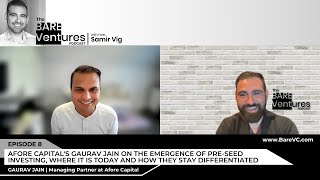
Afore Capital's Gaurav Jain on the Emergence of Pre-Seed Investing and How They Stay Differentiated