Afore Capital's Gaurav Jain on the Emergence of Pre-Seed Investing and How They Stay Differentiated
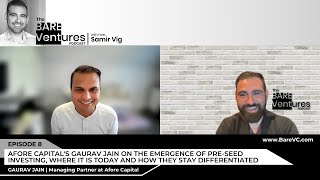
In this Bear Ventures podcast episode, host Samir Vavek interviews Gaurav Jain, managing partner of Afora Capital, one of the earliest pre‑seed focused venture funds. Jain recounts his personal journey from a software engineer at BlackBerry and early Android product manager to a venture partner at Founder Collective, where he observed a growing “catch‑22” for founders needing capital to gain traction but needing traction to raise capital. This insight led him to launch Afora Capital five and a half years ago with a co‑founder from Twitter. He explains how pre‑seed investing emerged as a distinct class, describing early round economics (median pre‑money $5.9 M, round size $1.5 M, post‑money $7‑8 M) and how post‑COVID market dynamics have pushed round sizes toward $2 M and post‑money valuations of $10‑12 M. Jain emphasizes that Afora’s differentiation is not the capital itself but the hands‑on support it provides founders in three buckets: recruiting early talent, building go‑to‑market and design‑partner relationships, and guiding subsequent fundraising. He discusses the importance of rapid iteration and pivots at the pre‑seed stage, noting that successful founders iterate quickly while dogmatic founders often fail. Jain also comments on the influx of large seed funds attempting to write pre‑seed checks, arguing that true value comes from focus, dedication, and the ability to be an active partner rather than a passive capital provider. Finally, he offers advice to founders on selecting early investors: prioritize investors who prioritize the founders, ensure strategic focus alignment, consider signaling effects of investor reputation, and conduct thorough back‑channel diligence on the people who will sit on their board for years. The conversation ends with Jain’s perspective on how the pre‑seed market may evolve as more capital chases early deals.
Chapters
Welcome to the Bear Ventures podcast, where we open the book on venture capital and give you a seat at the table. My name is Samir Vavek, your host for the episode, and joining me today is none other than Gaurav Jain, managing partner of Afora Capital, one of the first, uh, real true pre-seed funds in the market, really before it was even called pre-seed. Uh, Gaurav, it's great to have you on today.
Thanks, Amir, for having me. It's a pleasure.
Yeah, no, we, uh, have been in touch quite a bit over the last year or so, and fortunate to have worked with you on many fronts between Bear and Afor. So I'm excited to have you on the podcast, and you're probably the earliest stage investor I've spoke, uh, doing pre-seed before. It was cool. So I'd love to hear it.
What do you think, I'm the craziest one you've had so far?
Uh, yeah, no, I, I think we'll learn more about that as we go, but, but definitely You know, it's come up in a prior episode, but you have option value. You've gotta be a little kooky when you're doing pre-seed, not for option value, but as a strategy. But it certainly worked out well. Look forward to sharing more with everybody.
Perfect.
Well, Gaurav, maybe a good place to start would be a little bit about your background and the firm and strategy before I butcher it myself.
Awesome. So let's see, software engineer by training, went to University of Waterloo up in Canada. First, my family, first generation immigrants from India, moved to Canada when I was in high school. You know, as I guess a good Indian kid did software engineering here at BlackBerry actually, back when it was still a cool company. It used to be called Research in Motion in the early 2000s. And this was at a time when BlackBerry was selling like hotcakes. And was an engineer and embedded software developer on the core platform, wrote a bunch of code that was shipped on the BlackBerry devices. Then ended up starting a company that was venture-backed. That was my first exposure to venture as a founder myself. That was in the mobile space, which then brought me to the Android team as one of the first product managers at a time when, you know, Google was really going all in on mobile. You know, Google realized that Apple was running away with mobile via the iPhone. And, you know, for Google as a company, they hate intermediaries. And so Google wanted to have a horse in the race in mobile. So Android was the, was the answer to that. I was brought in with a mandate to help for market share. In the time I was working on the Android platform, we went from less than a million total users to about a million new users a day by the time I left. And for the last 10-odd years, I've been doing early-stage venture. Initially, I was in the fund called Founder Collective. I was there for 4.5 years. I was the first person to join the fund after the two founders. And, you know, Founder Collective was sort of Gen 1 of micro VC funds. Historically, in venture, you see these funds like a Sequoia or Kleiner that would do everything from the first round all the way to pre-IPO. But as the venture landscape has gotten more competitive, you see a lot more focus, right? As you would expect in any industry that becomes competitive over time. So in the 2000s, you saw an emergence of a new class of venture capital funds that were stage-focused. So Founder Collective is one of them, First Round Capital, and so on and so forth. So Founder Collective Fund 1 is a $50 million fund, was there to invest in the first rounds of companies like Uber, the Trade Desk, Coupang, which is the Amazon of Korea, went public recently, BuzzFeed, so on and so forth. I was there for 4 and a half years. Some of my investments included Airtable, that was started by a fellow product manager from the Android team, Cruise Automation that was acquired by GM, building autonomous vehicles, Firebase, and so on and so forth. But one of the things I started to see towards 2015, 2016 is, you know, very often I'd find myself telling founders, look, I like your background, I like what you're building, but you're too early for us, right? Go get some traction, go build a product, go get some, you know, some customers, and then we can underwrite a $3 to $5 million seed round. And very often the founders would turn around and go like, hold on a second, so I need traction to get the money, but I need money to get traction. Like, how do I solve this catch-22? So that's when the light bulb went off and we started Afora Capital as a reaction to that, to that problem, which is it was becoming harder and harder for founders to raise their first round of funding before they had anything meaningful to show, right? They wanted to raise $1 million to $2 million to get started with their business. It was becoming really hard as most venture capitalists moved later stage and wanted to write really big checks in companies that were later stage. So we started Afora 5.5 years ago, partnered up with my now co-founder who was the first PM at Twitter. One of the first 25 employees there. He was at Foundation Capital as a partner. We both started Defore in 2016 and the rest is history, as they say.
Yeah, no, it was a— and at the time for you to switch the script from you need traction and then we can invest to saying, you know what, forget it, I'm gonna start a fund and do it myself. How did you get the comfort around that? So most venture capitalists at that time, traction was their way to de-risk the deal and people had to turn to angel groups or friends and family money. Fast forward, what, 6, 7 years now, it's much easier to do that. But at that time, how did you guys get the comfort when nobody else was really doing it?
Yeah. This concept or the label of pre-seed is relatively new, right? When we started Afor, it was starting to emerge in the lexicon, but it was still very much on the fringes. But if you look at it from a first principles perspective, the phenomenon is not new. right? So if you— Jeff Bezos is on record talking about how he had to pitch, you know, tens and maybe even more hundreds of investors for the first million dollars for Amazon back in '94, right? And he finally was able to convince 20 people who wrote $50,000 checks each, right, for the first million bucks. And why was it hard to raise money the first million dollars in '94? Because most people were like, "Well, now what's the internet? Like, how do you make money on the internet? Can you really make money on the internet?" Right? That— those were the questions. right? And the first million dollars was really hard. Of course, if you were part of that syndicate, you did really, really well, right? Same thing with Airbnb, right? When they raised their first million dollars, it was really, really hard. Why was it hard? Well, who wants to share their house with strangers? Aren't you going to get killed doing that? Who wants to share your vacation house with some random stranger? There were so many reasons why you would believe, A smart person would believe this idea will not work. And that's why it was really hard to fundraise. And I can talk about Uber, right? Same thing. When our funder previously invested, you know, they were only doing Uber Black and like, you know, Uber Black cars feels like a relatively small market and like taxis are very hard to penetrate. Anyway, there's a lot of reasons why that first round is always really hard for founders, but all great companies start there, right? Most founders that are successful are first-time founders, right? right? And the ideas are non-obvious. So we knew that it was a very lucrative zip code if you can do it right, right? And it's always existed, and in our opinion, it'll always continue to exist. It'll always be hard to invest before it's obvious, right? It is because there's thousands and thousands of companies to look at, and you've gotta obviously pick a few to invest in. So we knew the opportunity was there, and we were hearing from founders, you know, firsthand that it was becoming— it was getting harder and harder for them to find that money. So we knew if we get it right, there's a lot of money to be made. And, you know, we had a— we had a conviction in ourselves that if the right diligence process with the right focus, we will be able to pick, you know, what we believe will be the next, you know, really big companies.
Yeah, and it's interesting. So, you know, if you look back then around your thesis of why you got comfort on the deal, I'm assuming a big part of it also was the the actual round dynamics, and we'll talk about why they've— how they've changed now, but can you talk a bit about where and how pre-seeds were pricing back then, and maybe what you're seeing in the market now is obviously more entrants that have come in?
Yeah. The median pre-money for Fund 1 was $5.9 million, and the median round size about $1.5 million, right? So the median post-money is about, let's say, about $7.4 million or so. So the idea is founders, when they're just getting started, they wanna raise $1 million to $2 million, right? They would price the deal at somewhere between $6 to $8 million post-money. So for a check of what, $750K to $1 million, we can get 10 to 15% ownership, right? That was sort of the portfolio construction with Fund 1, and Fund 2 is pretty similar. Now, of course, especially because of COVID the market opportunities for most of our companies have increased several fold, right? You see e-commerce adoption obviously has accelerated many, many years, right, because of COVID Same thing with cloud adoption enterprise, and I can go on and on and on. So as that has happened, and then you see public market comps and public market valuations for tech companies has, have ballooned quite, quite a bit. Of course, have come down a little bit in the last few weeks, but still elevated relative to pre-COVID, partially because the markets have gotten larger. You know, that has obviously translated all the way up to our round, right, to some extent, which is founders are saying, well, now I'm building for a much larger outcome and hence the price should be a little bit higher initially. So, you know, more recently I'll say the pre-seed rounds are probably maybe closer to $2 million in size and the post-money is maybe closer to $10, maybe sometimes $12 million post-money. So we've increased our check size a little bit, get that same 10 to 15% ownership. And the idea is You know, we will maintain our ownership in the next round for the best companies, and then we'll dilute alongside the founders as they raise more money. So if we can own about half of where we start, you know, that is kind of how we model out the portfolio construction.
Yeah. And, you know, thinking just if, you know, with this case Siloed, you know, one might look at it as, you know, that's a big jump in valuation. Is it— does it make sense anymore? But if you look at it relative to what's happened in the market, you're still getting some really great companies at really great valuations and being value-add to the founders early. And which is, you know, one of the other things that I want to talk— you're really the first institutional money in, in the— for the most part. What is it that you're kind of offering these founders? How are you helping them get from, uh, really zero to one, right? A lot of times, uh, you know, people talk about one to 10 or 10 to 100, but how do you get them from zero to one?
Yeah, totally. So look, as much as Obviously there's dearth of institutional capital at this stage, like true believers. We still believe that capital is not what our differentiator is, right? 'Cause that's already— So the reason founders choose to work with us is not because we're the only ones willing to write the check, but for many other reasons. And it tends to fall in one of three buckets where we look to help founders at different stages within that zero to one, journey. It tends to be around recruiting, right? So usually we invest in 1 or 2 founders, so they've gotta build that early bench, usually engineers, technical talent, but also as they start to scale the business, some go-to-market talent, their head of sales, some account executives, you know, SDRs, folks doing cold calling and so on and so forth. So we help them identify candidates, help them interview those candidates and help them close. You know, it's a tight labor market, as you know, so the best talent has many, many options. So where founders pull us in is to say, hey, here's, you know, Samir, who we've been talking to, we really like him, but he's got 3 other offers including from Google and Facebook and so on and so forth. Can you help convince him to take a lower salary and join us? So I'll get on the phone and I'll talk about why I believe this company will be the next big thing, why we invested, what our thesis was, you know, leverage the fact that I was an investor in Airtable and Firebase and Modern Health and say, hey, I've seen these patterns before and I believe the team and it's a really interesting business. So here's why you'd be, you know, an idiot to not join this company. And that helps close candidates. Number 2 tends to be on go-to-market, right? How do you, how do we identify design partners, right? Our first few customers, right? Not, not even the first few customers, design partners before that, right? Folks that we can co-develop the product with, right? Who will give me early feedback on on what is the right feature set, how do I, you know, who should I fund, and so on and so forth. So how do we help you again identify and recruit those design partners, get the initial business off the ground? And the third and probably the most, the biggest kind of area, it has to be around future fundraising, right? So the companies raise, let's say, pre-seed of $1 million, but then within 12 to 18 months they're raising a $10 million RC today. So thinking through who are the right partners we should pitch, how do we tell the story, the narrative, iterating on all of those elements tend to be where we get very involved. So those are 3 big buckets on why founders choose us, right, over anybody else. And frankly, a big part of their diligence for the founders is talking to other founders in our portfolio and validating to say, how were we actually helpful, right, beyond the capital, right? And they hear exact case studies and stories of where we move the dial. That's when, you know, it's a competitive market out there and that's how we end up getting into deals.
Yeah, no, I'd agree with you that that candidate, Samir, he sounds pretty wonderful. So— And the examples you gave are very much when the companies are kind of taking flight and growing and you're helping them scale. How do you think through being such an early investor, those scenarios where things might not work out according to plan? You have such a long time horizon between your money comes in and when potential— a lot can happen in the middle. Curious your thoughts on pivots and how you guys support that at that time as well.
More of our companies could pivot and they don't, right? And pivot is a very— it almost has a negative connotation. We actually think it's a positive thing. What that means to me is, look, when we invest, it's mostly a pitch deck and an idea, right? But when the rubber meets the road, the best founders learn a lot and learn really fast and iterate really fast. 'Cause ultimately the point of a business is to like meet a customer demand, right? Is not to build something you think the world should want, is something the world wants to actually use. So every single company that's been successful in our portfolio has gone through iteration cycles really, really fast, right? Where by the time they go from zero to one, the product and go-to-market looks very different than what we initially actually anticipated. And that's completely par for the course. And actually that is why we think focus matters in our business, because when you're a Series A, Series B investor, right? When you're used to investing investing at growth stage, the challenges the companies face are very different than challenges the companies face at our stage. So if a growth investor comes in at our stage, they will inevitably freak out because they're not used to seeing companies change directions so dramatically, so frequently. And, but we are very comfortable with that. In fact, we push, you know, for that level of iteration, right? Because if the founders are not iterating fast enough, we just don't think they're learning fast enough. And some founders, frankly, the ones that don't do so well, are very dogmatic, right? Very like, "No, no, no, I know exactly what to build," and they're just going to keep trying to push a square peg down a round hole. So I think it's very much par for the course. And, you know, look, man, even like when I look at some of our more successful companies like Modern Health, right, in the mental health space, you know, a company that does tens of millions of revenue now, there were many meetings, right? Many, many interactions we had in the first year where I'd walk away and go like, I think there's a chance we will lose our money here. Like, I don't think you've quite found, you know, that hook, right? Or we don't think you've quite found that, you know, beachhead from where we can grow. And that's okay. But we don't freak out in those moments, right? We stay with them, we stick with the founders. As long as they're willing to work hard and iterate and listen to the customer, we are there with them side by side. And some companies take a little bit longer to find that initial traction. Some companies find it faster, and that's completely okay. After having done this for 10 years now, you know, you've seen, we've seen a lot and we're cool with that.
Yeah, and it's a true testament to, I think, what a true pre-seed investor needs to do and kind of what separates the bunch. More and more you're hearing that that's not the case. And so, you know, I appreciate you kind of walking through that. And you mentioned, you know, maybe a growth stage investor coming into, your space or stage at pre-seed. You know, just what you're seeing in the market generally. You know, a lot of funds are raising very, very, very large seed funds which inevitably end up making their way into these pre-seed deals as well. Not that rounds mean anything anymore, the names, but, you know, curious your view on what's happening and where that goes.
Yeah, see, in venture, it is, uh, it is very much an access business. right? Unlike in public markets, if you have a good idea, you can go to the market and buy the stock, right? Nobody can really stop you from doing that. You can actually buy a lot of it too, right? Private markets work very differently, right? It's very much proprietary access, right? Um, and hence funds realize that the, the late— the later you are in the company's life cycle, the harder and harder it becomes to access. right? So it is all about getting in, in that, on the cap table as early as possible, start building that relationship as early as possible. And that gives you a lot of option value to then double down, triple down in future rounds. So the most coveted position, if you may, on a cap table, of course, is the seed round, is the first round or pre-seed, whatever you wanna call it, this absolute first, you know, first name on the, on the cap table. So everybody wants to do it, right? Every investor in venture capital will tell you like, yes, we wanna be the first, first investors. In reality, it's very hard obviously to pull it off, right? Because we talked about focus early. I think focus matters a lot. I mean, the founders see through that, right? Founders are asking themselves, is this investor just buying a cheap call option, right? Because for them, $2 or $3 million bucks doesn't mean anything. And if I decide to double down, are they genuinely here to build a business alongside me? So I think that's where obviously we end up differentiating ourselves versus everybody else. Market is also trying to invest at our stage. And I think what a lot of funds are doing, frankly, where they raise these $400 or $500 million quote-unquote seed funds is they're investing in post-traction rounds, they're just calling it a seed fund because they want the founders to feel like they shouldn't be talking to this fund because they're doing seed investments, right? But when they start talking to these funds, they'll very often push back and say, ah, yeah, I like you, I like what you're building, but you're too early for us, you know, unless it's a repeat founder, right? Unless it's a blank check founder who's made money for them or somebody else. Of course, in that case, you can walk into an Andreessen and collect a $10 million check and you're great. But if you're a first-time founder, again, I go back to the Airbnb example or Jeff Bezos with Amazon, first-time founders, little kooky, like doesn't really make sense, right? A lot of reasons they may not work. For those founders, it is still very hard to raise from those large funds. And it's because, you know, you can only write a million, $2 million check at our stage. If you're managing a billion, $2 billion, $3 billion, it's just, no matter how hard you work, you have 24 hours in a day. So you cannot write so many small checks and spend the time with the founders. It's just the math doesn't add up.
Yeah, no, I completely agree with you. And, you know, it's very important, I think almost, you know, one of the most important stages of the company. And again, every stage of a venture investor will say differently, but that really, that first check-in, you know, the folks that are there for you day and night, it's very, very important. And so I wanna kind of flip the question a little bit to, you know, advice for founders, you know, those out in the market where there's really more options than ever for a first check. There's websites you can go to, there's, you know, larger, more established venture or angel groups. There's more late-stage investors coming into the pre-seed, first-check space, more firms calling themselves pre-seed or first-check. What should they be looking for from an investor that comes into the cap table early?
Yeah, I think there's a few things. One, we say prioritize those that will prioritize you. For founders, this is not a call option, right? They're all in. In a lot of cases, founders have really bet the farm. right, to start this company and they've quit what's probably a pretty cushy job. You know, I mean, a mid-level engineer at Google can clear half a million dollars these days, right? So, you know, it's a lot of money they'll usually leave on the table to start this company and make zero salary. And they're in it for, you know, 10+ years if it's gonna be a successful company. And it takes a lot of hard work and stress, right, to build a business. So we tell founders, look, you want folks around you, we want folks that are partners with you that have a similar level of dedication to the company. So I think that's number 1. I think number 2, we were talking about earlier, focus matters. Is this the right product for you as a founder? Because of course the investors are buying a part of the company, but also the founders are buying the VC. They're trying to— they have ones that have many options, they should figure out which one's the best fit for them, right? Who can move the dial the most for them, right? That's number 2. I think the third thing also matters is signaling, right? Again, venture markets are very inefficient, right? Information asymmetry is a real thing. So we tell founders like, look, if you take money from a big fund who should have been investing in your Series A or B very early on, that if they decide not to invest in Series A, It doesn't mean it's gonna completely torpedo your round, but it does raise some questions, right? Why is this amazing Series A fund who's already at your cap table, has incredible amount of information about your company, why are they not, you know, leading this round that's their bread and butter? So again, that's another thing that could potentially, you know, potentially hurt you. So I think like those are probably the big things that, of course, you know, founder testimonials, right? Do back-channel diligence on the people you're gonna take money from. Jerry Milovin, who's a partner at Bessemer, he spoke at our pre-seed summit last year and he talked about how one of the founders asked him for a reference to a friend or family member. And it was kind of like, he was like, "Never heard that before." But like, actually it's very astute, right? Because when you take money from a firm, you're really taking money from a person who's going to join your board, who's going to spend a lot of time with you, and you really want to know what this person is you like to be around for many, many years, right? You cannot fire your investors, right? Unlike an employee, like once an investor invests in your company, only they get to decide when they leave your company, right? And so you've got to be really thoughtful about saying, hey, this is a one-way decision I'm making. So have I done my diligence to know this is the person, this is the firm that I want to work with for the rest of the history of this company? And that is why, you know, these days the rounds are moving so fast and I feel like there's some remorse later on when people realize they perhaps got into bed with somebody they didn't fully diligence. And you know, that's unfortunate and that's gonna happen. So we encourage founders to do a lot of diligence on us before they take, before they choose to take our money and talk to people. Of course, I'm happy to make intros to our portfolio founders, but the best thing to do is just backchannel us, right? And see what people have to say.
I like the question on, introduce me to a friend or family member. I haven't used it, and the next deal I do, they're gonna hate you for it, but I think it's a very good question. And you mentioned, you know, a few things that are interesting. You know, one is the founder's remorse, if you will, you know, later seeing that maybe they didn't make the right decision on, you know, taking the brand name or whatever it may be. And then the other part of that is signaling, which kind of ties to that in terms of companies still doing well, but maybe not the top 2% of the seed bucket of one of the late-stage funds. Now they're getting that question for their Series A. It's something that I'm personally seeing more and more and more of day by day as we talk to more and more founders. Curious your thoughts on— you've talked about the past and the present, but how do you see this shaking out? What is your view on You know, what do you think will happen to this market as this happens more and more?
Yeah, for sure. You know, in the last year, year and a half, I believe the valuations have gotten ahead of what— where companies really are from a fundamentals perspective. And you saw that in the public markets, you know, in the last— you know, January has been a, been a tough, you know, month for high-growth stocks that are, you know, negative cash flow and so on and so forth. And maybe there's more, more to go. I don't, I don't know. Same thing happened in the private markets. Now in the private markets, you know, deals don't get repriced as easily, right? Because we don't mark to market at the end of every day, right? The only time you really see repricing or mark to market is when there's a new round. So I think a lot of companies that perhaps raised money at a very high valuation relative to performance may find it hard to clear that watermark and then some, right, in the next, you know, when they go out to raise next, maybe this year or next year. So I think that's going to be one, you know, potential challenge that is going to happen. And look, I think the later-stage investors will see there's an opportunity as well, right? Where sort of the blood's in the water and the sharks come out kind of thing. And then that could happen. You know, when things were— money was easy, things were kind of going well, I think the founders that stayed disciplined will eventually, I think, thrive and the ones that were really first principles driven versus ones that just kind of got caught in the hype. I think that's one. I think you'll, you know, exits is another part that it's still unclear. There's like almost 1,000 unicorns in the world that are in the private markets, right? That's a lot of unicorns. And some are worth more than a billion. So, you know, total market cap of these unicorns in aggregate is well north of a trillion dollars. Yeah, these SPACs seemed like it was gonna be a good way to exit for some of these companies. I think it's become pretty clear the SPACs are a pretty terrible vehicle. You know, most are underwater and some very underwater. And it could be a function, maybe it was bad companies going, I don't know, maybe it's bad timing, whatever it was, but I don't think SPACs are gonna be the way a lot of good companies go public. So yeah, I don't know. I don't know what that liquidity looks like, frankly, especially for later-stage investors. right, who put in a lot of money at very high valuations and, you know, may or may not see liquidity anytime soon. You know, the thing with our fund, because we invest in pre-seed, because we invest so early, LPs understand they're in it for the long run, right? Companies take 5 to 10 years, sometimes more than that, to, you know, go public or be sold. So they're pretty patient. But I think when you're investing, you know, in a fund that's supposed to be doing pre-IPO, but companies take much longer to exit, you know, it's a trickier place to be. So there's gonna be, you know, some interesting times ahead. But that said, man, like, if you look for
More from Gaurav

How Soon Will AI Power A Billion Dollar Company Run by One Person? W/ Henry Shi & Guarav Jain | Ep11
Episode 28: Catch the attention of investors with non-obvious insights | Gaurav Jain
Early-stage Success: Insights From Afore Capital's Gaurav Jain on Investing in Pre-seed Companies
Biggest mistakes first time fund managers make with Gaurav Jain of Afore Capital | 1947 VC