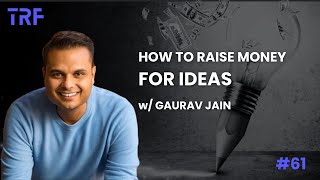
How To Raise Money For Ideas | Gaurav Jain | The Revamped Founder
Gaurav Jain, co-founder of pre-seed fund Afor, explains what he looks for in early founders: authenticity, iteration speed, domain expertise, and contrarian thinking backed by evidence. Afor uses first-principles diligence to predict product-market fit before conventional metrics exist, writing typical $1-2M checks with a 2x graduation rate to Series A.
Chapters
When we started Afor 7.5 years ago, pre-seed was a negative term, believe it or not, right? Pre-seed was reserved for founders who couldn't raise a seed. They were forced to call their round pre-seed. So it was a sign of weakness. So founders didn't really want to say, I'm raising a pre-seed round. And hence VCs didn't want to invest in pre-seed because who wants to invest in companies that struggle to raise a round, right? Some people go to the casino and some people are writing checks into startups, right? The odds are against you, right? Most startups don't work out. So it's okay for angels to lose a little bit of money. But when you're doing it as a living, it's hard. That's kind of our special sauce, if you may, right? Because I think most of the market believes that there's like nothing to diligence, right? You must be just throwing darts on the board. Like, how can you possibly know what's gonna work. So it's just like throwing darts on the board and kind of, you know, uh, crossing your fingers. But what we believe and what we do is a lot.
Thank you so much to Dula for being the early backers of the podcast. For entrepreneurs and founders just starting out, forming a US LLC, a bank account, managing taxes, compliance can be a daunting task. If you're a non-US resident or first-time founder who lacks the experience, knowledge to navigate the complex legal and financial landscape, it will be impossible for you to do all this. Doola is an all-in-one platform that simplifies the process of forming a US LLC, setting up a US bank account, and handling taxes compliance for startups and businesses all over the world. Doola's mission is to democratize access to the US market and empower entrepreneurs to focus on building their businesses without getting bogged down by bureaucracy. If you're building a company, there's no better option out there than Doola.com. Hey Gaurav Jain, how are you? Hope you're doing well.
I'm doing well. Thank you for having me.
Yeah, it's an honor. I've been eyeing this one for a very, very long time. So I think if we just get into it, so who is Gaurav Jain? Who are you?
Let's see. I grew up in India in a city called Dehradun. Unfortunately, I was not as mature as you are at your age. So I had to make many mistakes on the way to figure out what I really wanted to be. But grew up in Dehradun. Family moved to Toronto when I was in high school. I was about 15. And finished high school, did software engineering at University of Waterloo. Thought I was gonna be a, wanted to be a coder. Realized pretty quickly I was not very good at it. So decided to kind of go into more of the business side of things. Started a company that was venture-backed, so that raised multiple rounds of funding, which was my first exposure to venture. You know, I learned what venture was all about and what VCs did, that was kind of interesting. Did that, that brought me to the Android team in the early days, helped scale that platform from less than a million total users to about a million new users a day by the time I left. And went to business school and then I've been in venture since then, so it's been 12 years now. I've been backing founders that have a dream and an idea and I try to play a very small role in helping them make it a business. Obviously we give them capital, but also more importantly kind of helping them figure out how to get their business off the ground. Started this fund with my friend about 7.5 years ago and it's called Afor. It's a pre-seed fund. Our typical check size is anywhere between $1 to $2 million right at the idea stage and then help them make it a business.
Step back a little bit. Before you were the product manager for Android and different things like that, your first company, how did pre-seed look like for you?
It was not called pre-seed, but it essentially was pre-seed. We raised $600,000 in summer of 2008. It was largely from angel investors, a small fund. But you know, we were just coming out of undergrad, had no real attraction. It was really an idea and a dream, and somebody was kind enough to give us $600,000 to get us in business, and then we raised a Series A, a few million dollars, and kind of off to the races from there. And part of the reason to start a 4 is, you know, there is a gap in that funding market. You know, there's lots and lots of money once your business is doing well, right? Once it's revenue, ARR, it's got traction, it's got product market fit, lots of people are going to chase you. But not many people that are institutional in nature, right? Not just angel investors, but like true funds that will write meaningful checks at that early stage. Those are still few and far between. And that's kind of where we come in, which was a problem for us when we started the company that I started. It was, there were no pre-seed funds. So it's really hard to get funds to back us. So we had to find some angels.
Why do you think are angels comfortable at pre the pre-everything going good stage, better than institutional, they're not?
Yeah, there's a few reasons. You know, angels are usually writing small checks, right? So it's kind of like almost think of gambling money, right? Some people go to the casino and some people are writing checks into startups, right? The odds are against you, right? Most startups don't work out. So it's okay for angels to lose a little bit of money. But when you're doing it as a living, it's hard, right? Because you need to be writing bigger checks, you need to spend a lot of time with them, and it's just not the most, from a, you know, amount of dollars you can make, probably not the most attractive part of the market, to be honest. We think it's the most fun part of the market, but I think if you're looking to deploy lots and lots of capital, you gotta be investing later stage when the companies can absorb it, right? Because companies can't absorb a lot of capital at this early stage, and it's a lot of work. right, to get these companies off the ground. So it's like the inverse of like the opposite, right? It's like, can't deploy a lot of money, but you got to do a lot of work. So angels are up for it, but a lot of funds are not.
But I'm curious why though, because doesn't the power law help them out, help the institution out here?
It's a combo of like power law, but also how much of the company do you own and how much money you put to work, Right? So the power law is true, but it becomes a little bit more clear which companies are gonna be those outliers by Series A and Series B, right? And the power law still exists there. Of course, your cash-on-cash is not gonna be as high, but if you're, if your pick rate should be higher, right? Because the companies are a little bit more clear, you're not gonna invest in a lot of the duds. So I think it's like sort of the sweet spot, right? In some ways, if you're looking to deploy a lot of capital, you want to be waiting a little bit than going in too early. I think if you're looking to optimize cash on cash, you obviously want to be as early as possible, but that's not always the incentive.
What really changes from pre-everything to Series A from what you have seen?
Yeah, I think the product's in market, right? Customers are using it. There's some revenue traction, commercial signals flowing through the business. So You know, as an investor, you can call and talk to customers, understand why they brought the product, why they bought the product, why they use it, who else did they consider, how much they're willing to pay for it. And some of those things become a little bit more clear. The market pull becomes a little bit more clear versus at our stage, you know, it's less clear. Obviously we do a lot of work and diligence to build that confidence, but the data's not quite there.
Uh, this is like, this is one thing about F4, rather than all the pre-seed funds or the pre-seed fund managers I've had on, you guys have nothing to invest off of from what it's, from what the outer world sees. Where others do put a barrier as to what the minimum requirements are, you guys have nothing, it's like you're giving away money. But what does the process for you guys really look like? Seeing it pre everything.
And I think that's kind of our special sauce, if you may, right? Because I think most of the market believes that there's like nothing to diligence, right? You must be just throwing darts on the board. Like how can you possibly know what's gonna work? So it's just like throwing darts on the board and kind of, you know, crossing your fingers. But what we believe and what we do is a lot of diligence, right? We have a lot of confidence when we invest in these companies that they'll at least get to product market fit and then some, right? It's hard to know honestly which companies will be like independent big companies, public companies. That at our stage is not as clear, I'll admit. And even to the founders is not clear, right? Because when you look at the seed deck of Uber, right, to use a famous company back in the day, and it's public information, they talked about the market size to be $4.2 billion, right? The total market for their business was $4.2 billion. And usually founders exaggerate, so they probably thought the market was like $2 billion, and best companies get 5, 10, 15% market share in their markets, right? Most companies. So like you think of the revenue potential of that company, wasn't that much, but according to the founders, not according to the investors, according to the founders, Uber today does tens of billions in revenue, right? And it's not because the founders were conservative, it's anything but, but the founders themselves don't quite know exactly how big this can be. But what we try to really diligence is the short term. right? We have a lot of clarity on the short term on how this company goes from, you know, how this company goes from like this idea stage to Series A, right? To really get a sense of like, okay, I think there's a market pull here. I think there's a lot of customers who are ready to buy this product. And I think that we're able to build that conviction, you know, pretty confidently and pretty quickly. And which is why our graduation rate to Series A is 2x each.
Industry average. So if you talk about the long-term and the short-term, uh, planning or thinking, how do, how do you guys as an investor, as an investor at the very early stage, think extremely long-term while keeping the short-term?
Yeah, you know, we, um, we think a lot about the short-term, right? How does this company go from an idea to product market fit, idea to Series A, uh, to the next stage of financing, maybe next 2 stages. And then we have a point of view on the long term, but I will say that it's a little hazy, right? It's like, we think this market is small today, but it'll become really big for these reasons, right? But exactly how big it's gonna be, I don't know. Exactly what adjacencies the founders may find, right? Once they have success, we don't know. Like for example, if you go back to Uber, you know, they were just pitching the black car market, right? And yeah, you could have maybe if you squinted really hard to say, well, maybe they could do other stuff in transportation. But honestly, the journey that Uber has taken with UberX and UberPool and Uber Eats, I think that's very hard to predict. Very, very hard to predict. And even if you look at companies like Instacart, right? They make, I think like a good portion of their revenue from advertising. That would've been hard to predict too. you know, that so much of the revenue will come from advertising and not actually delivering groceries. Um, so I think you have to be comfortable with that level of, um, lack of clarity, and you're just backing strong founders who you think will find those adjacencies.
If, if you talk about, uh, revenue model, revenue model there, for like you give the example for Instacart or Uber Eats, for Uber actually with the multiple channels that is ads, At such a nascent stage for young companies that you guys invest in, like pre-aversion companies, do they have a revenue channel in mind or does that get developed over time? Or does the market decide how they get paid?
Yeah, I mean, I think they have a point of view, obviously, in the business model, but what we look for are founders who iterate really rapidly, they learn really rapidly, right? And so they put something out there, they get feedback from the market, and feedback may be explicit or implicit, right? Explicit feedback is like they tell you like, "No, this works, this doesn't work." Implicit might be you're trying to sort of suss out, right, on what the customer is not telling you directly because maybe they don't know themselves, but it's sort of what you can infer, right? Henry Ford is famous for saying, you know, "If I ask my customers, they tell me they want faster horses," right? Not cars. You can hear from the customer they want to go faster, right? They want to move faster, but you're not going to hear from the customer they want a car. They're just, all they can see is horses, so they just want faster horses, right? So I think you have to kind of understand the jobs to be done for the customer, understand what the priorities are, what's important to them, but then you have to then develop that product, develop the business model that's going to work for them, right? I think that's where we look to look for founders that have that commercial DNA to be able to combine the pain point that you're solving and then the right product to solve for that. And of course the business model being a part of it.
Actually, the founder is metaphorically having the pulse. Imagine the car where everyone else besides them is thinking about all this.
Yeah, I think that's what makes the founder special, right? It's the reason why startups can innovate and outcompete when incumbents are not able to do that, right? You would say Uber should have been a taxi company, right? That should have launched Uber, right? They already had the drivers. They already had the passengers, they already had the business model. All you had to do is just build an app, right? And boom, you have Uber. Doesn't work that way. You know, you would think that Walmart should have built Amazon, right? They already have the inventory, the supplier partnership, they have the brand, they have the customers, they have the money. Why can't they build Amazon? But this is what best entrepreneurs do, right? Is they look at that, that landscape, they look at the market, they look at the pain points, they reimagine kind of how that problem can be solved. And what we look for is, is this 10x better, right? Because the learning has been that humans are lazy and inertia is a very strong force, right? So if it's just a little better, humans, people just don't care enough to change behavior, change their day-to-day. but if it's 10x better, if it's meaningfully better, right? That changes the game, right? So it's like back in the day in the US at least, if you needed a taxi, you would call this number and they'd be like, "Oh yeah, it's on the way." It'd be there in 20 minutes. And you call 20 minutes later, they're like, "Oh yeah, it's on the way, 10 more minutes." You call 10 minutes later, they're like, "Oh yeah, it's on the way, 10 more minutes." And it's like, where is it, right? And with Uber, suddenly on the app, you can see exactly in real time where the driver is. 10x better, right? That is completely different game, right? Same thing obviously with Amazon versus Walmart. So I can go on and on. I think that's what the job of the founder is, to reimagine, to think outside the box, to be able to bring something net new to the market. And that's obviously our jobs to underwrite that.
Carrying this point, same exact point forward, if we look at it from your, the F4, the fund manager side of things, When everyone was doing pre-seed with prerequisites and you were actually doing pre-seed rather pre-everything, but you not get affected by what everyone else was doing with trying to—
Yeah, look, I think you have to be a first principles thinker, right? To be able to block out the noise. And you know, when we started up 4 or 7 and a half years ago, pre-seed was a negative term, believe it or not, right? Pre-seed was reserved for founders who couldn't raise a seed, so they were forced to call their round pre-seed. So it was a sign of weakness. So founders didn't really want to say, I'm raising a pre-seed round, and hence VCs didn't want to invest in pre-seed because who wants to invest in companies that struggle to raise a round, right? And hence LPs who invest in our funds were not interested in pre-seed funds. So that was sort of the state of the market, right? But what we saw on the ground were exceptional people, right? Really strong talent who had really good ideas, who just needed somebody to believe in them, who just needed some capital. And we saw lots of success stories, right? We saw, you know, Uber raised a million, million and a half when they got started. Amazon is, Jeff Bezos talks about how he collected 20 $50K checks, right? First million dollars for Amazon at $5 million post-money. Right? And tons and tons of stories like that where the best companies all start off with $1 to $2 million, right? That's always the case across vast majority of the best companies. So we knew from a first principles perspective, the opportunity was there. The talent is there, the businesses, the ideas are there. You know, there's historic examples of this, mostly it was done by angels. So we knew First principles, the opportunity's there. The market doesn't believe in it, market disagrees with us, that's fine. We're gonna go power through. It's sort of what people call contrarian thinking sometimes, right? So it's a contrarian bet. Sometimes it doesn't work, sometimes it works, but I think that is the job of an entrepreneur is to bring something to the market that is net new, right? And look, if it always worked, then it's not really risky, right? Then it'd be easy, everybody would do it. right? So I think it's actually a good thing that doesn't always work, 'cause it creates some level of risk in that. And I think that creates a certain kind of upside, right, for people that do it, which makes it worthwhile. So that's kind of how the ecosystem works.
How do you see your LPs' thinking change when you pitch something to them that they are not— they're not—
Yeah, look, LPs, and look, we were not able to convince everybody for Fund 1, right? A lot of folks, told us no, told us it was a bad idea, told us it's not going to work, told us this pre-seed is a fad. We heard all kinds of stuff. But I think, you know, job of an entrepreneur is to find enough people to believe in you so you can pursue your dream. And the people that believed in us, A, also saw the opportunity just like we did, right? They understood the first, when we described it to them and we explained it to them and we pointed to some data points, they were like, we get it, we see it. Number one. Number two, I think at the stage where we are, where we were, sorry, with Fund 1, you know, you need people that'll believe in you, right? As an individual, frankly, more than the idea. And this is what we do, right? At Pre-Seed, as I was talking about earlier, right? Is we, first we have to believe in the founders, right? To say, these are the incredible team. And then we kind of go, okay, well, what do you want to build, right? And tell us more. And like, And sometimes it's kind of connected because the way they describe their idea, the way they describe their vision helps us build conviction in them. And if you have conviction in them, we believe the idea more. So it kind of goes hand in hand, but I think it really comes down to believing in the individual or individuals first, and then believing in the opportunity. And I think folks backed us because they believed we could do, build something meaningful. And you know, we're obviously very thrilled and honored that they believed in us.
What really makes a person or founder rather believe in you?
Several different things. You know, one is the authenticity, right? Understanding why they're working on this, how they ended up on this idea. We look for sort of that trajectory, right? That makes this like almost inevitable as to why they would be doing what they're doing versus somebody who just like read a report on the internet and is like, oh, let me go do this because it's hot. Sometimes it can work, but a lot of times it doesn't work that way. Way. I think second is just the speed at which they work, right? So we try to really understand like in the last 3, 6, 9 months or whatever since you've been thinking about this, what have you accomplished? Who have you talked to? What have you heard back? What's worked? What's not worked? What have you learned? What have you changed? Like all of those things really help us understand the velocity at which these founders can move. 'Cause a lot of success, as you were talking earlier, is just about iteration speed, right? The clock speed of the founder or the founders, right? Put something out there, get feedback, learn, just keep doing that really fast. Backchannel helps us a lot, right? So we call up a lot of people that have worked with you in the past and sort of try to suss out what they believe. The non-obvious insights that the founders have as well, right? When they can point to something that most people don't believe, right? But they have this earned secret because they've been in the space for a while or they're somehow close to the problem. And that ends up being an unfair advantage to them, right? As they get started, eventually it becomes an obvious insight, but they have that window while it's still non-obvious where they can build something interesting. You know, in some ways for us that was pre-seed, right? For a few years, nobody really believed in us, and that's great. Allowed us to build a brand around pre-seed. When founders think of raising a pre-seed round, they usually think of us, which is great. Now a lot more people can pre-seed, right? So you gotta keep innovating, you gotta keep pushing the envelope, coming up with new stuff, but a lot of startups get off the ground.
Over the contrarian way of thinking that the founder should have, what do you think, how do you guys know at such an early stage that the founder, the contrarian way of thinking of the founder is not just random thing that they came up with versus it actually is, can be, is doable?
Yeah, you know, again, going back to first principles, right? We don't want to invest in contrarian stuff for the sake of Ontario, right? 'Cause a lot of times it could be wrong. So what we really try to understand is, okay, what's your belief? And then we go check with the market, right? To say, okay, if I was to just boil this down to first principles, is this the right, is this truly a pain point? Is this an acute enough pain point? Will users or customers gravitate towards this? Will they pay for it? Do they value it? I think all of those things you try to understand based on, again, the basic principles. To try to connect the dots, right? To say, okay, this is what the founder said. At the surface, seems kind of contrary and seems like not the right thing. But then when we go back and do diligence, it actually makes a lot of sense, right? And when those two things connect, that's what gets us excited.
How do you really do the diligence after listening to or talking to the founder?
It's a series of different steps. One obviously is talking to, backchanneling, you know, with the founder, right? Understanding who they've worked with, you know, previous managers, previous colleagues, folks who may have gone to school with, friends, whatever else we can get our hands on. And the second is like talking to folks that would be customers or users of this, right? So using our network to get in front of potential customers to better understand, you know, again, the things that we're talking about. So a lot of it is just talking to, folks, right, whether that domain experts, potential customers, just educating ourselves, right, on the opportunity as much as we can. Obviously it helps that we've been in the business for a while, so we've got a portfolio now who's in different spaces, we can lean on them. We see a lot, right, in terms of different ideas, different companies, so we just kind of build more of a memory, muscle memory on like what are interesting pockets of opportunity would be, what has been tried before, what has worked, what doesn't work, so. I think it's a combination of different things. There's no one silver bullet per se, but across, if you triangulate, I think we can get a pretty good sense.
When investing at such an early stage, when practically there is nothing on the table, how much of what you guys look at is past experience versus just what the founder is in that moment?
Because I actually think like the persona of somebody who's had past failures, especially in startups, it's actually a feature, not a bug. Because look, we all make first-timer mistakes, right? We all, the best people like learn, right? From their mistakes, they learn from doing and they learn from their experience. And I think when you have tried building a company, you've made a lot of mistakes, the first-timer mistakes, you learn. And I actually think the second time or the third time you're doing it, you're just not going to make those mistakes. You're going to make new mistakes, but hopefully not the same mistakes. And I think that just gives an unfair advantage. But what's also nice about folks that haven't had a lot of success in the past in their startup life is they're still hungry, right? They're still hungry. They're still, you know, keen to prove themselves, have a chip on their shoulder. So you're kind of matching somebody who's got experience with hunger. And that's a pretty potent mix. So we actually like that. right? Not everybody has that, fits that bill, but many founders we've invested in have tried something in college, high school, maybe had a startup before, didn't work out, acquihired, and then like now I just want to go back, like want to prove that they can do it and they've learned a lot and they're smarter on how to hire better, how to fundraise better, where to spend money, what to focus on, how to prioritize, like just learn so many things. So I actually think it's a really, really good sign when folks have folks have had that level of experience.
Why do you think in the whole startup VC community is hunger prioritized so much?
Because shit's hard, man. You gotta, you gotta, you gotta, there's a lot of people that want opportunity, but very few people that are willing to go for it. I think most people in life want life to come to them, right? And they want to be a passenger. Not a driver. And I think you've got to be a driver in life if you want to do something special and something big. I think if you want just a nice, you know, comfortable life, get a job, make money, nothing wrong with that, not judging, right? That's absolutely a totally fine thing to do. But I think if you want to like buck the trend and create jobs, build companies, build value, I just don't think you can be a passenger. I think you gotta be a driver, you gotta fight, you gotta hustle, you gotta go for it, right? You gotta grab it. And for that, you need hunger. And the thing is, it's hard and you're gonna have lots of failure along the way. And I think if you give up once, the first time you hit some roadblock, you're not hungry enough. I think you need that. That's why I use that as a metaphor, obviously. You need that level of, I'll do anything for this. 'Cause it's, It's freaking hard. It is freaking hard and it is, odds are against you. And if you don't have that hunger, you're not going to make it.
Does it come naturally or?
Yeah, it's a good question. Obviously I don't know the exact answer to that. My guess is it's a combo, right? I think you have to have ambition, right? In life, right? Which probably is, some of that is like, a lot of it is probably nature, not nurture. I think it's probably hard to learn how to be ambitious. But I think you also have to surround yourself with people who are going to uplevel you, right? I mean, I've certainly seen that in my life when I've had people around me that are just executing at a different level, thinking at a different level, sort of pulls you up implicitly and like your ambition levels go up higher, your hunger levels go up higher, the desire to wanting stuff goes up higher. So I think a lot of you can, can solve up for it by surrounding yourself with certain kind of people, but it's hard, man. It's hard, you know, when you don't have to take risk, when you don't have to have those sleepless nights, when you don't have to work on the weekends to then still want to do it, you know, it's kind of irrational, right? If you think about from a rational, logical, risk-adjusted basis, starting a company is actually a really bad way to make money, right? Risk-adjusted, right? You're much better off getting a job, and especially a lot of the people that are successful in building companies, they can get good jobs at a Google or whatever, name your company, Microsoft. So like for them to give up the opportunity cost, it's like, it's irrational, right? It's stupid, right? In a way to do that. So you have to really want it to still want to do it, right? And I think that's, I think some of that has to be just innate, right? It's maybe something in childhood, maybe, what you saw with your parents. But I do think if you hang out with the right kind of folks, that can also change you slowly but surely.
I think one last question that I'd like to end with, this has been incredible. I've been into SaaS and VCs since I was like 11. What do you think is one fact that would blow 11-year-old me away?
Believe it or not, you're going to miss your school days.
Yeah.
It might not seem like that right now, but it's the most beautiful days. I know it's stressful being in school, but you're going to look back and miss it. So don't be in a rush to just get through school.
Yeah, for sure. I mean, I hope so.
Awesome.
I think this will be incredible. I'll let you go now. And I think that's it from my side. Anything you'd like to say?
Good stuff. All right, man. Well, thanks for having me. Hopefully this turns out well. Thank you for inviting me and good luck with everything in your future.
More from Gaurav

How Soon Will AI Power A Billion Dollar Company Run by One Person? W/ Henry Shi & Guarav Jain | Ep11
Episode 28: Catch the attention of investors with non-obvious insights | Gaurav Jain
Early-stage Success: Insights From Afore Capital's Gaurav Jain on Investing in Pre-seed Companies
Biggest mistakes first time fund managers make with Gaurav Jain of Afore Capital | 1947 VC
Afore Capital's Gaurav Jain on the Emergence of Pre-Seed Investing and How They Stay Differentiated