Episode 28: Catch the attention of investors with non-obvious insights | Gaurav Jain
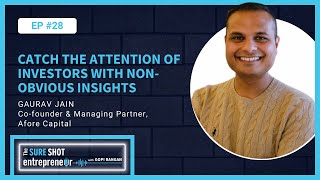
In this episode of The Sure Shot Entrepreneur, host Gobi interviews Gaurav Jain, managing partner and founder of A4 Capital, a Silicon Valley venture firm that specializes in pre‑seed, "0‑to‑1" investments. Jain recounts his personal journey from a software engineering student in India and Canada, to a mobile‑startup founder, an early product manager at Android, and a venture investor at Founder Collective before launching A4 with a co‑founder who also has a product‑management background. He explains A4’s stage‑focused, sector‑agnostic strategy: leading $750K‑$1M seed rounds, helping founders reach product‑market fit, and then supporting Series A raises. Jain details his diligence approach, emphasizing concrete 12‑18‑month forecasts, customer discovery, and non‑obvious insights that reduce perceived market risk. He shares concrete case studies—Cruise Automation’s innovative aftermarket data‑capture model and Modern Health’s positioning of mental health as the "fourth pillar" of employee benefits—to illustrate how founder conviction, storytelling, and bias for action influence investment decisions. The conversation also covers the practicalities of the investment process (30‑minute initial calls, rapid 2‑4‑week deep‑dive, virtual due‑diligence post‑COVID), the importance of long‑term relationships (e.g., Firebase founders becoming LPs, attending founders’ weddings), and frustrations with ecosystem inefficiencies in matching founders to investors. Finally, Jain discusses his civic engagement, supporting moderate political candidates and the ACLU, underscoring a broader view of impact beyond capital allocation.
Chapters
that the market actually ascribes a lot more risk to the stage where we invest than is actually real. And what does that mean? So we do a lot of diligence to try to understand what does the next 12 to 18 months look like for this company? We should be able to, with a high degree of specificity, have a sense on, okay, here's who the customer will be, here's how much they'll pay. I've already talked to a bunch of customers who would buy this product if it existed.
You are listening to The Sure Shot Entrepreneur. A podcast for founders with ambitious ideas. Venture capital investors and other early believers tell you relatable, insightful, and authentic stories to help you realize your vision. Welcome to The Sure Shot Entrepreneur. We are here today with Gaurav Jain, managing partner and founder at A4 Capital, a Silicon Valley-based venture capital firm. In this episode, Gaurav Jain and I talk about his journey into venture capital, starting as an entrepreneur and later working at Google as one of the first product managers, and how he started A4 Ventures. We talk about specific examples of startups that he invested in, like Cruise Automation and Moderna Health. He gives his perspectives on what he looks for in entrepreneurs, the storytelling, the market sizing, and other details that he likes to see in the conversations with entrepreneurs. Gaurav Jain, welcome to The Sure Shot Entrepreneur.
Thank you for having me, Gobi.
Tell us about yourself and walk us through your career journey over the years.
So I was born in a small city in India and then grew up in India. My family decided to move to Toronto in Canada. When I was in high school. So I finished high school in Toronto, went to University of Waterloo for software engineering. When I went to Waterloo, my goal in life was to become an engineer at Microsoft because that was the cool company at the time and that's what I wanted to do. Never was able to get a job at Microsoft, but by the time I graduated, Microsoft wasn't a cool company anymore anyway. But I ended up starting a company in the mobile space. That was my first exposure to venture as a venture-backed founder. So we raised what would be called a pre-seed round of about $600,000 in the summer of 2008. It was an interesting time to start a company because in the fall of '08, the global economy melted. Thankfully we survived. I raised a Series A in 2009. I knew it was the right place, right time. We were building software for smartphones. So I had interned at BlackBerry when I was at Waterloo. I'd worked at another mobile company in Singapore. So I'd been in the smartphone space for a few years. And of course smartphones at the time, mostly BlackBerry, were selling like hotcakes. And then of course the iPhone launched in 2007 and the apps from Tellemate. So it was the right place to be even though the macro was not doing so well. Our business was performing really well. Anyway, that brought me to the Android team in late 2009 as one of the first product managers there. Had a fantastic run. Saw Android from less than a million total users to about a million new users a day by the time I left. For the last 9 years or so, I've been in venture and initially with a fund called Founder Collective. On the East Coast, did investments there in my 4.5 years, and then left in 2016 to start Afor with my co-founder who I've known for many years, and he's got a similar background to me in some ways. I also born and grew up in India, and then he came to the US for his MBA, and then he was the first product manager at Twitter. He was an investor at Foundation Capital before we both left our previous firms to start Afor. And the reason we started the fund is to back founders super, super early. So both of us, when we were seeing in the venture ecosystem is that funds are moving later stage. Even seed funds were really acting like Series A funds in terms of what they were looking for in terms of traction and metrics before they would invest. Both of us are really passionate about the early stage, so we left and wanted to focus on what's being called pre-seed now. So we started Afor, raised our Fund 1 in 2016, and we do this for 4.5 years.
Now that you started your own fund, how is it different for you compared to angel investments and other investments that you made in the past?
Yeah, look, it's similar in a lot of ways in the sense that the core of the job is still the same, which is find the best people, find the best founders that are working on some really interesting stuff. You meet hundreds of these companies and you have to be able to quickly get to those 1 or 2 or 5 that you want to invest in and then support those companies getting to product market fit and scaling those businesses. So that core is the same. Whether I was working at a fund or if you're an active angel investor or now running a fund, there's a few additional things I have to do. As a founder myself now, you have to build a franchise and a brand from scratch. You have to fundraise yourself. So we've raised 2 funds now. In a lot of ways, it brings the humility back of what it's like to be on the other side as a founder raising capital and having to tell your story and convince people to give you money and take a bet on you. So there's some additional stuff. And of course, like customer service when it comes to LPs and our investors and so on and so forth, you are a lot more responsible for strategy and the future of the firm, but the day-to-day is fairly similar.
I can relate to that. Now that I started my own fund, I have more empathy for entrepreneurs. The fundraising process is pain for everyone. It's not easy to build something from scratch.
Yeah, totally. And it's easier in some ways to raise money for a fund. It's harder in some ways. It is, but there's a lot of similarities. But I think what definitely is common is you have to, you know, kiss a lot of frogs before you get a lot of nos. And I think you have to be up for that challenge.
Yeah, you got to get used to rejection. What kind of areas do you focus on for your investments?
We're more stage-focused than sector-focused. So you meet a lot of investors that'll say, oh, I'm focused on future of work, or I'm focused on VR, or whatever the case might be. That's one way to practice venture. We've taken a slightly different approach, which is more stage-focused, but be generalists. We are focused in that quote-unquote 0 to 1 phase. Typically it's a couple of founders that have a pretty clear sense of what they want to build, what use case they want to go after, who the customer may be. They've done a lot of customer discovery work, but they don't have a lot of traction yet. Maybe they have a prototype, maybe a pilot or two, but the business is still fairly early and this is typically their first money that they want to raise, usually at $1 million to $2 million. And that's the round we focus on, and that's the round we want to lead. We can write that $750K to $1 million check in that round, set the terms, and help the round to come together and partner up with co-investors, angel investors, strategics, so on and so forth, whatever the case might be, and then work closely with the founders to get them to that product-market fit stage where now they have some meaningful traction. And a better sense of like what the sales motion looks like or what the customer acquisition costs look like, then we can go on and raise a Series A, and then that could be a $5 to $10 million round. So we've done a bunch of stuff in enterprise software, B2B SaaS, some consumer fintech, insurtech. So generally from a sector perspective, we kind of say that we wait for the entrepreneur to kind of point us to the opportunity. So the founders will come in and be like, look, I've been working in this area for a while, or I've been experiencing this pain point and I really want to go solve it. Of course, it's our job to diligence that and see if it's a fit for for, and then if it is, then we'll, we'll make that investment.
Yeah, this is a difficult space where going very, very early, super early, there's a lot of risk there. And some VCs call themselves early investors, but they don't really take that kind of risk. What stage is too early for you? How early is too early and how late is too late for you?
Yeah, I think if the founders haven't quite picked like a use case that they want to tackle, that's likely too early. So for example, You know, and we meet some stellar rockstar founders with a great resume and they're like, well, look, I want to do something in healthcare. That's great. I want to help you identify exactly in healthcare what you want to do, but we're not going to invest at that stage, mostly because it ends up a lot of times being sort of this endless, you know, series of R&D experiments to find something that they're excited about. The challenge with that is, A, they may not find something. A, that they're excited about to build, or B, they find something that we're not excited about to be an investor in. It's just not fun in either of those scenarios. So we'd rather be helpful at that stage and wait for you to say, okay, this is the exact problem I wanna solve. And for us to obviously diligence to see if it's a fit for Afor. And, and what would be too late is I think if they had meaningful traction where they can raise like a seed Series A, then we, we still wanna be considered for that round, but we feel like we're not as differentiated. I think where we really stand out from other investors is in that sort of pre-product market fit stage when it's still not, you know, clear how big this can be. You said something interesting. You said, you know, it's very risky at the stage where we invest. We hear that and it actually gets us really excited because it is conventional wisdom that like, wow, like you're investing like before there are any customers, before there's any traction. Isn't that like really risky? Are you just like throwing a dart in the dark? We push back on that because we think that the market actually ascribes a lot more risk to the stage where we invest than is actually real. And what does that mean? So we do a lot of diligence to try to understand what does the next 12 to 18 months look like for this company? We should be able to, with a high degree of specificity, have a sense on, okay, here's who the customer will be, here's how much they'll pay. I've already talked to a bunch of customers who would buy this product if it existed. So we're not taking as much market risk as one would imagine. Now, Of course, we don't know exactly how big this can be or exactly where this will go, because companies at our stage within 12, 18 months will evolve the product and the customer pitch and narrative and so on and so forth. And that's fine. That's par for the course. And we embrace that. But I think if you invest in something and like it just doesn't get to first base, we think we've screwed up in diligence. And I think the market thinks that, oh wow, if you can't get a strong sense of how this becomes a public company one day, like it's too risky. I don't know. That's an opportunity for us and that's where we are different. Than everybody else.
What do you look for at this stage when you invest? Can you give an example of a company and describe like, what was the conversation like? How did you meet them?
Yeah, for sure. So I'll mention a company I invested in a few years ago called Cruise Automation. This is a company in the driverless space, and I'll pick on a few things that I remember from the process as sort of a way to really demonstrate kind of our diligence process. So when I met Kyle Voigt, the founder CEO, this probably was like 2015. 2014. He wanted to build the first driverless car to go on the road. I'd worked at Google before, so I knew Google had been investing a lot in driverless cars. I knew Tesla was working on it. Like, at the surface, it felt like it wasn't a startup opportunity. It felt like it was a very expensive R&D experiment to build a driverless car. So I pushed Kyle on that. I said, look, I like you, your background, but driverless cars, I mean, look, if you can build it, of course there's a massive market for this, but I'm not convinced that a startup can pull that off. The reason autonomous vehicles are really challenging is because there's millions of edge cases. So for example, if a plastic bag is flying across the highway, you and I know it's a plastic bag, we'll just drive right through it. But for a computer, for a sensor, they can't differentiate whether it's a plastic bag or a, or a human. And obviously the response is very different in those two cases. There's millions of these edge cases, and the only way to solve for that is just with data. The reason it's really expensive to build these autonomous cars is because you need a lot of data. And how do you capture data? By having cars on the road that are constantly capturing this data. So my response to Kyle was like, "Look, I think it'll cost you hundreds of millions of dollars to build this car. Like, why would an investor like me want to back you at seed?" He had an interesting non-obvious insight. What he said was, "Look, you're right, it's a data problem. But the way I'm going to gather data is not by putting hundreds of cars or thousands of cars on the road, which is what Google is doing and others are doing." But instead, I'm going to build an MVP, a product that I can put as an aftermarket part. And he picked Audi S5. He said, all that aftermarket part does is like keep you between the two lanes. It can help you change lanes, and then maybe it'll help you change like one, go from one highway to another. Simple technology, but I think I can find some like early adopters for this, for whom that technology is not already built in the car. So I can put this in the trunk and then I'll give you free car wash. "Every weekend when you come in for a car wash, I'll download all the data from the hard disk that you've captured through the week. I'm going to use all that data to keep learning and making these models better." I was like, "Huh, that's a non-obvious insight. That's an angle of attack that's very different than what everybody else is doing or wants to do," which is conventional wisdom is put a lot of these cars with test drivers on the road. Look, I didn't know exactly if it was going to work, but the way he'd been thinking about the problem, The way he sort of has a nonlinear thinking got me really excited. To add to that, he talked about how he'd gone to MIT studying like computer vision, AI, and so on and so forth, because he's been wanting to build autonomous cars for a long time. But the reason he finally started this company in 2014 is because he felt that the sensors had come a long way and the models had come a long way where stuff was more or less available off the shelf. The first autonomous vehicle was now actually an endeavor worth pursuing. So anyway, like hearing sort of his insights and understanding how authentic he is and understanding how his career trajectory really positions him to have that unfair advantage to build this company at this time got me really excited. Kyle had previously started Twitch, or he was in the founding team of Twitch, which hadn't sold, by the way, to Amazon yet. So he wasn't a quote unquote celebrity just yet. Twitch was just another company. But the fact that he had like gone through a pivot before with Twitch, which started as a different company and like gone through those gyrations got me the comfort that, okay, if he can get to first base, I believe he should be able to then broaden from there and then figure out where to take it. To summarize, like, it was his authenticity, understanding the story behind the story, if you may, understanding the career arc of this person and why you want to back this person. I think that was special for me. I think number 2 would be the non-obvious insights he had, in this case about the go-to-market, which I thought was the hardest part of building autonomous vehicles. And then 3, just having the comfort in him that somebody I want to be putting my time behind because he's going to ask the right questions, he's going to gather the data from the market, he's self-aware enough to understand, okay, how do we go from strength to strength? Or when there's an obstacle, how do we get past that? So I think those 3 things put together made for a package that we thought was worth backing.
You mentioned the science fiction part of it where this feels like it may not see the light of day anytime soon. How do you develop conviction? Is it the matter of the founders having conviction and telling the story behind the story? Are there also other things that you look for that are kind of qualitative and subjective?
Yeah, look, I think you can tell by asking a lot of questions on whether these founders have like a bias for action or not. Are they just like impatient types which are like, I want to learn from like being on in the field and not like learn in vacuum? You want to get that makes sense. You can't ask that question directly, but you can indirectly kind of get at that. So for example, in the case of Cruise, one answer would have been, well, look, we're putting people's life in danger and blah, blah, blah. So like, we're going to build a perfect product and then bring it to market. The other is, look, we don't have to. We can scale down what the product promises. We're not saying this is an autonomous vehicle. We're going to sell this as a driver assist. So the driver still is in the car, but that way we can get to market in weeks and months, not years. Or when they can talk about their— even at our stage, while the company may have no the real traction, like you talk to them, they're like, yep, I already talked to 50 customers. Here's what we learned. Here's the common patterns. Oh, and then we showed them a very bare-bones prototype and had them play around with it. You can sort of get a sense of, are these people just really impatient to make stuff happen or are they very comfortable with taking their time to do the right thing? Which I think actually is something that a big company spoils you with. Like at a big company, especially let's say Google, you have that comfort of taking time, and the bar is very high on like if you screw up. So one thing I joke is with the Google, two things you don't learn is customer acquisition, how to make money. Those are two things that are very, very important, for example, as a startup founder. And you can get away at Google for a long time without launching a product. The company still continues to do well. You want to see, even if somebody's coming from Google, like they don't have that inculcated so deep rooted in them that it just won't be a good fit for a startup.
How many times do you meet the founder before you decide to make an investment? I see that these standard stories of, uh, you know, how to— MACAC, LTV ratio, all of those things are important, but I'm curious to see, does it take multiple conversations over weeks or months? Like, how do you make these decisions?
Yeah, we move fairly fast. It's partially coming from my experience of having been a venture-backed founder and now of course raising money as a fund manager, is I think fundraising is a means to an end and not an end in itself. So we want to get out of the way as quickly as possible. Let the founders get back to focusing on the customers, not on their investors. So we try to be as efficient with their time as possible. At the same time though, it is a big decision for both sides. I think the average, like, successful venture-backed company lasts for like 10+ years before there's an exit. The average marriage in the US lasts for like 7 years or something. So like picking your investors is like a bigger decision in some ways than your life partner, or at least in the, in the US. So it's, it's a big decision. So we want to do the right, do justice by the process for both the founders, because they can't fire us once they bring us on the cap table. And for us, because we cannot uninvest. You know, the process lasts anywhere from 2 to 4 weeks. We meet between my co-founder and I, but 3,000 companies are sent to us a year. We'll probably meet some small fraction of that. Obviously these days with COVID it's all virtual, but pre-COVID and hopefully post-COVID, it would be usually starts off virtual with a quick 30-minute call just to get a sense of could this be a fit or not for us? There's a massive drop-off from there. So I'd say about 90% of the companies we have to unfortunately say no after that first meeting. And then for the 10%, I'll have my co-founder also meet with the founders within 24 hours or so he's met with them. And now we can both debrief. If it looks like it could be a fit for us, that's when we go really, really deep. That's when we will spend, I don't know exactly, an aggregate, probably 4 to 8 hours, maybe 10 hours or so with the founder, the different founders, maybe key, key team members if they have anybody else, just to kind of get to know that as well, get to know like how they operate. Are we a good culture fit? The kind of founders, for example, I like are ones that have a healthy combination of they gather data, they seek feedback, they talk to a lot of people, but at the same time, they don't overreact from what people say, right? They're able to synthesize what they hear and they can make up their mind and they can form a strong point of view. So, you know, that's the kind of founder I like to back. So you want to get to know them, you want to do diligence, obviously talking to some potential customers and so on and so forth. But within kind of a couple of weeks, we can go from start to finish. Has anything changed for you in this process because of COVID Yeah, because we're not able to spend as much time with the founders, especially obviously in person, we do a lot more backchannel references on the founders to see if we can get a sense from somebody who we trust, who has worked with these people in the, in the past, who can, can vouch for them, especially as we're now not bounded by just investing in Silicon Valley. We're investing certainly across the US and Canada and maybe even opportunistically outside. There are folks coming in from the outside the network, it's just the bar is higher on just getting to know them, whether directly or indirectly. And deals are moving fast as well, because investors don't go on vacation anymore, or nobody goes on vacation anymore. And because of Zoom, we don't have to commute and stuff. The velocity of fundraising has just gone up because we're forced to make decisions even faster than we had in the past. You just try to lean more on what other people may also, you know, know about these folks. That's probably the one big change. Yeah, in some ways, honestly, I like the new normal of kind of doing things virtually just makes it a lot more efficient, probably for the founders. I mean, as a founder myself, having raised money for a company and a fund, like just the overhead of like going running from office to office, checking in downstairs at reception, then going upstairs and waiting for the person to come in and getting the water. I'd rather be focused on my business rather than doing that overhead. And now with Zoom, you can be in and out of meetings so fast. So I think there's a lot of upside to the new process. Parts of that will stick. But look, at the end of the day, what makes a successful company hasn't changed. So the process will more or less stay the same.
Yeah, in some ways, working from home has improved my productivity, cutting out a lot of wasted commute time and networking events that didn't really matter as much. But I really miss the personal interactions and the serendipitous conversations.
Yeah, totally. And especially the networking events in the evening, the dinners, the— I think that's for sure. And like, even for the founders we back, I used to prefer to like go out for a dinner or something with them. And just really get to know about them and their family and where they grew up and share my story, because I— we look to build these like long-term relationships that really transcend that one company. So I'll give you some examples. I backed a company called Firebase back in 2012 with the seed round, and the company was acquired by Google in 2015, I think. And then those founders did really well personally. They ended up becoming LPs in our fund, pretty significant LPs at that. Then one of them ended up starting a new company, which we got invited to, even though he could have just backed his company until like Series B or something. He had a lot of other investors wanting to invest, but he let us write a small check. So we look for these like really long-term relationships and friendships, frankly, more than anything else. I went to one of the FireBusiness founder's wedding earlier this year in Hawaii. So like, yeah, that's the kind of stuff we're looking for. For that, you just got to get to know people outside of just that very formal transactional kind of pitch meeting.
Yeah, like you said, no, once you invest, it's a long-term relationship. Neither can they get rid of you, and nor can you get rid of them. Could you give an example of a startup? What have they done to make it easy for you to understand the business and evaluate them and get to know the founders?
Yeah, it's a good question. I think you have to be able to tell a story that's captivating. And look, I'm not a natural storyteller, so a lot of it comes with practice. A lot of it comes from getting feedback from people. And try to tell your story to somebody who doesn't know much about the business or maybe not even in the industry. Only when you can explain the story well to them and they get really excited about what you're pitching, I think that's when you're ready. I feel a lot of founders get too lost in the weeds, the details, and I get it. I'm a founder myself. There's a lot of details that took a lot of hard work to figure out and you're excited about and you want to share that story, but you have to empathize with the person on the other end. I meet 5 to 6 new companies a day. It's just like at some point If it's too complicated, you're just not able to grok all the important details fast enough. But if you can simplify it, if you can really tell a story of why this is so captivating, why the world is gonna look like the way you're articulating it, that's important. Then if things are interesting, we can all dig into the details later. But I wouldn't throw the details too early, too much. Boil down the story, simplify what's so special. Focus on a few things, maybe one or two things that you have figured out that are super non-obvious or that are working really well, or one or two things that need to go right. For this to be big. That's really important because somebody said, I was too busy, so I wrote a long letter. It's actually really hard to say things in few words or to write a short document and still be able to get your message across. That's really important, especially the early stages where the numbers are not there. A lot of it is kind of potential and hope, vision versus, you know, real data.
Can you give an example of a startup that did it really well?
Yeah, one that comes to mind is a company called Modern Health. The founder, Allison Watson, she was a product manager at a company called Collective Health. Collective Health basically helps a lot of self-insured employers, so big companies that pay for their own health insurance. This is a software layer that, that powers that. And I remember meeting her even before I met Modern Health, which is basically an emotional and mental wellbeing platform for employers. Before I met her, I'd been through my own kind of mental health journey. I I knew that it is a problem that affects a lot more people than people talk about. It's like very stigmatized. And I felt like there was an opportunity to build a business around that to help people, but I hadn't met an entrepreneur yet that I felt that had it figured out. So anyway, met Allison and remember she came in and she really talked about how she was very passionate about mental health, you know, but also at Collective Health, she had seen that a lot of employers had started to ask about benefits around mental health. Employers started to say like, look, we realize mental health affects productivity of our employees and we'd love to help in some ways. Do you have something? And there was no good partner that Collective Health couldn't point to. That's sort of what got her to say, hold on a second, I'm going to leave and start a company to solve this problem. That was it. It's like, hey, look, I saw this problem. I think it's massive. Here's some reasons why. She told stories about like what she would hear in these calls with HR benefits managers or, you know, employees and so on and so forth. She talked about like, here's how we're gonna solve it. And she has some really interesting insights around how not everybody— it's a spectrum. Some people are clinically depressed on one extreme end, maybe 10% of the workforce. It's a normal distribution. And most of us in the middle somewhere, which is like on and off episodic, like issues with mental health. There's a bunch of folks that just wanna do like proactive mental health work. Anyway, she could really summarize as to like, there's a real opportunity. I think I'm hearing it from customers. Here's some early ideas on how we can solve the product. And like, that's it. As you dig in, you start to learn more and more details around how the algorithm would work or how the marketplace would work and so on and so forth. But you can capture your imagination by talking. One of the things she talked about was like how she believed mental health will be the fourth pillar of benefits. There's healthcare, obviously physical health insurance, at least in the US, then vision and dental. And she talked about how mental health could be the fourth one. And like that in and of itself, you're like, huh. Yeah, like mental health is important, maybe even more important than vision and dental. Why don't employers offer that? Because it affects productivity so much, especially when you're an information economy worker. So anyway, like that captures the imagination, then you start to dig in and get more excited.
It's great for the individual and it's definitely great for the company as well.
I agree.
Is there a pet peeve or is there something that you don't like that you see in these meetings with entrepreneurs?
I generally have a pet peeve in the sense that like, feels like this whole ecosystem is still fairly inefficient for both of them, where especially as a founder, just being able to find that investor, getting an intro to them, it's still, it's not a solved problem, which is crazy. Cause like with so much technology and AI, you'd imagine it should be easier. And same thing with investors. I would love to spend more time with fewer companies where I think that I could be a fit for them. I could be helpful to them and I'm excited about them. but I still end up meeting a lot of companies where I think what they're working on is really interesting or they're impressive. It's just not a good fit for me personally or for the fund. That is a pet peeve that I hope gets solved more and more over time. And believe it or not, even now when our portfolio companies will come to us, hey, look, we're gonna raise a Series A or Series B, we'll start with a blank spreadsheet and start to populate it with names and who we should reach out to. That is nuts. It's bananas that that's how it works because it's so much about top of mind, so much about who did I speak with last week? And that's the name I remember, not the person I met 6 months ago. I think there's a bunch of inefficiency in how supply meets demand in this marketplace. I think somebody will solve it at some point. That's one. I think as we were talking earlier, founders that are just not able to articulate exactly why what they're working on is truly special and different. You know, part of me feels like maybe there is something there if only they could just articulate better. Maybe that articulation just takes some practice. Not everybody is Barack Obama and charismatic, and that's okay. I think that's just one of many things that are needed to build a successful business. I think that's definitely frustrating. Also, just not being able to invest in more companies. We have to say no to so many founders, so many great founders. I think it's definitely heartbreaking. I mean, I write an email to the founders, you know, no more than a week after I meet with them, if we're not going to invest. And it's just, it's tough because I know what it's like to be on the other side. There's a lot of things I'm not the biggest fan of. Yeah.
I want to switch to the last part of our conversation. I want to ask about community involvement. Is there a nonprofit organization that you like, you're passionate about?
Yeah, one of the areas where I've become more active is, is politically. I know it's not a nonprofit directly, but I think it is incredible how much power and influence politicians have, and at the same time, how disinterested people in Silicon Valley and tech in general are. That's not great. That's not good for our country. To be so polarized and like for people to not be, you know, engaged in what I think is their civic duty. So one of our friends ran for Congress and I supported him through running fundraisers and just like getting more voices of reason in Congress that are more moderate, not just like right or left, which I feel like is just going to take us in a completely wrong direction. So we're finding ways to be helpful beyond just obviously investing in companies, especially with Given what's happened last year with COVID and BLM and so on and so forth, I feel that is an area which us folks in tech maybe think that it's not our cup of tea, but I think we have to be more involved. ACLU is great, and God bless those folks because there's so many people whose, you know, rights and liberties get affected a lot of times because of what politicians are doing or how regulation affects folks and like whether that's immigration and so on and so forth. We definitely support that organization financially because I think they're doing God's work.
Yeah, we certainly need to be more actively involved in both local politics and national level politics. This is great. I think we could easily spend another hour just chatting about different things, but I'm so happy that we were able to schedule time today to record this. Thank you very much for coming to The Sure Shot Entrepreneur.
It's a pleasure and honor. Thank you for having me here. I very much enjoyed the conversation too.
Thank you for listening to The Sure Shot Entrepreneur. I hope you Enjoyed listening to real-life stories about early believers supporting ambitious entrepreneurs. Please subscribe to the podcast and post a review. Your comments will help other entrepreneurs find this podcast. I look forward to catching you at the next episode.
More from Gaurav
How Soon Will AI Power A Billion Dollar Company Run by One Person? W/ Henry Shi & Guarav Jain | Ep11
Early-stage Success: Insights From Afore Capital's Gaurav Jain on Investing in Pre-seed Companies
Biggest mistakes first time fund managers make with Gaurav Jain of Afore Capital | 1947 VC
Afore Capital's Gaurav Jain on the Emergence of Pre-Seed Investing and How They Stay Differentiated