EP #21 - The Windeatt Way | Test & Tag Duo, $200k/yr (How teamwork really does make the dream work!)
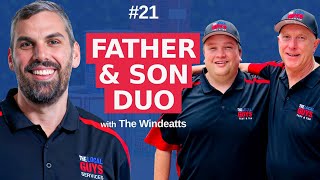
Greg and Mitch Windeatt run a test-and-tag and fire safety franchise near Newcastle. They grew from $90k in year one to $110k in year two and are targeting $200k by adding fire safety certification and a third team member. Greg handles strategy while Mitch runs operations, and they're formalising quarterly meetings for the first time.
Chapters
Oh well thanks. Thanks very much gentlemen for joining us. Much appreciated for, for taking the time. I want to first maybe tell us who you guys are, how you know each other and what you do within the local guys.
Okay. Well it's sitting on the old bloke. I'll, I'll head off. It's a Greg and Mitch windy it father and son team. So obviously we've been, we just talked up our two years with the local guys.
Yep. So in our test and tag division.
Yeah, test and tag, yep, yep. And it all how we came to it, it all came about probably or just over two years ago when Mitch found himself he had a contract with ServiceNow files and that finished up so he was looking for something to do. He fancied an idea of working for himself. So I suppose as parents do we sort of said oh well we could maybe help you with that. I said it has to be something because I've retired from my previous occupation which was Fire and Rescue New South Wales. So I said it'll have to be something I feel reasonably comfortable with. I've got a bit of background in and funny enough when I was with fire and rescue all those years ago cause we were shift workers. Like a lot of fires I had a part time job and I used to do a bit of contract work for a company called Quell Northern up here in Sydney going around checking fire extinguishers, hose reels and all that and it was, I did that for a couple of years and it was funny, it was just when the test and tagging were starting to come in I saw oh, what's this all about? Life moves on. We decided to sell up and leave Sydney. We moved up here to Port Stevens and I advanced my career in the fire, Fire brigade too sort of around all that period. So when Mitchell said that I sort of had seen I think no ads over the time for the gyms, test and tag and all that. So that's where we well might have a look at this. We'll start doing a bit of googling, see what comes up. And that's when I think the local girls came up.
What was the motivation there Mitch, for yourself? Why were you. Because how, how old are you Mitch?
I'm 31.
31. So what was the motivation there to sort of look for, you know, going to start something for yourself as opposed to going out and getting another job?
Well you know it was kind of given to me as a bit of a challenge and I think Greg and I both saw that as a challenge. To be beaten. So we gravitated toward Tess and Taggers because I'd always heard about it growing up, and Greg used to see people doing it at the fire brigade, and we'd always. I'd always heard people talking about it every now and then. And then, I don't know. When the opportunity came up, it was kind of just like the stars aligned and we just thought, oh, you know, we've been hearing about test and tag. We can do fire extinguishers as well, you utilizing Greg's knowledge. So it just felt like the stars aligned and we just thought it was an excellent opportunity and we wanted to be involved.
Really.
Yep, sure. Sure. And, you know, I guess that's a. It's an interesting dynamic that you've got there, being the father and son set up. Because I know, Greg, you've mentioned to me in the past, like, for you, this is sort of something that you want to help Mitch get to sort of set up and all the rest of it, and then you're looking at sort of easing back to retirement. That that's been basically the plan that you. How you guys saw it sort of unfolding is if I got it right.
Yeah, absolutely. That was specifically my idea in the early days. But here we are two years later and I'm just as involved as anything. Look, I've actually enjoyed it. I feel like I have a bit of a flair for sort of running a business. I just. Having that background work I mentioned before, I thought, well, this is something. And the thing was, also local guys go back two years ago, and you were particularly in the growth phase. You still are now. Yeah, but it was. You were just starting to grow. And I thought, well, this is something to sort of get on board with. Having said that, that is still my goal is to step back. So we've. And funny enough, just doing the tiny Meredith sessions, Tony's put some ideas into my head about. I suppose we'll get to that point where we sort of just Mitch and I reach a bit of capacity where we can't do much more because there's. There's only so many hours on the day and I do not want to be working five days a week. So then he sort of said, well, maybe should it look at another. A third person? So I've been thinking about that and I'm thinking that's where we're going to try to go, hopefully within the next 12 months. I don't think we're at that point yet, but that's part of why I've been going down the fire safety side of things because A, it's my background. B, I know the regulatory environment's about to change here in New South Wales come February next year. And that's why I've been trying to align myself to capitalize on that, I suppose you could say. So. Yeah. I'm hoping that it'll work out and then. I mean, I'll still be involved, I think, and I just don't think I'll be fair and Mitch for me to just to dump it on him and walk away.
Yeah.
But I. At the same time, I probably want to move to more of a. I suppose you could say a strategic level where I'm sort of more looking for. What did Tony say? Going out, you're like the dump truck, collecting all the loads of work and all that and coming back and then sort of depositing to mention wherever the third person might become to actually go out and do the tactical work. And that's. In my previous role and. And fire Rescue. Last 10, 15 years, I was up at that executive strategic level. So it's. That's where I like to be. I suppose that's what I'm used to be used to being. Yeah. So that's. That's that sort of plan. Yeah. I think I always will be involved because it's. I think as you. And you will probably know this as people, even though you might retire and as you move into your 60s and your 70s, it is important that keep your mind active and your body active.
Absolutely.
So it. It helps keep definitely my mind active and test and tag. And while it's not hard physical work, it's physical movement. So it's good for me to sort of stay involved, but I'd like to be able to squeeze a few extra days off so I can also enjoy myself and go away on holidays when we can.
Yeah, I know you just mentioned you're about to head off to Antarctica and South America, which is. Which is very exciting. And I love the. The fact that you guys are leaning into the business and doing the coaching sessions that we offer with. With Tony and stuff like that. And I think, as you know, business is like anything you get out of it, what you put into it. And if you lean into it constantly lean into it, it helps you out because you guys are. I don't know, is Newcastle considered rural? I don't suppose it is. I mean, you're what, an hour and a half out? Regional.
Sorry. Yeah, yeah. Is outside of Sydney. It's the biggest regional city in New South Wales?
Yeah. Yeah. So there's challenges. I mean, although it's a big regional city, there is challenges with it, with being outside of a major capital city. I know these guys do do some travel into Sydney and stuff like that, but I think given the fact that you're not in the heartbeat of Sydney or the heartbeat of Melbourne or a major capital city, to be able to grow the business to the point that it's at after two years is a strong testament of how much you actually have leaned into the business. Tell me, what was the. The first sort of six months like?
I think it was fairly busy. We had a few days, we didn't have anything on, but it sort of kicked off pretty quickly from the moment we still got switched on. I think we had a lead within a day, within that, within 24 hours and we converted that lead and actually just been back there last week doing the test and tagging again. So. And that. That job is a skills training business that delivers skills to the care sector, so nursing age care, all that kind of thing. And they've got quite a large business and it takes to get through their office and their training rooms. It takes us a couple of days to do it.
Wow.
For.
For both of you as well. So that's a decent, decent job there. We.
And we do their icd. So we've just got to go back because we've got to work for them when there's not too many. We're going back early on a Friday morning. It's not a. They don't have any classroom booked and there's not many staff there because as you know, to do the RCD test, we've got to trip the power in and out, go back Friday, tomorrow week and then we'll finish that job off. So that was one of our first ones.
So we.
We kicked off. We're a fairly big customer. And six months after that, because we were prepared to travel to Sydney, that helped us and I think another good job we picked up a couple months after starting was a quarry out near Wiseman's Ferry, which is sort of near the Hawkesbury area, northern sort of northwestern area of Sydney. And they've been. And that was mainly just checking fire extinguishers because it's a level two mine site. I think they've told me, therefore they're governed by the Mining Board, one of the government department it is. So therefore they got fairly stringent safety compliance requirements and definitely because every earth moving equip piece of equipment they have, which is some of them are quite large trucks. They've got to carry at least two fire extinguishers. So they were looking for someone. The previous guy, they had wanted them to bring all the extinguishers to like their workshop where he could just stand there at the back of his truck and check all the fire extinguishers. And the guy, the service manager said, well, that doesn't really work for us because one of them's. We got trucks all over the place and a fire occurs down one of the pits and we've got all the fire extinguishers stuck up here just to suit. You basically gave that guy the. They sacked him and we're looking around and when I had the conversation with him after getting the lead and he said, do you have a four wheel drive? I said, yeah, absolutely. We've got a Mazda B250. He says, you'd be prepared to drive around the quarry and go to each individual truck. I said, yes, of course we will. Here we scored again. We converted that lead and we've been doing them ever since. And I've been one of our good customers and we get on. We've built that rapport now with that service manager and he's now, because that business is growing too, they put on apprentices and all that. So they put a new work health safety manager on who we get on well with. So that's. That's another one of our clients that we got within the first six months and we're still servicing them.
It's great, isn't it? And that's the beautiful thing I love about test and tag is the clients tend to be quite sticky. You look after them in ways like that and it's like 10 years later you're still servicing those same clients. I think our retention rate in test and tag is, you know, I know for myself when I was doing it, I was around over 90% retention rate year on year. And, you know, very similar to these guys. You know, you're on the front foot, you let them know when the testing's due, you don't mind adding the extra value by, you know, running around doing the, the extinguishers at where they need them done rather than having it all come to me. And before you know it, which, you know, it seems like obvious stuff to us. And before you know it, it's like all of this revenue that I've made from last year, I can pretty much guarantees coming through to the next year, plus anything new that comes, you can actually build a sustainable business on that. Mitch for yourself. Was there any lessons that you learned during that initial stage of business in the first sort of year that you look back at now and just go, oh, that seems so obvious. But at the time it's really sort of didn't quite understand it then.
Yeah, I think definitely in the first six months you're still getting a hang of all the different environments that you'll be working in. You know, you might go work in an office one day and then the next day you could be working in a quarry. So you need to really be prepared to be adapted, adaptable to whatever like the day throws at you. You know, you got to be able, like Greg said, like for example, having a four wheel drive was the reason why we got that quarry job. So you're not always going to be working inside offices. You've got to be prepared to like, you know, venture out. And that's the beauty of the job, is that not every day is the same, Every day is slightly different. And it's that variation and just like seeing like how businesses work on the inside can be actually very eye opening and you know, it's great to just see how stuff is done, you know, behind the scenes and, and that's, that's, you know, that's one of the things I love about test and tagging. It's being able to like, you know, just get like work in all these different places and get all this life experiences. Like that's the best, that's the best thing, I reckon.
I couldn't agree more. That was one of my most favorite things about the job is I could literally go into all of these places that the general public would never get to. You know, I've been in the federal police where they tap phone calls. I've been, you know, to remote Aboriginal communities. I've been all over the place and so fascinating to be able to see the interworkings of different businesses because you're at different ones every single day. And although the job, you know, is repetitive, every job's repetitive that you do in the world. But you get to go out to a different site and meet different people and, and see different things. So I couldn't agree more. That was definitely one of my most favorite there as well. Greg, do you have any advice for any new franchise partners? Particularly maybe someone that's coming on as a team that you would give to them having yourselves go through that experience now for the last couple of years?
Yep. If they're coming in as a team, I suppose they want to make sure their team Bond is reasonably good because Mitch and I, we do have to communicate, have the conversations to make sure we know what we can do at each job. But we do. We get on. We work pretty well actually. So we never have any real differences of opinion about how we're going to attack a job. We might get to a job any of us a job we've been to before. Obviously we always say hello to our site contact and have a bit of a chat with them. Then we might do a bit of a. Just a. That little bit of a size up about a. What are they doing here today? Where can we start? Because we've got two testers now and we'll go Rich, do you want to go do those couple of offices up there? I'll go down and start in the kitchen. So we have that little bit of a. You got to be able to just know you can work with each other I think is for people who are working as a team. So that probably for a team environment just to make sure you know you. You can work with each other. And then also I think you got to be open. Open to I want to say suggestions open to where you're prepared to go. Like we were in the early days we were prepared to go to Sydney and that was when you didn't have many. I think you only had one other franchise partner down Sydney at the time. So that's. And we did. I think we. We mainly I think we said we wanted to make me try to do the northern suburbs to just make traveling a bit easier for us. But I'm glad we did. We've picked up some good clients from it and it's. We got accustomed to. Initially it was all driving down to Sydney but now we're quite accustomed to do we got to. We have found somewhere to stay because we try to build.
When we.
We got our Sydney run we call it to go. We try to group them together and if we have to stay down overnight we have somewhere where we stay now that's at a reasonable price and we build up a routine around that.
Yeah.
So anyway actually my wife's in the background so yeah we've now picked them up as a customer too so. So I think it's making sure you. You can work as a team being open to what the. What opportunities come your way. Just don't go oh I just want to work within this enclosed or my area. And also trying to I suppose think bigger picture too. Sometimes you might. You get a job. It might just be a minimum charge job but sometimes you could step into some in charge shops and opportunities can come from whoever you meet in that minimum charge jobs to maybe upsell whether you might just doing the test and taking but maybe they need the fire extinguisher checked and or oh yes, we have another bunch of tradies who at another site and need their test and taking done. So yeah, just keep your, your mind open to what opportunities.
You never know what's going to come out of it. Yeah, I mean my favorite story on that one was we had a, one of our franchise partners in Western Australia go out for a minimum charge job. I thought it was gonna be there for five minutes. It turned into the entire university. Massive, massive job just from a minimum charge job. So you just never know what's, what's going to come from it. Which I couldn't agree more. Now you did mention your lovely wife, Robin.
Yes, she's in the background. I say admin assistant.
Yeah, well that was, that was my next question. So I know that she's on board as well. So she'll assist from helping to run the office side of things and have send you guys out and keep these, try and keep these guys as busy as possible while you're out there doing the testing. And she's helping to run the, the office side of things. Is that how it kind of works? How does it work?
Rob mainly does because we do our own reporting. So Rob mainly does that because she can type quicker than what I am working or find a way around the computer quicker than what I can. So often I'll prepare because we're still a lot of the jobs you're doing as you know in excess of 100 items particularly we're still using your old raw data sheets. So I'll bring it home like okay pages three, two, one, whatever it is and I'll give it to Rob. Can you type that up today? And then she'll do that and then I'll come home and just attach the reporting and do the invoice. So but that takes, that's a lot of work Rob doing basically that reporting work for us. I'll do most of the like sending out emails and all that. I do that myself because I like to sort of map how we're going to do things. When are we going to do that? Sydney run and try to schedule it naturally to suit us. Sometimes we have to do it to suit the customer but then that's when you've got to be a little bit adaptable and move. Okay. They want us to come on this Particular day. Okay. I'm not going to do that business over there. I know I could sort of move them to this day so that, that kind of scheduling, I suppose I don't mind doing it. It's. Yeah, so that's. But Rob is mainly reporting as bulk of the work she does, and that does save Mitch and I a lot of sort of background work.
Yeah, absolutely.
And. And buddy Rob just said. Yeah, they start having to pay for reporting.
Okay, all right. If we lose you, we know why. Thank you so much. Well, so before we lose you then, Mitch, maybe I'll ask you, do you ever have any disagreements? And if so, how do you sort of resolve that being a family business? There's three of you in there now. How do you kind of navigate that?
I think he's gone.
We've lost him. I'm going to put the question over to you, Greg. So family business. There's three of you in the business. How does it work? If.
If, if.
Because surely disagreements come up. I wish to say that my family never had any disagreements or anything like that, but I'd be lying. They probably had three. Just why we've been having this conversation. How do you navigate that? How do you sort of resolve that in a family business with three people in there?
I think we all understand we need to get the job done. We need to make sure we're delivering on our customer service and we prioritise naturally doing the job, completing the job and then doing the reporting, sending the invoicing, that sort of is our priorities and then all the other routine admin that follows behind that. We don't really have that many sort of disagreements. Mitch and I case there have been a few times when he says, no, I want to do. I want to do the kitchen, you do the office. So that kind of stuff. But that's pretty good, though. But usually we'll sort it out and we'll just get on with it.
Yeah.
I tell you what we are doing for the first time. We're actually. I'm calling it a AGM this Saturday because we sort of. We've had conversations along the path over the last two years, but we never actually sat down. I'm going to print up some reports and discuss. This is how we've gone. So celebrate the milestones, but actually start to think, okay, if we want to get a third person on. On board and for me to actually not just say I want to step back a bit, but actually be able to do it. Yeah, what's our objectives and what's the sort of strategies we're going to put in place. So we're doing that. This will be our first AGM and I'm calling it that.
Yeah, yeah.
And I've actually, I've even gone as far as printing up a little agenda. Yeah. Rob's saying I'm using ChatGPT to help me and, and also I'll do, I've just been doing our zero reconciliations and I'll be next day or so. I'll do some reporting off that.
That's great. I love that you guys are doing that and I, I think that you'll be really empowered through that process. We have something very similar. We call them our STRATOP meetings or strat and I literally just had one leadership one today and they've been so successful for us that we now have them for every department in the business. And I think what it does is it helps align every on the same goals because it might be that you think it's this way, Mitch thinks it's this way and then all. But it might be just off by 1 or 2 degrees. A very slight difference. But as you go further and further into the future that one or two degrees can end up being quite a big difference. Where I think if you have those meetings and you have them every quarter and everyone gets to talk about this is where we want to go and this is how we're going to achieve it. It just realigns everyone and we found it to be, be so powerful I couldn't recommend them more and then you just have regular check ins with them. So, so I think that's amazing that you guys are doing that and I think again it's a testament to how, how strong the business is going. Which is, which is fantastic. All right, so last one on that side of things, a family run business. Now, as we know, most family run businesses are run from the kitchen table. So how do you guys kind of separate work mode from family time? Do you clock off at certain times or is it because that's, that's the only problem? I find we've, we've run out many businesses off the kitchen table but sometimes it's hard because you're never 100% at work and you're never 100% at home. It's always that blend between the two.
Yeah, you're right. Look, I think we stick to our sort of routine that, and that's. We know in the morning we have our sort routine how we get up and have a breakfast and whatever, then we'll enable Certain times like I've got to start getting ready now. So we, that routine is important so that gets us out the door and as I say while we're gone Rob's doing the reporting or whatever. Then we try to, generally speaking on the day we try to usually finish on site around 3:30 in the afternoon and because that allows us time to travel home and for us to do a bit of admin if it's send emails or whatever it may be before the final knockoff which is say around 5ish or 5:30. And then basically I don't. None of us do any work at, at night and similarly we tried to on Fridays but that hasn't happened much in the past few weeks because I've been busy sort of getting the work done before we go away. We try maybe not maybe book jobs for a Friday but try to make that our major admin day for the week. So that way I try to keep the weekends for all of us free. Sometimes we have to do a bit on the weekend but I try to keep it free.
Yep, yep.
No, that's good I suppose because I did 40 years in the fire brigade and the last 1015 I was probably close to 15 years up. That's managerial level. I sort of learned how to divide my family time from my work time because I'd be on call at times. So yeah, I'm just wearing. And then also building in that I suppose a bit of redundancy too for when we Rob and I go away. So Mitch takes up the reins. We have had my daughter in law been doing some administration taking over Rob's role while we've been away. We've just trained her up to do that. Yeah. So that's all support Smitch when we've been away, mainly when we've been out of the country. Yeah. So that's how we do it. Okay.
Talking about contracts you've sort of mentioned before, you know about the mines and the quarries and stuff like that. So you do have some pretty big clients on your list. How did you manage to land those?
Those they've all came from support center leads.
Okay.
We have, we have, we have scored some jobs from referrals and that and actually I'm doing a new customer next week which was just from someone we knew who referred us. So a bit of that but I think supports in the least particularly in those first six months like we're talking about before. That's where a lot of that work came from. Okay. And it was just how we were trying to do it we. If a lead comes through. I tried. I'm virtually on that phone as quick as I possibly can be. Yeah.
And I think that's a massive one. That is that time band. Yeah. Yeah.
If I can do it there and there on the spot, I will. Sometimes we're in the middle of doing something so I've got to wait maybe 10, 15 minutes. But I try to get to that contact as quick as I can. Have that conversation with them, try to understand what they're after, send them the quote virtually. Because I'll do that on the phone and then yeah, follow up following day or two days later. And then once I sort of get the A or nay, I always send the client contact form. That'd be my next step because I like, I like to just get that, that detailed information for them. And also it's the opportunity to do a bit of upselling. We do these up services, fire extinguishers, no microwave leakage, RCDs. So you can tick those boxes if you need something else done. And so it's a good little sort of what I say tactic. It's a good little way of value add. What is it?
Yeah, yeah, yeah. And. And it's amazing how many actually come back where, you know, they might have only wanted one service and it's amazing how many of those come back and you've got two, three, four services that they've ticked. Yeah. So great, great tool. Absolutely. So how, how has the income sort.
Of been pretty good. Gross sales. I know. So I just had a look at it the other day. In our first 12 months, our gross sales around that 90,000 mark, this last 12 months it's 110,000. So that's gross. I haven't worked out I'm going to do that. That's why I was doing a bit of zero work. Well, I don't know if we're net profit, so I know for last, the first financial year we had to pay, we had a tax bill. So as I said, if you're paying tax, you know you're making a profit.
Yeah, it's from, from what I saw, I think you're around double that first year now.
Okay. Somewhere around there. Yeah. I mean I just remember when we went to the first because I just look at a kick serve and when you're seeing the invoices as like that, that ongoing perpetual count and I just remember on the first 12, so that was about 90 and I thought it'd be good to get the second 12 months or the second year the crack to 200, which we have. So. Yeah, And I've got to get done the detailed report. That's. That's for the weekend.
Yep. So 200 and that's. I mean, obviously that's with two of you in the business as well.
So it does help because we got that and we got the two testers. It does help our capacity. If I was. Or one of us was by herself, I can understand it. This one person, one tester probably can't get through that work as quick.
Yeah, yeah, you're not going to get a Friday. You're not going to get an admin Friday day if you try to have. Yeah, yeah, yeah, exactly right. No, that's good. Okay. Now we've talked a little bit about upskilling with. With Tony. Now, I know you also mentioned about upskilling yourself in regards to fire testing and stuff like that. You've been very on the front foot around that type of training. Do you want to just talk about that a little bit and why you've been so aggressive on making sure that you're upskilled as much as possible in regards to fire and everything like that?
Yeah, well, the background, my background, first of all. That was probably the key sort of foundation and it was so naturally I have had a national inclination to go that way also. It was funny, we went to Flamestop. This is probably in the early days when we've just started, so probably not quite two years ago, but maybe within our third or fourth month. And we bumped into another contractor there and he said, oh, yeah, he said, no, blah, blah, blah, blah. He says, you know the legislation for New South Wales changing come February. And I was like, well, what's going on there? And he says, oh, well, it's going 1851 for servicing like a fire extinguishers, for fire hose reels and all kinds of fire safety products. It's going to become mandatory, not just recommended practice, so in New South Wales. And also he said it's basically saying that you've got to be a competent. Not just you think you are, you have to actually prove you are a competent person. So that started me. Oh, okay. So did a bit of Googling and then I got on to. And I think it came from a conversation from Damien Collins, Shem Compliance. And I did do a bit of research but I end up landing with them. So I did my certificate too, I think an inspection and testing Fire safety, I think it's what it's called. And there's a. Obviously a competency course number attached to it. So I did that and that took me a little bit longer than what I thought. I think I did the, the four day online sort of zoom training part of it that was in July last year, July 24th. I didn't end up not thinking oh I'll knock this over in about three or four months. I know all of this. I was wrong. I actually learned some stuff I didn't. Wasn't aware of and I only, I think I finished it back in April this year. So, so that, that was a, a milestone and kicked a goal there. But so what does that give you?
What services does that give you the ability to test now that you know a lot of other people out there can't test? So you can go through and do your fire hose reels. Fire hose reels.
It didn't. Hydrants were another module on.
Yeah.
So I chose not to do hydrants because the complications around booster systems and all that. I just thought I'd kiss it, you know, I'll keep it simple. So extinguishers, fire hose reels and generally you can tell where they're going to be connected to booster system lights. I can do fire doors. I thought I just keep it simple. There's enough work just in that. Yeah. So that and then once I got that certificate I then approached the fpa FPA and said this is my skill level. And they've then accepted that certificate too. And I said okay. I think they've accredited me as a technician to be able to expect a test on extinguishers, likes and fire. I just kept it firehose rules because I had to prove a bit of background experience. I had to do analysis all our jobs to show how many fire doors I'd actually checked. And I thought oh really, I don't have any. So I just stuck to what stuck to the knitting so to speak. So I've done that. Then I got that accreditation. Then I knew with this upcoming which kicks in in 13th of February next year. I thought because I've had a few people over the last two years when we've been doing the fire safety stuff actually said to me can you do sign off on annual fire safety statements? No, I can't.
Yeah.
So I thought and one company under the ndis, it's like these ndis care homes. They've actually said to me because I said look, I'm looking going down this path. I said well once you do come back and see us or contact us because we'll, we'd really appreciate someone who could do we're having trouble finding people to do it who can sign off. So that's why I'm now doing my final accreditation, which means I had to do an extra couple of modules, an extra three, which I've just completed one today and I've got two to do. And they're basically around assessing building, building fire safety plans, I think it's called, and then assessing building fire safety system. So they're the only. I've only got two to go now. Then once I've done that, I can then go and get the certification for one of the word to be able to do it. And then I think I actually got a pay fee for it. But then on, on the registry I think it fell for two years. I think it was two years. So then naturally once I've done that I will then start marketing with our existing client base, probably reasonably heavy and I'll probably do and then also local marketing in the area. Cause I know straight often over the last two years when I've been doing and I've been make trying to upsell with do you need your fire extinguishers done? How often I've been told, I know SCADA managers look after that or God, that's, that's a market I've got to get like facility managers, facility companies. I've got to get into this somehow. I've got to crack this little nut wide open because I think there's obviously, obviously other companies trying to do the same. But I've just. Once I get that certification finding fire safety statements, I think that'll be a good one to explore.
And the beautiful thing about that is.
That'S why I've been up.
Yeah, well, I mean that's the thing like people sort of say, oh, you know, it, it's, oh, it's a harder barrier to get injury and stuff like that. But sometimes having a higher barrier to entry is a fantastic thing because all of a sudden for those people that have gone and done that additional upskilling and all the rest of it, the competition's a lot lower. The price that you can put it out at is higher because you know, you're, you need a higher skilled technician to come in, perform that and there's less of them. So all of a sudden it's like, you know, for that bit of time and energy and money that went into it, oh, I'm getting it, you know, tenfold in the number of clients that are coming in. And then guess what, they need their test and tag done. They need their LCDs done. And it just compounds and compounds.
Exactly.
So I think it's very wise.
Yeah. And that, that, that's very good words of what you said about that high barrier entry. Because I was just in that kitchen conversations because I've had to pay a fee to do these modules. I said I had to pay money to do the certificate too. Now I've had to pay another fee to do these couple of modules and I've had to go through. Now I've had to do multiple choice. I've had to do three lives or scenarios that we had to video and send them in about how I deal with customer service. And as I said that, Rob the other day, a lot of people just went, yeah, I don't got time for that. I'm not spending money on that. But it creates that barrier to the average J Blow for one of the word.
Which is great. Which is where you want to be.
That.
That is fantastic. You know, we see that a little bit with our pest control division. I think it's not as straightforward to get your license as say maybe, you know, one day course like it is for test and tag or for cleaning. You know, anyone can pick up a mop and call themselves a cleaner. Where, you know, pest control is a little bit more full on as far as getting licensed and all the rest of it. But on the other side of that license and a little bit, you know, on the cost involved in that and then, you know, more in insurances and stuff like that. But on the other side of that, it's a lot more open and you can, you can charge quite a bit more and stuff like that because that barrier to entry is a lot higher. All right, cool. Well, I want to thank you so much for your time, Greg. And I know we lost Mitch partway through, but I want to thank him for his time as well. I think it's been a really great window into this story of the windy at and the success that you have built in a short period of time and then you continue to build. I'm excited to see where that business goes and I'm. And I'm also excited to see you in the next chapter of your life where you do get to sit back a little bit more and enjoy the next chapter of life and then see Mitch come in and take over the reins in that driver's seat more, which is. Which would be great to see. And I know that you've got an exciting trip coming up very soon where you're off to South America and off to Antarctica. And stuff like that. So I wish you both, yourselves and Robin an amazing time there. And give Mitch, I know he's hobbling around on one crutch at the moment, so it doesn't.
It doesn't.
So, yeah, I know there's so many. So it's probably going to be a bit of a backlog of work and a bit of work that needs to happen beforehand and backlog afterwards. But, yes, I want to thank you so much for taking the time with me today and giving us a little bit of a window into this. This business that you've grown.
Yeah. Oh, thank you. And thank you for the opportunities. And I say one day we'll have to get to Adelaide and meet you guys or one of my suggestions. I've had some national conferences one day.
Oh, it's. We've been talking, don't worry. Yeah, no, no, no, we've been talking. You guys get some pretty specky weather up there, so we would happily look to northern New South Wales to come up for. And I think that, you know, we keep talking about it, maybe, maybe not this year, but maybe next year we can look for an excuse to. To get off into that warmer weather and.
Yeah, that'd be.
That'd be amazing.
No, I look forward to that, actually, as I think we had that conversation before. I think the networking opportunities, just to start with, internal networking and just sharing of information, people's experiences and what they're seeing out in the marketplace, I think it'd be worth the investment of everyone's time and probably a bit of money, too.
Yeah, couldn't agree more. Couldn't agree more. All right, thanks so much, Greg. Really appreciate spending the time with us.
No worries. Thank you. See you later.
Bye.










