EP #24 - 100 Franchise Partner Special (w/Jarrad Goulding)
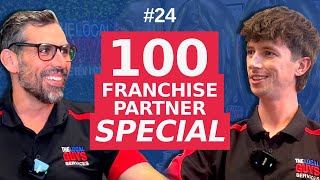
Jarrad Goulding, co-founder of a service-based franchising business, hit 100 franchise partners by switching from percentage-based to flat-fee pricing and stepping back from hands-on work to focus on growth. He credits his partner Stacy, a strong internal team, and hiring people with the right attitude over experience.
Chapters
Well, we've got the decorations. Jared, We've just ticked over a huge milestone. 100 franchise partners.
I know. Who would have known, or I think it's seven years ago now, six or seven years ago now, who would have known 100 franchise partners. That was the big goal for myself and Stacy as we thought that would be the definition of success is if we could hit 100 franchise partners. And it felt absolutely. I gave myself probably a 10% if I'm lucky chance of hitting that. Wow. But I thought, well, you never know until you try. So yeah, being here now and finally hitting the milestone of 100. Yeah, it's. Me and Stacey were only talking about it this week and it has that element of disbelief about it. You just kind of just go. Doesn't feel real. Yeah. So yeah, very, very surreal.
Yeah.
Yeah.
Talk to me about those early days. You know, what was it like going from 0 to 1 before any of the office, any of the staff, just you and Stacy.
How was just seemed like another business idea that, you know, I've had plenty of business ideas so it just seemed like another one and seemed like a good idea because we knew that service based business was great because I've been in that industry for a long, long time and it always looked after us very, very well. So I think in hindsight it kind of was a little bit obvious. But also. Yeah, million million business ideas and you know, so you never know what one's going to sort of work out and stuff like that. But yeah, looking back on it now, yeah.
I don't know what was one of the businesses that didn't work out. Do you have any that you want to share?
I. I'll give you there's probably about 4 million. But the one that comes to mind was I had a business that I was going to start called Elite Fitness Foods. Now it's actually very common things. So like you know the muscle food things. Yeah, there was no muscle food things. Pre made meals. Pre made meals for people that wanted to do bodybuilding.
Yeah.
The only thing that there was back in those days was like light and easy. Yeah, that was it. That was the only one. Yeah. And I thought what a fantastic idea to have something like that for people that are going to the gym that want protein heavy meals, that it's completely done for them, you know that obviously you can go out and get the protein powders and all that sort of stuff and that's pre packaged and that's fine. But to actually have a meal carved out for you, made for you I thought there would be a market for that. Didn't take off, to be honest with you. I didn't have the resources. I was young, I went to my dietitian. I wasn't an expert in that industry either. So I remember going to a dietitian and she just told me, don't do it. Like you don't know what you're doing. Yeah. Who are you to come up with this? Like you've got an idea. And I'm like, well, that's kind of why I'm talking to you. I'm talking to a dietitian. She goes, well, I commend you for that. But yeah, just don't do it. So. And I didn't have the resources, I didn't have, you know, anything to start a commercial kitchen, do any of that sort of things. I think I made up a couple of boxes as like, yeah, prototypes, thank you. That I was going to do in that regard and then it just died on the vine, so. Just never ended up doing it. But that was, that was an idea and it turned out that was pretty good idea. But you need to have, obviously capital and you need to have a lot more than just the idea.
Feel like you had to go through those fails to get to where you are now.
Definitely, definitely, yeah. No question. If I hadn't tried to open up a lot of businesses in the past, I would have had no idea, you know, I was building out websites, I reckon, like it Must have been 2,000, I guess. I was building up websites for a car detailing business that I'd started from scratch called Car Gleamers, which is still the guy, still got it now, still running it successfully and, you know, just learning little things like that on how to start a business that was how to start a service based business, you know, mobile car business, I had to work out. We created it where we didn't have to have any power and we didn't have to have any water. We had our own power and water. So could operate the gurney and operate, you know, everything that we needed completely mobile so we could go to, you know, car parks, anywhere we wanted to go. And I went to car parks and places like that to do jobs where we just didn't have access to all that sort of thing. So problem solving in regards to all of that marketing, online advertising, digital marketing, all of that side of stuff, we're all learning throughout that process. So yes, 100%.
Yeah, yeah. I always like to say it's not.
A loss, it's a lesson. Yes, very, very true. Yep. Yeah. And if you don't mind having that lesson, you know. You know, it's hate. No one, I don't know of any entrepreneur or any person that's created a successful business has just gone out and first one off the gun has just been this, you know, big success probably happened, but it's not very copy one in a billion. Yeah. It's normally the person that just keeps getting knocked down, pick up again. But they take all the lessons along the way that get them to. Then they get that where opportunity and timing sort of meet and then they take everything they've learned before that into that one and then that's what happens to them to set it off.
Yep.
I love that. Yeah.
Well, let's come back to the local guys.
Sure.
When did it feel real like? When did it feel like you really got something here?
There's a couple of times, I think when I saw a vehicle out in the road for the first time, it wasn't my vehicle. That was weird. I think we'd had friends and family sending us Snapchats of, you know, vehicles out there and go, oh, look what I just spotted. And that was weird to see that. I think being in another state and seeing a vehicle was like a weird thing to see. Now going into other countries, going over to New Zealand and stuff like that and seeing vehicles over there and that's an odd thing to do to see. So yeah, I mean, watching some of the really early guys and watching their businesses grow and seeing, wow, this is really successful and they're really making some money, that was like a pinch me moment and really exciting as well. So there's been a lot of those along the way. So yeah, there's a couple.
How long did it take to get that first franchise partner?
Yep. So I remember having two guys that were really interested. One was one of the workers for one of the companies that I was doing test and tag for and he was a fire guy technician and he was really interested in it. Kept on and I was sort of just mentioning it in passing, oh, this is what I'm doing. Oh, I'm really interested. Blah, blah, blah, blah. And so I said, all right, well, let's go meet. And met with him and his wife in a restaurant with myself and Stacy. And at the time I had it as a percentage based model and they didn't end up accepting and probably rightly so, it probably wasn't a great offer at the time. Had another guy that lived directly over the road from our office and he was really interested. Got him out on experience day with myself. And that nearly happened and then didn't happen. I remember bringing them into the office, him and his wife. And the office was smaller than this space that we're in here.
Yeah.
Didn't have enough seats in there. I don't think we had enough room for seats. One of them had to sit on like a phone book or something, something on the floor. And I was like, this is really selling the success here. We're all huddled in this tiny little thing and for some weird reason they didn't buy it. Yeah, wonder why. Yeah, exactly. So they were the two that were really close but they were like genuinely interested, which felt odd because I was just like, you know, I've just made this, we've just made this thing out of thin air and stuff like that. And then eventually, yeah, we had a franchise partner that joined on that percentage model and then we, we had some thoughts around that and we decided, you know what, that's not best for franchise partners. We think that the best model for franchise partners would be a flat fee model. So let's switch it and let's go flat fee model. And we knew to get better quality franchise partners from a flat fee model. So we offered it out to him to see if he'd like to switch. Here's what you're on currently. Here's what we're looking at switching at. You get to choose either because legally you can stay where you are if you want to. And he said, yeah, it's a no brainer. I'll go to the new one. And yeah, that was a good move, I think. And I think it's just a lot.
Clearer for how long after launching the business was that.
It would have been within the first sort of four or five months, I would say. Yeah, yeah, it wasn't long after. It's hard to say like, you know, from. Because when you launch the businesses there's lots of stuff that's happening everywhere. So when the official launch was. I don't really know. Yeah, I was just very, very busy. I remember Stacy.
There's no anniversary.
No, no. Well, I remember Stacy getting really frustrated with me back then because you just said all you do is sit on the laptop and work. But it was a season of life that sort of had to do to get everything done. And now we laugh about that time because I, I was just constantly on the laptop and just working, working, working. But it's what needed to be done at the time to get everything aligned and stuff like that and set up. Yeah, yeah, Time and energy at that time had to. So now, yeah, we can laugh about it, but at the time she thought she had a. She was a single. Single mother or single wife. Yeah.
So you have been building a business, but you've also been building a family at the same time. Talk to me how you've juggled your family.
Four kids. Three.
And the business.
Oh, thank you. Sorry. Yeah, yeah. Well, Stacey would say she's got four, but yeah, yeah, no, that's challenging. Definitely. I saw a thing online the other day that they were saying for the 40s and 50s, I think it is, is generally some of the hardest times of your life because you're not only. And happiness levels generally, I'm not saying that's me, but happiness generally are lower during those decades compared to other decades because you've just got so much pressure throughout those times. So other people who are watching this will know, you know, they've got families, young families and also trying to manage work and stuff like that. It's very, very challenging. So I've got a good friend of me that said, he's explaining it to one of his friends the other day and they were saying, oh, you must be enjoying having such a break on holidays now and stuff like that. And he goes, let me explain it to you. When I leave my job, I go to my second job which is the kids and the family and stuff like that, because it's, you know, it's a full on time of life and we're just in that season of life. I'm lucky I've got a, an amazing partner in Stacey that she helps make it a lot easier. So I'll give you, if you want any advice, that's the most important decision you'll ever make in your entire life is whoever you end up marrying. And make sure you get that one right because it will impact every aspect of your life. So I'm lucky I got that aspect of my life right, which makes a lot of the other aspects a lot, lot easier. So yeah, it's just a busy time of life.
Yeah, yeah. Talk to me about those constants. You know, what has been that one constant in the whole time? Something that hasn't changed at all since day one till now.
Having Stacy on my side would be definitely, yeah, that's. It doesn't matter what we're going through, it doesn't matter what happens. Like we, yeah, I've got that constant there. And then just every day we just talk about whatever's going on at home or going on here or Whatever. And we can just talk through any issues, any concerns, any problems, anything like that. So that is definitely the one constant for sure.
Do you guys ever want to give up at any time?
No. No, I don't think so. No. Never had that. I think the. The local guy's story has always been up and to the right, which is. Which is, you know, not saying that that will always be the case, but that has been its history over the last six to seven years.
Awesome.
So, no, there's never been anything of wanting to give up. Of course, there's been challenging times and stuff like that, but I think challenge hides opportunity, and I think that intends. If you know how to look at challenges in life and you. You know that they're actually disguised opportunities. It actually, when you fix that problem or solve that problem or recognize the opportunities in that problem, it actually takes you to another level. I love that. Yeah. So it's. We now see those challenges that come up as big opportunities, and it's happened time after time, and every single time it does and we solve it, it goes to the next level. But if we don't, then we just keep repeating the same one until we can work it out. Yeah.
It's a positive feedback.
It is.
You get over one hump and then you feel like you can do the next. Bigger hump.
Yeah.
Easier.
Yeah. 100%. And it's no different to our franchise partners, and it's no different to anything like that. The thing that you're avoiding is generally the. What is it? There's a book about it. I forgot what it is. But the obstacle is the way is the scenario. For sure.
You lean into it.
Yeah. Lean into it always.
So what has changed in the last six, seven years? I know we've got a bigger office.
Yeah. But bigger office, bigger team, a lot more franchise partners, a lot more stuff that's relying on us, a little bit more difficult to change from this direction to this direction, because there's a lot of people that are moving.
Not as agile.
You're not. Yep. And you've got to be. You've got to run it like a startup, because if you don't, there'll be other people that can. And so you've got to make sure that things are constantly uncomfortable and changing and all the rest of it, which can be a challenge for people because you're always evolving and always pushing forward. So it's never just like, can we just sit for five seconds? And it was not doing that. And like, I was just having a meeting earlier this Week with our franchise team and just talking about all the new AI stuff that we're doing and all the new innovations and all the new things that we're putting in softwares and all this sort of stuff, and it's, you know, it's going to be like, oh, my God, what's. You know, constantly things are happening, but you have to be like that. So, yeah, I know we're doing a lot of stuff, from international growth to AI to new systems, all of that sort of stuff. And you just have to be constantly growing because if you're not evolving, you're dying, basically. So. Yeah.
Always evolving here.
Yeah.
Like that.
Yep.
What are some things that didn't exist back then that you just cannot live without now?
Our team, as corny as it is our team is, is crucially important.
It's not that corny.
Yeah. Before it was just, you know, I can just, as I said, like, Stacey was just, you know, a single, single woman or whatever at that stage, so I could just outwork it and stuff like that. But you can only max that out to a certain point. And when You've got over 100 franchise partners and international and you've got a lot of families that are relying on that sort of thing, you can't just keep scaling at that level. I only just pushed you recently to, you know, scale yourself out more and stuff like that. We're constantly doing that with the team, so. And then before you know it, you go, I don't know how I could have lived without having someone else working with me, assisting me. So. So, yeah, that's a big thing that. Yeah. Be able to do what we do now without the support of everyone in this office.
Yeah. Because you did start out as a testing tagger, as like your own franchise partner while you were sort of onboarding. Franchise partner.
Yeah.
And now you've obviously walked away from that. Talk to us about that transition from working on the tags to now full time in the office.
Stacy was in the middle of giving birth to our first or second. I think it was the second and might have been first and got a text message from our only employee saying, I quit, effective immediately. And we had a great relationship with them, but just being given another opportunity and it starts immediately, so I can't give you any notice.
Yeah.
And we're just like, great, it's all happening. Yeah. And that was, you know, how we could keep, you know, things ticking over and stuff like that was very important too. You know, I think we might have had one or two franchise partners Potentially at that stage. So we had to make the decision of are we, you know, test and taggers or are we a franchising business? And we just decided that that's it, we're a franchising business. Even though that doesn't make anywhere near enough money or anything like that yet we are franchise in business. That's what we're doing. We're throw hat over the fence and just got rid of the work and that just went all full blown franchising. That's it. And yeah, it was a very good decision I think.
Is that a hard decision to make at that time?
Definitely, yeah, yeah, massively hard decision because it was, you know, a massive percentage of our income and how we pay for our bills and how we keep the business going and safety and you know, everything. So it's. You have to be. Yeah, yeah. It was hugely. Risk in the business. However, I think it was the right decision and then what it allowed us to do as well is free up bandwidth in our minds and our energy and focus that bandwidth on pushing the business forward and being a franchising business. And that allowed us to push forward a lot harder. Where if we kept our toes in both camps, I think it would have happened a lot slower. Yeah.
Yep. Well that ties in perfectly with my next question. You know that's a risky decision you've made, but what are some no brainer decisions that you've made throughout the years that you had to make?
Hiring you was a no brainer. I had to push for that one really hard and I got a lot of pushback on that one. We don't need it. We don't need it. We don't need it.
I'm flattered.
Yeah, yeah. Well, we hadn't met you at that stage so it wasn't specific to you unfortunately. But we're very happy with the outcome. But for your role was, was a no brainer to me. I thought that that was really important thing to be able to tell our story was, was really, really important and I saw the way that video is going online and stuff like that and I thought that that was. We needed, we had a very good story to tell and I believe we still got a very good story to tell. We're very family based, corporate. We're just about rising tide lifts all boats and we want to rise together with our franchise partners. But we needed to tell that story and we needed to put that out there and we needed to be known as a, you know, a brand that is a becoming a household name and the only way to do that is to be able to consistently put that story out there. So that was a no brainer for me. Again, it all comes at a, you know, at a financial cost and an input of time and energy and doing what we're doing right now and all the rest of it. But I think it was well worth, I feel, think. I think it was well worth it and I think it's, yeah, it's, it's paid.
Jared, how do you think you've changed throughout the years, your mindset?
Yeah, a lot. Yeah, a lot. Yeah. Very, very different. I think if you spoke to those who know me well before and after.
I heard you were a bit of a party animal at one stage.
Yeah, yeah, maybe, yeah. No, I would say I was a massive. I mean, I don't know what you've heard on the grapevine, but yeah, no, it's very different. I think every year I have to, you know, like I'm, I was just on the tools doing test and tagging. I would listen to a lot of audible, a lot of business books. But apart from that, you know, like to go out and enjoy having a palmy, having a few beers, you know, watching some sport. That was pretty much me like. And now I don't drink, I am pescatarian and yeah, I don't party or anything like that. So. So yeah, very, very different. I've had to constantly change and try and evolve who I am because as Stacy says, you know, just not. You're not different person, you're just trying to evolve as much as you can and try and be better as best as I possibly can and, and try and be the best role model for my kids. That's a big, big one for me. So yeah, just, yeah, so every year I'm trying to get better and. And then you get into a high pressure role, which my role is a high pressure role. So, you know, trying to understand all the different pressures of that and then learning it all at the same time as well. Because it's not like I went out and did an MBA and just under, you know, and have been doing this for 20 years. I've literally come from being on the tools, understanding it. Maybe it's a test and tag business understanding that well, but then trying to understand a large, much larger business and then understand the franchising and just so many different elements of it. But I love it. It's great. And every day I get to do the thing that I love most, which is business and watching people grow their businesses. So yeah, it's cool.
Yeah, it is really cool. Let's go back to Jared with franchise partner number one. You sit down a coffee, sit down for a coffee with yourself at that point, what would you say to Jared at franchise partner number one?
I'm in a big rush all the time. I'm still in a big rush. I think it's a little bit of my secret weapon in some ways that I'm constantly just a pusher. I think, you know, a lot of the staff and all the rest of it would, would see me as a pusher. I think I've settled down a little bit from that and just allow systems more and stuff like that. But I would, I'd probably say take a breath a little bit more and just relax because, you know, you can probably still get the same output without having to be like, let's white knuckle it and go 100 mile an hour and just push, push, push, push, push. I think that has its place, definitely. But I think as well, spending five minutes, 10 minutes, half an hour, an hour to sit down and plan something out and then execute that plan, I think is a, is probably a better strategy. That being said, already very gone, made 17 mistakes, worked out the right way to do it and go on there before someone's already made a decision. So it's a little bit of back and forth, but yeah, I think that. Just kind of reminding myself that it's, it's all, it'll all be fine. It's all heading in the right direction. And as long as you build, you're building something that I think is genuinely trying to help people and help people grow and provide value to the market and provide value to the franchise partners, then it's going to get to where you need it to get it to go. I think. Yeah, that's probably just settled down, relax and lean into that and it will head in the right direction.
Yep. What's one thing that all the most successful franchise partners have in common?
I think attitude would be number one. Definitely. Attitude's everything we talk about all the time. We can teach skills. Attitude is massively important. We see franchise partners come into training and you can pick the ones almost instantly that are just coming in there and they just want to. They're really excited and they just really want to get out there and learn and absorbing all the information as much as they possibly can and just excited by it. Just excitement and attitude really can take you a long, long way.
You've talked about passion.
Yeah. If you can see that coming out of someone you're already 80% of the way there, like you really are. And that will come through to the customers, it will come through to repeats, it'll come through to all that sort of side of things. Passion and excitement and a good attitude. You basically, you're a long way there. Wow. Yep, yep.
All right, you've got center stage here. Is there anything you'd like to say to our franchise partners out there?
I mean, I'm proud of all of our franchise partners. I see the growth that they're getting and that makes me really proud of them. I see the business that they're creating. I just heard today that one of our franchise partners is looking at selling their business for a couple hundred thousand dollars in their first year. Like that sort of stuff I just think is incredible. So, you know, I think the stage is being set for success and really all they've got to do is lean into it, lean into the customers as much as possible. Look at your customers as a long term partner, a long term thing. Don't look at it as what am I going to get out of it? For this one visit, know that that's going to be your biggest source of referrals. As for repeats, for additional revenue through those repeats. So definitely look at it as a long term relationship that you're building with people because if you can just add that little bit of extra value to single person, you know, you're just leaving a couple of minties behind. When after you've cleaned a house or you know, a two dollar pen, after you've, you've done something or just touching base with them at Christmas and just saying, hey, we wish you a Merry Christmas. It's just all those little 1 percenters that build up and then when they get a competitor knocking on their door, they're just not interested.
Where's my minty?
Yeah, yeah, exactly. Or they just go, you know, just keep walking. We're happy. Like, you know, and they're not. Oh, we can do it 20% cheaper, 10% cheaper. That's, that's great. Like we're happy with the guy we've got. And that's all relationship built. It's all relationship built commercially. It might get you in the door, but relationships will keep you in the house or in the business. So constantly be working on those relationships because that's your recurring revenue and that's your new referrals and you can build a business off of that. You really can. And it's very, very, you can rely on that business in five years time. Ten years time, I know I'm still going to have the clients that I've got this year and they've just been assisting me to grow. So I've guaranteed I've got that amount plus all the new clients that are going to come and that's a very scalable way of building a business. Also, the ones that don't come along, don't be afraid to. All the ones that, you know, don't happen to convert into a customer, don't be afraid to ask them questions of why, what is, what do they say, you know, doing the same thing and expecting a different result is definition of insanity. Well, then that, like, you know, if you've got a low conversion rate, think outside the box and go back to those ones. Let's say you've got a really low conversion rate. Let's say you're at 20 or 30%, really low. There is seven or eight people out of 10 that you can be contacting to get feedback that week to go, hey, why didn't you pick up my services? And then you've got the ability to change it to get that to now that you're at 60, 70, 80 and beyond percent conversion rate and all of a sudden you've changed like that, as opposed to just going, oh, I'm just not going anywhere, I'm just not getting anywhere. So, you know, take that extra time, this is your business, lean into it, ask those questions because all of a sudden you get that little bit better, that little bit better, a little bit better and the numbers start blowing out massively.
Don't be afraid to be a bit vulnerable.
Yeah, yeah, absolutely, yeah. Where did I miss the mark? I need to know if someone didn't rebook in again. Hey, can you give me the feedback? I'm just trying to grow my local, my family business and I. The feedback will help it. And don't be afraid to hear the negatives, because the negatives, you're only as strong as your weakest link. So the negatives is what will make you five times bigger. You don't want to go to your five best customers that love you and just go, you're the best, you're the best, blah, blah, blah. No, give me the hard stuff, I want the hard stuff. And then just work on those things because now you've got a stronger business and if you just keep doing that, you're going to have a very, very successful business.
Yeah, well, I want to wrap up with some plans for the future. I know we've got a lot of Plans for the future. Do you have any that you can share?
Yep. So that's a big part of my plans for this year. Recently hired a general manager, which is assisting me in being able to work on things on the business more. So, you know, we. We are looking at international growth, which is. Got some exciting things to released there. We are looking at. Big part of my business, of what I'm doing as well, is trying to make the business better. How can we incorporate things like AI and things like better technology, better software and better systems for our franchise partners? We just released one recently for our test and taggers on the reporting side, which has been a game changer for them and turned reporting time frames around from like a week down to as soon as they leave site, they're providing the reports, which means they get paid faster. Our clients are way happier because they get the reports instantly. It's not chasing up around it and it's way cheaper. We gave that out to them for free, so everyone's using that now for free. So things like that, it's just how we can just, you know, like, no different to what I said about our franchise partners providing as much value to the customers as possible. That's the same advice I give myself. So what am I doing constantly or what are we doing as a team? Constantly, that we can continue to keep pouring that value onto the engine, onto our franchise partners, so that they can do their jobs better. So that might be, you know, better reporting tools for, so they can run a better business. You know, see where the conversion rates are, their ATVs, their average transaction value, all these different types of things that work better. So again, we get the feedback through our QAR's, our quarterly quality assurance reviews from our franchise partners. And I go, what are the consistent themes that we're getting back? And I only met again with the franchising team earlier in the week and we were saying, here's the things that we want to like, this is the feedback we know we're getting. These are the things we want to work on. And, you know, getting lots of smiles and nods is encouraging to us because it's like, all right, we're on the right path. Let's keep leaning into that so that then it turns our weakest parts into our strongest parts. No different to the feedback that I said for the franchise partners. Yeah, I love it. Yeah.
Well, congratulations on 100, Jared.
Thanks, mate. Cheers.
Thanks for the chat.
Yep, perfect, thanks. Thanks very much, Harvey.










