EP #27 - When Pest Control Becomes More Than Just Business
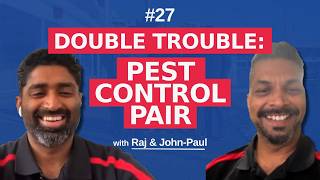
Raj and John Paul left desk jobs to launch a pest-control franchise in Craigieburn, Victoria in 2024. They split duties by strength: Raj handles marketing and scheduling, John Paul manages customer communication and termite work. Their strategy relies on repeat clients, personal follow-ups, and rapid response to leads from Facebook and referrals.
Chapters
Cool, Raj and Jean-Paul, thanks so much for joining us. Much appreciated, guys. I know we were just talking a minute ago off air and you were saying that you've been busy doing jobs this morning and doing this now and then about to head out for some commercial jobs later on this afternoon. So I appreciate you both taking the time. Did you want to start with maybe telling us who you guys both are, what you do at The Local Guys, and where you're kind of from?
Do you want to say, John, or?
Yeah. Yeah. So I'm John Paul. That's my name, John Paul. It's one word. And yeah, so we moved to Melbourne about a couple of years back and we thought what to do. And then we, and then I thought pest control is a good idea. Jumped into it, started doing pest control with you guys and Raj. Raj got to know more about Local Guys and we did the course and then we got the license. Holy moly. And then finally we are here. So Very happy with the journey that we took since 2024. And that's the time we both left our desk jobs and came out of it and got more into fieldwork, which is good. And I tell you, I like this better than working on a computer. I mean, like 9 to 5 kind of thing. This is more fun. It's more outdoor. You meet a lot of people. Yeah. So that's something about me. That's it.
What was it that you guys were doing before? What sort of jobs did you have?
I was working with the University of Tasmania doing a few things there. Especially looking at compliance on international students' side and things like that. Yeah.
And what about yourself, Raj?
I was working with Hume City Council in their community development team.
Okay. So very different to the pest control industry then.
Absolutely. Yeah.
So what was it that, I mean, what, you know, jumping from two vastly different careers, why, how was it that pest control ended up rising to the top out of all of the options that you could have sort of gone for?
I mean, basically, you know, when we were looking at, you know, going into business, then we inquired about few options, you know, like cleaning, carpet cleaning, you know, and all those things pop up here and there. But out of that, you know, we thought that pest control would be a better option because it's more challenging. We both like to stimulate our mind, you know, even though we are not working on the desk, but we still like to go out and see if there is a challenge or not. And I think with the pest control, you know, what we imagined at that time has come true. So there is no day that we don't enjoy our work because it's always a challenge. You are going against nature.
Yeah.
And trying to figure out whether, you know, what they're going to react. And it's not the case that 99% time they're going to react exactly how you want them. It could go here and there. So we love talking to the customer, spending time, and plus we did not want to do very heavy physical work. So that was another reason, you know, because cleaning involves a lot of, you know, physical work plus early mornings, late nights. With pest control, you know, we can fit it in between the daytimes. We don't have to go out in the night or early mornings. You know, there are some days when we do that, but normally the case, you know, we are home by lunch or, you know, have time to spend with the kids and stuff like that. Take dog for the walk. So yeah, that's the, that's the reason we chose pest control.
Yeah, sure. No worries. And I guess, was business ownership always the goal? Because obviously you could have just gone out and got jobs as pest controllers or, you know, learnt through that way. Why, why did you decide that you were looking to start your own business rather than just stay as employees?
We have more control over the work that we want to do. We can go up as much as we want to. With work, you're staying in the same level every day. With what we are doing with now, because we are two people, we can go separate ways and do more work. Plus, if there's something that we can, we can do together as well, it saves time. It works more efficiently. So that's, that's what I feel different with this. Yep.
And I guess that's one of the things that you guys have done that's a little bit more unique than, than I would say most of our franchise partners where typically for most of our franchise partners, it's one person. And if it is two people, generally they come from the same house. Hold. So it's a husband and wife team or whatever, where obviously for yourselves, you've decided, what's your guys' relationship with each other?
We're just friends. We met in Tasmania in 2012.
So, yep.
Um, I mean, you know, I actually didn't know Raj at all.
I actually was studying with Raj's wife. We both were studying the same master's and Raj's wife, Silkish, she introduced me to Raj and that's how I knew him. But yeah, we actually, yeah, so We met through his wife and we were studying together.
What was the motivation between doing that, doing it together as opposed to sort of doing it separately?
I mean, the reason was, you know, I moved to Melbourne 2 years before John Paul and I started working in a company like with Hume City Council. And when John was planning to move here and I said, well, if you're coming over here, it's better that we can, you know, go into business together. We know each other and our chemistry is good working together. Plus, I mean, the idea was always, you know, to not take too much stress as well. That's the reason I thought, you know, if you are by yourself, you get burnt out quickly and stuff like that. So having two people safety-wise was really good. Plus, you know, it really worked out well because it's been two years and we are still enjoying the work. The reason is if there is like, we handle different things. For example, if the customer complains, John is the one who speaks to them. Because sometimes I can lose my temper. And so John is pretty calm and providing resolutions and talking to them. I do most of the marketing and admin stuff on Facebook and stuff. John is the termite inspector because he's been in compliance. So I haven't done the termite course. John does all the termite work for us. So things like that, you know, we can pick and choose what I like, what John's like, and then, you know, it's not too much of a workload on us as well. Yeah, I think if we, if I would have done it by myself or John would have done it by himself, we would have been got fed up or burnt out.
Yeah. Yeah.
So much things.
So many things to take care of. Yeah. There's pros and cons of both. And like, I know, and it's great that you guys have found where your strengths are and you play to those strengths. Cause I think that's a really important part of the parcel. I know with myself and Stacy, you know, we've been in multiple businesses together. And I remember when we first started up our Boost Juice and we were kind of stepping on each other's toes a little bit because she would try and do the one part and I'd try and do the same part. And we were just kind of stepping on each other's toes where after a little while, and you guys have been in business together long enough now, you get to realize, oh, they're better at this part. I'm better at this part. And you sort of stick to your little areas. You can divide and conquer a lot more, which is a really good, good side of it. I guess the downside of it is the fact that you've gone into a brand new business and now it has to support or two households. So, you know, it's a lot on a brand new business to kind of do. You guys have navigated that really, really well. But yeah, it's, you got to kind of almost get double the revenue to be able to sort of look after both of those households where if it's a husband and wife, it's generally, it's all channeling through to that one household anyway. But I mean, you guys have done a fantastic job of that. So, you know, it's, it's pros and cons of everything, but it's I mean, the idea, I would say one thing on that.
I mean, certainly, you know, everyone has a clear vision what they want to achieve out of the business. So our one was not primarily just going after money. We wanted to learn the skillset properly and be able to help customers as well. So, you know, most of our customers are repeat customers. They enjoy talking to us and what has happened over the years, even though in starting, you know, is financially you know, quite hard. But what happens after a couple of years, it's not, I mean, it's not super duper financially thing, but what happens that we are okay now, I can say, you know, and we have retained all our customers on top.
Yeah. I mean, the thing is year 2, so you're ticking over to year 3. Year 3 is a really fun part. I always tell all of our guys, once you get to year 3, that's when things start to get crazy because you get your repeats from year 1, your repeats from year 2. And then you repeat new customers in year 3. But talking on that, you guys had a bit of a record month. I won't talk any numbers or anything like that, but I know broke some records last month as far as turnover, which were incredible numbers. I know Sean, your divisional, grabbed me last week and said, hey, have a look at this. And I was like, oh my God, that's a fantastic number. So I won't talk to what number it was, but it was a very impressive number.
Yeah.
Yeah.
I mean, there was a lead that we got last year and John was consistently working on that lead and it took us almost 1 year to get through to them. And finally, you know, when we cracked the job, it was a big job and that's why you see a big spike coming through. We spent how much, John? I think $19 on that lead.
Yeah.
Wow.
And that That worked out pretty well for us at the end.
Wow. So that's a commercial customer?
Commercial customer.
Yeah. And that's going to be an ongoing one that you'll hopefully be servicing ongoing now?
Yeah. Yeah.
Hopefully. Yeah. Yeah.
That's right.
Yeah. And that's the, that's, yeah. And that's, that's the trick. That's the whole game, right? Isn't it? It's getting them in, servicing them once, making them super happy, and then turning it into that's revenue every single year. For moving forward. That was my whole thing with Test and Tag when, you know, I was on the tools as far as that's great that we've done the job once, but what I want to be doing is servicing that same customer every year for the next 10 years and ongoing. You know, hopefully that means that now it's every February or whatever the rotation is with that client is that now that we know that's the big one to look forward to.
Yeah, yeah.
Plus they have other, other big sites as well. So we are hoping that we'll be able to, you know, work out another deal with them and stuff like that. So yeah, the next plan for me and John is to employ someone and get them trained with local guys and have another car, a dedicated person so we can, you know, focus more on retaining those last 2 years of customers, getting new business on board. So that's what we are planning at the moment.
Well, that's exciting. That's really exciting. That's the next phase of the business and you're at a bit of a crossroad where I I quite often talk to franchise partners that get to that crossroad and it's kind of the whole thing of, do we want to expand? Do we want to bring on staff members or do we just want to kind of fire some of our worst customers or further away customers and just try and up our pricing and just try and hold on to as much net profit from where we are now. But I'm kind of like you guys, you know, I constantly want to be evolving and growing and stuff like that. And, you know, and you can only do that by once you're at the point you're kind of at is to start bringing on a team. Having someone else out there representing yourselves and continuing to grow. And it's challenging at the beginning, but to be honest with you, once you get that model right and you get used to managing people, if, I don't know if you've managed people in the past or whatever, it's then scalable. So then you can scale that to, okay, well, we've done it with one. So moving to three, it's the same model just with two other guys. That's right. Yeah. And it frees your time up quite a lot as well because then you can spend less time going out and doing actual job jobs and you can focus on growing the business. Growing and managing.
And that's, that's, that's, that's right. The scalability is definitely a part of our plan. And, and, and with the earlier conversation as well, the skill sets that we both have complements each other. Raj is really good in scheduling. He knows where should we be at certain point of the day so that we can manage the time because we work all over Melbourne. We work from east to west all the way and from north to south. And it's good because without that, we can't manage people in future. So you need to have that kind of brains to figure out a map of the day and then manage the time with the jobs that we have. It gets crazy some days.
Yeah.
And Raj is pretty good with that. I tell you that because when he says we'll be at 12 o'clock at this client's place, we'll be around that time at that client's place, which is really good. Like I can't do that. That's not my skill set. So yeah, so it works. And I think that's how the scalability will happen as well. So if we have it, if we in future get an employee, that all that skill set will then help us to see how best we can go further.
What's your process for booking in existing clients? What's your process on that for making sure that, you know, a job, yes, I think you said you saw a new client this morning or you got a new one later on today. What's the process in place for making sure that that client is then booked in again for another general pest next year? Do you have, I'm assuming you will have a process in place for that.
So basically what we do, we give them our details and stuff like that. Plus what we are doing, like, you know, the first year clients within every month, for example, it's a March month. So when March is about to start, last week of February, me and John Paul will sit down. And call all our March customers from last year, personal calls saying, we came last year, we did this, how you going? Do you want another service? Are you okay? So it's just kind of a personal messaging at this stage that we are using rather than, you know, just sending them marketing messages and stuff. We do that sometime, but we found that personal calls are much better.
I couldn't agree more. I couldn't agree more. And I mean, I don't know what your average transaction value is, your ATV is, but let's say it's around $250, $300. Somewhere around there, you know, to pick up that phone. And I would say you've probably got a pretty high conversion rate on those customers. I would say a good number of them probably rebooking again. So let's say you're at 60 to 70%, I don't know, somewhere around there, 50 to 70%, somewhere in that range, I'm sure rebooking again. You know, for the sake of, if you break that down of what that call's worth to you, let's say it's a $300 ATV and let's just say you're only getting 50%. That means every one of those phone calls is worth $150 to you. Do you know what I mean? Like it's a no-brainer to just like that, that we're talking about scalability-wise. That's a very good way to be scaling out a business where you can, and as you say, you just build that habit in once a month. And that's exactly how I used to do it with Des and Dag is what are my clients for next month that I'd serviced a year ago and just calling them all up and just saying, hey, it's that time of the month again, time for, or sorry, that time of the year again, time to refresh the pest control. I've got some time available next Tuesday. How does that How does that sound? Because I know Nathan looks after my pest control and it's the same thing with him. I said, I don't want to know about it. Just, I know Stacy and the kids, if they see a spider, they freak out. Oh, same time every year, just come out, send me a text and say, I'm just coming out on this day and we'll make sure it's available to you. And I think there's a lot of people in the same boat that just want that convenience because I think once you get a general pest and once you get pest control done, a lot of people try and do it themselves, but once you get it done once, you're like, I'm never doing it again myself. Because what you see in spiders and what you see in insects and all the rest of it compared to doing it yourself versus getting the professional in is chalk and cheese.
Oh, absolutely. And I mean, you know, our philosophy has always been helping people as well. So, you know, we've gone to places where a pensioner was there, I think a couple of weeks back, and she got quotes for German cockroaches for $750 to $950. And she called us and I said, look, I'll come have a a look and she was referred to us by someone. So we went in, had a look, very bad condition of the house. I mean, she's living by herself and I said, okay, what can you afford? You know, I'm gonna help you out. And she said, this is all I have. She had $165 and we said, that's fine. We did the service for her, told her what to do. Next week I went in, we did a service and she was so happy. And so she's given us 3 references. We got 3 jobs because, and those 3 jobs, I did not have to sell anything. They just said that, look, Stacy has said, I'm just booking you and, you know, you helped her out and we want you. So, you know, it translates. If you do good, it comes back to you. That's been our philosophy and it's worked well for us.
Yeah, I couldn't agree more with that. And I talk about that a lot during training. And I think I see obviously a lot of new franchise partners coming in and I always try and explain to people that if you go out there trying to be a money chaser, it's like those reverse magnets. Money just seems to elude you. But if you just go out there and you're just constantly trying to put value out to the world, it's funny how money just comes and it follows you and people just constantly want to throw certificates of appreciation with the Queen's face on it at you. So that's clearly what you guys have been doing and it's obviously working.
Absolutely. And I 100% believe in that, that, you know, like, for example, if a tradie comes to my house, and I booked him for a service, I do not want that person to upsell me anything because what happens, people will not remember that I got an extra service. I know that upselling is good, but what happens, they will say, oh, I booked him for $250. I ended up paying $350. So that $100 will register in their mind saying I was charged extra. You know, everyone forgets I got an extra service, but that registered, oh, you know, you said $250, but I ended up paying more. So I have personally noticed if we don't actively upsell, it helps retain that customer for longer because many people believe that, okay, I booked you for this thing. I don't need anything else. Don't try to upsell me. And sometimes people in pressure will take your product, but then next thing they're never gonna call you back.
Yep. Yep. Yep. And I think the thing with that is, and I mean, everyone's got their own style. I know with me, that was a big, thing that I needed to change in my mindset in the fact that I don't even call it upselling anymore. I just generally call it adding more value. So like, you know, if you can see you're a problem, you're a problem solver. That's basically what you are. You know, you go out there and you solve problems for people. And if you see an additional problem, it might just be saying, hey, not putting any pressure on you. I see that you've also got a problem with X, Y, and Z. If that's something ever in the future that you want to take care of as well, I do offer that service as well. Yeah, yeah. That's all.
That's all we say.
Yeah, so very light, very light.
And stuff like that. We say, look, this is what it costs, but I can do a better price if you want. But if you don't want, let me know. We are happy to come back when you have money. And a lot of time people are, people appreciate that much better. And not like I've never upsell or, you know, added value. We have, it depends upon customer to customer.
Yeah, of course. Of course. If you've got the little old lady that's, you know, you can clearly, it looks like she's on a budget and we're trying to, just increase the ATV. It's, uh, it's, it can come off as cheesy for sure. Question. All right. So what was the first month like? Do you remember? I know it was a couple of years ago now, nearly a couple of years ago now, but do you remember what that first month was like?
John?
I think I would say it was very exciting because it was everything new, meeting new people every day, at least 4 or 5 people every day, getting into their homes, checking things, what, you know, what the problem is and figuring out how to treat.
No, our first job was European boss. And we were there at the site and I could see, you know, thousands of wasps flying and we were so worried that how are we gonna do it? So I called Shawn at that time and Shawn said, yeah, don't worry, just put the suit on and go on and, you know, do the dusting and stuff. So when starting, it was quite scary to see, you know, every time a customer called, we were like, oh, how I'm gonna convert this customer? Is he gonna come to me or not? And when people declined your course, you did not get the job. So it was a bit disheartening, but then as the time progresses, then you learn. So the first month was quite, you know, kind of, you know, anxious time for us as every customer was like a new job and also what do you do here? How do you go in the roof and stuff like that? So, plus dealing with new people and things like that. But I think after first month we were fine.
Yeah. Yeah. And that's the thing, obviously Sean being the divisional for pest control, He's got 10 years, 10 years of experience. So that's where you tend to, you know, rely on his help as much as you possibly can. And I'm sure you guys were probably calling him on a daily or a weekly at least and running into problems with that. But as the business gets, you know, more is older and older and your experience goes up and your confidence goes up, then they turn into sort of weekly calls and then they turn into fortnightly calls and then turn into monthly calls. And then it's only when you get those really challenging ones and stuff like that.
Yeah. Yeah.
Yeah.
And Trainual also helped us at that stage. We had Trainual.
Yeah.
And that was good too, to get some idea on how to treat certain things and things like that. So that was really good too. And Sean really helped as well.
Great. So those people that don't know, Trainual is our learning management system. So we've got a bunch of videos on there. We've got standard operating procedures. We try and put in, Sean works a lot of time on that and trying to constantly update stuff. On that so that you can just jump on and look at the app and see all the videos and all of the procedures of how to do hopefully every service. And that's, that's, I know he spends a lot of time sort of trying to have that as good as possible. So I'm glad that these guys have been utilizing that and getting a lot of value out of that as well. Is there any advice that you give to someone starting off their business in their first year? If you could speak to yourselves, I suppose, in that early days of business, is there any sort of advice that you would give yourself now being nearly 2 years in the job?
We can both give one-liner advice. I mean, I would say that, you know, be calm and patient, have patience. You know, work comes with time and patience and delivering good customer service. Focus on customer service, not only on how much money you made, because when you start focusing on that, it gives you more anxiety and then you get more upset and demotivating. So have patience and just wait for the right time to arrive.
Yep. Yep. And I think that's the thing. It's kind of like, you know, Rome wasn't built in a day or trust the process. These are all things that we say sometimes. And you know, it's, we're not a get rich quick scheme at The Local Guys. It's, you got to put the effort in, you got to put the work in. It is a vehicle for success. But as I always say, how well people drive that vehicle is entirely up to them. And if it's, it's not just sort of sitting back, I think sometimes business ownership gets glorified and people go, oh yeah, I'm just going to be sitting back and counting my money. And, you know, I'll have little minions running around doing all the work. It's, it's not that at all. You've got to get in there. You know, there's only one person to blame as, you know, it's the person in the mirror. And you've got to just constantly be trying to get 1% better every day. But I think the thing is, it builds momentum as well. And once you get the momentum, it's kind of like trying to drive a car. When you first start the car, you know, the revs are really high and you're only moving the wheels over a tiny little bit. But as you start to get momentum up and before you know it, you're in 5th gear, you're going 110 kilometers an hour and the revs are really low, but it takes time to get that up and get that ticking over. So, no, I think that's right. Talking about that, because I think there's something that's really ingrained with that. And I think one of the key aspects of being successful and having a successful business is about habits and routines. What are some sort of habits or routines that you guys do on a daily or on a weekly or on a monthly that you think maybe separates you as other business owners that probably aren't as successful?
John, what we do is we do a day before meeting. So what happens next day? So let's say today's Tuesday, end of today, we'll have a think through of what is happening tomorrow, plan out for tomorrow. And if there's more jobs required on the day, we then think, okay, we need to be looking out for Hypages or things like that where we pick up our leads or leads from you guys. We plan our next day. That's what we do. And on a monthly basis and also on a weekly basis, we see how best we can get the numbers for next week. Calendar so that we can plan next week and maybe call clients or text them or something like that. Or if there's something that we need to do for next week so that we can get more leads and things like that. So more day-to-day meeting as well as a little bit more long-term plan on what we are planning to do for the month or so, things like that. Yeah. Yep.
Sure. And talking about local area marketing, what are some of the main ways that you sort of market your business with your local area marketing?
To be honest, you know, I think we have let our work do the talking whenever we've got the jobs. And I think with local area, what happens if you are known for your good customer service, you haven't ripped anyone off and they haven't seen the spider bag after 2 days, it starts working. Plus, I mean, you know, the relationships we have built with real estate people and local businesses around the areas and stuff like that, and always given them high priority that when they needed something done urgently, we've done it on the same day or next morning for them. And you know, sometimes they are unable to pay for 30 days. So we have adjusted the times their invoices are paid as well. So, you know, we don't pressure them to pay right now because they have to pay out of rents and stuff like that. We haven't gone down the road of dropping flyers and stuff like that because a lot of other companies do that. And I think it's just a lot of people have their own letterbox now and no spam. And I've seen people still putting their flyers, so you make people more angry for your company if you do that.
Yep, sure, sure. So you mentioned also that HighPages, so you get some leads from HighPages as well?
Yeah, I've got through HighPages.
HighPages, Some from Facebook as well and stuff like that. Some of the community groups. So I haven't actually, we haven't actually done any Facebook marketing for past 3, 4 months, but we have people who refer to us, you know, like this morning also I had a job that has come through. Somebody was asking for pest controller and a customer of ours have put our name there. So that customer called me and the customer can see it's not me. Who is promoting myself. Other pest controllers have gone and put their own names. Call me, call me, call me. And somebody else put our name and we got the job.
Yep. Yep.
So my understanding with the HighPages is they sell the lead off 3 times. So you've got a couple of other competitors there that you're dealing with. So I guess the benefit of the leads from us is you're the only person that gets the quote come through. So statistically, I guess you're not competing with another couple of companies that have got the the same lead through, but it's all a piece of one holistic approach to local area marketing. So I think everything's kind of got its place in the world. And I like the fact that you're diversified in that area because that's the whole thing. We talk to a lot of our franchise partners in it is if you've got all of your eggs in one basket, if things go quiet there for a month, that's where everything is in. Where you've spoken about, you've got real estate agencies as clients. Clients, you've got some commercial stuff, you've got leads that come through from us, you've got Hirepages. It's a good holistic thing across the whole side of things where if one's down, the other one can be up. If the other one's down, the other one can be up. How did you go with getting the real estate agents? How was that to cut into those ones and how fruit— have they been, are they a good client to have?
Yeah, I think I 100% agree to have that relationship with your local real estate people. There will be different companies around the area. There's tons of companies that have properties in the market, and it's good to have at least few good relationships with people in that industry because they get constant work. They have hundreds of properties in the market, which sometimes need certain pest issues to be treated, or sometimes they have end of lease coming up and things like that. So it's always good to have that kind of relationship around the area. And yeah, so that really helps 100%.
Yeah. What's your favorite type of client? Is it commercial? Is it residential?
We love both of them.
So same sort of thing as we were talking about before. It's nice, holistic to have a little bit of both. When one's busier, the other one's quieter and stuff like that. What would you say, because we talked a little bit about repeat clients, what would you say your percentage of work now comes from your repeat clients? Or referrals versus the new stuff that comes through? Do you know roughly what you think it would be?
50-50, I would say.
Oh, wow. Well, that's good. Yeah. Yeah.
Sometimes it's more as well, depending upon, you know, which month we are in. But I would say that it's around 50-50 mark.
Okay.
Okay.
Well, that's a really healthy number. That's— and the more you can increase the repeat side of things, the better, because obviously as soon as you can turn us off for leads and stuff like that, or, you know, HighPages, then it's just more profitability. Obviously, any of the existing clients that come through to us, we just send you out at no cost. It's a, you know, it's much more profitable to be servicing an existing customer than it is to try and find a new customer, pay for that acquisition cost, have them like you, know you, and trust you. It's a lot easier than just to look after your existing customers that already like you, know you, and trust you.
Yeah, absolutely.
Yeah. So that's a really— that obviously goes to show that your clients are really enjoying the work that you're providing to them if you've got already 50% that are the repeat work. And it just means that you're not as worried the next month because you already know that your calendar's half full or, you know, set up that you don't have to be sitting there going, oh, are we going to be busy next month or not? It's already half taken care of. And that should get more and more, the more years you tick on, the bigger that pipeline gets obviously, and the more your calendar's already booked out. And then you just have to kind of say to everyone, sorry guys, we have to up our price again because we're just too busy. Or as you say, you just keep onboarding new staff or both.
Yeah.
Yeah. Once we get 10,000 Good number.
That's a good number. All right. I wanted to talk to you a little bit, I guess, about pricing, not talking about specifically what do you charge for this or what do you charge for that, but more on the pricing side of things. Like when you first started out, how did you sort of price your jobs and how did you know to price them confidently and where you sat in the market? Because obviously every market's different in Australia. How was that when you first got started around the pricing side of it?
I mean, I think Local Guys provided us a guideline. Clients. They did a market research, so we just pretty much use exactly the same what was provided to us, and it worked out well for us. Yeah, so Sean provided us a detailed analysis. This is what market competitors are charging, these are the prices should be, and we stuck to that. Sometimes we have gone 10-15% up and down, but generally we have stuck with the pricing provided to us in the start.
Yep, so you're still just rolling with that pricing now, and it seems to have been in a reasonably sweet spot for you. There hasn't been really big needs to adjust it. Well, that's good. That's really good. And is that something you, have you actively gone back to your existing clients as of yet and increased price with inflation or anything like that? Or at this stage, it's more about building up the pipeline. Yeah, no, look, I was pretty, I was like that a lot as well, to be honest with you. My whole thing was I never really increased pricing much, probably to my own detriment, to be fair. I was more about, I just want to bring in more clients. And that was how I increased my revenue on that side of things. Yeah, it's an interesting one. I guess at a certain point you've got to go, all right, we've got to look to increase, you know, as we all know, inflation just keeps going up and up and up. So we've got to be at least aligned with that. But, but yeah, it might get to the point where you guys go, all right, cool. Let's just do a 10% increase across the board. Because I think if you leave it too long, then you have to jump everybody up by 20% and then everyone panics. Where if you just go, it's 5% here, 5% there, 5% there, no one sort of complains too much about 5%, but 20% they will.
That's right. That's right.
Yeah. Something to think about as the business expands, I guess. And I know you've had so much on your plate over the last 2 years to kind of have to think about that as well is a whole nother thing. But I think as your business is getting to the point where it's maturing, And we're looking at additional staffing because obviously you're less profitable when you've got other staff members on. So it's just another cost that you have to think of. It may get to the point where you go, all right, we've got to allow for the fact now that we have to have X margin. And we might need to look at it as a price increase of, you know, 10% or whatever the number is. Because 10% doesn't sound like a lot, but that 10%, the whole lot of it drops straight to the bottom line. Because you've already paid all the expenses. You've paid your royalties, you've paid your lead fees, you've paid your insurances, you've paid everything already. So that extra 10% all drops to the bottom line as far as profitability. That's spending for you guys to, for you and your families. So something to consider over the next sort of 6 to 12 months. Is there any advice you'd give to anyone sort of nervous about quoting on jobs? I'm sure that that was probably a concern for yourselves when you first got started. Of how do we go out and quote on jobs and particularly if it's like termites or something that's a little bit less than just reading off of the card or even the approach that you take when it comes to quoting with new clients, etc. Is there anything that you guys kind of do in that regards now that you just think, oh wow, I wish I knew that in my first week?
Normally, what we do, we are basically, if this is termite, definitely we don't provide quote over the phone. We go have a look. Anything that seems like, you know, it's a little bit above value of $400, $500, we try to go on the site and have a better look before committing any price. Otherwise, generally, if it's, you know, standard job, we can look at the house on Google and stuff and general pest control or rodent, then we give a standard price over the phone.
Yep.
Yep.
Sure. And I think that's really wise. I used to do the exact same thing. If it was over, I think I was at $500, anything under $500, I'd to do over the phone, anything over $500, I'll try and get out there as fast as possible. And even if I'm in the middle of a job, I'd just kind of go, yep, cool, I'll be back out. Test and tag jobs generally run all day or whatever. So, you know, it's not like I'm out here for an hour. I'll go out there and I'll quote it up, get in before any of the competitors and then go back to my job and finish it up. And generally speaking, if you physically go out there and have a chat to someone, you're a lot more inclined to saying yes because you've actively taken the effort of going out and meeting them face to face as opposed to someone who's just sent through some pricing online and hope to do it. So that's definitely going to help, I think, with the conversion rate, but these guys have already got that all dialed in, which is great. All right. Well, we're nearly finished up, guys. I might just get a couple of fun, quick ones before we finish up and then we'll go from there. What's the strangest pest best job that you've ever done?
Like, do you mean the type of pest or the customer?
Just either, or probably the type of pest that you've ever done, but just the strangest job you've ever had. I saw one on the weekend. I'll get you started. I still see all the leads that come through on the weekend and I had it via text message and I had one that came through on the weekend that said it was someone called urgently because they had a baby rabbit stuck in the engine of their car and they needed help with it desperately. I can't remember what state, I think it was Tasmania. Actually. But yeah, there was a baby rabbit stuck in there and I thought that was a new one. I'd never seen that one before. Have you guys ever had any sort of weird or wacky ones?
Yeah, I mean, we had one request first time when we never caught any possum. A guy called us and he said, "Hey, you know, I can hear the human beings walking in my roof." And we were like, and he said, "I'm 100% sure it's a human being." And when we went to his house, We put the ladder in and he said, I want to go back, go up as well. I said, you can go have a look first. And he said, no, no, no. First you go check and then I'll come behind you. Yeah.
Bodyguard.
So he actually followed us up back there. It was just a bird up there. But I think that was quite funny. He was very convinced it was a human being up there.
I remember Sean saying to me once, he said, what was it? I'm going to butcher it. But he said, if it sounds like a rat, it's probably a mouse. If it sounds like a possum, it's probably a rat. And if it sounds like an elephant, it's probably a possum or something along those lines.
Yeah.
So it sounds a lot worse, a lot heavier and a lot worse than it actually is, right?
Yeah.
That's right.
Yeah. Yeah. Yeah.
That's because the roof void is normally enclosed and any sound that is made, it bounces back louder. So it echoes back.
Interesting. It's kind of like a subwoofer, how subwoofer works in the box.
Yeah, something like that. Yeah, that's right.
Yeah. Right. Okay. No worries. Well, I want to thank both of you guys very, very much for spending some time with me. I really appreciate it. It's been fascinating learning more about your business and the drivers behind the business and what levers you guys are pulling to make sure that you're successful. I think that you've got everything in the right place. I think now it's just a matter of just keep punching out the weeks and the months because you've got it. I can see it. It's just now about just having that rubber on the road for as long as possible. And it's just going to keep compounding and compounding, getting bigger and bigger. So well done, guys. You're a great representation of the brand there in Craigieburn, Victoria. And yeah, we couldn't be more proud of both of you. And I'm excited to watch the business continue to grow.
Thank you very much, Jarrad Goulding.
Wonderful.
No worries.
Thanks so much, guys. Appreciate it.
Thank you.
Cheers.
See ya. Bye.










